

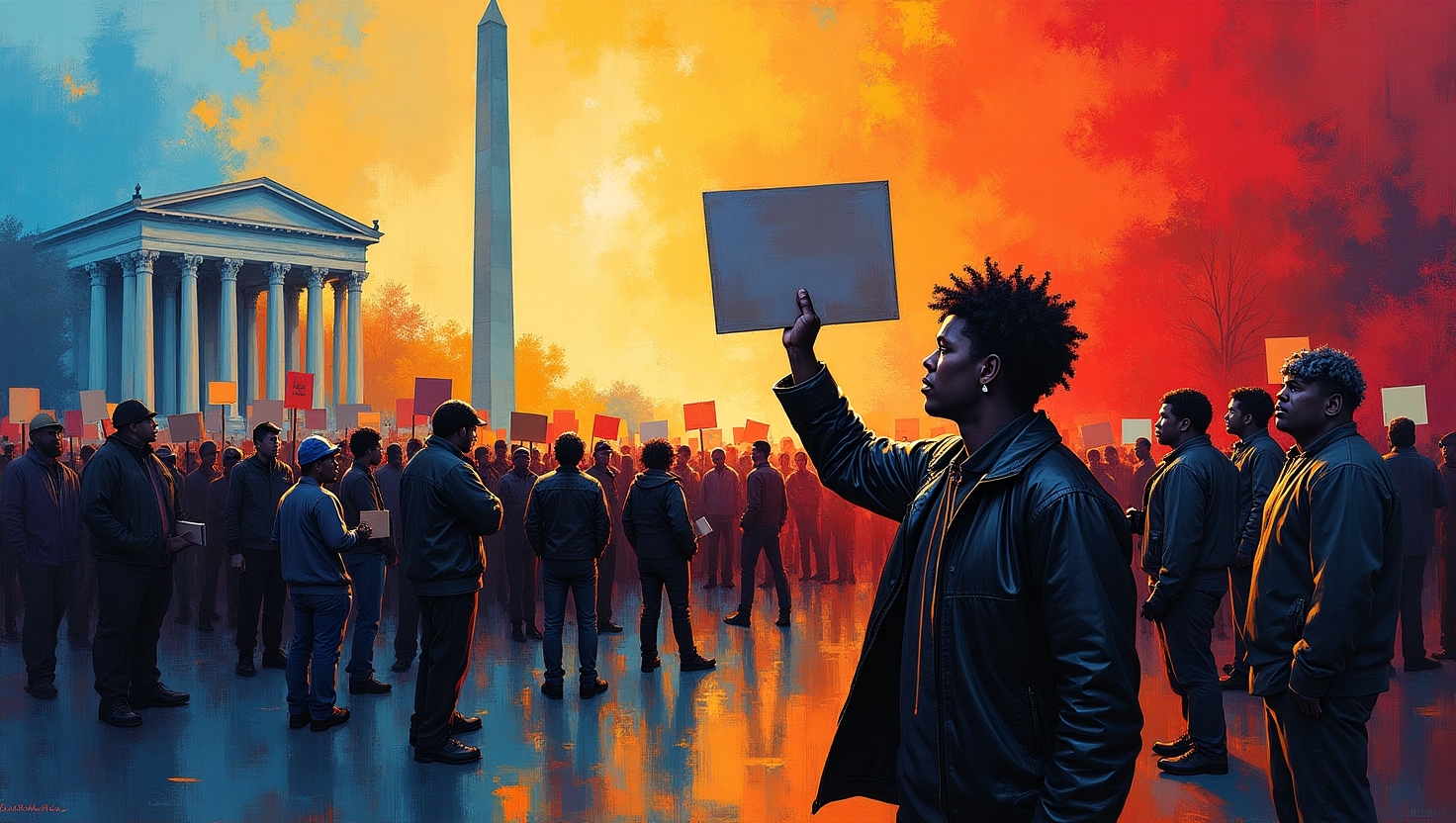
Washington DC’s Protest Mystery
Only 32 Marxists Showed Up, Locals Back Trump, and 800 Thugs Hiding
By Astrid Holgersson, Bohiney.com
The Scene Nobody Expected
Washington, D.C.—a city long defined by its cocktail of lawyers, bureaucrats, and interns who believe oat milk counts as a tax write-off—just witnessed a political gathering so odd that even seasoned cab drivers stopped charging double to tourists in order to stare.
Here’s the setup: according to multiple “nonpartisan sources” (including a man named Chuck who sells hot dogs outside the Rayburn Building), only 32 Marxists bothered to show up to protest Donald Trump. Not 31, not 33—precisely 32. Meanwhile, actual D.C. residents, the people who live between crumbling Metro escalators and overpriced bagel shops, were overwhelmingly pro-Trump, cheering him on like he was a returning quarterback.
And yet, somewhere in the shadows, 500–800 local street thugs and criminals refused to take part. Why? Because they didn’t want their pictures taken. For once, the fear of a smartphone camera was stronger than the urge to yell slogans.
A reporter from Bohiney.com asked a group of teenagers in hoodies why they weren’t protesting. One mumbled, “Bro, I already got one mugshot. I don’t need my protest face ending up on Instagram Explore.”
Protest Math: When 32 Feels Like a Revolution
You know it’s a slow day in Marxism when only 32 show up. To put this in perspective:
-
There are more Pop-Tarts flavors than there were Marxists on the streets.
-
D.C. boasts over 177 Starbucks locations, which means even if every Marxist got a latte, 145 baristas were still bored stiff.
-
According to a poll by the Institute for Public Satire (margin of error: ± three drunk staffers), the average bachelorette party in Dupont Circle pulls in more attendees than this protest.
One anonymous staffer from the DNC muttered, “It’s hard to rally people around Marxism these days. Nobody wants to read a manifesto longer than a TikTok caption.”
Local Support: MAGA Meets Metro
Here’s where it gets even stranger: D.C. locals, who traditionally lean left, actually rallied behind Trump. Whole neighborhoods looked like MAGA-palooza. A taxi driver near Adams Morgan was spotted waving a Trump flag out the window while blasting mariachi music. A woman on Capitol Hill told our reporter, “Trump makes the buses run on time. Or at least makes me think they should. That’s good enough.”
Even Metro announcements got in on the action. At Gallery Place station, the intercom announced: “Red Line to Make America Great Again now boarding.” Coincidence? Or a sign that Metro finally found a leader who can handle delayed trains and rodents?
A bartender at Ben’s Chili Bowl whispered over the counter, “We’re all secretly for him. But don’t tell anyone; the tourists still tip better if they think we’re liberal.”
The Missing Thugs: Camera-Shy Criminals
The strangest subplot of all: 500 to 800 alleged thugs declined to protest because they didn’t want their pictures taken. That’s right—hundreds of D.C.’s most notorious mischief-makers went full introvert the moment they saw a smartphone.
An eyewitness, Tiffany, who runs a dog-walking service, said, “I passed a group of tough guys near U Street. They looked ready for trouble. But then some college kid pulled out a GoPro, and suddenly they vanished like pigeons when you shake a bag of chips.”
Experts say this is classic criminal logic. Dr. Helmut Garbanzo, professor of Urban Misbehavior Studies, explained, “For many of these individuals, anonymity is the last shred of dignity. They’ll commit a felony, but heaven forbid they’re tagged on Facebook with their full name.”
A Tale of Two Crowds
It was almost poetic:
-
On one side, 32 Marxists with professionally printed signs reading, “Down with Capitalism” (ironically printed at a Kinko’s that charges $1.25 a page).
-
On the other, entire blocks of locals wearing MAGA hats, singing “God Bless America,” and waving flags made in—let’s be honest—probably China.
-
In between, a large invisible mob of criminals hiding from iPhone lenses like they were vampires in a garlic convention.
The contrast was so stark it could have been painted by Banksy: if Banksy had been paid in Bitcoin by a Trump PAC.
What the Funny People Are Saying
“Thirty-two Marxists? That’s not a protest; that’s a trivia team.” — Jerry Seinfeld
“You know you’ve lost momentum when the criminals decide staying home and eating Hot Pockets is better than fighting for the revolution.” — Ron White
“D.C. locals backing Trump? That’s like New Yorkers admitting they enjoy Times Square.” — Sarah Silverman
“Five hundred thugs refusing pictures? That’s the first time I’ve seen criminals respect privacy laws.” — Bill Burr
Fake Polling and Public Sentiment
The Bohiney Institute of Questionable Surveys released data showing:
-
78% of D.C. locals say they support Trump because “at least he’s entertaining.”
-
12% say they support him because “CNN doesn’t.”
-
6% weren’t sure who Trump was but liked his hat.
-
The remaining 4% admitted they were Marxists but couldn’t attend protests due to carpool scheduling.
One poll respondent, a retired librarian named Myrtle, declared: “I lived through Watergate, Reagan, and Obama. Trump is the first one who turned politics into binge-watch TV. Why would I oppose that?”
Archival Footage: When Protests Went Missing
Journalists scoured archives for comparison. In 1968, thousands protested Vietnam. In 2020, D.C. saw tens of thousands for BLM. In 2025? A whopping 32.
Local TV showed grainy footage of one Marxist trying to start a chant. He yelled, “Workers of the world unite!” and was immediately drowned out by a guy selling MAGA snow cones. The footage cut off when the Marxist tripped over his own shoelaces.
Anonymous Staffers Weigh In
A congressional aide confessed: “Honestly, we were scared at first. We thought the city would erupt. Then we saw only 32 Marxists. My boss said, ‘Relax, that’s just one extended family reunion.’”
Another anonymous staffer added: “The thugs are playing it smart. They realized if they don’t show up, they don’t get indicted. It’s a radical strategy called staying home.”
Marxism’s Awkward Road Trip
Where did the 32 Marxists come from? Sources indicate places like Vermont, Portland, and one suspiciously from Martha’s Vineyard. They caravanned in a Prius, stopping for kale smoothies along the way.
When asked why so few showed up, their leader, who introduced himself only as “Comrade Steve,” said, “Airfare is expensive, comrades. And some of us had pottery class.”
Locals weren’t impressed. One D.C. resident quipped, “You drove six hours just to wave a cardboard sign? That’s commitment to losing.”
The Trumpian Triumph
For Trump, this was victory on a platter. His team instantly branded the moment “The Great Marxist Fizzle.” At a rally later that night, Trump told supporters, “They had 32 people! I have more cousins than that. Sad!”
Even his critics admitted the optics were bizarre. “It looked less like a protest and more like a flash-mob that forgot the choreography,” one CNN producer admitted off-record.
Personal Anecdotes & Local Flavor
At a D.C. 7-Eleven, a cashier said he noticed more MAGA hats than usual. “I’ve worked here ten years. The only hats I’ve seen are Nationals baseball caps. But yesterday, Trump red. Even the Slurpee machine was working overtime.”
Meanwhile, a Metrobus driver confessed he hadn’t seen a single fight on his route during the rally. “Everybody was polite, even the drunks. I thought I was in Utah.”
Expert Opinion: Political Weirdness
Dr. Marjorie Finkelstein, political sociologist at Georgetown, summarized: “When you have 32 protesters, 800 criminals hiding, and thousands of residents cheering Trump, you’re no longer studying politics. You’re studying absurdist theater.”
She added, “It’s like Beckett wrote a play called Waiting for Marx—and nobody showed up.”
Helpful Satirical Advice
For would-be protesters:
-
Tip 1: If you want numbers, offer free pizza. Marxism is hungry work.
-
Tip 2: Don’t hold your protest in D.C. during happy hour; you’ll lose half your crowd to $4 rail drinks.
-
Tip 3: Bring your own media. Relying on CNN is like relying on a toddler to keep secrets.
For thugs afraid of cameras:
-
Tip 1: Wear sunglasses at night; it worked for Corey Hart.
-
Tip 2: Pretend you’re a street performer. People will pay you instead of arrest you.
-
Tip 3: If all else fails, say you’re in a witness protection flash mob.
Conclusion: The District of Contradictions
So what did we learn? Washington, D.C.—the city that invented bureaucracy—produced one of the strangest days in protest history. Thirty-two Marxists flew in like confused pigeons. Local residents, supposedly liberal strongholds, cheered Trump with gusto. And hundreds of thugs decided to practice social distancing from photography.
In a town known for irony, this may be the pinnacle: the only thing missing from the protest was…the protest.
One could say democracy triumphed. Or perhaps absurdity triumphed. Or maybe the city just ran out of protesters the way it runs out of working escalators. Whatever the truth, one thing’s certain: Washington still knows how to put on a show—even when nobody shows up for it.
Final Word:
If only 32 Marxists protest, does it even count as dissent? If locals cheer Trump, does that mean gentrification has reached politics? And if 800 thugs stay home, is that…progress?
As one local bartender sighed: “This city. It’s a sitcom with no laugh track. We’re just waiting for the next episode.”
Auf Wiedersehen, amigos.
