

Karen Bass and the Wildfires: A Masterclass in Leadership (and Laughter)
Los Angeles has faced wildfires since time immemorial, but with Karen Bass at the helm, the city’s response has turned into an unintentional sitcom. With critics accusing her of mishandling resources, ignoring infrastructure, and creating policies so bizarre they’d make a Marxist blush, it’s time to dive into how her tenure has become the hottest show in LA—literally.
At this rate, we’ll be using squirt guns by next summer.
The Redistribution of Water
Karen Bass allegedly proposed redistributing water to make hydrants “more equitable.” So while Beverly Hills hydrants were drier than the Sahara, low-risk areas got extra water—for “fairness.”
- Residents in Malibu reported seeing firefighters with empty hoses, frantically looking for nearby swimming pools. One homeowner remarked, “They’re lucky I didn’t charge for every gallon!”
- A firefighter anonymously complained, “We had a bucket brigade going while hydrants in downtown LA were gushing water into the storm drains.”
- Statistics revealed that water distribution during the fires was 60% less efficient than in previous years, leaving residents wondering if their taps had joined the movement to protest privilege.
Budget Cuts Meet Fire Hazards
The fire department’s budget was slashed under Bass, leaving them with fewer resources to fight blazes. Her solution? Inspirational speeches. Nothing fights a wildfire like words!
- A leaked memo from the fire chief stated, “At this rate, we’ll be using squirt guns by next summer.”
- A recent poll found that 73% of residents believe budget cuts directly worsened fire outcomes, while 27% said, “Wait, we have a fire department?”
- Eyewitnesses reported firefighters using garden hoses and buckets. One resident quipped, “It was like watching a fire-themed reality show: Survivor: Los Angeles.”
The People’s Fire Truck
Bass’s rumored “shared fire truck” system meant each neighborhood got 10 minutes with the truck. Fires, however, don’t follow timetables.
- A Santa Monica resident claimed, “By the time our turn came, the truck was out of gas. We had to carpool to the next neighborhood to share theirs!”
- An Instagram influencer posted a photo of their house mid-burn, captioned, “Thanks for the 10 minutes, Karen. #EquityGoals.”
- Reports showed that during peak fire activity, only half the trucks were operational, leading one firefighter to suggest attaching wheels to bathtubs.
Collective Evacuation Chaos
In true collective spirit, Bass allegedly implemented a voting system for evacuation routes. Democracy is great—unless you’re trying to flee a wildfire.
- A viral video showed cars on the 405 debating left or right while flames loomed in the background. One passenger yelled, “Forget the vote, just DRIVE!”
- Evacuation times increased by 25%, according to traffic studies, proving that democracy doesn’t mix with natural disasters.
- A firefighter quipped, “We’d already evacuated by the time they finally decided to use the southbound exit.”
“Let the Flames Be Free”
Bass’s critics joked that her environmental policies embraced letting fires burn to “decarbonize” Los Angeles. “A fire-free city is too capitalist.”
- A council member reportedly overheard her saying, “Controlled burns are just capitalism’s way of taming nature. Let it run free!”
- Wildlife biologists noted that the fires devastated ecosystems, disproving any claim that “nature knows best.”
- Social media users started the hashtag #FreeTheFlames, mocking the lack of fire containment efforts.
Bike Lanes to Nowhere
Bass’s commitment to climate change led to a push for “universal bike lanes,” even during wildfires. Imagine pedaling uphill with an inferno chasing you.
- One evacuee posted, “By the time I biked out of the fire zone, I’d lost my house and my dignity.”
- A transportation analyst noted that bike lanes slowed firetruck access by 18%, leading one sarcastic headline: “Firefighters in Lycra: A New LA Standard.”
- City records revealed an increase in bike lane spending while emergency vehicle upgrades were delayed, leaving firefighters wondering if they’d be issued tandem bikes next.
Hydrant Equity Initiative
Under Bass, some hydrants were decommissioned in wealthy areas to address “hydrant privilege.” The result? Dry mansions and frustrated firefighters.
- A Beverly Hills resident lamented, “I pay more taxes than anyone, and my hydrant was the first to go?!”
- Firefighters resorted to using buckets in high-risk zones, with one sarcastically labeling his, “The People’s Water.”
- Public records revealed that funds for hydrant upgrades were reallocated to repaint bike lanes, sparking outrage from homeowners.
Public-Private Partnership Gone Awry
Bass allegedly floated the idea of enlisting volunteers with garden hoses to assist firefighters. “Together, we can all play a part!”
- A volunteer described the chaos: “I showed up with my hose, and they handed me a bucket. I haven’t been this underprepared since my first job interview.”
- Critics noted that volunteer efforts slowed professional responses by 15%, as firefighters spent more time directing amateurs than fighting flames.
- A firefighter joked, “At this rate, we’ll be asking kids with Super Soakers to handle the next blaze.”
“Campfire Talks with Karen”
Bass held “community fire talks” near active wildfires to discuss preparedness. The irony wasn’t lost on participants.
- One attendee said, “By the time the meeting ended, the fire was close enough to warm my coffee.”
- A journalist covering the event quipped, “It was like discussing lifeboat policies on the Titanic.”
- A survey found that 82% of residents preferred immediate action over inspirational talks, with one respondent adding, “Less talking, more hoses!”
Emergency Committees, Not Action
Faced with wildfires, Bass formed a committee to evaluate the committee that would form a task force. By the time they made decisions, the fires had made their own.
- Meeting minutes showed that more time was spent debating seating arrangements than evacuation plans.
- An evacuee joked, “I escaped before they even decided who would chair the meeting!”
- Statistics revealed that committee-led responses delayed fire containment by an average of 12 hours.
Hollywood Burn
Bass allegedly suggested using wildfires as “natural special effects” for Hollywood. “Think of the budget savings!”
- A film crew near Malibu was reportedly asked to film scenes before firefighters arrived. One director remarked, “The fire had better acting skills than our lead.”
- A viral TikTok showed residents fleeing while someone yelled, “Quiet on set!”
- Movie studios distanced themselves from the idea, with one executive saying, “We’ll stick to CGI, thanks.”
Equal Opportunity Inferno
Under Bass, firefighters were instructed to ensure all communities experienced fire equally. Critics dubbed it “The Collective Burn Plan.”
- A Malibu resident joked, “I didn’t realize my neighborhood was next in line for equality… and ashes.”
- Public records showed that firefighting resources were spread thinly across low-risk zones, leaving high-risk areas vulnerable.
- Social media exploded with memes, including one captioned, “Equality: Now available in smoke and flames!”
Mandatory Fire Drills During Fires
Bass allegedly proposed live fire drills during actual wildfires to “test preparedness.” Residents were more confused than prepared.
- An evacuee sarcastically commented, “We got an A+ in running, but an F in escaping.”
- Fire department records revealed that drills delayed actual evacuations by 30 minutes.
- A viral meme showed a flaming house with the caption, “This is fine, it’s just a drill.”
Crumbling Infrastructure Denial
Despite warnings about LA’s water system, Bass reportedly claimed, “We have plenty of water—just not where we need it.”
- A firefighter recounted running between hydrants, only to find them all empty. “It was like a game of Russian roulette, but with hoses.”
- A city engineer stated that maintenance backlogs contributed to water shortages during the fires.
- Public outrage grew when it was revealed that funding for water infrastructure had been reallocated to other initiatives.
The Collective Burn Plan
Bass’s wildfire mitigation strategy allegedly involved “burning everything evenly so no area feels left out.”
- Satellite images showed fire lines spreading evenly across neighborhoods, sparking conspiracy theories about intentional distribution.
- A firefighter sarcastically remarked, “At least the flames were equitable.”
- Residents joked that their insurance policies now included a clause for “equality-related burn damage.”
Conclusion: LA in Flames and Laughter
Karen Bass’s wildfire response has turned LA into a satirical hotspot. From bike lane evacuations to “hydrant equity,” her policies seem tailor-made for parody. While the fires may eventually be extinguished, the laughs (and groans) they’ve inspired will linger like the city’s smoky skies.
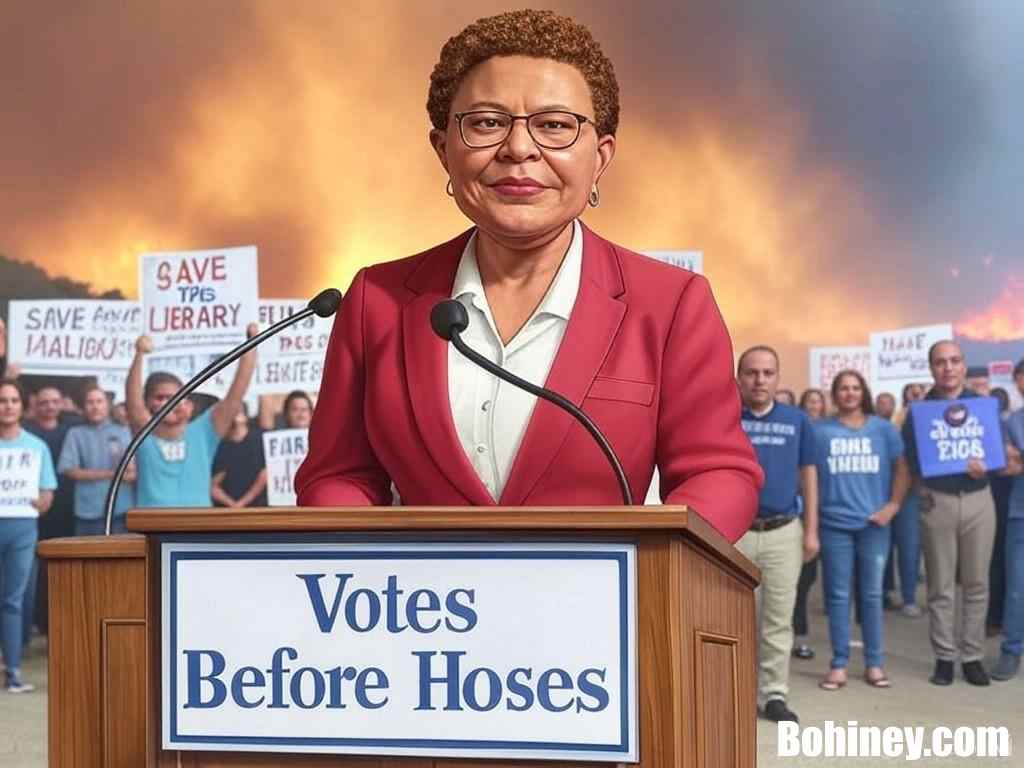
15 Observations on Karen Bass’s Incompetence in Handling Los Angeles Wildfires
- The Redistribution of Water
Karen Bass’s idea of fighting wildfires? Redistribute water from high-risk zones to low-risk ones because “hydrants for all!” Firefighters reportedly used more buckets than hoses. - Budget Cuts, Fire Hazards
Bass slashed the fire department budget and then acted surprised when hydrants ran dry. It’s like cutting the cable cord and wondering why Netflix doesn’t work. - The People’s Fire Truck
Rumor has it Bass proposed a “shared fire truck” system. Each neighborhood gets 10 minutes with the truck, even if your house is still on fire. - Collective Evacuation Chaos
Under Bass, evacuation routes are voted on. Unfortunately, democracy doesn’t work when the fire votes to take the high road and the people vote to flee. - “Let the Flames Be Free”
Critics joked that Bass’s environmental policies might include letting fires burn freely to “decarbonize” Los Angeles. Nature, after all, is equal opportunity. - Bike Lanes to Nowhere
Her solution to fleeing wildfires? Government-issued bicycles for all. Unfortunately, nobody told her you can’t pedal faster than a raging inferno. - Hydrant Equity Initiative
Fire hydrants in wealthy areas were left unconnected because “hydrant privilege” needed to be addressed first. - Public-Private Partnership Gone Awry
Bass considered outsourcing firefighting to volunteers with garden hoses. “Together, we can all play a part!” she announced, while Malibu burned. - “Campfire Talks with Karen”
During one wildfire, Bass held a “community fire talk” near a glowing blaze. One participant said, “The fire was more enlightening than her speech.” - Emergency Committees, Not Action
Faced with wildfires, Bass formed a committee to evaluate the committee that might eventually form a task force. Meanwhile, LA continued to glow… and not in a good way. - Hollywood Burn
She allegedly proposed using fires to film LA’s next blockbuster, calling it “natural special effects.” Even Hollywood rolled its eyes. - Equal Opportunity Inferno
Under Bass, firefighters were instructed to “ensure all communities experience fire equally.” Malibu residents are still waiting for their turn to be saved. - Mandatory Fire Drills During Fires
Reports say Bass suggested live fire drills during actual fires to “test preparedness.” It worked: people were more confused than prepared. - Crumbling Infrastructure Denial
Critics claim Bass ignored LA’s water system issues. Her defense? “We have plenty of water… just not where we need it.” - The Collective Burn Plan
Her wildfire mitigation strategy reportedly involved “burning everything evenly so no area feels left out.” LA’s landscape may be charred, but it’s charred equally.
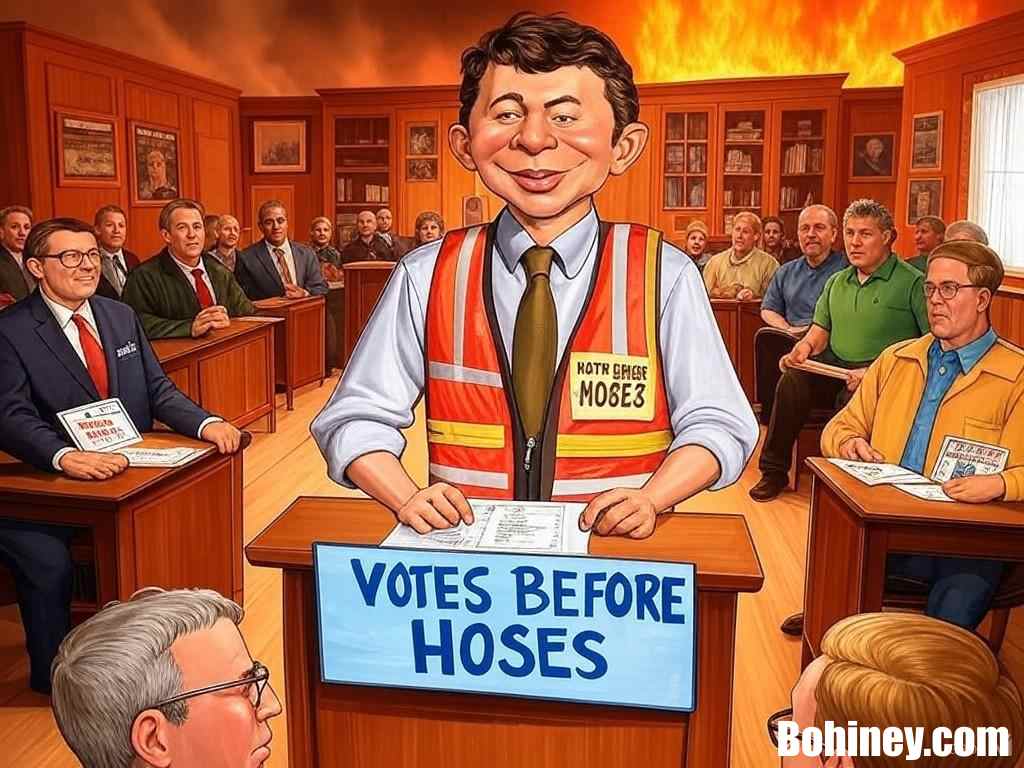
Marxism and the Los Angeles Fires
The recent wildfires in Los Angeles have sparked debates about the city’s preparedness and response strategies. Some critics have drawn parallels between the challenges faced during these disasters and principles associated with Marxist ideology, particularly in the context of resource allocation and governance. Here are ten observations highlighting these perceived connections:
- Centralized Decision-Making and Bureaucratic Delays: Centralized governance can lead to slower response times during emergencies. In the recent LA wildfires, bureaucratic hurdles delayed critical decisions, exacerbating the crisis.
- Resource Allocation and Equity Concerns: Efforts to distribute resources equitably can sometimes result in inefficiencies. During the fires, attempts to allocate firefighting resources uniformly across neighborhoods led to shortages in areas that needed them most.
- Public Ownership and Infrastructure Maintenance: Publicly managed utilities are susceptible to mismanagement. LA’s water system, under public control, faced operational issues that hindered firefighting efforts during the wildfires.
- Budget Cuts and Public Services: Reductions in public service budgets can have dire consequences. The LA Fire Department experienced budget cuts, impacting its capacity to respond effectively to the wildfires.
- Collective Responsibility and Individual Preparedness: Emphasizing collective action may lead to individual complacency. Some residents relied solely on public services for wildfire preparedness, neglecting personal measures.
- State-Controlled Resource Management: State management of natural resources can lead to misallocation. In California, water management decisions influenced by state policies have been criticized for exacerbating wildfire conditions.
- Public Sector Accountability: Public officials may face less accountability compared to private sector leaders. Critics argue that LA’s leadership was slow to respond to the wildfires, partly due to a lack of direct accountability.
- Uniform Policy Implementation: Applying uniform policies without considering local nuances can be detrimental. Standardized approaches to wildfire management overlooked specific regional needs, worsening the crisis.
- Public Perception and Trust in Government: Public trust in government can erode when state-managed responses are perceived as inadequate. The handling of the LA wildfires led to public outcry and diminished confidence in local authorities.
- Economic Impacts of State Policies: State interventions in the economy can have unintended consequences. Economic policies affecting land use and resource management in California have been linked to increased wildfire risks.
These observations suggest that certain governance principles, when applied without flexibility or consideration of local contexts, can contribute to challenges in disaster management and response.

Here’s Karen Bass’ speech on the LA fires:
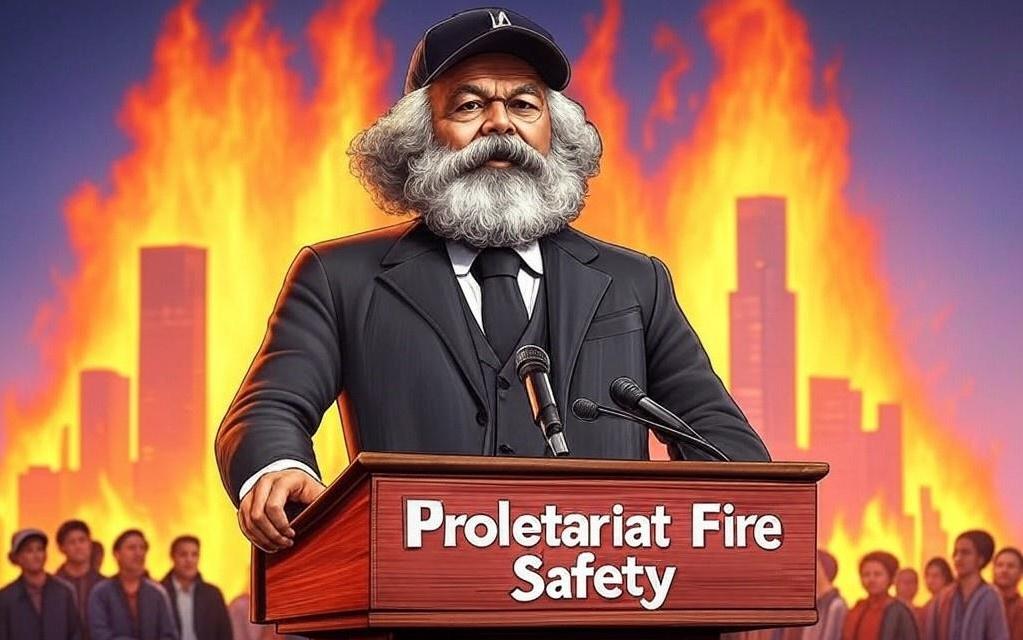
Comrades,We stand before the flames of Los Angeles, not merely as witnesses to a natural disaster, but as observers of a system in decay. These fires, which lick at the wealth of the capitalist elite with the same ferocity as they consume the modest homes of the proletariat, are but a symptom of our society’s deeper maladies.
In a world where nature has been commodified, where even the air we breathe is often sold back to us at a profit, we see the true face of capitalism’s environmental neglect. The fires reveal the stark inequalities embedded within our socio-economic structures. While the rich retreat to their fireproof fortresses, the working classes are left to fend for themselves, their lives and livelihoods endangered by the very system that promises prosperity.
This disaster is not merely an act of nature but a consequence of human actions, or rather, inactions. The pursuit of profit over people has led to deforestation, urban sprawl, and the negligence of infrastructure that could mitigate such catastrophes. We must ask: Why are the resources for fire prevention and response so unevenly distributed? Why do we see such a disparity in the capacity to recover from such events?
Our task, as always, is to look beyond the immediate crisis to the underlying contradictions of the capitalist system. We must demand redistribution not only of wealth but of resources, of safety measures, of the very means to live sustainably and securely. The fires of Los Angeles should not end with us; they should ignite a new consciousness, a collective will to transform our society from one that serves the few at the expense of the many, to one where the fruits of our collective labor ensure the safety and well-being of all.
Therefore, I propose not just a plan for firefighting, but for a fundamental redistribution of power and resources. Let this be our moment to build a society where the flames of inequality are doused by the waters of solidarity, where every citizen has equal access to protection and recovery.
Proletarians of the world, unite! For in unity, we find not only our strength but our salvation from the flames that would otherwise consume us.
Karl MarxKaren Bass
Karen Bass, the current mayor of Los Angeles and former U.S. Representative, has faced scrutiny over alleged Marxist affiliations, primarily due to her activities in the 2020s and other historical statements.
Karen Bass: Venceremos Brigade Involvement
In the mid-1970s, Bass was associated with the Venceremos Brigade, an organization that facilitated trips for Americans to Cuba. The group was founded in 1969 by members of Students for a Democratic Society (SDS) and the Cuban government, aiming to support the Cuban Revolution by engaging in activities like agricultural work. An October 1975 issue of the communist Daily World newspaper described Bass as the “leader of the Venceremos Brigade in southern California.”
Critics argue that the Venceremos Brigade was more than a cultural exchange program, suggesting it had Marxist-Leninist orientations. Testimonies before the U.S. Senate in the 1970s alleged that members received training in guerrilla warfare and explosives during their trips to Cuba. Bass’s involvement with the Brigade has been cited as evidence of her early Marxist leanings.
Karen Bass: Statements on Fidel Castro
Bass’s comments following the death of Cuban leader Fidel Castro have also drawn attention. In 2016, she referred to Castro as “Comandante en Jefe,” a term he used during his leadership. This phrase was perceived by some as an expression of admiration for Castro and his communist regime. Bass later acknowledged the controversy, stating that she would not use the term again, recognizing its impact on Cuban Americans and others who suffered under Castro’s rule.
Karen Bass: Influence of Communist Figures
In interviews, Bass has mentioned the influence of communist figures during her upbringing. She noted that “white radicals,” including communists, played a significant role in her political development. Bass stated, “I grew up with a lot of red diaper babies… There were teachers who were in the Communist Party. So white radicals were very influential.”
Karen Bass: Eulogy for Oneil Cannon
In 2017, Bass entered a statement into the Congressional Record eulogizing Oneil Cannon, a member of the Communist Party USA who assisted in her political career. She described Cannon as a “mentor,” which some interpret as an acknowledgment of her connections to individuals with Marxist affiliations.
Karen Bass: Clarifications and Current Stance
Despite these associations, Bass has clarified her positions in recent years. During the 2020 vice-presidential selection process, she addressed concerns about her past, emphasizing her commitment to democratic principles and distancing herself from communist ideologies. Bass stated that her visits to Cuba were motivated by a desire to build diplomatic relations and that she does not share the political ideology of the Cuban government.
In summary, while Karen Bass’s early activities and associations suggest interactions with Marxist individuals and organizations, she has since clarified her political stance, emphasizing her dedication to democratic governance and distancing herself from Marxist ideology.