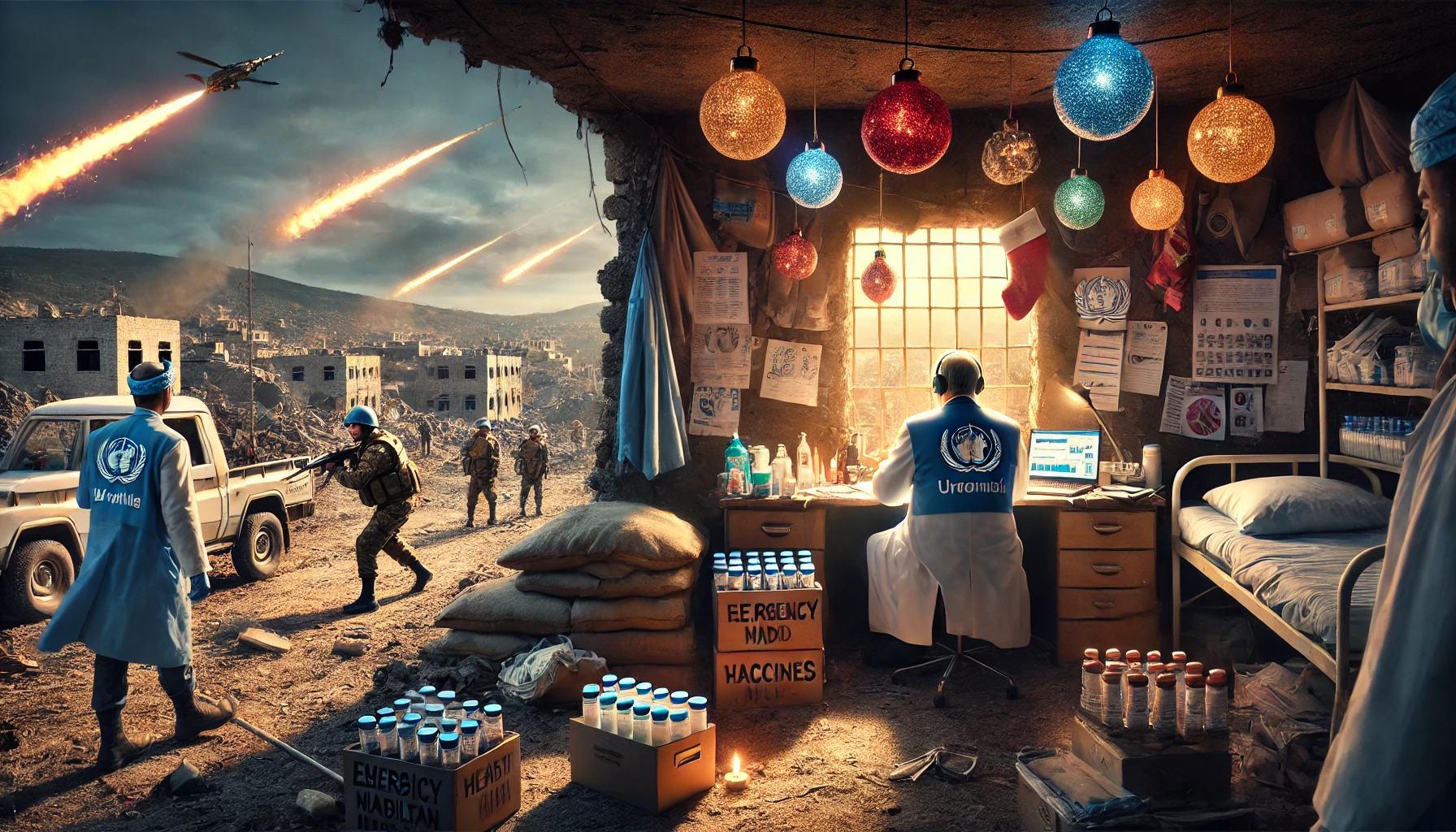

WHO Chief’s Yemen Adventure: “‘Silent Night’? Not in Yemen, Apparently”
The WHO’s New Slogan: ‘Health for All, Even If Bombs Are Dropping'”
By Shell Shockington | Crisis Central
In a move that has left the global health community scratching their heads—and their flak jackets—the World Health Organization’s (WHO) chief decided to spend Christmas in Yemen. Yes, Yemen, the war-torn nation where airstrikes replace fireworks, and the holiday soundtrack is more “boom-boom” than “fa-la-la.” While the rest of us were sipping eggnog and arguing over whose turn it was to carve the turkey, this intrepid diplomat was reportedly basking in the festive glow of tracer fire and emergency sirens.
A Health Mission Wrapped in Chaos
According to sources, the WHO chief declared, “I love the smell of airstrikes on Christmas morning,” an apparent homage to war movie clichés—or perhaps a coping mechanism. This holiday excursion was part of an ongoing mission to assess Yemen’s healthcare crisis, a task that combines the holiday spirit of giving with the adrenaline rush of narrowly dodging surface-to-air missiles.
Eyewitnesses at the airport confirmed the chief’s arrival under the most festive of conditions: an air raid that lit up the sky like an apocalyptic Christmas tree. One local journalist described the scene: “It was like Santa’s sleigh was being chased by fighter jets. Except instead of toys, he brought… uh, vaccines.”
Evidence of Festivity Amid Chaos
Local vendors, eager to spread holiday cheer, reportedly tried to sell the WHO entourage makeshift ornaments fashioned from spent shell casings. “It’s not much, but it’s shiny,” said one entrepreneurial Yemeni merchant. When asked about traditional holiday treats, another vendor offered up a ration pack with the cheerful note: “At least it’s non-perishable.”
‘Silent Night’? Not in Yemen
While many around the world celebrated a peaceful Silent Night, Yemen’s version was anything but. “The only thing silent here is the power grid,” quipped a local health worker. And yet, the WHO chief, armed with a clipboard and what we can only assume is the world’s most comprehensive insurance policy, trudged onward.
Military analysts noted that the airstrike coinciding with the chief’s arrival wasn’t coincidental. “Diplomats in a war zone are like catnip for tactical maneuvers,” said retired Colonel Dan “Boom Boom” McCannon. “It’s a classic move: air raids plus a high-profile target equals the ultimate Christmas spectacle.”
Dr. Linda Felch, an expert in international crises, commented, “While most of us are avoiding family debates over politics, the WHO chief is navigating actual missile debates. It’s commendable, though I can’t help but wonder if this is his way of skipping Secret Santa at headquarters.”
Tourism in Yemen: A Unique Holiday Destination
The WHO chief’s visit inadvertently shone a spotlight on Yemen as an unconventional tourist destination. Forget white sandy beaches or snow-covered chalets—this year, it’s all about adrenaline-fueled diplomacy.
Travel bloggers have already taken note. One influencer, who goes by the handle @FearlessFiona, posted: “Why spend Christmas in Paris when you can spend it dodging drones in Yemen? #AuthenticTravel #AirstrikeAesthetics.” The post quickly gained traction, sparking debates on ethical tourism.
Analogical Comparison
If Christmas vacations were ranked by intensity, Yemen would be the skydiving-without-a-parachute equivalent. Meanwhile, Switzerland—home of the WHO headquarters—is more like a cozy, predictable sleigh ride through the Alps.
Deck the Halls—With Explosions and Diplomacy
While most of us decorate with tinsel and fairy lights, the WHO chief found himself amid an entirely different kind of holiday décor: smoldering rubble and hastily strung tarps. Yet, in true festive fashion, the delegation reportedly hung improvised ornaments (recycled shrapnel) around their temporary shelter. “It’s not Christmas without a little sparkle,” joked one staff member, moments before ducking into a bunker.
Local health officials joined the delegation for a makeshift Christmas dinner, which consisted of canned goods and bottled water. “It’s the thought that counts,” said a nurse, raising her water bottle in a toast. “And right now, I’m thinking this is the weirdest Christmas of my life.”
When asked why he chose Yemen for the holidays, the WHO chief reportedly replied, “The world’s health crises don’t take a vacation. Why should I?” His team, however, had mixed feelings. One staffer quipped, “I didn’t sign up for this level of festive danger.”
Rudolph, Guide My Plane—and Watch Out for Missiles
The journey to Yemen wasn’t without its logistical challenges. Reports indicate that the flight path resembled Rudolph’s Christmas Eve route, with evasive maneuvers to avoid anti-aircraft fire. “We were basically doing the slalom in the sky,” said a pilot who wished to remain anonymous.
For ground transportation, the team relied on what can only be described as “Yemen’s finest off-road sleighs,” also known as armored vehicles. “It’s not quite a one-horse open sleigh,” joked a security advisor, “but it gets the job done.”
‘Twas the Night Before Christmas—In a Bunker
If Clement Clarke Moore had penned his famous poem in Yemen, it might have sounded like this:
“Twas the night before Christmas, and all through the shelter, not a creature was stirring—except the guy manning the mortar.”
The WHO delegation reportedly spent Christmas Eve in a reinforced bunker, where morale was surprisingly high. One staffer led the group in a rousing rendition of “All I Want for Christmas Is Peace,” while another handed out rationed chocolate bars. “It’s the little things,” one delegate said, unwrapping her treat.
This bunker camaraderie echoes historical accounts of soldiers during World War I’s Christmas truce, where opposing sides paused to share moments of humanity. While the WHO delegation didn’t have a ceasefire to celebrate, their resilience mirrored the spirit of those wartime holidays.
Global Health on the Frontlines
The WHO chief’s visit wasn’t just a publicity stunt; it highlighted the dire healthcare situation in Yemen. Hospitals are overwhelmed, medical supplies are scarce, and the ongoing conflict has left millions in desperate need. Despite the risks, the delegation delivered vaccines, medical equipment, and much-needed hope.
According to the WHO, nearly 80% of Yemen’s population requires humanitarian assistance, and the country faces one of the world’s worst healthcare crises. “Our presence here isn’t just symbolic,” the chief emphasized. “It’s a reminder that even in the darkest places, health is a universal right.”
A Christmas to Remember
As the WHO chief wraps up his whirlwind Christmas in Yemen, one thing is clear: this is a holiday story for the ages. Whether you view it as a heroic act of global health diplomacy or the ultimate way to dodge a family gathering, it’s hard to deny the impact of his visit.
So, while most of us were cozy by the fire, binging holiday movies, the WHO chief was living his own action-packed blockbuster. And who knows? Maybe next Christmas, he’ll trade airstrikes for a slightly less explosive adventure. But if not, at least we can count on him to keep showing up—no matter how loud the sirens get.
Disclaimer:
This article is satirical and should not be taken as factual reporting. Any similarities to real events are purely coincidental, except for the parts that are actually real, which are still kind of ridiculous. If you’re planning your next holiday, we strongly advise against following in the WHO chief’s footsteps—unless you’re a trained diplomat with a penchant for adrenaline.