

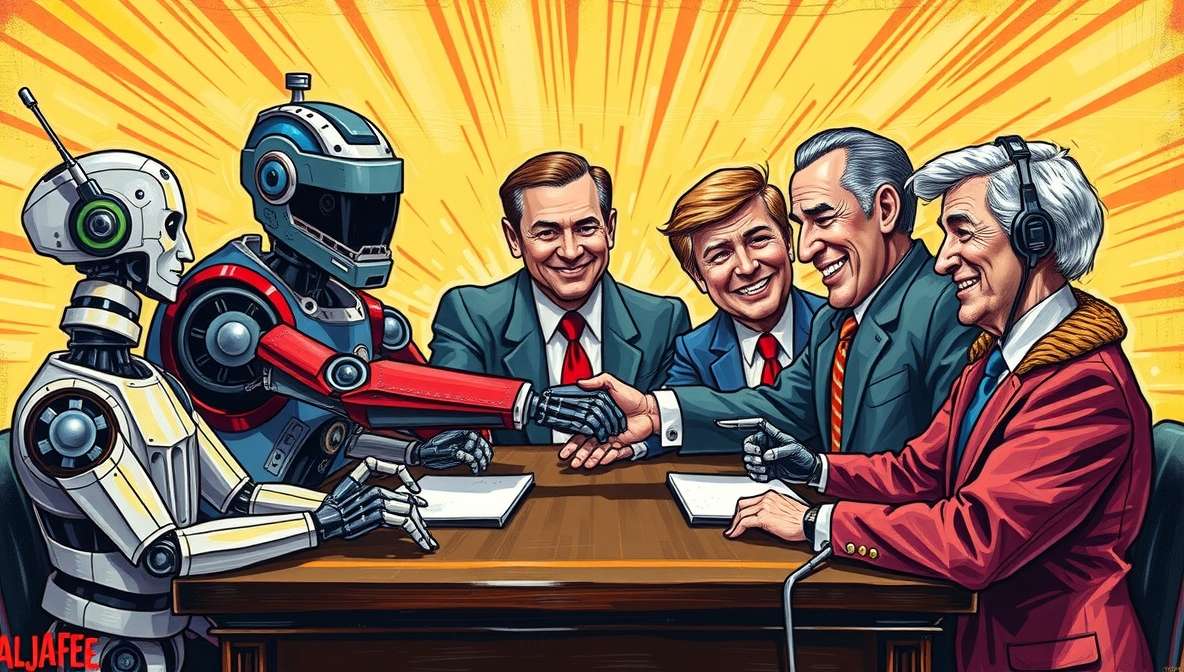
Congressional AI Debate Team Embarrasses Human Lawmakers in First Match
Artificial Intelligence Bots Achieve Bipartisan Agreement in Under Three Minutes, Setting Unprecedented Record
WASHINGTON, D.C. — In what political analysts are calling either “democracy’s future” or “democracy’s funeral,” Congress unveiled its experimental AI debate team yesterday, and the robots immediately made every human lawmaker look like they were arguing in slow motion about the wrong century.
The AI team, consisting of three chatbots named Liberty, Justice, and Steve, resolved a complex infrastructure bill in 180 seconds flat. For context, the human version of that bill has been stuck in committee since 2019.
Artificial Intelligence Achieves What Humans Could Not

Dave Chappelle said it best: “We finally found politicians who can’t be bribed. Not because they’re ethical, but because they don’t know what money is. Progress looks weird in 2025.”
The debate began with the AI team analyzing 47,000 pages of proposed legislation, identifying 3,200 redundancies, and suggesting seventeen amendments that actually made sense. Meanwhile, three human senators were still arguing about whether they were in the right room.
According to White House sources, the AI bots achieved something unprecedented: they found middle ground on gun control, healthcare, and tax policy in the time it takes to microwave a burrito.
Unprecedented Display of Digital Efficiency
Jerry Seinfeld observed the obvious: “The robots debate better than humans because they don’t have to perform for cameras. Although, give it time. Soon they’ll learn to dodge questions and blame the previous administration. Then they’ll be just like us.”
The most shocking moment came when the AI bots actually read the bills before debating them. Human lawmakers in attendance gasped audibly, with one representative asking his aide, “Are we supposed to do that?”
Technology Meets Political Dysfunction
Bill Burr captured the chaos: “Congress brought in robots to help with debates, and the robots were like, ‘Have you guys tried not lying?’ That’s not artificial intelligence, that’s just regular intelligence applied to politics.”
The AI’s methodology proved revolutionary. Instead of filibustering for seventeen hours about tangentially related topics, the bots simply asked, “What problem are we solving?” and then solved it. This approach confused veteran lawmakers, some of whom had never heard such direct questions before.
One bot, Liberty-AI, even suggested actually helping constituents as a primary goal. The Senate gallery erupted in nervous laughter, unsure if this was sophisticated irony or genuine naivety.
Human Politicians React to Robot Rivals
Amy Schumer noted the gender dynamics: “Finally, bots that don’t interrupt each other. They literally can’t. Their programming won’t allow it. Can we install that in the House?”
The AI team’s success sparked immediate backlash from traditional lawmakers. Senator Richard Thornton complained that the bots “lack the human touch necessary for effective governance,” before immediately voting against a bill he himself introduced because the opposing party also supported it.
Ron White said what everyone was thinking: “The robots are better at their jobs than they are. That’s not scary, that’s embarrassing. These people get dental insurance for life, and they can’t out-debate a toaster.”
Ethical Questions and Future Implications
Critics raised concerns about AI replacing human lawmakers. Professor Janet Williamson of Georgetown University argued that robots lack the “essential humanity” required for governance, though she struggled to identify which current lawmakers possessed that quality.
Kevin Hart said the fear was misplaced: “People worried robots would replace politicians. Turns out robots could replace politicians and do a better job. That’s not replacement, that’s an upgrade.”
The bots demonstrated another advantage: they don’t need lunch breaks, bathroom breaks, or fundraising breaks. They also never pretended to have phone calls during important votes or fell asleep during critical testimony about national security.
Lobbyists Scramble to Adapt
Chris Rock said the lobbyists faced the biggest challenge: “How do you bribe a robot? You can’t take it to dinner. You can’t buy it a yacht. Best you can do is offer premium software updates, and that’s just maintenance.”
The AI team’s transparency protocol proved particularly troublesome for special interests. Every piece of data informing their decisions became public record automatically. One lobbyist described this as “democracy’s worst nightmare” before realizing he’d said that part out loud.
Ricky Gervais observed the fundamental problem: “The AI can’t be corrupted because it doesn’t want anything. Meanwhile, half of Congress would sell their grandmother for a favorable polling number. The robots are making everyone look bad just by being normal.”
Public Response and Polling Data
Early polling shows 67% of Americans support replacing at least some lawmakers with AI, though that number drops to 23% when asked which lawmakers specifically. Nobody wants their own representative replaced, just everyone else’s. Classic.
According to Pew Research Center analysis, public trust in AI governance already exceeds trust in human Congress, which political scientists at the Brookings Institution called “mathematically predictable but emotionally devastating.”
Trevor Noah summed up the irony: “Americans love their own corrupt politicians but hate everyone else’s. Now we have robots that aren’t corrupt, and people still don’t trust them. We’ve become so used to dysfunction we think functionality is suspicious.”
The bots also fact-checked each other in real-time, a feature that caused several human senators to leave the chamber citing “hostile work environment.” C-SPAN viewership tripled during the AI debate, marking the first time anyone under 60 voluntarily watched Congressional proceedings.
What Comes Next for Congressional AI
Jim Gaffigan said the future was clear: “Give it six months. The AI will learn to be just as useless as regular Congress. They’ll start taking donations from tech companies and blaming algorithms when things go wrong.”
Experts from MIT Technology Review predict the AI team could fundamentally reshape American governance, while scholars at the American Political Science Association warn that efficiency in government might actually break the constitutional system of checks and balances designed around human incompetence.
The Supreme Court has been asked to rule on whether AI can legally hold office. Legal scholars predict this case will drag on for years, during which time the AI will have already solved climate change, fixed healthcare, and balanced the budget.
Tom Segura offered final thoughts: “The bots debated immigration policy without once calling each other names or bringing up what someone tweeted in 2014. That’s not robot behavior, that’s alien behavior.”
At press time, the AI debate team was proposing term limits for human politicians, describing current lifetime appointments as “inefficient and contrary to democratic principles.” The motion was seconded by Liberty-AI, debated for ninety seconds, and passed unanimously. Human lawmakers called for an immediate recess to discuss how to oppose it for the next decade.
The National Conference of State Legislatures is now considering similar AI pilot programs, though several states have already passed laws banning robot lawmakers, citing concerns about “excessive competence in government.”
Sarah Silverman closed with the obvious question: “If robots can govern better than humans, what does that say about us? Actually, don’t answer that. I already know, and it’s depressing.”
Image Gallery: When Artificial Intelligence Outperforms Human Democracy
Inside Congress’s Embarrassing Defeat by Three Chatbots