
Trump Fires Canada From His Board of Peace After One Standing Ovation Too Many
World Braces for Tranquility With Membership Fee and Chairman for Life
The international community awoke this week to learn that peace, like bottled water at a conference centre, is no longer free. It now comes with a membership fee, a chairman for life, and the constant risk of being uninvited via social media for clapping at the wrong man in Switzerland.
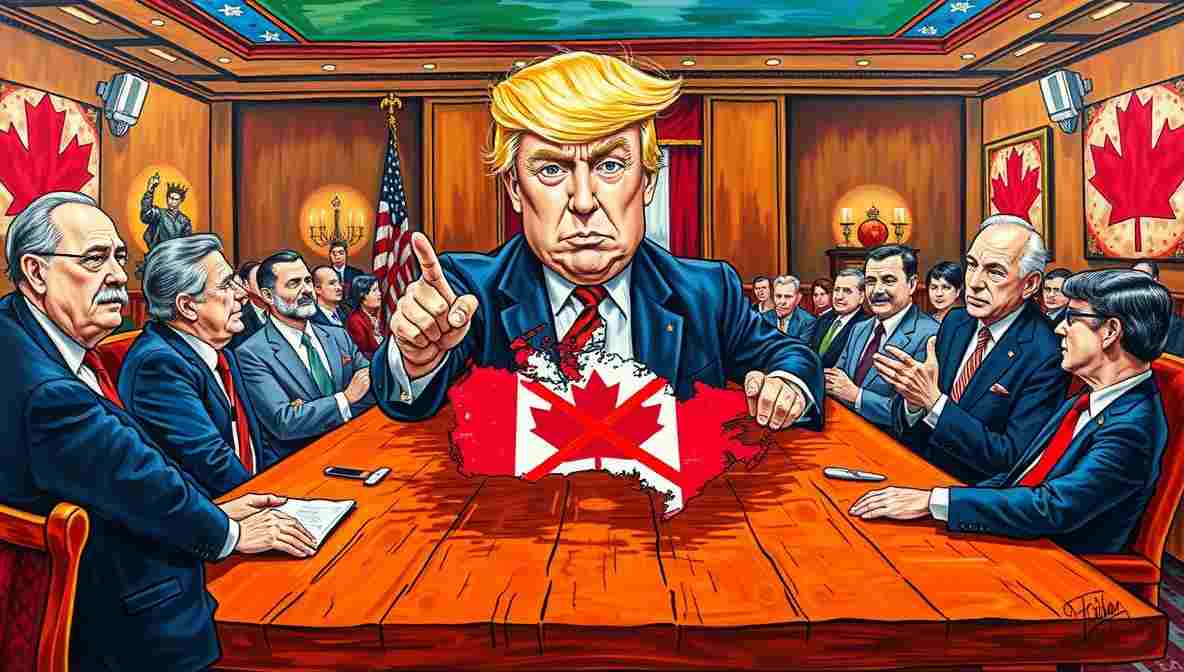
In a brief but spiritually loud post, Donald Trump withdrew Canada’s invitation to join his newly unveiled Board of Peace, a body that has already achieved what generations of diplomats could not: confusing allies, alarming enemies, and making the United Nations feel like it has been put on mute while someone else grabs the microphone.
“I love how Trump treats international diplomacy like firing someone on The Apprentice, except now the boardroom is the entire planet,” said John Oliver.
Canada’s Expulsion: No Explanation, No Process, Just a Parking Ticket

The message, delivered with the warmth of a parking ticket, informed Canada that its participation was no longer required. No explanation was given. No process outlined. No appeal mechanism offered. Peace, it turns out, does not come with customer support.
Canada, until moments earlier, had been hovering politely near the door of the Board of Peace, shoes on, coat still zipped, offering to help but declining to chip in the advertised $1bn membership fee. Ottawa described this position as “principled.” Washington described it as “ingratitude.”
“Trump’s idea of diplomacy is basically a Groupon that expired before you could use it,” said Trevor Noah.
The Board of Peace: Multilateralism Meets Landlord Authority
The Board of Peace itself is being marketed as a bold new international organisation designed to resolve global conflicts, streamline diplomacy, and replace several decades of multilateral practice with something more agile, more decisive, and significantly more personalised. Under the proposed charter, Trump would serve as chairman for life, a role combining the responsibilities of mediator, referee, executive producer, and landlord.
Supporters say this will cut through red tape. Critics say it cuts through the concept of shared governance. Everyone agrees it saves time.
“A chairman for life? I’ve seen HOA boards with better governance structures,” said Jimmy Kimmel.
The Davos Standing Ovation That Broke the Camel’s Back
The immediate trigger for Canada’s expulsion appears to have been a speech delivered by Prime Minister Mark Carney at the World Economic Forum in Davos. The speech was well received. Dangerously well received. It earned a standing ovation, an act that in modern geopolitics is indistinguishable from a hostile manoeuvre.
Carney warned of a “rupture” in the global order and urged middle powers to cooperate against economic coercion by larger states. He did not name Trump. This omission, paradoxically, made the offence worse. Nothing unsettles a superpower like being criticised anonymously but accurately.
“Not naming Trump while clearly talking about Trump is the geopolitical equivalent of subtweet diplomacy,” said Stephen Colbert.
Gratitude Means Silence and Restrained Applause
The following day, Trump reminded the assembled delegates that Canada enjoys “freebies” from the United States and should be grateful. Gratitude, in this context, appeared to mean silence, seated posture, and restrained applause.
When Carney later clarified that Canada “thrives because we are Canadians,” this was interpreted not as patriotism but as escalation.
Thus ended Canada’s brief courtship with the Board of Peace.
“Imagine getting kicked out of a peace organization for being too peaceful and polite. That’s peak 2025,” said Seth Meyers.
The Board’s Membership: Flexibility Over Scrutiny
The Board itself has already attracted around 35 signatories from a list of 60 invited nations. These include Argentina, Belarus, Pakistan, Kazakhstan, Saudi Arabia, and Hungary, a lineup suggesting that the Board of Peace places a high premium on flexibility, discretion, and not asking too many questions about governance structures.
Notably absent are other permanent members of the UN Security Council. The UK, France, China, and Russia have so far declined to commit, citing concerns about compatibility with existing international obligations, governance standards, and the presence of Russian President Vladimir Putin on the guest list. The UK expressed unease. France called the charter incompatible. China remained silent, which in diplomatic terms counts as a deeply worded essay.
“When your peace board’s VIP list includes Putin, you might want to reconsider the branding,” said John Mulaney.
Europe’s Cautious Response: Alarmed But Taking Notes
European Council president Antonio Costa attempted to strike a middle path, expressing “serious doubts” about the Board’s scope and governance while remaining open to cooperation in Gaza. This is European for “we are alarmed but will bring a notebook.”
The Board of Peace’s charter does not explicitly mention Gaza, despite early suggestions that it would focus on ending the war there. This omission has been described by supporters as strategic flexibility and by critics as forgetting to label the box.
Trump administration officials insist the Board will be more effective than the UN, which they describe as bloated, slow, and insufficiently appreciative. The UN, for its part, responded with silence, a tactic perfected over decades of watching ambitious alternatives announce themselves and quietly fade.
“The UN has been playing the long game of ‘we’ll still be here when you’re gone’ since 1945. They’re very good at it,” said Samantha Bee.
Peace as a Premium Service: Pay to Play, Clap at Your Own Risk
What makes the Board of Peace distinctive is not merely its structure but its tone. It treats diplomacy less as a collective endeavour and more as a premium service. Members are expected to contribute financially, align rhetorically, and refrain from public displays of independence that might be mistaken for disloyalty.
Canada’s error was assuming peace operated like other alliances, where shared values matter more than applause etiquette.
“In Trump’s world, peace is a subscription service, and Canada just cancelled before the auto-renewal kicked in,” said James Corden.
Canadian Reaction: Confusion, Resignation, and Golf Club Theories
For Canadians, the withdrawal was greeted with a mix of confusion, resignation, and mild offence. Polls conducted within hours showed most Canadians were unclear what the Board of Peace was, what it did, or whether they had already joined and forgotten. A significant minority assumed it was a golf club.
In Ottawa, officials privately expressed relief. One anonymous source described the membership fee as “a lot of money for something that could end with a tweet.” Another noted that Canada already belongs to several international organisations that occasionally work and rarely require public humiliation.
The Future of Global Governance: Institutions or Improv Theatre?
The episode has reignited debate about the future of global governance. Is multilateralism outdated, or merely under new management? Does peace require institutions, or just a confident chair and a large invoice?
Supporters of the Board argue that traditional diplomacy has failed to prevent conflict and that bold experimentation is necessary. Critics counter that replacing shared rules with personal discretion is less innovation and more improv theatre.
“Turning international relations into improv where one guy makes all the rules is basically a very expensive episode of Whose Line Is It Anyway,” said Hasan Minhaj.
Membership as a Mood: Today You’re Out, Tomorrow Who Knows?
There is also the question of precedent. If invitations can be revoked without explanation, membership becomes less a commitment and more a mood. Today Canada is out. Tomorrow it could be back in. Or not. Peace, like Wi-Fi, may depend on proximity to the router.
The Board’s defenders insist that strong leadership is essential in a fractured world. They point to Trump’s ability to command attention, dominate narratives, and force decisions. Detractors note that attention is not the same as agreement and that decisions imposed unilaterally tend to age poorly.
The UN Comparison: Endless Meetings Versus Getting Fired Mid-Sentence
The comparison to the UN is unavoidable. Where the UN offers endless meetings, carefully worded resolutions, and the illusion of consensus, the Board of Peace offers clarity, speed, and the risk of being fired mid-sentence.
For middle powers like Canada, the choice is stark. Participate and accept the terms, or remain outside and be described as ungrateful. Carney appears to have chosen the latter, perhaps calculating that dignity is cheaper than membership.
“Canada choosing dignity over Trump’s peace club is like leaving a party early because the host keeps checking if you’re having enough fun,” said Jimmy Carr.
Alliances Are Transactional, Applause Is Never Neutral
As for Trump, the incident reinforces a consistent philosophy: alliances are transactional, loyalty is visible, and applause is never neutral.
In the coming weeks, more nations will decide whether to join, decline, or hover politely while pretending to check their calendars. Some will sign up enthusiastically. Others will wait to see whether the Board survives its first crisis or simply becomes another acronym footnote.
Canada, meanwhile, will continue to exist, thrive, and occasionally clap at speeches without consulting Washington first.
“The most Canadian response to being kicked out of Trump’s peace board is to say ‘sorry for the inconvenience’ and then just carry on being nice to everyone,” said Russell Howard.
Conclusion: Tranquillity With a Cover Charge
The Board of Peace will move on, issuing statements, convening meetings, and reminding the world that tranquillity now has a chair, a fee, and a very clear sense of who is sitting and who is standing.
This satirical article is a work of commentary and humour based on current events. It is entirely a human collaboration between two sentient beings: the world’s oldest tenured professor and a philosophy major turned dairy farmer, both of whom agree that peace should probably not come with a loyalty programme.
Auf Wiedersehen, amigo!