

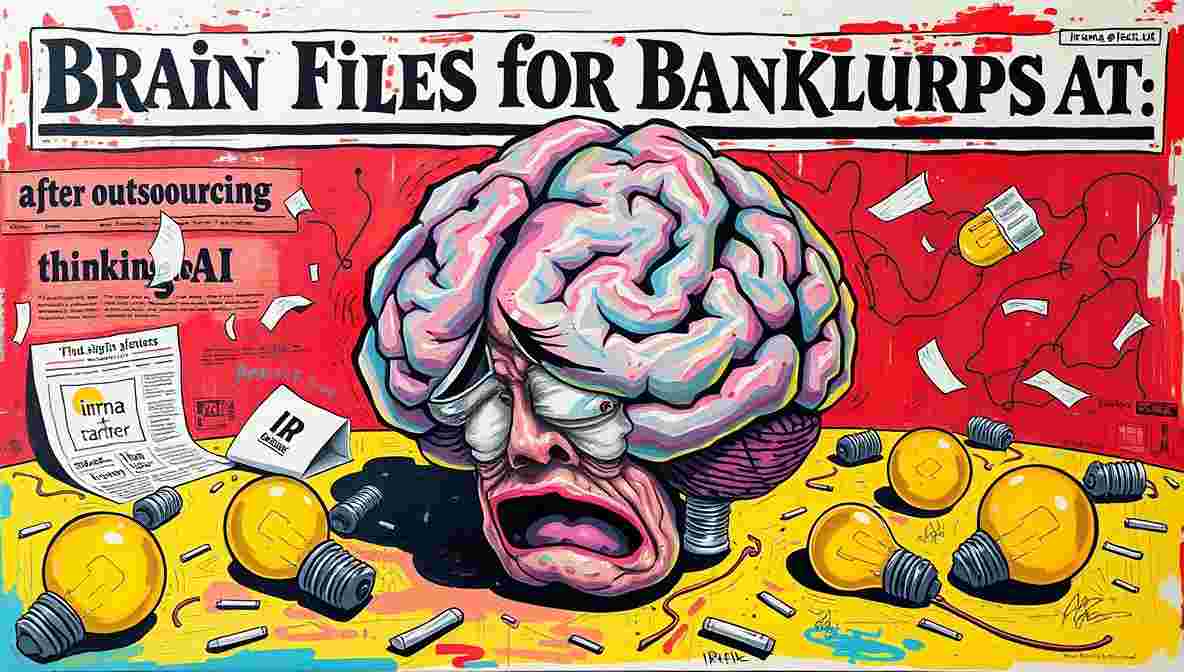
Breaking: Brain Files for Bankruptcy After Outsourcing Thinking to AI
A top researcher says a new divide is emerging in AI use — and most people are on the losing side. The Great AI Deskilling has begun, and Todd from Accounting didn’t even notice.
15 Observations About AI Making Us “Smarter” (Allegedly)
- People now say “I had a thought,” but legally it belongs to an algorithm in California.
- Critical thinking has been replaced by “Ctrl+C, Ctrl+Confidence.”
- Humans used to brainstorm; now we drizzle AI output like salad dressing and call it “innovation.”
- A recent poll found 92% of workers nod thoughtfully at AI answers they don’t understand, while Googling “what is understanding.”
- Office meetings now feature one human, six laptops, and a chatbot doing all the talking.
- The phrase “let me think about that” has been downgraded to “let me prompt about that.”
- Students don’t cheat anymore — they collaborate… with a robot that never sleeps and has no moral compass.
- GPS made us forget directions; AI is now making us forget directions in life.
- The smartest person in the room is now whoever knows how to phrase a question like a Victorian poet.
- We used to fear robots taking jobs; now we fear them taking thoughts and leaving us with vibes.
- “Original idea” now means “I changed three words the AI gave me.”
- Workers produce 10x output with AI, and 0.2x understanding.
- The brain is now a decorative organ, like parsley on a steak of machine-generated content.
- People say AI is a tool, but it’s starting to feel like we’re the attachment.
- The future isn’t humans vs. machines — it’s humans asking machines if they are still humans.
The Great Cognitive Layoff Nobody Applied For
Somewhere in a sleek office filled with ergonomic chairs and existential dread, a man named Todd proudly announced he hadn’t had an original thought since February.
“I’m more productive than ever,” Todd said, staring blankly into the glowing rectangle that now functions as both his boss and his inner monologue. “I generated 47 emails, three reports, and a breakup text. Honestly, I don’t even know who I am anymore, but it’s very efficient.”
Todd, it turns out, is not alone. According to a growing body of research and at least one concerned scientist waving her arms like a substitute teacher losing control of a classroom, humanity is entering what experts call a “cognitive divide.”
On one side: a small group of people using AI like a sparring partner — challenging it, questioning it, wrestling ideas into submission like intellectual cowboys. On the other: everyone else, politely accepting whatever the robot says, like it’s a fortune cookie that went to Stanford.
Rise of the Cognitive Couch Potato
Dr. Vivienne Ming, a researcher who sounds like she reads books for fun (which already makes her suspicious), found that roughly 90–95% of people are using AI in the most human way possible: lazily. Only a tiny minority — 5–10% — are doing something radical. Thinking.
“These individuals engage in ‘productive friction,'” Ming explained, using a phrase that sounds like either a philosophy concept or a terrible brand of lotion.
The rest of us have embraced what scientists are now calling “cognitive outsourcing” — a polite way of saying, “Eh, you do it.”
One anonymous office worker admitted: “I used AI to write a report about critical thinking. I didn’t read it. Seemed redundant.”
The Evidence Is In, and It’s Slightly Embarrassing
A leaked internal survey from the Institute of Human Effort (which may or may not be located inside a Starbucks) revealed:
- 87% of workers feel smarter using AI
- 82% cannot explain what they just produced
- 61% believe “confidence” is a valid substitute for “understanding”
- 100% still say “great question” before copying the answer
Meanwhile, real-world examples are stacking up like unread terms and conditions. One software consultant proudly built an entire app using AI, only to later admit he had no idea how it worked.
“It’s like I built a car,” he said, “but I’m not sure where the wheels go or why it’s on fire.”
The Brain: Now Optional

Experts warn this trend could lead to “deskilling” — a phenomenon where humans slowly forget how to do things because a machine does it faster. We’ve seen this movie before:
- Calculators made us worse at math
- GPS made us worse at directions
- Autocorrect made us worse at spelling
- Now AI is coming for the big one: thinking
Tech theorist John Nosta described AI as “anti-intelligence” — bold, considering it’s currently writing half the internet. His concern? AI delivers answers before we struggle, skipping the messy, character-building part of thinking. We’re getting dessert without eating the vegetables, and now nobody knows how to cook.
Eyewitness Testimony: The Man Who Forgot How to Code
Rohan, a seasoned engineer, recently confessed he hasn’t written code in months. “I just… describe what I want,” he said, staring into the middle distance like a man who once had hobbies.
At first, it felt liberating. Then unsettling. Now? He occasionally whispers to himself: “Did I ever know anything?”
Cause and Effect — Or: How We Got Here Without Noticing
Let’s break it down like a very polite intellectual autopsy:
- AI makes tasks easier
- Humans use it more
- Humans think less
- Humans get worse at thinking
- Humans rely on AI even more
Congratulations. You’ve unlocked the Cognitive Subscription Model™. Cancel anytime… but you won’t remember how.
What the Funny People Are Saying
“I asked AI to help me think, and now I’m in a codependent relationship with a toaster.” — Jerry Seinfeld
“We didn’t lose our minds. We just leased them out monthly.” — Ron White
“I love AI. It finally gives men an excuse for not knowing anything.” — Amy Schumer
Expert Analysis: Totally Serious, Probably
Professor Leonard B. Crankshaft of the Cognitive Gymnasium Institute explains: “Thinking is like a muscle. If you don’t use it, it turns into… LinkedIn posts.”
He recommends “mental pushups,” such as:
- Disagreeing with AI on purpose
- Asking “why” at least once
- Reading something longer than a tweet
These radical techniques are expected to confuse most users.
A Helpful Guide: How Not to Become a Decorative Human
Experts suggest a revolutionary approach: use AI… but also use your brain. Shocking, I know.
Some even recommend a “10-80-10” rule: think first, let AI assist, think again. This reportedly increases understanding and reduces the likelihood of accidentally writing a business memo that sounds like a horoscope.
Final Thought (Generated by AI, Approved by Humans)
AI isn’t making us stupid. It’s just making it incredibly convenient to act stupid. And like all conveniences, it comes with a hidden cost: the slow, quiet erosion of the one thing we thought was ours.
Our ability to think. Or at least… to pretend we were thinking all along.
This article is a work of satire and intellectual mischief, crafted through a deeply serious collaboration between two highly credentialed humans: one being the world’s oldest tenured professor, and the other a philosophy major who now owns several emotionally complex cows. Any resemblance to reality is purely a side effect of reality being increasingly indistinguishable from parody. The real story behind this piece draws on research by Dr. Vivienne Ming and coverage in Business Insider, which found that a cognitive divide is widening between a small minority using AI as a genuine thinking tool and the vast majority who have quietly subcontracted their cognition to a server farm in Northern Virginia.
Auf Wiedersehen, amigo!