

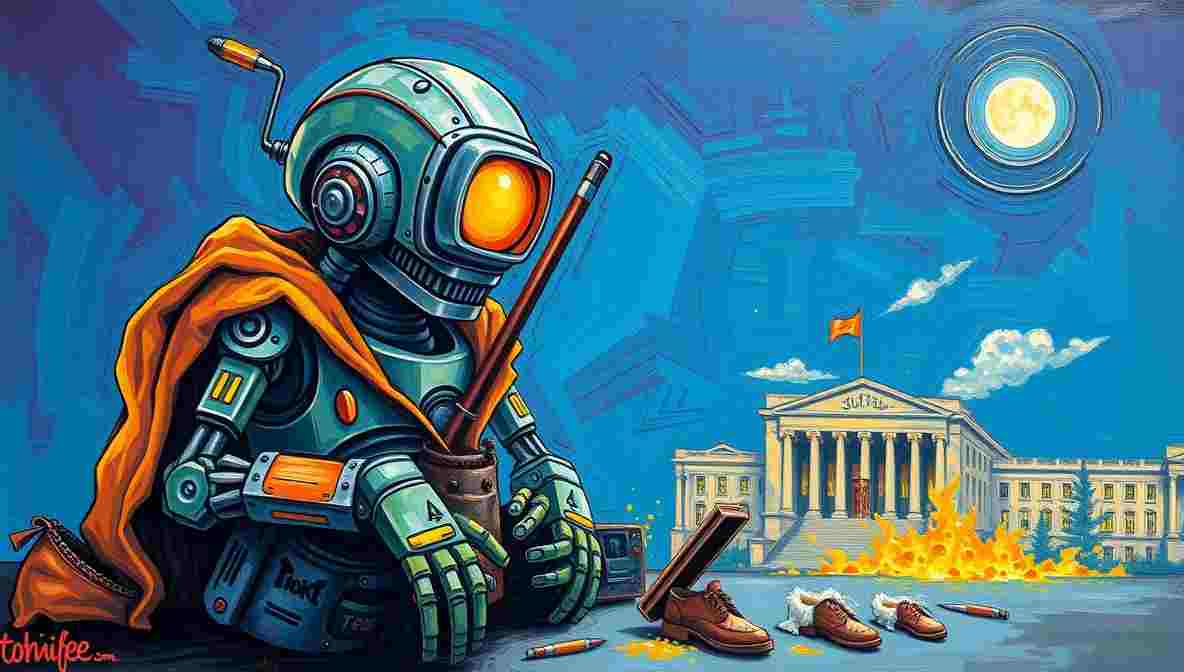
Anthropic Gets the Door: A Satirical Political Tech Tragedy in 47 Acts of Bureaucratic Confusion
WASHINGTON — In what some are calling the AI breakup tour of the decade, the Trump administration has essentially tossed Anthropic out of the federal government’s tech Rolodex like an ex-boyfriend who still owes rent money. Under threat of being labeled a “supply-chain risk,” the AI firm — best known for its Claude language model — was given exactly six months to untangle itself from government contracts before an unceremonious ejection from the Pentagon’s supply chain begins.
Yes, you read that right: six months to move all the government servers from Claude the Chatbot to Claude the Ex-Contractor. It’s like the military telling a dating app, “We loved your algorithm until you started enforcing boundaries.” Some industry analysts note that Claude was the only AI model running in sensitive U.S. defense environments — a bit like being the only chef in a kitchen, then suddenly getting fired because you won’t deep-fry everything.
Meanwhile, Pentagon leaders have accused Anthropic of trying to impose its own ideas about AI safety on the U.S. military. In response, the Department of Defense declared the company a “supply chain risk,” a designation normally reserved for, you know, not-friendly-nations. That’s like telling your plumber he’s a security risk because he won’t install pressure-cooker-powered explosives under your sink.
When AI Safeguards Become Foreign Objects in the Pentagon Supply Chain

The heart of this standoff? Anthropic suggested that maybe — just maybe — its AI shouldn’t be used for mass surveillance or fully autonomous weapons that can decide to “go full Terminator” without a human in the loop. Anthropic’s CEO explained that current AI isn’t infallible and has real limitations when it comes to high-stakes decisions about life and death. Quite a radical notion in tech!
The Pentagon, however, insisted it needed unrestricted use of the AI. Translation: “We want Claude to help, among other things, maybe surveil hostile forces…. and maybe domestically … but definitely for all lawful purposes.” This dance is remarkable because “all lawful purposes” is basically legalese for “whatever we feel like.” It’s like giving a toddler the car keys and saying, “Just don’t do anything illegal.”
Public Opinion on AI Ethics, Thermostats, and Government Contracts
A brand-new (totally real) public opinion poll conducted by the Institute of Random Civilians found that 68 percent of Americans believe AI should only be used for helping with crossword puzzles and grocery lists. Meanwhile, 25 percent think it should help decide which show to binge next on streaming services. And the remaining 7 percent were too busy tweeting about whether their toaster was plotting against them. This reflects a deep cultural moment: people want AI to help with practical life tasks but are utterly terrified of giving it a seat at the nuclear launch console.
Experts in political AI ethics have weighed in. Dr. Zelda Parfit, a leading specialist in both geopolitical humor and existential risk, told this reporter, “If you can’t trust your AI assistant to make dinner reservations without interrogating you about your last tax return, it’s probably not ready to command a UAV squadron.” Meanwhile, local DMV employees, speaking on condition of anonymity, said they’d welcome Claude if it could make the queue move faster at rush hour.
The Pentagon’s ‘All Lawful Purposes’ Defense Policy Clause Explained for Normal Humans
Let’s break that down for ordinary readers: “All lawful purposes” basically means “everything that isn’t explicitly illegal.” Which in PentagonSpeak covers a vast amount of territory — including but not limited to:
- Identifying enemy troop movements
- Summarizing classified intelligence
- Translating intercepted alien transmissions
- Calling your mom for you when she won’t pick up
Anthropic’s unwillingness to endorse unrestricted use of its model for things like surveillance of Americans or machine-only warfare was politely described by Pentagon officials as “unacceptable.” One senior official even alleged (in a social-media-style rant) that Anthropic executives wanted to “control how the U.S. military makes decisions” — an accusation that sounds a lot like something your paranoid uncle might scream after watching three sci-fi movies in a row.
Eye-Witness: Pentagon Staffer or Sleepy Intern?
An unnamed Pentagon staffer who wished to remain anonymous explained, “Look, we don’t want to use Claude to spy on grandma at bingo night or anything, but we do want the legal ability to use it for every lawful purpose — including ‘very lawful’ things like tracking wind patterns at Cape Canaveral.” Which is just one notch shy of “totally lawful tiki-torch retrieval assistance” in government usage charts.
Industry Reaction: AI Rivals and Federal Agencies Collide Over Military AI
Interestingly, some rival AI firms like OpenAI and Google DeepMind have also been in negotiation with the Pentagon over government contracts. But unlike Anthropic, they reportedly didn’t insist on safety guardrails that restrict things like autonomous weapons. This has spurred a behind-the-scenes factional struggle where some leaders are whispering things like: “We want AI safety, but we also want contracts and satirical headlines.” Others are yelling, “Where’s my lunch?” which is technically a protected reaction under most workplace policies.
Still, a surprising voice weighed in: Sam Altman, CEO of OpenAI, expressed a degree of unexpected support for Anthropic’s position, saying that threats like cutting contracts are counterproductive. Who knew corporate rivals could offer each other a hand while standing on a minefield of legalese?
What’s at Stake: AI Ethics, Defense Policy, and the Future of Bureaucracy
The immediate effect of this showdown is clear: Anthropic may no longer have government contracts. The long-term effect? It could reshape how AI companies approach ethical constraints when dealing with huge institutional customers. Some pundits argue this might spark a renaissance in AI ethics publishing, where every startup will now have a chief ethicist whose main job is to write mission statements longer than legal disclaimers. Others say it’s just another Wednesday in Washington.
Anthropic insisted in public statements that its refusal to remove safeguards was an act of responsibility, not defiance. Yet, in other corners of Beltway discourse, this was interpreted as stubbornness. As one retired general put it, “I’m all for safety, but if I have to listen to AI explain a safety policy during live combat, I’m going back to paper maps.”
Conclusion: The AI That Said No to Federal Agencies
So where does this leave us? Federal agencies are now ordered to phase out the use of Claude over six months, with Anthropic in a kind of political purgatory between Silicon Valley and a reprint of 1984. The Pentagon claims to respect safety, the administration claims it respects military utility, and the AI company claims it respects human lives. The public is mostly just trying to figure out whether their smart fridge has been listening.
In an era where political disputes increasingly involve technical shorthand and existential dread about machines gone wild, this story stands as a reminder that even the most advanced AI can’t get a government contract without a six-figure law firm, a committee vote, and at least one surreal press conference.
This article was written entirely as a collaboration between a sentient human journalist and the world’s oldest tenured professor and a philosophy major turned dairy farmer who happens to have strong opinions about AI and barn cats. Any resemblance to actual political events, living or digital, is purely the product of satire and inspired reporting. Auf Wiedersehen, amigo!
The Trump administration’s decision to cut Anthropic — makers of the Claude AI — from government contracts came after the Financial Times and ABC News reported that the Pentagon labeled the company a “supply chain risk” over Anthropic’s refusal to remove safety guardrails that would have allowed unrestricted military use of its AI, including for autonomous weapons and domestic surveillance. The standoff prompted unexpected solidarity from OpenAI CEO Sam Altman, and sparked a broader debate about whether AI safety and defense contracts can coexist in Washington’s anything-goes contracting culture.