
Cuba Announces New Renewable Energy Plan: “The Moon, Vibes, and Two Working Flashlights”
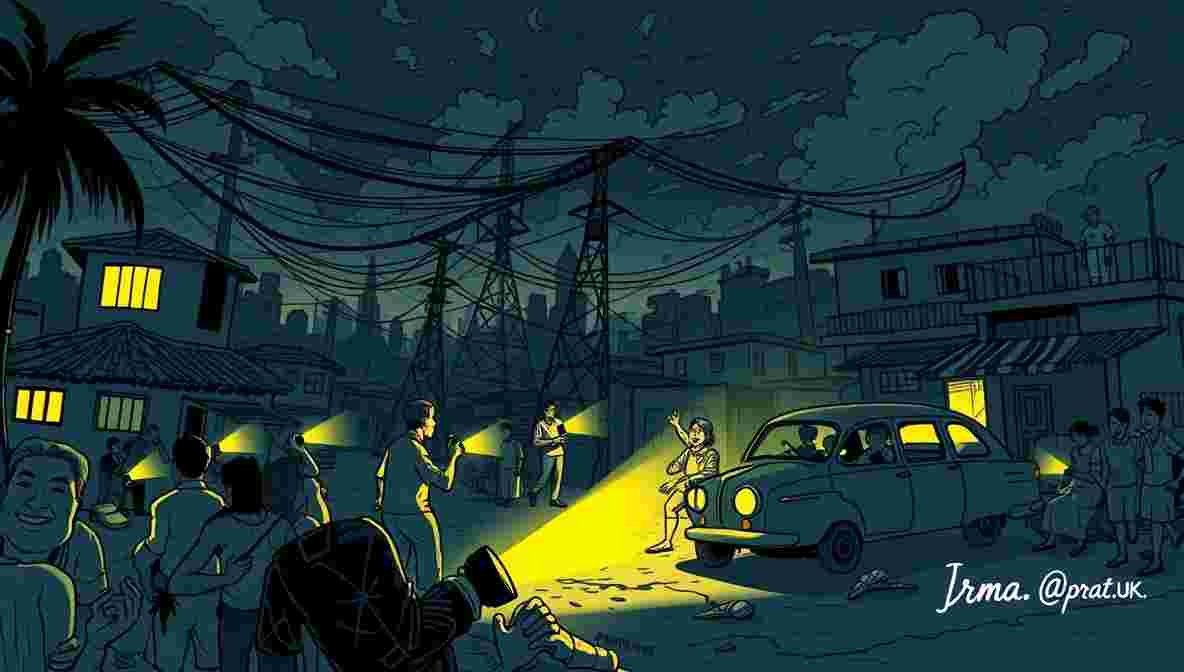
HAVANA — In what officials are calling a “bold return to pre-electric authenticity,” Cuba experienced its third nationwide blackout this month, leaving millions of citizens to rediscover the ancient art of walking into furniture.
The outage, triggered by what authorities described as an “unexpected failure” at a thermoelectric plant, has been widely rebranded by government media as a “spontaneous national candlelight festival.”
Residents of Havana, now experts in flashlight-based navigation, report that the country has finally achieved what climate activists have long demanded: zero emissions, zero electricity, and approximately zero patience.
The Peer-Reviewed Science of Strategic Darkness
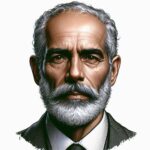
According to Dr. Ernesto Valdés, a government-approved energy expert who once fixed a blender using optimism alone, the blackout is “not a failure, but a transitional phase toward darkness neutrality.”
“Electricity is a colonial concept,” Valdés explained while holding a candle like a man auditioning for a gothic opera. “We are deconstructing dependence on energy by removing energy entirely.”
Independent research supports this claim. A recent survey conducted by the Cuban Institute of Statistical Guessing found that:
- 94% of Cubans have now memorized the layout of their homes by shin injuries
- 82% believe their phone flashlight is their “closest friend”
- 17% accidentally applauded when the lights didn’t come back on, assuming it was a scheduled outage
The U.S. Oil Blockade: Now With Extra Irony
The crisis has been linked to a tightening U.S. oil blockade, which has choked off fuel supplies and left Cuba producing only a fraction of its energy needs.
U.S. officials, meanwhile, insist the issue is not a lack of fuel but “a surplus of socialism,” a diagnosis delivered confidently by several men who have never fixed a power grid but once reset a router.
An anonymous American policy advisor, speaking from a fully lit office with three backup generators, explained:
“We’re not causing the blackout. We’re simply encouraging Cuba to discover candles. It’s cultural enrichment.”
Havana Nightlife Thrives, Technically Speaking
Despite the darkness, Havana’s nightlife has adapted. Bars now offer “BYOF” policies, short for Bring Your Own Flame, while musicians have returned to unplugged performances, mostly because they have no choice.
One eyewitness, 64-year-old Ofelia Oliva, described the scene:
“This is becoming unbearable… but also kind of romantic if you ignore everything else.”
Tourists, meanwhile, have praised the blackout as an “immersive historical experience,” noting that for just $200 a night, they too can live like it’s 1897 but with worse Wi-Fi.
Cuba’s Crumbling Power Grid: A Bold Experiment in Hope
Cuba’s electrical grid, described by engineers as “held together by determination and possibly duct tape,” has struggled under years of fuel shortages and aging equipment.
The recent collapse marks the second nationwide blackout in a week and the third this month, which experts say is either a crisis or a new monthly subscription model.
Government officials have responded by creating “micro-islands” of electricity to power essential services like hospitals and, in one case, a single working coffee machine that has now become a national landmark.
International Aid Arrives With Solar Panels and Opinions
As the crisis deepens, international aid groups have arrived with food, medicine, and solar panels, along with a refreshing supply of strongly worded opinions.
Critics note that some visiting activists are staying in air-conditioned hotels while discussing energy poverty, creating what experts call “the most comfortable protest in human history.”
One participant defended the arrangement:
“You can’t fight injustice if you’re slightly warm.”
What the Funny People Are Saying About Cuba’s Blackout
“I don’t mind a blackout. It’s the only time your phone battery feels like it’s winning.” — Jerry Seinfeld
“They say the grid collapsed. That’s not a collapse, that’s a retirement.” — Ron White
“Cuba said ‘lights out’ and meant it spiritually, emotionally, and electrically.” — Dave Chappelle
Cause and Effect, Explained Like a Very Tired Economist
Here’s the chain of events, simplified for anyone currently reading this by candlelight:
No oil → No fuel → No electricity → No refrigeration → Everyone suddenly very interested in canned beans
It’s the kind of economic model that really makes you appreciate light switches. Or at least remember where they used to be.
Cuba’s Energy Future: Bright, Conceptually
Cuban officials remain optimistic, announcing plans to restore power “soon,” a term that has been carefully defined as “before morale collapses completely.”
In the meantime, citizens continue adapting with resilience, humor, and an impressive ability to locate objects in total darkness using only profanity.
One government memo, leaked by an anonymous staffer who may or may not exist, outlined the next phase of the national energy strategy:
“Phase 1: Darkness
Phase 2: More darkness
Phase 3: Evaluate candles”
Experts agree the plan is “ambitious.”
Final Thought: A Nation That Glows, Just Not Electrically
In the end, Cuba has achieved something remarkable. In a world obsessed with screens, noise, and endless electricity, it has created a society where people are forced to look up, talk to each other, and occasionally trip over chairs.
It’s not ideal. It’s not efficient. But it is, undeniably, a vibe.
And if the lights ever come back on, many residents say they’ll celebrate the only way they know how now:
By immediately turning them off again, just to be safe.
Auf Wiedersehen, amigo!
Cuba’s energy crisis has been building for years, rooted in the island’s dependence on aging Soviet-era infrastructure and Venezuelan oil subsidies that have steadily dried up. The U.S. embargo, in place since 1962 and tightened under Trump-era sanctions, severely restricts Cuba’s access to fuel, spare parts, and foreign investment. The state electricity monopoly, Unión Eléctrica, has repeatedly failed to keep the national grid functional, resulting in rolling blackouts that in 2024 and 2025 escalated into full nationwide outages lasting days at a time. President Miguel Díaz-Canel’s government has blamed the U.S. blockade while critics point to decades of mismanagement and the failures of a centrally planned economy. Meanwhile, ordinary Cubans — already enduring severe food and medicine shortages — are left navigating daily life in the dark.