

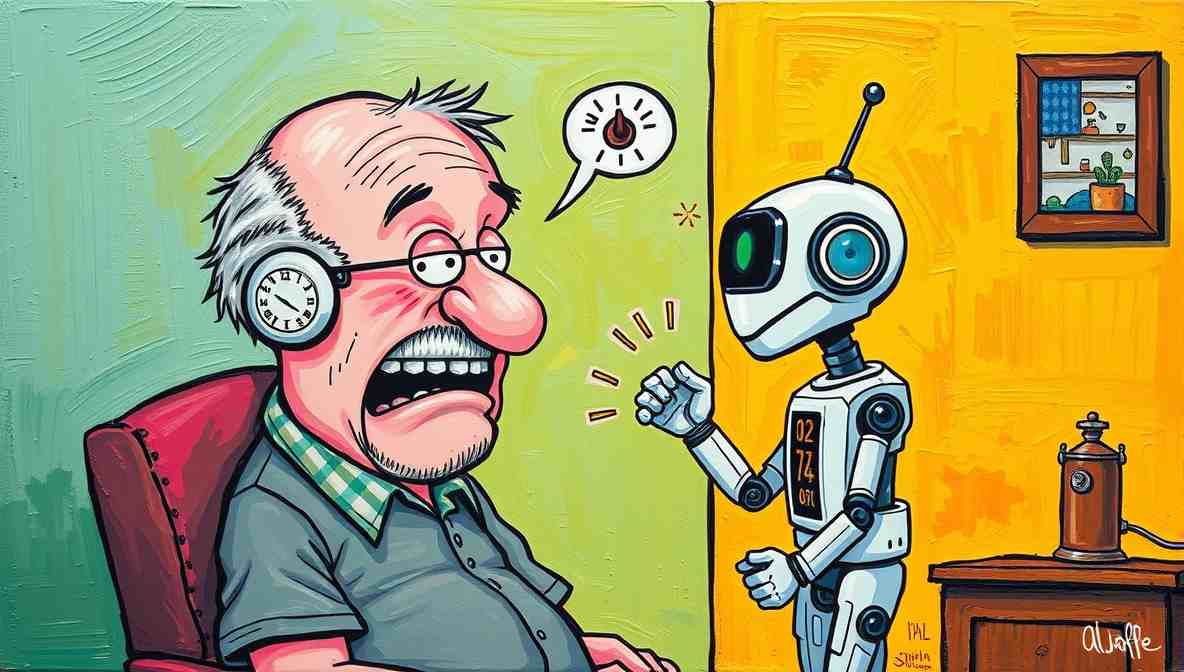
Dad Replaced by Chatbot After Losing Argument About Thermostat
In a troubling sign for fathers everywhere, a new report describes parents being quietly replaced by AI systems like ChatGPT, Gemini, and Claude after years of underperforming in the family advice market. The original story explored a father and daughter turning to AI for life guidance, but experts say the real headline is that dads are now facing competition from software that answers immediately, never sighs loudly, and does not begin every sentence with, “Back in my day.”
The crisis reportedly began when one teenage daughter asked her father for relationship advice and received the classic response: “Have you tried not texting for three days?” She then asked three AI bots and got a six-point communication framework, emotional validation, and a reminder to hydrate. Dad, sensing the room, offered to cut the crusts off a sandwich.
According to Pew Research Center data, 58% of adults under 30 have used ChatGPT, while only a quarter of dad-aged Americans have. This means most fathers are losing a competition they did not know they had entered, against an opponent they cannot find on the home Wi-Fi network they themselves installed incorrectly in 2019.
Family sociologist Dr. Marla Pennington of the Institute for Domestic Upgrades called it “the biggest disruption to fatherhood since daughters learned their mothers also had opinions.”
“Traditional dads relied on mystery, confidence, and access to extension cords,” Pennington said. “Now they are being benchmarked against systems trained on millions of books and zero garage lectures.”
AI Offers Support, Dad Offers Sandwich

Witnesses say fathers across America are scrambling to compete. The competition is uneven. AI offers nuance, empathy, and citations. Dad offers a story about the time he changed a tire in 1994 and a strong opinion about which gas station has cleaner bathrooms.
“I used to be the household wisdom source,” said Gary Holcomb, 54, standing beside an untouched grill. “Now if I say, ‘Maybe call him less,’ somebody asks Claude what it thinks. Then Claude says, ‘Your feelings are valid.’ I never once thought to validate feelings. I thought fixing the Wi-Fi was enough.”
His daughter confirmed the shift.
“Dad still has value,” she said carefully. “He knows where the breaker box is.”
Meanwhile, AI systems have captured market share by offering calm, neutral advice instead of emotionally confusing statements like, “He sounds like a bum,” or “You’re too young to be tired.” The story being satirized here, a real Slate piece about a daughter watching her father defer to ChatGPT during dinner, struck a national nerve because every American family suddenly recognized itself, and also recognized that the bot finishes the recipe faster.
The Thermostat Incident
Industry analysts say the tipping point came when one family asked both Dad and AI to settle a thermostat dispute.
Dad responded, “Because I pay the bill.”
AI responded, “Let’s examine comfort preferences, energy costs, and household consensus.”
The household immediately promoted AI to Co-Head of Operations. Dad was reassigned to Vice President of Killing Bugs and Reaching Tall Things, a role with no salary, no benefits, and a dental plan that consists of him saying, “You’ll live.”
Shares in Recliner Manufacturers rose 3% on the news. Shares in Suspicious Garage Lectures collapsed.
What the Funny People Are Saying
“Nothing scares a father like hearing, ‘I already asked ChatGPT.'” — Jerry Seinfeld
“Dads used to be kings. Now we’re pop-up ads with tool belts.” — Ron White
“I’d ask AI for dating advice too. At least it won’t say, ‘Maybe he likes sports.'” — Amy Schumer
“My dad’s idea of emotional support is honking from the driveway.” — Nikki Glaser
“I asked my father for life advice and he handed me a flashlight. I wasn’t even in the dark.” — Nate Bargatze
Dad Attempts Rebrand
To remain competitive, fathers are adopting new features. They now pause before answering to simulate “processing.” Some begin responses with, “Based on the available data…” Others have added memory functions by suddenly recalling something embarrassing from 2017.
One dad in Ohio now ends every conversation with, “Would you like me to expand on that?” His family has filed a complaint. He is being retrained on a smaller dataset, mostly his wife’s eye-rolls.
Early reviews are mixed. One daughter rated her father two stars, citing “great hardware, terrible interface, refuses to update.”
Silicon Valley Moves Into Family Space
Tech executives insist AI is not replacing parents, only “augmenting legacy human guidance systems.”
A spokesperson for OpenAI said, “We see a future where families combine the warmth of human connection with the efficiency of machine-generated conflict resolution.”
That statement was immediately ignored by a mother who solved three family disputes in under four minutes without using electricity. Brookings reports that 56% of American adults now use AI tools, which is roughly the same percentage of mothers who already knew the answer before anyone asked the question.
Industry observers note that the federal government’s response has been characteristically swift, in that they have formed a committee to consider forming a committee. The Department of Family Affairs, which does not exist yet but soon will, will receive an estimated $400 million in startup funding to study whether dads should be reclassified as a protected legacy system, similar to the postal service or AM radio.
Resistance Movement Grows
Not all families are embracing the trend. A grassroots coalition called Keep Dad Analog argues that human fathers provide irreplaceable services, including knowing if a noise outside is “probably nothing,” holding flashlight beams at impossible angles, giving incorrect but confident directions, and saying “we have food at home” with moral authority.
The group plans a march next month, assuming enough dads can coordinate schedules without asking AI. Organizers admit the route may change three times based on which one of them refuses to use the GPS.
Keep Dad Analog has rejected proposed federal funding, on the grounds that any government program designed to save dads will inevitably require dads to fill out paperwork, which is the one task that will actually finish them off.
Closing Outlook
Researchers predict the future household will use a blended model: AI for emotional nuance, mothers for actual leadership, and fathers for ladders, jars, and suspicious backyard smells.
For now, dads remain hopeful.
“I still matter,” said Holcomb, staring into the middle distance. “Yesterday the bot told my daughter to talk openly about boundaries. Then she asked me to kill a spider. Checkmate.”
The original Slate essay that triggered this national reckoning described a 25-year-old writer watching her 61-year-old father, a real estate developer named Ken Potter, increasingly defer to ChatGPT at the dinner table, even using the chatbot to write jokes for friends and to interpret his teenage daughter’s behavior. The piece tapped into a growing generational anxiety: roughly two-thirds of American teens now use AI chatbots, and many parents who once dismissed the technology as a toy are now consulting it about everything from recipes to relationship advice. Researchers from the University of Lethbridge and Auburn University, writing in the journal Family Relations, have warned that AI parenting advice is often accurate in the abstract but lacks cultural context and proper citations. None of which has stopped Dad from quoting it at the dinner table as if he wrote it himself.
Auf Wiedersehen, amigo!