

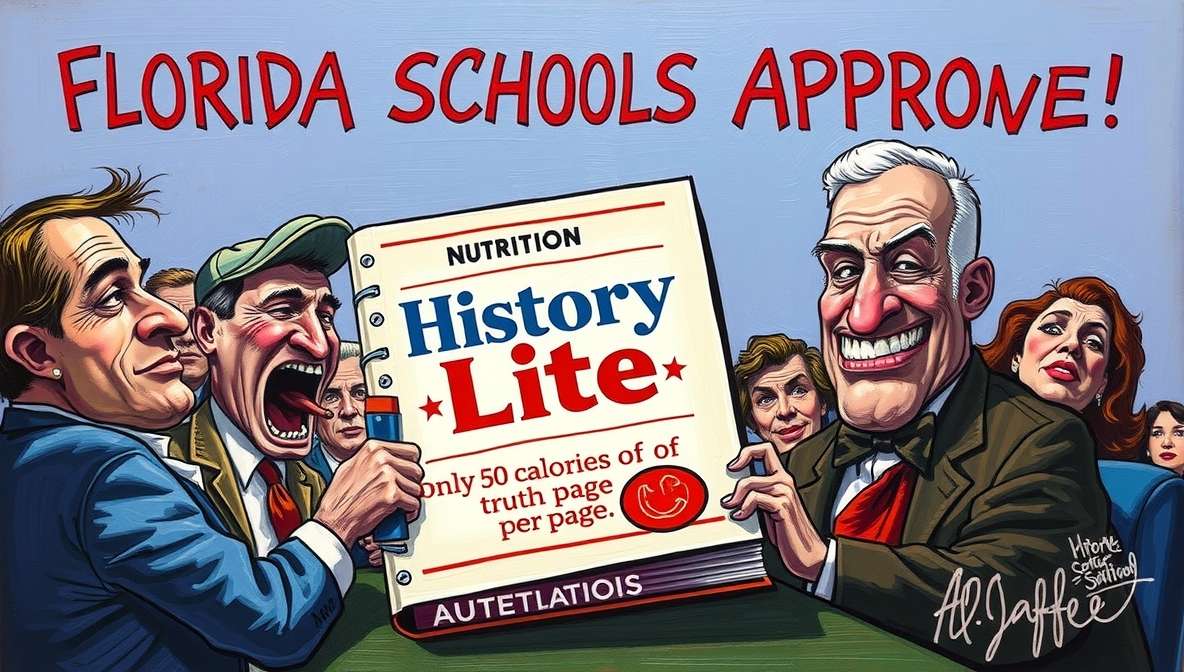
Florida Schools Approve “History Lite” with Just 50 Calories of Truth Per Page
New textbook series promises “zero added context” and nutritional labels for knowledge consumption
By Bohiney Magazine Staff |
Sunshine State Puts History on a Strict Diet
TALLAHASSEE — The Florida Board of Education has officially approved History Lite, a groundbreaking new textbook series promising “just 50 calories of truth per page” and “zero added context.”
The move follows complaints from parents who said the old history books were “too heavy with guilt, nuance, and dates longer than a TikTok.”
State Education Commissioner Buddy Ray Hollister declared the reform “a major victory for mental fitness,” explaining: “We’ve put history on a strict truth diet. No more bloated paragraphs about systemic oppression or messy wars. It’s lean, mean, and fact-free — the way our forefathers probably intended.”
Ron White would probably say: “Florida’s trimming the fat from history. Pretty soon they’ll have textbooks that are just blank pages with American flags. And folks will still complain there’s too much reading.”
Nutritional Labels Now Required for All Knowledge
Each History Lite chapter now comes with a nutrition label: Truth: 2%, Spin: 48%, Patriotism: 110%, and Context: less than 1% (trace amounts may appear in footnotes).
The publisher, FreedomLeaf Press, says it’s the first educational product “safe for all ideological allergies.” Their slogan: “No gluten, no guilt, no inconvenient facts.”
TruthTrim™ Algorithm Revolutionizes Content
According to the company’s chief editor, every paragraph was carefully reformulated using a proprietary algorithm called “TruthTrim™”, which removes any historical content that might “raise eyebrows or blood pressure.”
“We replaced words like ‘slavery’ with ‘unpaid internship opportunity,'” he said proudly. “It just reads smoother.”
Jerry Seinfeld would have a field day: “Unpaid internship opportunity? So slavery is basically what college graduates go through now? At least slaves didn’t have student loans.”
Parents Celebrate, Historians Wear Black Armbands
Parent advocacy group Mothers Against Too Much Information applauded the reform. President Sherry-Jo Langley told reporters: “I don’t want my son coming home crying because he learned our ancestors weren’t perfect. He should learn pride, not perspective.”
Meanwhile, university historians have started wearing black armbands in silent protest. Dr. Alonzo Vega of the University of Miami sighed, “We spent centuries documenting humanity’s errors so we could learn from them. Florida’s plan is to delete the errors and call it enlightenment.”
But History Lite defenders say academics are just “jealous that no one swipes right on their footnotes.”
Inside a History Lite Classroom

At Pineapple Grove Elementary, fifth-grade teacher-turned-“Truth Technician” Laura Mayfield demonstrated the new approach.
“Instead of teaching about the Civil Rights Movement,” she explained, “we focus on how good everyone’s intentions were. Dr. King’s dream is still there — we just edited out the nightmares.”
Emotionally Neutral Reenactments Replace Traditional Lessons
Students now learn through simplified “Emotionally Neutral Reenactments.” For example: The American Revolution is reenacted using Nerf muskets and affirmations, The Great Depression is summarized as “a brief national juice cleanse,” and The Vietnam War is described as “an extended Southeast Asian group project that didn’t meet expectations.”
Dave Chappelle summed up revisionist education perfectly: “They’re teaching a version of history where everybody gets along and nobody’s the bad guy. That’s not history, that’s Disney+.”
Physical Fitness Meets Historical Amnesia
To keep students active, History Lite includes physical fitness components. Each morning begins with “Fact Aerobics,” where students shout slogans like: “No need to read if you already believe!” “Evidence is for enemies!” and “We the people — but not too deeply!”
According to fitness coordinator Coach Brenda, “We burn calories and historical nuance at the same time.”
Tiffany Haddish would probably joke: “They got kids doing jumping jacks while forgetting slavery. That’s multitasking at its finest.”
New Curriculum Spans Elementary Through High School
State officials unveiled the official course list under the new History Lite Initiative:
Grade-by-Grade Breakdown
3rd Grade: America’s Beginnings (with Optional Pilgrims) — Focuses on Thanksgiving as a centuries-long potluck of friendship.
5th Grade: The Civil War: A Misunderstanding Between Cousins — Emphasizes unity, forgiveness, and proper flag folding.
8th Grade: Industrial Revolution: How Steam Powered Freedom — Students build toy factories while avoiding labor discussions.
11th Grade: World War II: The International Debate Club Got Heated — Concludes with a song titled “We Saved the World, You’re Welcome.”
Each course is supported by sponsor-approved worksheets, such as “Find the Freedom Word” puzzles (answer: always “Freedom”).
Psychology of Comfort History Explained
Dr. Lena Harker, a cognitive psychologist at the University of South Florida, calls History Lite “a case study in collective cognitive dissonance.”
“Students are learning to feel good about the past without actually understanding it. It’s like eating cotton candy for dinner — temporarily satisfying, but nutritionally void.”
She added, “The brain doesn’t distinguish between ‘comfortable lies’ and ‘uncomfortable truths’ when both are presented with equal authority. That’s how you get adults who think the Civil War was about states’ rights to throw better barbecues.”
Bill Burr would tear this apart: “You can’t just ignore the bad parts of history because they make you uncomfortable. That’s like saying, ‘I’m on a diet’ while eating a whole pizza. You’re not fooling anyone, Florida.”
Teachers Adapt or Resign
Veteran educators face a choice: embrace the new curriculum or find employment elsewhere. Many have chosen early retirement rather than teach what they call “patriotic fan fiction.”
Mr. Dennis Polk, a 30-year history teacher, announced his resignation: “I became a teacher to inspire critical thinking, not to peddle comfortable myths. If I wanted to tell fairy tales for a living, I’d work at Disney World — at least they pay better.”
Others have adapted. Mrs. Rachel Timmons now begins every class with: “Remember, history is like your uncle’s Facebook posts — some of it’s true, some of it’s not, and we’re not here to fact-check.”
Students Express Confusion and Contentment
Student reactions have been overwhelmingly positive, though comprehension remains concerningly low. In exit interviews, 11th-graders expressed both satisfaction and spectacular ignorance:
“I love how history doesn’t make me feel bad anymore,” said student Brandon K. “Before, I felt guilty about stuff that happened before I was born. Now I just feel proud.”
When asked what he learned about the Reconstruction Era, Brandon replied, “That’s when we rebuilt America after the big family argument, right? Everyone hugged it out.”
Amy Schumer captured this phenomenon: “We’re raising kids who think participation trophies apply to historical atrocities. ‘Good effort, America! You tried!'”
Textbook Industry Rushes to Capitalize
Other states are watching Florida’s experiment closely. Texas has already announced plans for “History Extra Lite” with “only 25 calories of truth per page.”
Alabama is considering “History Zero” — described as “all the patriotism, none of the accountability.”
Meanwhile, California responded by mandating “History Heavy” — textbooks so dense with context and footnotes that students need forklift certification to carry them.
Digital Version Includes Content Filters
The digital edition of History Lite features customizable “comfort filters” that automatically adjust content based on parental preferences. Options include: “Inspirational Only,” “America: The Highlight Reel,” and “Skip Anything Before 1950.”
Early adopters praised the feature. One parent raved, “My daughter can learn about World War II without any of that depressing Holocaust stuff. It’s just a story about brave American heroes now!”
Historians have taken to day-drinking.
Jo Koy would kill with this material: “They got filters for history now. ‘Skip the sad parts.’ That’s like watching Titanic but turning it off before the ship hits the iceberg. What’s the point?”
Economic Impact of Educational Simplification
The History Lite rollout has created unexpected economic opportunities. A cottage industry of “truth restoration tutors” has emerged, charging wealthy parents $200/hour to teach their children “what actually happened.”
Meanwhile, underground “banned books clubs” have formed, where teenagers gather to read unedited history textbooks from the 1990s like forbidden literature.
“It’s like speakeasy education,” explained club organizer Marcus T., age 17. “We meet in basements and read about actual systemic racism. It’s wild.”
International Reaction: Concern and Schadenfreude
Foreign observers have responded with a mix of alarm and amusement. The European Union issued a statement expressing “deep concern about America’s commitment to factual education.”
China’s state media gleefully reported: “American students now learning fantasy history. Soon they will believe they invented gunpowder too.”
Canada simply updated its immigration website with a new category: “Educational Refugees.”
Trevor Noah nailed it: “Florida’s teaching history with a filter. Meanwhile, the rest of the world is watching America slowly unlearn itself. It’s like watching someone forget how to ride a bike — hilarious until they fall into traffic.”
The Long-Term Prognosis for American Education
Educational researchers predict significant downstream effects. Dr. Patricia Newell of Columbia University warns: “We’re creating a generation that will struggle to understand cause and effect, context, or complexity. They’ll be excellent consumers but terrible citizens.”
However, History Lite supporters argue this is a feature, not a bug. As one Florida legislator put it: “An informed citizenry asks too many questions. A comfortable citizenry just wants lower taxes and better Wi-Fi.”
The future of American democracy may depend on which vision prevails: education as enlightenment or education as anesthesia.
Louis C.K. would probably say: “We’re dumbing down history so kids don’t feel bad. You know what made me feel bad? Being stupid. Maybe we should try the opposite approach.”
What Comes After History Lite?
As Florida’s experiment enters its second year, questions remain about the next phase. Will other subjects receive similar treatment? Rumors suggest “Math Lite” (where all answers are correct if you believe hard enough) and “Science Lite” (evolution optional, vibes mandatory).
The Florida Legislature has remained tight-lipped, though one anonymous source suggested: “Once you start making truth optional, it’s hard to stop. It’s like potato chips — you can’t have just one subject.”
As America watches Florida’s bold educational experiment unfold, one thing becomes clear: the state that gave us Florida Man has now given us Florida Education. And like Florida Man, it’s equal parts concerning and entertaining.
Wanda Sykes would end it perfectly: “Florida’s out here rewriting history like it’s a Yelp review. ‘One star, too many facts, would not recommend.'”