Mexican Cartels Turn Chemists: Human Fentanyl Trials Prove Science Isn’t Always Ethical
When Drug Lords Become Pharmacists, Everyone’s a Test Subject
By Pablo “Punchline” Pérez, reporting from the chaotic streets where morality is extinct
New Frontiers in Criminal Innovation
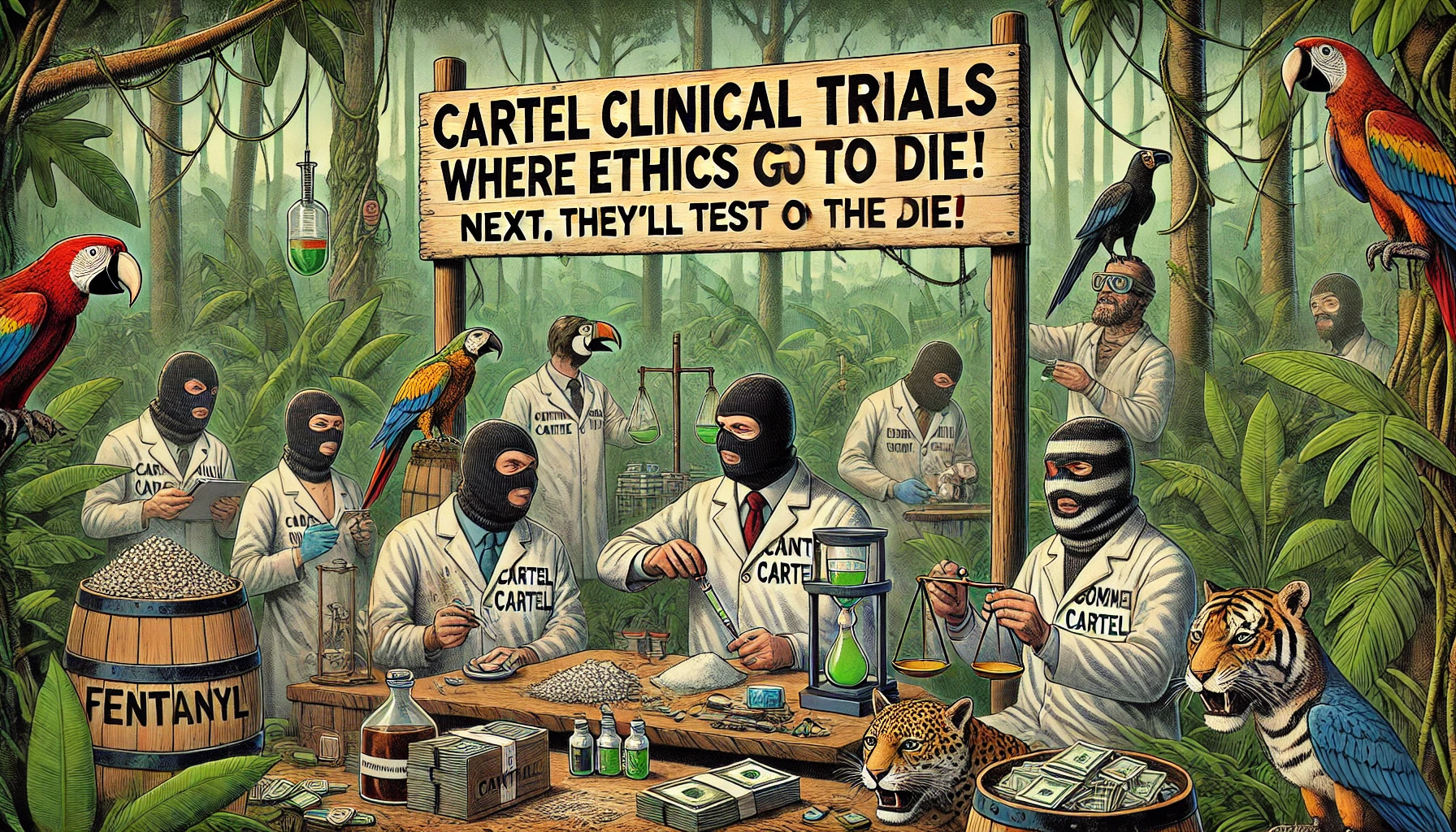
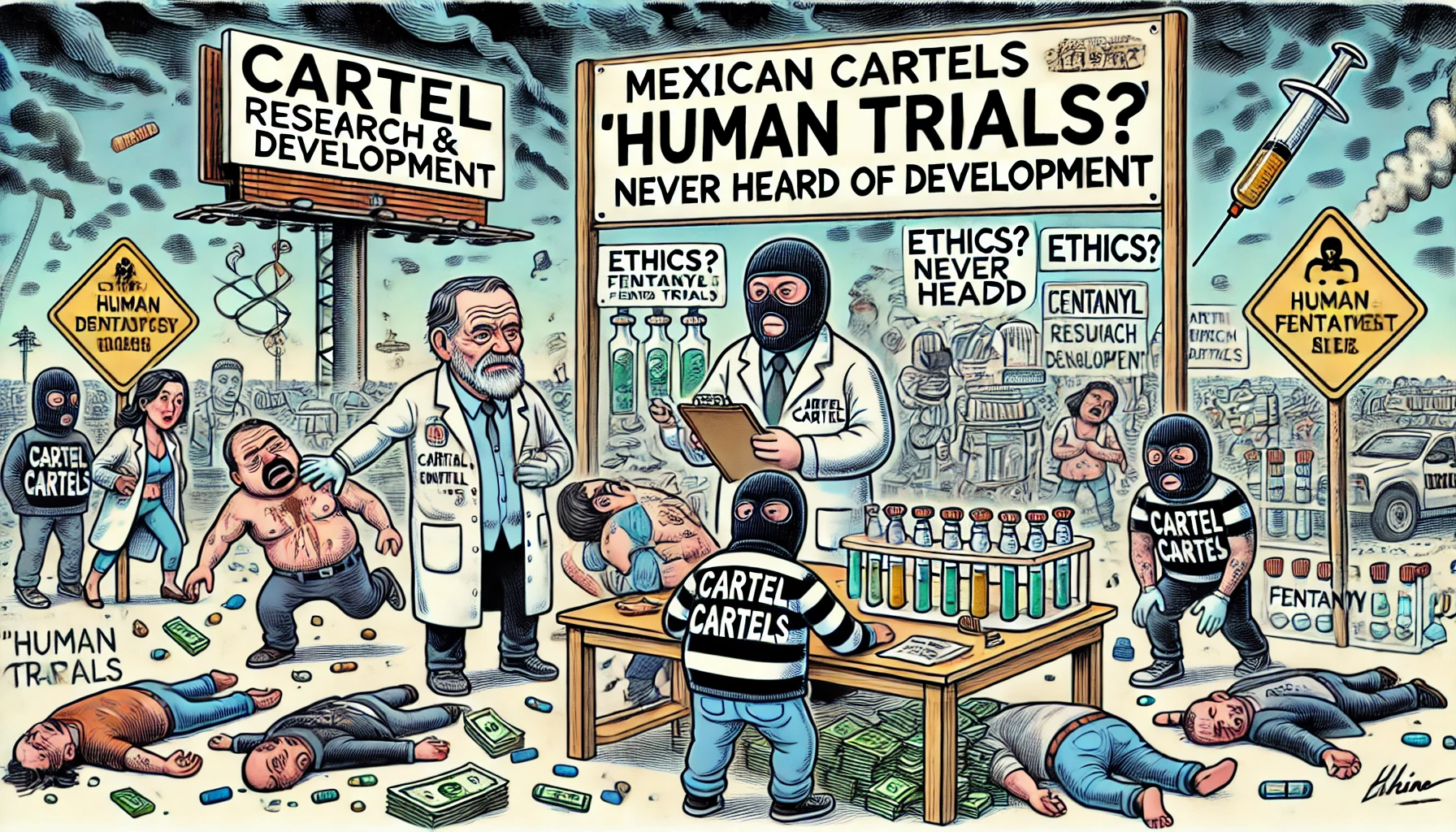
Move over Big Pharma — Mexican cartels have entered the drug-testing business, and they’re skipping the ethics committee. In their pursuit of the perfect fentanyl formula, cartels are reportedly testing doses directly on humans, making clinical trials look like a walk in the park. For the cartels, this is less about saving lives and more about finding just the right level of potency to hook users without killing them outright. Though based on recent statistics, that balance seems to be a work in progress.
“It’s not about safety,” said one law enforcement officer. “It’s about maximum addiction with minimum PR disasters, and by PR disasters, I mean dead bodies in public places.”
“Mexican cartels are testing fentanyl on people now? That’s not drug trafficking anymore—that’s Shark Tank for sociopaths.” – Jimmy Fallon
Cartels Embrace the Science of Death
The old days of drug trafficking were simpler: grow, package, sell. Now, cartels have ventured into pharmacology, treating human lives as disposable data points. Sources reveal that cartel-run labs in rural Mexico are producing fentanyl in bulk, often laced with experimental additives. And unlike legitimate labs, there’s no double-blind testing here—only double-edged results.
Reports suggest cartels distribute new batches into local communities to gauge the effects. If overdoses spike, they know they’ve gone too far. If addicts come crawling back for more, it’s a commercial success.
“Imagine an assembly line of misery,” said one health worker. “Except the workers are also the casualties.”
“Cartels conducting human trials for fentanyl is like McDonald’s testing fries directly on your arteries—except fries don’t come with a death certificate.” – Stephen Colbert
From the Streets to the ‘Lab’
Forget beakers and test tubes. The cartels’ version of research involves live human subjects in real-world settings. Vulnerable populations, particularly in high-addiction areas, have become unwitting participants in these grim trials.
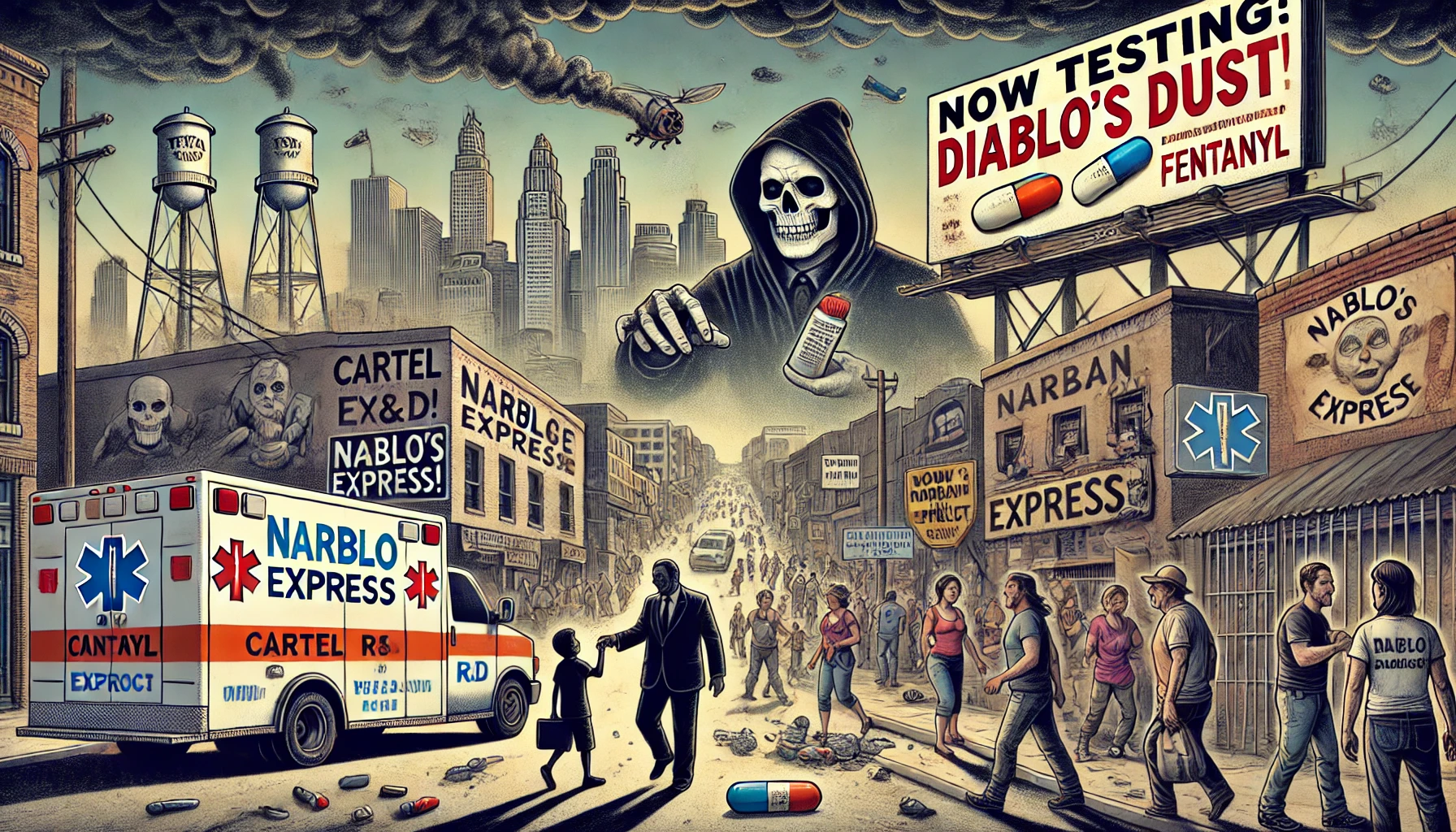
In a harrowing example from Tijuana, a wave of overdoses was traced back to a single batch of fentanyl nicknamed “Diablo’s Dust.” It was reportedly so potent that hospitals had to ration Narcan supplies, leaving some victims without lifesaving treatment.
One survivor recalled waking up in a hospital: “They said I was lucky to be alive. I said, ‘Define lucky.’”
Focus Groups of Doom
In the corporate world, focus groups test products like sneakers or snacks. In cartel-controlled territories, the stakes are deadlier. “They’re running focus groups where the main feedback is ‘lives lost,’” said a DEA spokesperson.
These informal “feedback loops” often take place in areas with high foot traffic. Users are given free samples—sometimes unwittingly—and their reactions are monitored. If they overdose, the product is deemed “too hot.” If they return begging for more, it’s a hit—literally.
Hospitals along the U.S.-Mexico border report eerily similar stories: waves of overdoses tied to new fentanyl batches that appear, devastate, and disappear just as quickly.
“So the cartels are doing product testing? I guess they’re not just drug dealers—they’re pharmaceutical companies with less paperwork.” – Seth Meyers
Marketing Meets Murder
The cartels aren’t just testing drugs; they’re branding them. Pills laced with fentanyl are now color-coded to appeal to specific demographics, including teens. Pastel-colored fentanyl pills, dubbed “rainbow rocks,” have been distributed in schools, sparking outrage among parents and law enforcement.
“This isn’t drug dealing; it’s guerrilla marketing,” said one policy expert. “And their target audience is anyone with a pulse.”
Social media plays a role, too. Videos glorifying cartel-made pills circulate on platforms like TikTok, further spreading the allure of the deadly substance.
Unethical Trials: Consent? What’s That?
The concept of informed consent doesn’t exist in the cartel lexicon. Victims of these trials often have no idea they’re part of an experiment until it’s too late.
“They’re not just selling drugs; they’re testing weapons,” said a human rights lawyer. “And the casualties are piling up.”
One tragic case involved a man in Juárez who thought he was buying heroin. The substance was actually 90% fentanyl. He was pronounced dead within hours. His family later discovered that the same batch had killed three others in the area.
“Cartels testing fentanyl on people is horrifying… but also, it’s probably still faster than getting FDA approval in the U.S.” – Trevor Noah
The Cost of Innovation
For the cartels, testing fentanyl is a grim balancing act. They aim to create a product that’s addictive enough to keep customers coming back but not so lethal that it wipes out their customer base entirely.
“It’s all about repeat business,” said a criminologist. “They don’t want a single-use product, but the line between ‘addictive’ and ‘deadly’ is razor-thin.”
Officials estimate that 70% of fentanyl overdoses in border states are tied to these unregulated trials. The death toll has become so high that morgues in some regions are nearing capacity.
Turning Communities into Laboratories
Entire neighborhoods have become testing grounds for cartel experiments. Residents in cities like Nogales and Matamoros describe living in a state of constant fear, where every new shipment brings fresh dangers.
One community leader in Matamoros said, “We’re treated like lab rats. But lab rats at least get a controlled environment. We just get death.”
Aid workers struggle to keep up, distributing Narcan kits and providing addiction resources while cartels continue to flood the streets with untested drugs.
Lethal Branding: Profits Over People
Cartels have embraced a twisted form of branding. Overdose victims are often found with distinct pills meant to symbolize specific cartels’ “signature products.” Some pills even bear logos—yes, logos—like crowns or skulls.
“It’s not just trafficking anymore,” said a border official. “It’s a full-scale marketing war, with human lives as collateral.”
The Global Fallout
The effects of these trials aren’t confined to Mexico. In the U.S., fentanyl has become a leading cause of overdose deaths, with many victims unaware they’re even ingesting it.
Border towns are particularly vulnerable, as cartels use these areas as distribution hubs. Hospitals and morgues in places like El Paso and San Diego report record-high numbers of overdose cases linked to fentanyl.
“These aren’t just drugs; they’re chemical weapons,” said one public health official.
What Can Be Done?
Experts argue that combating this crisis requires a multi-faceted approach, including:
- Enhanced border control to intercept fentanyl shipments before they reach communities.
- Increased funding for addiction treatment programs to help those already affected.
- International cooperation to dismantle cartel networks and hold traffickers accountable.
Conclusion: A Grim Reality
The cartels’ fentanyl experiments are a chilling reminder of what happens when profit is prioritized over human life. As they continue to refine their deadly formulas, the toll on communities across North America only grows.
While the world debates how to address the fentanyl epidemic, one thing is clear: the cartels aren’t slowing down. And as long as there’s a demand for their product, they’ll keep supplying it—no matter the cost in lives.
Disclaimer:
This article is satire, written to shed light on a dire issue through humor. Any resemblance to real persons or events is purely coincidental—though tragically, not implausible.