

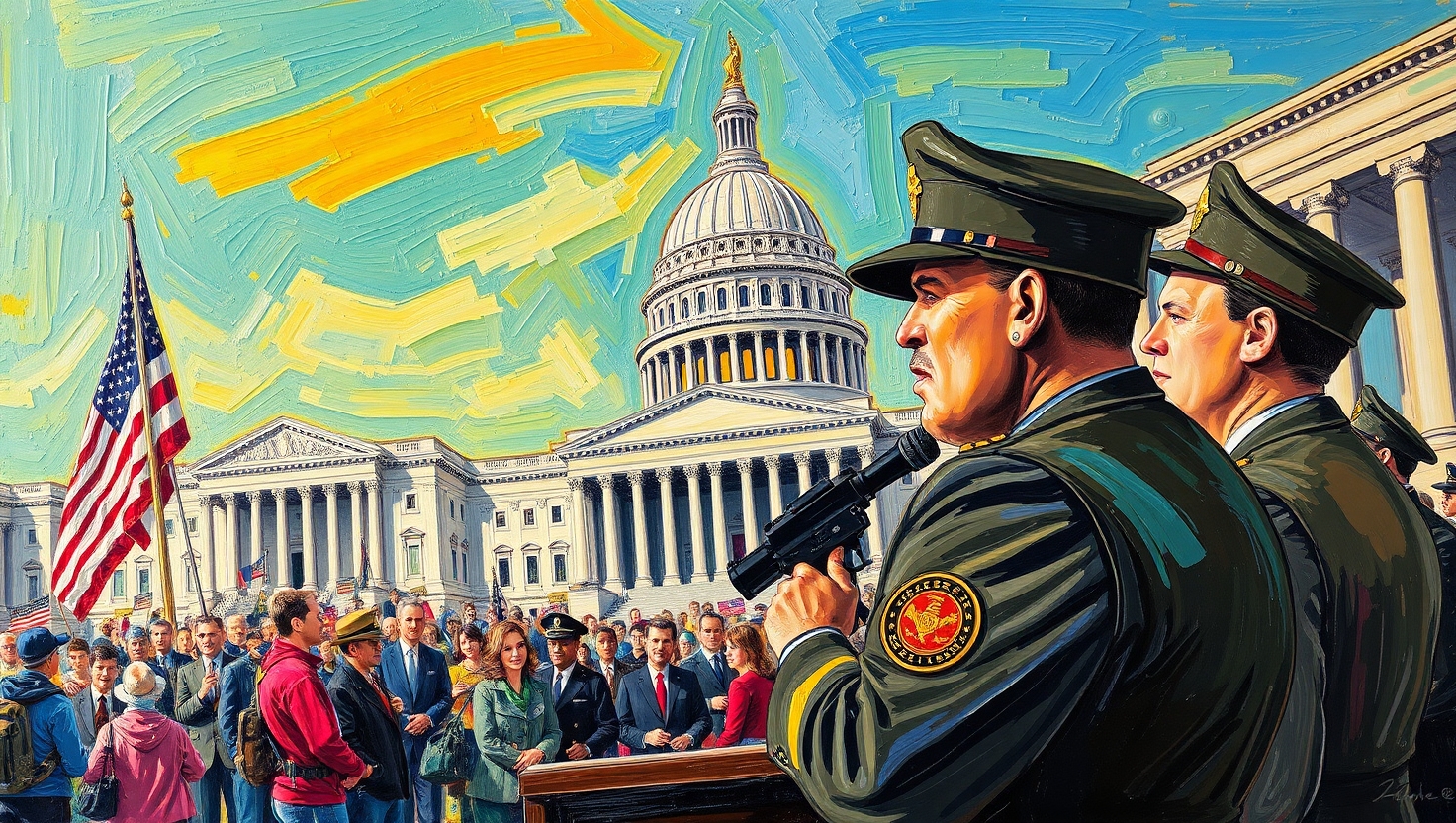
Congress Holds Heated Debate On Whether National Guard Should Guard Congress
Lawmakers Struggle to Determine If Military Protection Should Protect Military Protectors
WASHINGTON — In what political scientists are calling the most circular debate since the infamous “Who Watches the Watchmen” Senate subcommittee hearing of 1987, Congress spent fourteen hours Wednesday debating whether the National Guard should be deployed to guard Congress, or if Congress should guard the National Guard, or if both should guard each other in some sort of mutually protective embrace that resembles a governmental group hug.
The debate began when Representative Martha Collins (R-TX) innocently asked during a routine Defense Appropriations hearing, “If the National Guard is supposed to guard the nation, and we are the nation’s representatives, shouldn’t they be guarding us specifically?” This seemingly logical question immediately sent the House into a parliamentary tailspin that required three emergency consultations with the House Parliamentarian and one wellness check from the Capitol physician.
Security Committee Experiences Identity Crisis
The House Committee on Homeland Security convened an emergency session to address what Chairman Michael Torres (R-FL) described as “an existential crisis of protection protocols that threatens the very fabric of who guards whom in this great democracy of ours.”
“We’ve been so focused on protecting America from external threats that we forgot to ask the fundamental question: who protects the protectors of the protectors?” Torres explained, visibly confused by his own statement. “It’s like Russian nesting dolls, but with weapons and constitutional authority.”
The committee’s deliberations were temporarily halted when member Congresswoman Sarah Kim (D-CA) pointed out that if the National Guard were guarding Congress, and Congress oversees the National Guard, it would create what she termed “a feedback loop of protection that could theoretically continue until everyone in Washington is simultaneously guarding and being guarded by everyone else.”
Pentagon Releases Statement of Bewildered Support
Defense Secretary Lloyd Austin issued a carefully worded statement expressing the Pentagon’s “complete and utter confusion regarding the current protective paradigm, but unwavering commitment to protecting whoever needs protecting from whatever needs protection from.”
“The Department of Defense stands ready to deploy the National Guard to guard Congress, or to deploy Congress to guard the National Guard, or to deploy both to guard each other in shifts,” Austin announced during a press briefing where he appeared to be reading from notes written in crayon. “We’ve run several war game scenarios, and honestly, we have no idea what we’re doing, but we’re prepared to do it with maximum efficiency and minimum understanding.”
Military strategists at the Pentagon have reportedly developed seventeen different protection formations, including the “Congressional Circle of Trust,” the “Legislative Phalanx,” and something called the “Democracy Huddle” that requires all 535 members of Congress to stand back-to-back in a giant defensive formation while National Guard members form concentric circles around them.
Bipartisan Confusion Unites Congress
In a rare display of unity, both Democratic and Republican leadership expressed equal bewilderment regarding the proposed protection protocols. House Speaker Kevin McCarthy and Minority Leader Hakeem Jeffries held a joint press conference where they spent most of the time looking at each other questioningly and shrugging.
“I think we can all agree that protection is important,” McCarthy stated tentatively. “Whether we’re protecting ourselves from threats, or protecting the protectors from threats, or protecting the threats from… wait, that doesn’t sound right.”
Jeffries nodded in agreement, adding, “The Democratic Party firmly supports a comprehensive protection strategy that ensures all protectors are adequately protected while maintaining the protective integrity of our protective institutions. I think that’s what I meant to say.”
Senate Launches Filibuster About Filibuster Protection
Not to be outdone, the U.S. Senate immediately launched its own investigation into whether the National Guard should protect senators from lengthy filibusters, or if senators should protect the National Guard from having to listen to filibusters. Senator Ted Cruz (R-TX) began a filibuster about filibuster protection that lasted eighteen hours and included a dramatic reading of the entire National Guard manual followed by his personal theories about the constitutional implications of circular protection.
“The framers of the Constitution never explicitly addressed the question of whether the military should protect legislators from their own legislative processes,” Cruz declared at hour fourteen, while three National Guard members stood behind him, ostensibly protecting him from the physical strain of his own talking. “This is uncharted constitutional territory, like Lewis and Clark, but with more bureaucracy and kevlar vests.”
Capitol Police Express Professional Jealousy
The U.S. Capitol Police issued a formal complaint expressing concern that their role in protecting Congress might be superseded by National Guard deployment. Chief Tom Manger held an emotional press conference where he questioned whether his officers were “not guard enough” for congressional protection needs.
“We’ve been faithfully guarding Congress for over 150 years,” Manger said, voice breaking slightly. “Now suddenly everyone wants the National Guard to do our job. What’s next, the Coast Guard protecting the cafeteria? The Space Force monitoring the gift shop?”
The Capitol Police union has threatened to file a grievance with the Department of Labor claiming that National Guard deployment would create an “unfair competitive advantage in the congressional protection marketplace.”
Lobbyists Demand Equal Protection Consideration
Washington’s extensive lobbying community has filed a formal petition requesting that if Congress receives National Guard protection, registered lobbyists should receive equivalent security measures. “If Congress is being protected while making decisions that affect our clients, we should be protected while trying to influence those decisions,” argued K Street veteran Patricia Williams. “It’s only fair that the entire democratic process receives equal protection under the law.”
The American Lobbyist Protection Association has proposed that each registered lobbyist be assigned one National Guard member for every $100,000 in annual lobbying expenditures, creating what they call “proportional democratic defense.”
Military Academies Offer Emergency Coursework
Both West Point and the Naval Academy have announced emergency curriculum modifications to address what military educators are calling the “Congressional Protection Paradox.” New courses include “Advanced Circular Defense Theory,” “Legislative Body Protection Dynamics,” and “Constitutional Guard Duty Ethics.”
“We’re training the next generation of military leaders to understand the complex interplay between protecting elected officials and being commanded by those same officials,” explained West Point instructor Colonel Rebecca Martinez. “It’s like a military science version of ‘Inception,’ but with more standing at attention and saluting.”
International Community Offers Advice
Foreign diplomatic missions have begun offering unsolicited advice on congressional protection protocols. The British Embassy issued a statement noting that “Parliament has managed to function for centuries without needing the army to guard individual MPs, though we do acknowledge that American democracy operates under different… circumstances.”
The French Ambassador suggested that Congress consider rotating protection duties among different military branches to “maintain democratic equilibrium,” while the Canadian Embassy simply sent a polite note expressing hope that “whatever you decide, everyone stays friendly about it.”
Think Tanks Produce Conflicting Studies
The Brookings Institution released a 847-page study concluding that National Guard protection of Congress would create “unprecedented democratic efficiency,” while the Heritage Foundation published a counter-study arguing that such protection would result in “constitutional catastrophe and possible democracy implosion.”
Both studies reached their conclusions using identical data, leading political scientists to conclude that the protection debate has entered what Georgetown University’s Dr. James Patterson describes as “the realm of pure ideological interpretation, where facts are optional and confusion is mandatory.”
Capitol Tour Guides Require Security Briefings
The dramatic increase in protection protocols has necessitated comprehensive security training for Capitol tour guides, who must now explain to visitors why some hallways contain more armed guards than others. “It used to be simple,” explained veteran tour guide Margaret Thompson. “Congress worked in the building, Capitol Police protected the building, tourists visited the building. Now I need a flowchart to explain who’s protecting whom from what.”
Tourist groups have reported confusion when encountering National Guard members protecting Congress members who are being escorted by Capitol Police while discussing protection protocols with Pentagon liaisons. “It’s like government nesting dolls,” observed visitor Tom Rodriguez from Phoenix. “Guards protecting guards protecting guards. I counted seventeen different uniforms on one hallway.”
Budget Committee Discovers Protection Costs
The House Budget Committee revealed that comprehensive congressional protection could cost taxpayers up to $2.3 billion annually, not including the expense of protecting the people who calculate protection costs. “We need protection to calculate protection costs,” explained Budget Committee Chair Jodey Arrington (R-TX). “It’s protection all the way down.”
The Congressional Budget Office has requested its own National Guard detail after receiving death threats from taxpayers who discovered the cost estimates. CBO Director Phillip Swagel noted that “providing objective analysis of protection costs has apparently made us targets requiring protection, which will increase protection costs, requiring additional analysis.”
As congressional leaders continue debating the fundamental question of who should guard whom, Americans wait patiently for their elected representatives to resolve this circular protection paradox and return to the simple business of governing a nation that somehow managed to function for over two centuries without requiring military protection for every democratic deliberation.
Humorous Observations
Congress has discovered that protecting democracy is significantly more complicated when you have to figure out who protects the protectors of democracy from the democracy they’re protecting.
The National Guard manual apparently never included instructions for “guard the people who give you orders while they debate whether you should be guarding them,” creating an unprecedented military logistics challenge.
Congressional debates about protection have become so confusing that lawmakers now require protection from their own protection discussions, creating what mathematicians call an infinite loop of defensive bureaucracy.
The Pentagon has confirmed that protecting Congress from itself while Congress protects the country presents strategic challenges not covered in any existing military doctrine or constitutional law textbook.
Capitol Police are experiencing what psychologists term “professional identity crisis” after learning their 150-year mission might be redundant if the National Guard takes over congressional protection duties.
The protection debate has revealed that American democracy operates on the same principle as Russian nesting dolls, except each doll is armed and has constitutional authority.
Congressional committees are now spending more time discussing who should protect committee meetings than actually conducting committee business, creating a protective paralysis of democratic process.
Military strategists have calculated that if every protector requires protection, Washington would eventually consist entirely of people protecting other people in an endless chain of defensive positions.
The constitutional framers apparently never anticipated that protecting elected officials would become so complex that it requires constitutional scholars to interpret protection protocols.
Congressional tour guides report that explaining the current protection system to visitors requires advanced degrees in both military science and constitutional law, plus a minor in interpretive dance.
Budget analysts have determined that the cost of protecting people who calculate protection costs creates an economic paradox that threatens the entire concept of fiscal responsibility.
The circular nature of congressional protection debates has created the first documented case of democratic recursion, where the process of governing becomes entirely consumed by governing the process.
Foreign diplomats are studying American protection protocols as an example of how democracy can become so concerned with protecting itself that it forgets what it’s supposed to be doing.
The protection paradox has unified Congress in unprecedented ways, proving that nothing brings lawmakers together like collective confusion about fundamental governmental operations.
Democratic institutions have discovered that the question “who guards the guardians” becomes exponentially more complicated when the guardians guard other guardians who guard the original guardians.
Comedian Commentary
Jerry Seinfeld observed: “Congress wants the National Guard to protect them from having to do their jobs. What’s next, the Coast Guard protecting them from making decisions?”
Amy Schumer noted: “Congress is arguing about who should protect them while they argue. It’s like getting a bodyguard for your therapy session about getting a bodyguard.”
Ron White remarked: “These politicians want military protection from democracy. That’s like hiring a bouncer for your own house and then wondering why you can’t get to your own refrigerator.”
Dave Chappelle commented: “Congress wants the National Guard to protect them from Congress. Finally, a bipartisan issue everyone can agree on!”
Bill Burr stated: “So Congress needs protection from doing their job? Join the club! I need protection from my job too, but nobody’s calling the National Guard.”
Chris Rock said: “White politicians are so scared of democracy they want the military to protect them from it. Black people have been trying to get protection FROM the military this whole time!”
Jim Gaffigan observed: “Congress debating protection is like me debating whether I should protect my diet from cake. We all know how this ends—badly and with regret.”
Trevor Noah noted: “In most countries, when politicians need military protection from their own people, we call that a dictatorship. In America, they call it ‘enhanced democracy measures.'”
Sarah Silverman quipped: “Congress wants the National Guard to guard them from each other. That’s not protection, that’s marriage counseling with weapons.”
Gabriel Iglesias commented: “Congress needs protection from Congress? That’s like me needing protection from my own appetite. Good luck with that!”
Tom Segura observed: “The government can’t figure out who should protect the government from the government. And these are the people running the country.”
Nate Bargatze said: “My dad was in the National Guard, and he definitely didn’t sign up to referee congressional arguments. That’s what C-SPAN is for.”
IMAGE GALLERY
