

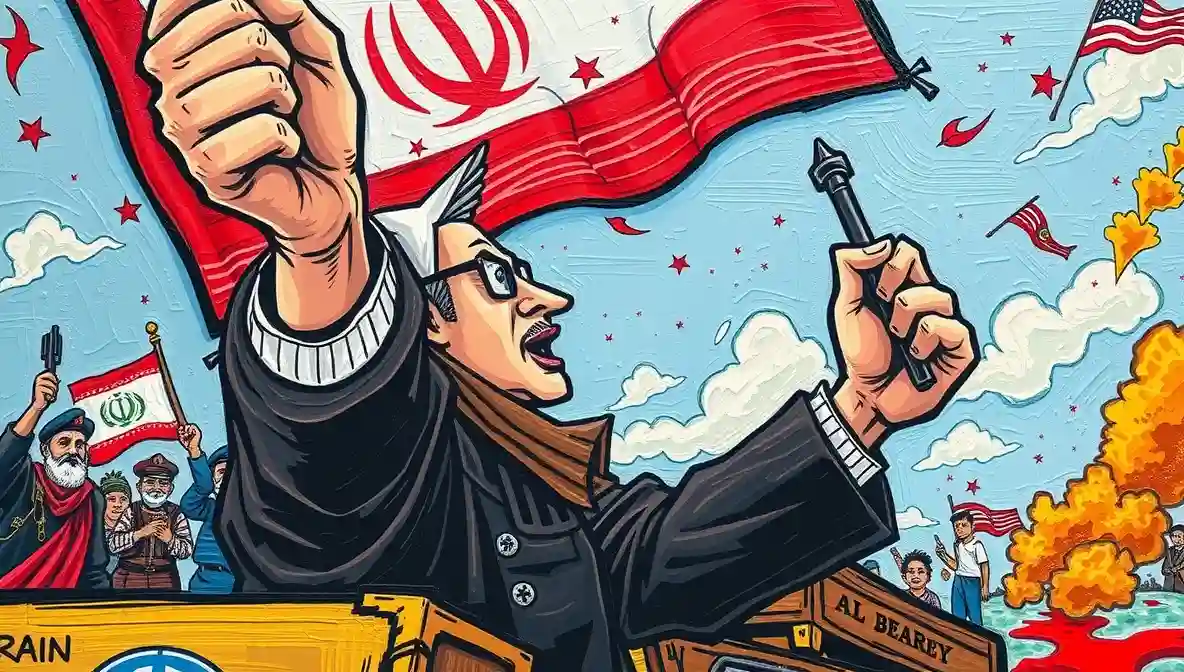
NPR Discovers War Is Complicated, Immediately Suspected of Rooting for Iran
“Killing Bad Guys, who want to use nuclear weapons, might come back to haunt Israel.” – NPR
Somewhere deep inside a softly lit newsroom, between a tote bag and a whisper, a producer gently asked: “What if… killing all the bad guys… creates more bad guys?” And just like that, America’s most soothing voice accidentally stepped on a geopolitical landmine.
Welcome to the 2026 Iran war, where bombs are loud, headlines are louder, and analysis somehow sounds like it’s narrated by a yoga instructor who just discovered unintended consequences.
The War So Far: Explosions, Strategy, and Vibes
The current conflict kicked off with the U.S. and Israel launching large-scale strikes on Iran in early 2026, targeting military sites, nuclear facilities, and leadership figures. Thousands of targets have been hit. Senior leaders eliminated. Infrastructure damaged. And yet… Iran is still very much in the game.
In fact, as the war enters its fourth week, despite heavy losses, Iran has doubled down — retaliating across the region, hitting energy infrastructure, and threatening global oil supply. U.S. Central Command reported striking over 8,000 Iranian targets, and somehow the thermostat in Tehran is still set to “existential defiance.”
Translation: America brought a flamethrower to a chess match, and Iran flipped the board and lit the table on fire.
Meanwhile, policy expert Karim Sadjadpour told NPR that what began as a “war of choice” has morphed into a “war of necessity” — because Iran did exactly what Iran told everyone it would do. Trump, to his credit, said this “took him by surprise.” Which is a little like being surprised that punching a beehive results in bees.
NPR’s Crime: Noticing History Exists
Now here’s where NPR enters like a substitute teacher with a PhD in “Well Actually.”
Their basic argument, echoed by analysts across outlets, is this:
- Killing leaders doesn’t always end movements
- It can sometimes radicalize successors
- It doesn’t fix underlying grievances
Experts warn that “decapitation strategies” — the military term for eliminating top leadership, not a suggestion for the NPR comment section — often fail long-term and can even backfire by making regimes more extreme.
In other words, you don’t solve a hornet problem by punching the hive and announcing victory.
But in today’s media ecosystem, saying “this might backfire” gets translated into: “Why does NPR love hornets?”
The New Rule: If You Don’t Clap, You’re Cheering for the Enemy
We’ve entered a fascinating era where analysis must come with applause or it’s considered treason-adjacent.
An anonymous Pentagon staffer reportedly said: “We prefer coverage that includes explosions followed by immediate emotional validation.”
Meanwhile, a fictional media watchdog group, Americans for Aggressive Agreement, released a poll showing:
- 62% believe questioning strategy is “basically rooting for Iran”
- 21% think nuance is “European”
- 17% asked if NPR stands for “Not Pro-Revenge”
Notably, an actual NPR/PBS/Marist poll found that only 36% of Americans approve of Trump’s handling of the war, while 56% oppose it. This suggests that a majority of the country is, technically, in agreement with NPR — which is either reassuring or deeply confusing, depending on your tote bag situation.
Killing Your Way to Stability: The IKEA Approach to Foreign Policy
The current strategy, according to critics, has a familiar problem: it removes leaders without assembling what comes next.
History offers examples:
- Iraq: leadership removed → chaos buffet
- Libya: leadership removed → surprise sequel nobody ordered
- Militant groups: leaders removed → new leaders, same problems
Experts warn Iran’s system is deeply institutional, meaning replacements come pre-installed and often more extreme. Israel has reportedly killed multiple senior Iranian officials — including the Intelligence Minister and the head of the Supreme National Security Council — and Iran has replaced them faster than a Subway manager on a Friday night rush. Even Tulsi Gabbard admitted before the Senate Intelligence Committee that “the regime in Iran appears to be intact.”
It’s like uninstalling one app and discovering it was just the homepage icon.
And as the UN’s nuclear watchdog chief told NPR, even after the heaviest bombing of Iran’s nuclear facilities, the country retains enrichment capabilities scattered across universities, labs, and facilities. In other words: you can bomb the filing cabinet, but the spreadsheet is still in the cloud.
Meanwhile, Iran Plays the Uno Reverse Card
While the U.S. demonstrates overwhelming military force, Iran has leaned into asymmetric tactics:
- Disrupting global oil through the Strait of Hormuz
- Launching drone and missile attacks on Gulf energy infrastructure
- Expanding cyber warfare
- Attempting to strike the joint U.S.-U.K. base at Diego Garcia — from 2,500 miles away
Result: global energy markets wobble, prices spike 45%, crude tops $110 a barrel, and suddenly your gas bill is part of foreign policy. The International Energy Agency is now begging people to work from home and slow down on the highway — a sentence that would have gotten you laughed out of a think tank in 2023.
A senior energy analyst described it as: “They can’t win the fight, so they’re setting the thermostat to ‘economic panic.'”
The Trump administration’s response? Temporarily lifting sanctions on Iranian oil. That’s right — the U.S. is now easing pressure on the country it’s actively bombing. This is what foreign policy experts call “complicated,” and what the rest of us call a Tuesday.
Civilian Casualties: The Part Everyone Mentions Quietly
Even precision wars have… imprecision.
One strike reportedly hit a school, killing civilians, including children. Now, here’s the uncomfortable truth NPR keeps pointing at like a polite librarian tapping a sign:
These moments don’t just cause tragedy. They create narratives. They create anger. They create recruitment posters.
Which is exactly why analysts say: yes, killing “bad guys” can sometimes create more of them. This is not a pro-Iran take. This is forty years of counterterrorism research wrapped in a tote bag and gently handed to you with a complimentary NPR mug.
The Media Battlefield: Facts vs. Feelings
Modern war has two fronts: the physical battlefield and the narrative battlefield. NPR is fighting the second one with facts and context. Everyone else is fighting it with caps lock, vibes, and the phrase “you’re either with us or against us.”
A fictional cable host summarized it best: “If you explain a problem, you are the problem.”
Meanwhile, the Trump administration’s own messaging on why we went to war has been, diplomatically, all over the map — nuclear threat, proxy groups, Iranian protesters, Israel dragging us in, preemptive necessity, and regime change, depending on which press conference you caught. The strategy has been described as “laser focused” while simultaneously pivoting every 48 hours. Laser focused, apparently, on a very large moving target.
So… Are They Cheering for Iran?
No. That’s the punchline.
They’re doing something far more dangerous in 2026: they’re explaining that war is messy, outcomes are uncertain, and strategy matters.
Which, in today’s climate, sounds suspiciously like treason wrapped in a tote bag.
Final Thought: The Real Backfire
Here’s the twist no one likes: the “backfire” NPR is talking about isn’t just military. It’s political. It’s economic. It’s generational.
You can win every strike and still lose the story.
And in modern warfare — where oil spills are choking the Persian Gulf, desalination plants are under threat, and roughly 100 million people in the region depend on desalinated water — the story sticks around a lot longer than the smoke.
And somewhere in a softly lit newsroom, a producer is quietly updating their Wikipedia page under “controversial for explaining things.”
This satirical article was produced through a highly disciplined intellectual collaboration between the world’s oldest tenured professor and a philosophy major turned dairy farmer, both of whom agree on one thing: war is serious, analysis is not cheering, and anyone who confuses the two probably also thinks yelling at the weather makes it rain less.
Auf Wiedersehen, amigo!
In early 2026, the United States and Israel launched a large-scale military campaign against Iran, targeting nuclear facilities, military sites, and senior leadership figures in what the Trump administration described as a preemptive necessity. Iran retaliated by effectively closing the Strait of Hormuz — the waterway through which roughly 20% of the world’s oil passes — triggering a global energy crisis and driving crude oil prices above $110 per barrel. NPR, in covering the conflict, repeatedly aired expert analysis warning that “decapitation strategies” — eliminating enemy leadership — can backfire by radicalizing successors and failing to address structural grievances. This earned NPR criticism from pro-war commentators who accused the network of sympathizing with Iran. A new NPR/PBS/Marist poll found 56% of Americans oppose U.S. involvement in the war, while Trump’s approval rating on the conflict stands at just 36%. Iran’s new Supreme Leader, Mojtaba Khamenei, has continued directing the conflict despite the deaths of multiple senior officials, and U.S. intelligence chiefs have confirmed before the Senate that the Iranian government remains “intact but degraded.”