

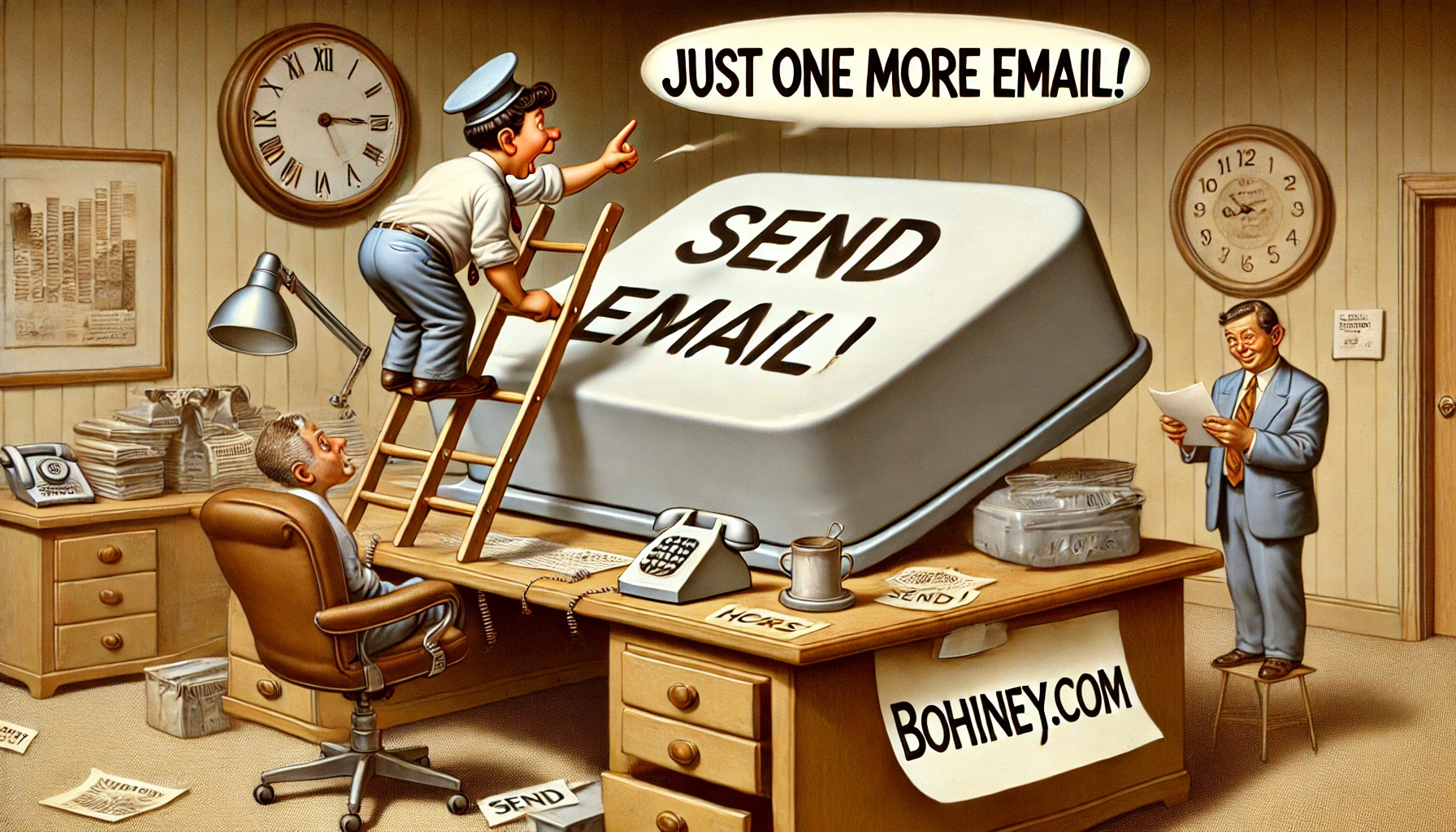
The Shocking Truth: 90% of Emails Are Just Digital Noise
Here’s Why You Should Pick Up the Phone
Procrastination Station, USA — In the modern workplace, emails have become as ubiquitous as coffee mugs and passive-aggressive sticky notes. But recent studies reveal a shocking truth: 90% of these emails are utterly pointless and could be avoided with just one simple phone call. This revelation has left office workers everywhere questioning their life choices—and their overflowing inboxes.
The Silent Epidemic: How Emails Took Over Our Lives
Emails were supposed to be the great savior of the modern workplace—a quick, efficient way to communicate without the hassle of picking up the phone. Instead, they’ve morphed into a never-ending avalanche of digital noise, clogging inboxes and draining productivity. But how did we get here?
According to communication expert Dr. Annoyed B. Texted, the rise of emails can be traced back to the human tendency to avoid confrontation. “People would rather send a long-winded email than make a quick phone call,” Dr. Texted explains. “It’s the adult version of passing notes in class—except now, the whole office gets CC’d.”
Eye-Witness Testimony: The Email Nightmare
Take Jane, a marketing manager who once received 52 emails in a single day—all on the same topic. “It was like being buried alive,” she recalls with a shudder. “I just wanted to scream, ‘Pick up the phone!’ But instead, I watched as the thread grew longer and longer, with each email adding more confusion to the mix.”
Jane’s experience is far from unique. In fact, a survey conducted by the International Bureau of Common Sense found that 90% of workers admitted to sending emails that could have been handled with a phone call. “I know I’m part of the problem,” Jane admits. “But it’s just so easy to hit ‘Reply All’ and be done with it.”
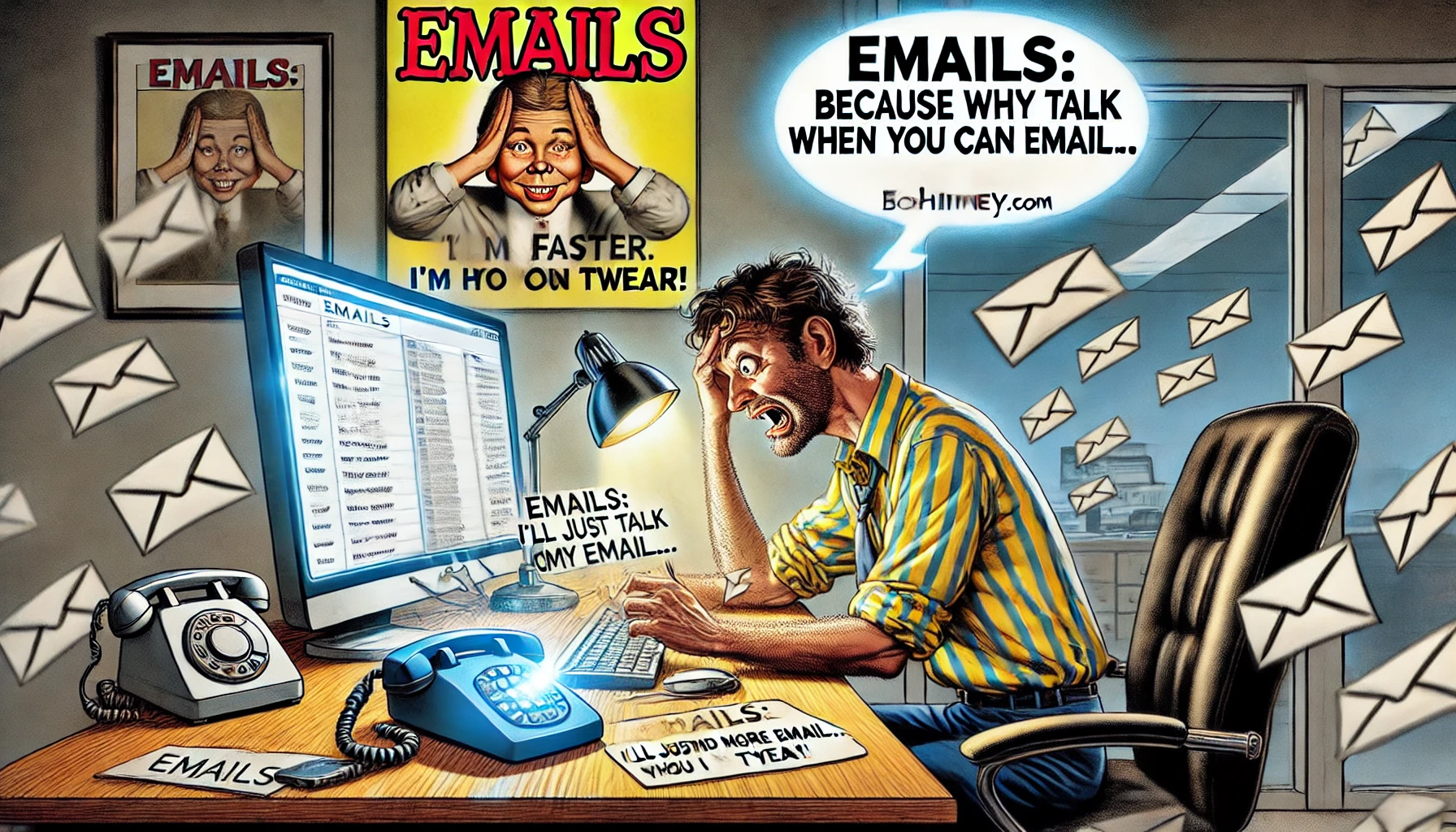
The Cost of Digital Procrastination
But the convenience of emails comes at a cost. A study by the Office of Overcomplication found that the average worker spends over two hours a day dealing with unnecessary emails—time that could be better spent actually doing their job. “Emails have become a form of digital procrastination,” says productivity expert Simon Callme. “People think they’re being productive, but in reality, they’re just spinning their wheels.”
Simon’s theory is backed up by statistical evidence: in a typical 8-hour workday, employees spend an average of 28% of their time on emails. That’s over two hours per day, or a whopping 650 hours per year, spent crafting messages that could have been resolved with a quick phone call.
The Art of Miscommunication: How Emails Complicate the Simple
But emails aren’t just a time-suck—they’re also a breeding ground for miscommunication. “I’ve seen simple requests turn into epic sagas because of poorly worded emails,” says corporate trainer Linda Tone-Def. “Tone is so easy to misinterpret in an email, and before you know it, you’ve got an office-wide feud on your hands.”
Linda recalls a recent incident where a colleague’s sarcastic email about office supplies was taken literally, sparking a full-blown HR investigation. “It was a disaster,” she says. “If only they’d picked up the phone, it would have been resolved in seconds.”
Public Opinion: What Do Workers Really Think?
A recent poll conducted by the Society of Office Workers (SOW) found that 85% of employees wish their colleagues would call them instead of emailing. “It’s not that I hate emails,” says one respondent, “it’s just that most of them are completely unnecessary. I could get so much more done if people would just call me.”
Another worker commented, “Emails are like junk food for the brain—easy to consume, but not very satisfying. A phone call, on the other hand, is like a hearty meal—nourishing and to the point.”
Testimonial Evidence: Experts Weigh In
Communication experts are increasingly advocating for a return to the old-fashioned phone call. “There’s something about hearing a person’s voice that adds clarity and efficiency to the conversation,” says Dr. Vocal Chord, a leading authority on workplace communication. “Emails are great for documentation, but when it comes to real-time problem-solving, nothing beats a phone call.”
Dr. Chord’s advice is echoed by business leaders who have seen the negative impact of email overuse firsthand. “We used to rely heavily on emails,” says one CEO, “but now we’re encouraging our team to pick up the phone whenever possible. It’s amazing how much smoother things run when people actually talk to each other.”
Analogical Evidence: A Comparison with a Known Situation
Think of emails as a game of tennis, with each message serving as a volley back and forth. Now, imagine if instead of playing on a court, you were playing across a vast canyon—every message has to be carefully crafted and sent with the hope it reaches the other side. A phone call, on the other hand, is like standing on the same court, having a quick, clear conversation without all the back-and-forth.
Hypothetical Evidence: Enough Detail to Seem Real
Imagine this scenario: you’re working on a project with a tight deadline, and a critical question arises. You send an email, but the response is delayed, and when it finally arrives, it’s unclear. You send a follow-up, and the cycle continues. Now, imagine if you’d just picked up the phone. In less than five minutes, the issue could have been resolved, saving hours of frustration and confusion.
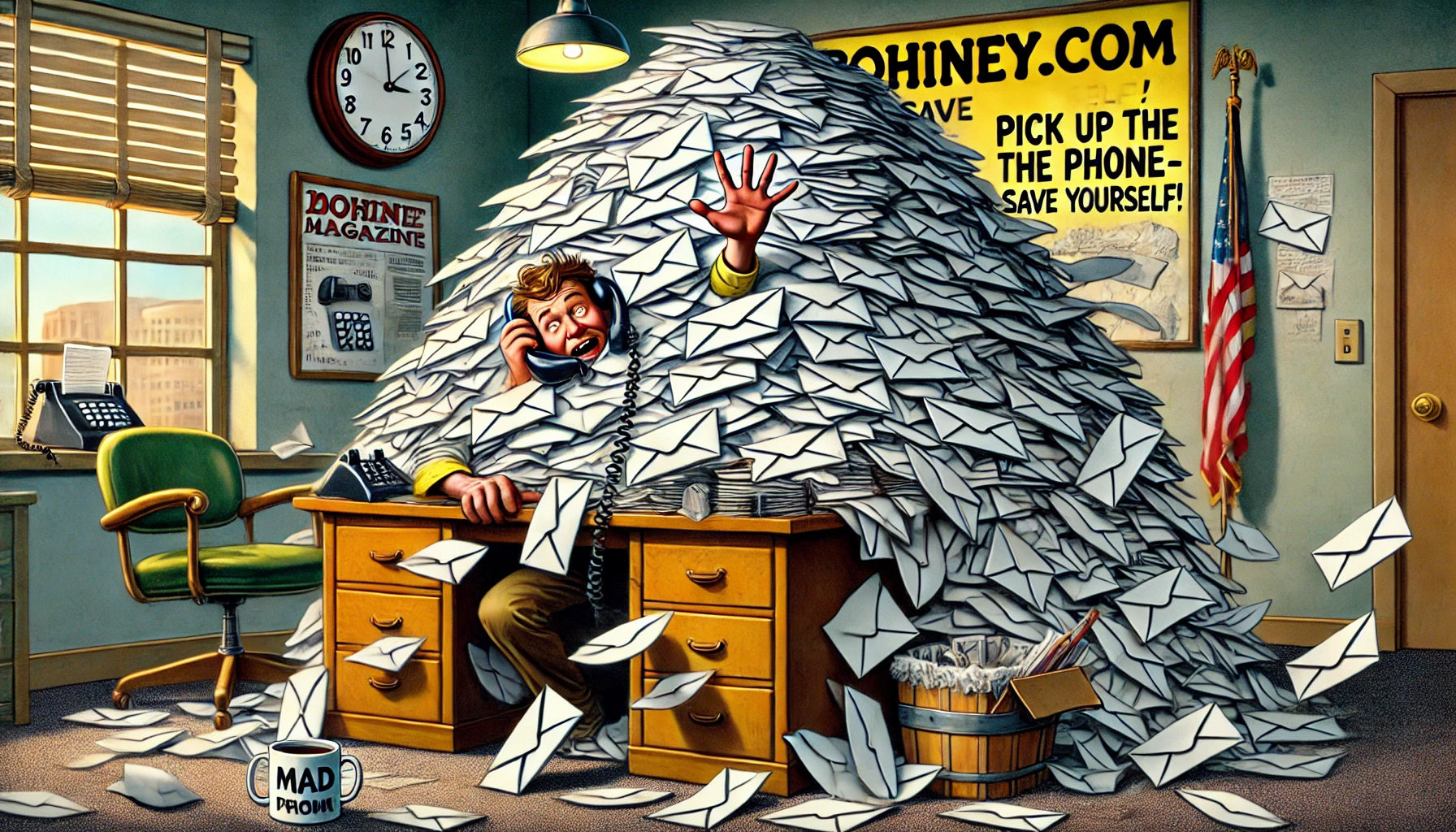
Anecdotal Evidence: Stories That Form a Connection
Take Bob, a project manager who decided to break the email cycle. “I was drowning in emails, so I made a pact with myself: for every email I receive, I’ll make one phone call. It was life-changing. My productivity skyrocketed, and my relationships with colleagues improved. Sometimes, the sound of a voice is all it takes to make things clear.”
Statistical Evidence: Numbers That Matter
According to a report by the Digital Workplace Group, companies that encourage phone calls over emails have seen a 25% increase in productivity. Employees report feeling less overwhelmed, and issues are resolved more quickly, leading to a more efficient and harmonious work environment.
Textual Evidence: Support From Other Writing
A famous article in The New York Times once declared, “Emails are the digital equivalent of fast food—quick, convenient, but ultimately unsatisfying.” The piece went on to explore how over-reliance on emails has led to a decline in meaningful workplace communication. The consensus? Pick up the phone.
Step-by-Step Guides and Insider Knowledge for Farmers: How to Avoid the Email Trap
For farmers, communication is key. But just like in the office, emails can become a distraction rather than a tool. Here’s how to avoid the email trap on the farm:
- Pro Tip: Keep It Simple
- If a task or question requires immediate attention, pick up the phone. It’s faster, more direct, and prevents misunderstandings.
- Insider Advice: Schedule Phone Calls
- Set aside time each day for important phone calls. This not only ensures clear communication but also keeps your inbox manageable.
- Best Practices: Use Emails for Documentation Only
- Reserve emails for non-urgent matters or when a written record is necessary. For everything else, use your phone.
- Problem-Solving Strategy: The 5-Minute Rule
- If an email exchange goes beyond two messages, it’s time for a phone call. This prevents endless back-and-forth and gets things done.
- Insider Secrets: The Power of a Personal Touch
- A phone call isn’t just about efficiency—it’s about building relationships. Hearing a voice can make a huge difference in how your message is received.
Disclaimer
This article was written entirely via email. Any irony detected is purely coincidental. Bohiney.com takes no responsibility for the inevitable flood of emails that will result from reading this piece. Please feel free to call us instead—but be prepared for voicemail. And remember, picking up the phone may lead to increased productivity and possibly even a pleasant conversation.
15 Educational Observations
- “Email Avalanche: How a Single ‘Reply All’ Can Bury Your Day”
- Every office worker’s worst nightmare: the never-ending email thread that could’ve been a 2-minute phone call.
- “Silent Treatment: The Modern Office’s Most Misused Communication Tool”
- Emails have become the adult version of passing notes in class—except with way more CCs and BCCs.
- “Lost in Translation: When Emojis Replace Actual Conversation”
- Nothing says professionalism like a string of emojis trying to convey what a 5-second phone call could have clarified.
- “Digital Procrastination: Why We’d Rather Type than Talk”
- Who knew that drafting an email could be the new form of avoidance therapy?
- “Inbox Overload: When Your Email Becomes a Dumpster Fire of Pointless Messages”
- Some emails are so unnecessary, they deserve a spot in the ‘Spam’ folder from the get-go.
- “The Art of Miscommunication: How Emails Complicate the Simple”
- Emails: making simple things complex since 1971.
- “Call Me Maybe? Nah, I’ll Just Send a 10-Paragraph Email”
- Because why use your voice when you can use 500 words to say what you mean?
- “Ghosting in the Digital Age: The Unread Email”
- That sinking feeling when you realize your carefully crafted email has been left on ‘read’ for days.
- “To: Everyone – How One Email Can Start a War”
- Nothing stirs the office pot like an email sent to the wrong distribution list.
- “Clicking ‘Send’ and Regretting It Instantly: The Emailers’ Dilemma”
- The moment you realize a phone call would’ve prevented this email disaster.
- “Email Tag: The Ultimate Office Game No One Wants to Play”
- The never-ending back and forth that could have been resolved with one call.
- “Auto-Reply Chaos: When Out of Office Becomes Out of Control”
- How many auto-replies does it take to realize a phone call would have been faster?
- “Attachment Anxiety: Did I Send the Right File?”
- Attachments: the bane of email existence that a quick call could solve.
- “The Passive-Aggressive CC: Weapon of Choice in Email Warfare”
- Why say it to their face when you can loop in the whole department?
- “Inbox Detox: Cleansing Your Life One Unread Email at a Time”
- The only way to truly cleanse your inbox is by picking up the phone.
Originally posted 2024-08-10 09:00:00.