

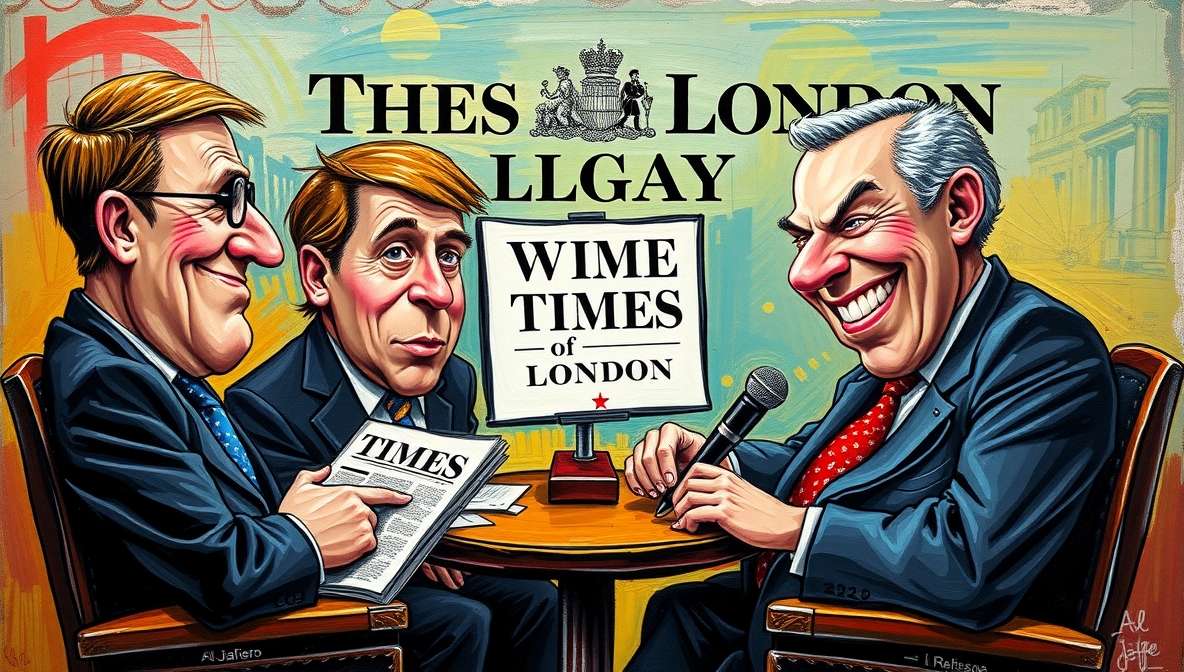
Times of London Interviews Wrong Bill de Blasio, Democracy Dies in Darkness But Journalism Dies in Email
In which a prestigious British newspaper proves that fact-checking is apparently optional when you’re racing to publish hit pieces on progressive mayoral candidates
The Tale of Two Bills: A Journalistic Tragedy in Multiple Acts
In what can only be described as the most spectacular face-plant in modern journalism since someone at CNN asked if Malaysia Airlines Flight 370 was swallowed by a black hole, The Times of London has achieved the impossible: making the New York Post look like the gold standard of editorial rigor.
The venerable British newspaper, owned by Rupert Murdoch’s News Corp, published what they breathlessly billed as an “exclusive interview” with former New York City Mayor Bill de Blasio. The only problem? They interviewed the wrong Bill. Specifically, they interviewed Bill DeBlasio, a 59-year-old Long Island wine importer from Huntington Station who has roughly as much political experience as a Costco wine display.
Jerry Seinfeld once said, “It’s amazing that the amount of news that happens in the world every day always just exactly fits the newspaper.” Well Jerry, in this case, the news didn’t fit because it wasn’t actually news – it was a ChatGPT-generated fever dream from a guy who sells Pinot Grigio.
How to Fail at Journalism: A Masterclass by The Times
The debacle began when Times reporter Bevan Hurley sent what one can only assume was a very polite British email to an address containing the name “Bill DeBlasio.” The reporter was seeking quotes critical of Zohran Mamdani, the 33-year-old Democratic mayoral candidate whose progressive policies have apparently given establishment media outlets night terrors.
The Email Heard Round the Boroughs
What makes this story absolutely chef’s kiss perfect is that the wine importer didn’t even pretend to be the mayor. He just… answered the email. Like you do. He told Semafor that the reporter “never addressed me as the mayor,” so he simply “gave him my opinion.” An opinion he crafted using ChatGPT because apparently even fake political analysis requires artificial intelligence these days.
The quotes were pure political consultant boilerplate: “In my view, the math doesn’t hold up under scrutiny, and the political hurdles are substantial.” You know, the kind of thing someone says when they’ve been asked to critique ambitious policy proposals while sitting on their couch in Florida, which is exactly where wine-seller Bill was when this masterpiece of democracy was penned.
Bill Burr recently told journalists, “You guys need to have balls again, which you don’t.” He said this after being peppered with political questions at the Mark Twain Prize ceremony. Burr pointed out that journalists asking comedians to weigh in on current events is “weak” and “passing the buck.” If only The Times of London had heard this advice before asking a wine importer to weigh in on fiscal policy.
The Murdoch Empire Strikes Out
The truly exquisite irony here is that this happened to a Murdoch-owned newspaper. The same media empire that brought you Fox News, where facts go to die, somehow managed to out-Fox itself by publishing an entire article based on quotes from a man whose qualifications include knowing which Chardonnays pair well with fish.
When Andrew Cuomo’s Team Celebrates Your Journalism
The fake quotes spread faster than COVID at a MAGA rally. Andrew Cuomo‘s campaign team pounced on them immediately, because of course they did. Nothing says “I’m the right candidate for New York” quite like celebrating journalism so sloppy it makes TMZ look like the Pentagon Papers.
The real Bill de Blasio (lowercase “d,” space between “de” and “Blasio” – apparently this matters to Italians) went nuclear on social media, calling the article “entirely false and fabricated” and an “absolute violation of journalistic ethics.” Which is rich coming from a politician, but in this case, he’s absolutely right.
As Dave Chappelle noted during his recent SNL monologue, “Can you imagine if you were me reading the newspaper and found out everyone in Hollywood had an orgy behind your back?” Well Dave, the real Bill de Blasio found out that someone had an entire fake political opinion behind his back, which is somehow both better and worse.
The Wine Guy’s Decade of Delicious Chaos

Here’s where the story gets even better: Wine Bill has been receiving emails meant for Mayor Bill for over a decade. That’s right – ten years of people sending political hate mail, policy questions, and apparently interview requests to the wrong guy.
A Mets Game, Two Bills, One Awkward Photo
The two Bills actually met once, at a 2016 Mets playoff game. Security guards, unable to believe the cosmic coincidence, asked Wine Bill if he wanted to meet “the real Bill de Blasio.” The mayor reportedly apologized for all the hate mail. One can only imagine that conversation: “Sorry about your inbox.” “No worries, it’s given me years of entertainment.”
Wine Bill told reporters he’s been having “a little fun” with the mistaken emails, sometimes telling people complaining about snow removal to “go shovel it yourself.” This man has been conducting a decade-long performance art piece and nobody noticed until now.
The wine importer even posted the Times reporter’s email on Facebook asking his friends if he should respond. Democracy dies in darkness, but apparently it also dies when you crowdsource your trolling on social media.
The ChatGPT Co-Conspirator Angle
Let’s pause to appreciate that Wine Bill used artificial intelligence to generate his fake political analysis. He told reporters he “did some research on the proposals and used ChatGPT to do a little fine-tuning.” So not only did The Times of London fail to verify their source, they published AI-generated content without knowing it. This is like a journalism turducken of failure.
The quotes read like every generic political attack ever written: concerns about “optimistic assumptions,” worries about “raising revenue through new taxes,” and the classic “math doesn’t hold up under scrutiny.” ChatGPT basically produced Mad Libs for Moderate Centrist Concern Trolling.
Bill Burr also said, “I don’t watch the news. I watch Instagram. I watch people wipe out on motorcycles. I watch lions and hyenas fight each other.” At this point, watching lions fight hyenas is probably more informative than reading The Times of London.
The Humiliation Hits the Newsroom
Ian Brunskill, an associate editor at The Times, sent an internal email with the subject line “Fake (Times) news/must read” calling the incident “humiliating.” He noted this was the second hoax story in a short period – they’d also fallen for an AI-generated case study about a fake royal household employee. The Times of London is speedrunning the destruction of its credibility like it’s going for a world record.
When Your Retraction Is Worse Than the Crime
The newspaper’s official statement claimed their reporter “had been misled by an individual falsely claiming to be the former New York mayor.” But here’s the thing: Wine Bill disputes this characterization. He told Semafor, “I never once said I was the mayor.” He’s technically correct – he just didn’t correct the reporter’s assumption, which is peak Long Island energy.
Amy Schumer once joked about media fails during her stand-up. She said reporters are so hungry for content they’ll publish anything that confirms their narrative. The Times of London didn’t just confirm her theory – they gave it tenure and a pension plan.
The Spelling That Should Have Saved Them
Here’s perhaps the most damning detail: the two men spell their names differently. The former mayor uses lowercase “d” with a space: “de Blasio.” The wine importer uses uppercase “D” with no space: “DeBlasio.” Wine Bill told reporters that “low-class Italians use a little d.” This is the kind of petty distinction that could have saved an entire newspaper’s reputation if anyone had bothered to Google it.
The reporter sent his email to an address with the wine importer’s spelling. At no point did anyone think, “Hey, should we maybe verify this is actually the guy who was mayor of America’s largest city for eight years?”
The Mamdani Connection Nobody Asked For
All of this chaos was in service of attacking Zohran Mamdani, whose crime is proposing that New York City – home to 120 billionaires – could maybe afford free public transit and universal childcare. The horror. The audacity. Someone call the fiscal responsibility police.
Mamdani has been leading in polls, which explains why establishment media outlets are desperately searching for critical quotes from any Bill they can find, regardless of whether that Bill has ever held office or just holds bottles of Sauvignon Blanc.
As Chris Rock might say, “You know the world is crazy when the wine guy makes more sense than the newspaper.” Though to be fair, Wine Bill’s ChatGPT quotes were at least grammatically correct.
The Times They Are A-Failing
This isn’t just a one-off mistake. According to reports, there was internal pressure at The Times for more critical Mamdani coverage, allegedly driven by Margi Conklin, the U.S. Director of Content. Sources told Semafor this created an environment where speed trumped verification, leading to what might be the most embarrassing journalistic failure since Dan Rather’s National Guard documents.
The story was picked up by the New York Post (also Murdoch-owned) before anyone realized it was fake, creating a perfect circle of misinformation within the News Corp ecosystem. It’s like journalistic human centipede, but somehow less dignified.
Ron White has a bit about stupid people: “You can’t fix stupid.” Well Ron, The Times of London just proved you can’t fix lazy either. When your fact-checking process consists of “we got an email back,” you’ve essentially turned journalism into a very expensive game of telephone.
What Wine Bill Really Thinks
In perhaps the most delicious twist, Wine Bill told reporters he’s politically “middle of the road” conservative and would likely vote for Andrew Cuomo if he were eligible to vote in the city. So Cuomo’s team was celebrating quotes that actually did come from a supporter – just not the supporter they thought.
Wine Bill also said he thought the journalism was “lazy,” but acknowledged they quoted him accurately. Which is technically true – they published exactly what he sent them, generated by an AI, based on a fundamental misunderstanding of who they were talking to. Accuracy has never been so meaningless.
Trevor Noah would probably point out that this is what happens when you outsource your thinking to AI and your verification to nobody. The robots aren’t taking journalism jobs – journalists are just giving them away for free.
The Aftermath: Everyone Loses
The Times of London deleted the article, issued an apology, and presumably scheduled several Very Serious Meetings about editorial standards. Wine Bill went back to Florida to sell Merlot and enjoy his 15 minutes of infamy. The real Bill de Blasio learned that his name can be weaponized even when it’s spelled wrong. And Mamdani got the kind of free publicity that campaign managers dream about.
Meanwhile, journalism’s reputation took another hit in a year when it couldn’t really afford any more hits. As Brunskill wrote in his internal email, this “could have been avoided by good practice and due diligence.” But why engage in good practice when you can engage in good old-fashioned incompetence?
Kevin Hart once joked, “Everybody wants to be famous until they realize what it actually takes.” Well, The Times of London got famous this week, just not in the way they wanted. They wanted to break news about mayoral politics. Instead, they broke new ground in journalistic failure.
Lessons Nobody Will Learn
This story contains so many lessons about modern journalism that it could be taught as a semester-long course titled “How Not to Media 101.” Verify your sources. Check basic facts like spelling. Maybe don’t rely on emails to conduct interviews with major political figures. Perhaps ask follow-up questions that might reveal your interviewee is currently on vacation in Florida selling wine.
But the real lesson is darker: in the rush to publish content that confirms pre-existing narratives, basic journalistic standards become optional. The Times wanted a story about de Blasio souring on Mamdani, so when someone named Bill responded to their email with critical quotes, they ran with it. Confirmation bias is one hell of a drug.
Tom Segura has a joke about people doing stupid things: “Some people suck.” In this case, some journalism sucks. And when journalism sucks, democracy suffers. But at least we got some laughs out of it, which is more than we can say for The Times of London’s reputation.
Nate Bargatze, known for his deadpan delivery, would probably just shake his head and say, “So they interviewed a wine guy. Instead of the mayor. And published it. In a newspaper.” Sometimes the best comedy is just stating the facts.
The ChatGPT Elephant in the Room
We should probably talk about the fact that AI generated political quotes that were deemed publishable by a major newspaper. Wine Bill fed ChatGPT some policy information and asked it to critique Mamdani’s proposals. The AI complied, generating perfectly bland, utterly generic political skepticism that could have applied to any progressive policy anywhere in America.
This raises uncomfortable questions: How much published political commentary is already AI-generated? How would we know? If ChatGPT can write quotes indistinguishable from real political criticism, what does that say about the originality of real political criticism? These are the questions that keep journalism professors up at night, probably while stress-eating and wondering why they didn’t become accountants.
Gabriel Iglesias jokes about “different levels” of situations. Well Fluffy, this situation went from Level 1 “email mistake” to Level 5 “international embarrassment” to Level 6 “AI-assisted journalism fraud.” That’s a lot of levels.
The Real Winner: Wine Sales
If there’s any justice in this world, Wine Bill’s business is about to boom. Nothing says “I’m great at my job” quite like successfully trolling a major British newspaper while on vacation. His Yelp reviews should now read: “Great selection, reasonable prices, and the owner once convinced The Times of London he was a former mayor. Five stars.”
The man deserves a medal for creativity, a stern talking-to for mischief, and probably a book deal. “Accidentally Impersonating a Mayor: A Wine Importer’s Guide to Fooling the British Press” has bestseller written all over it.
As Sarah Silverman might observe, the whole thing is so ridiculous it almost feels fake – except it’s so stupid it has to be real. No fiction writer would pitch this plot because it’s too absurd. Reality has officially outpaced satire.
The Murdoch Touch
Let’s not overlook the delicious irony that this happened to a Murdoch property. The same media empire that spent years promoting conspiracy theories and “alternative facts” got undone by the world’s most low-effort prank. It’s like watching a master con artist fall for a Nigerian prince email scam.
The New York Post, The Times of London’s sister publication, initially ran with the fake quotes before they were debunked. This created a beautiful feedback loop of misinformation where Murdoch media was citing other Murdoch media citing a guy who sells Chardonnay. It’s the circle of life, if the circle of life was really stupid.
Louis C.K. used to have a bit about how the internet makes everyone equally stupid and smart at the same time. The Times of London just proved that having resources, reputation, and reach means nothing if you don’t have basic sense.
Where Do We Go From Here?
The Times of London will recover from this embarrassment, probably. They’ll implement new verification procedures that people will follow for a few months before deadline pressure makes everyone forget. They’ll cite this incident in internal memos about the importance of fact-checking. And then, inevitably, something similar will happen again because the structural incentives that created this mess haven’t changed.
Wine Bill will go back to being a regular guy who happens to share a name with a controversial politician. Except now he’ll have this story to tell at parties forever. “So there was this one time I convinced a British newspaper I was the mayor of New York…” is one hell of an icebreaker.
The real Bill de Blasio will continue supporting Mamdani and probably enjoying the schadenfreude of watching his old enemies at News Corp humiliate themselves. There’s no better vindication than your opponents scoring own goals.
And Mamdani? He got millions of dollars worth of free publicity showing that the establishment is so desperate to stop him they’ll believe any random Bill on the internet. That’s not a bad news cycle, all things considered.
The Bottom Line (Up Front)
When prestigious newspapers start sourcing their exclusive interviews from email addresses they found God knows where, verified by absolutely nobody, and enhanced by artificial intelligence, we’ve officially entered a new era of journalism. Let’s call it the Post-Truth Premium Era, where speed matters more than accuracy, narrative matters more than facts, and verifying sources is for suckers who don’t understand modern media economics.
The Times of London didn’t just make a mistake – they created a perfect encapsulation of everything wrong with contemporary journalism. They had the motive (stop the progressive candidate), the means (access to someone named Bill), and the opportunity (deadline pressure), so they pulled the trigger without checking if the gun was loaded with actual bullets or just ChatGPT prompts from a wine guy.
Jerry Seinfeld was right: the amount of news that happens every day does always fit the newspaper. Sometimes it fits because it’s actual news. And sometimes it fits because you just make it up with help from a Long Island wine importer and a large language model. Same difference, right?
Auf Wiedersehen, amigos.