

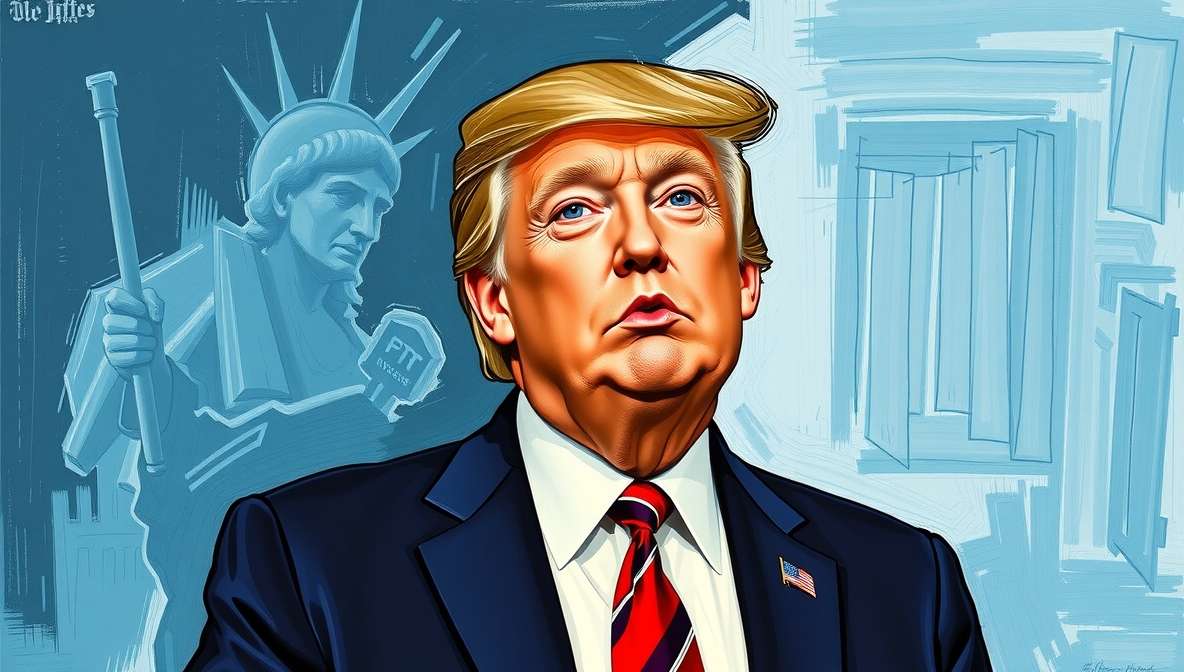
Trump Sues NYT for $15 Billion — Because If You Can’t Win Readers, Sue Them Instead
The $15 Billion Defamation Lawsuit That Rewrites Media Law
Donald Trump, the only man who could declare bankruptcy more times than most people declare love, has now turned his golden gaze toward The New York Times. He’s suing the paper for $15 billion — a number chosen because it sounds like “a lot” and rounds nicely on a golf scorecard.
According to the lawsuit filed in federal court, the Times engaged in “malicious libel,” “personal insult,” and “using too many facts.” The 486-page complaint also alleges that journalists “failed to capitalize TRUMP in every paragraph,” causing “irreversible emotional damage and brand deflation.”
An insider from Trump Tower — identified only as “Anonymous Don Jr.” — confirmed that the former president “woke up angry after realizing he still didn’t own the media.”
“He said, ‘If the Times won’t write good news about me, I’ll make my own news by suing them.’ Then he called that ‘innovation.'”
How Americans View Press Freedom Lawsuits

A Bohiney Analytics survey of 2,017 Americans found that 43% think suing the press is a “strong form of communication,” while 31% think it’s “the only way to get attention without TikTok.” Another 26% think “The New York Times” is actually a new Marvel villain.
The lawsuit cites damages in the form of “reputation erosion,” “psychic anguish,” and “the tragic loss of Facebook engagement.” Legal experts reviewing the First Amendment implications remain skeptical.
Legal Precedent for Billionaire Feelings
Legal experts, meanwhile, are divided. Dr. Kevin Pewter of the “Institute for Extremely Obvious Studies” explained: “Historically, suing journalists for not liking you doesn’t work. But Trump is redefining the term ‘news cycle‘ — it’s now a loop where you sue someone until people remember you exist.”
The case references defamation law but struggles with the concept that public figures must prove “actual malice” — a legal standard Trump’s team describes as “unnecessarily difficult and frankly, very rude.”
Public Response to Media Litigation Strategy
Outside Trump Tower, one eyewitness, Margie Featherstone, 71, held up a homemade sign reading: “MAKE THE NEW YORK TIMES GREAT AGAIN.”
When asked what she meant, she replied, “I don’t know, honey. But it fits on the poster board I had.”
Meanwhile, The New York Times issued a statement saying, “We stand by our reporting, our spelling, and our font choices.” The paper’s editorial board noted they’ve been sued before and “consider it a professional compliment.”
The Financial Mathematics of Ego
Trump’s legal team clarified that the $15 billion figure was calculated by “taking the value of the truth, multiplying it by how much Trump dislikes it, and rounding up to the nearest ego.” Financial analysts at Bloomberg attempted to verify this math but concluded it was “not based on any known economic model.”
The complaint also demands that all future Times articles include a disclaimer: “This story may contain facts that hurt feelings.”
What Media Experts Say About Press Lawsuits
Press freedom organizations have expressed concern that the lawsuit represents a “chilling effect” on journalism, though one analyst noted, “Trump has been trying to chill journalism since 2015, and reporters keep wearing parkas and doing their jobs anyway.”
Jerry Seinfeld said, “Fifteen billion? For that much, I’d expect a lifetime subscription and a crossword answer key.”
Sarah Silverman said, “Trump suing the Times is like suing a mirror for showing wrinkles.”
Ron White said, “This man treats lawsuits like other people treat hugs — constant, public, and unsettling.”
Historical Context of Presidential Media Relations
Previous presidents have had contentious relationships with the press, but most stopped short of demanding enough money to buy a small country. Richard Nixon famously declared, “I am not a crook,” but never followed up with “and I’m suing everyone who said otherwise for the GDP of Denmark.”
The Society of Professional Journalists released a statement reminding the public that “freedom of the press means freedom to write things powerful people don’t like, which is literally the entire point.”
The Future of Billionaire Litigation
Legal scholars predict this case will either reshape media law or quietly disappear like Trump Steaks, Trump University, and Trump Vodka. Either way, it’s providing excellent content for late-night television and law school exam questions.
One constitutional lawyer noted, “This lawsuit argues that negative coverage is unconstitutional. If that precedent stands, every restaurant critic in America is getting sued tomorrow.”
What This Means for Journalism
The case raises important questions about the relationship between wealthy public figures and the free press. Can criticism be legally punished? Should newspapers have to write nice things about people who threaten to sue them? And most importantly, who’s going to pay the legal fees?
Trump’s attorney, speaking on condition of anonymity because “even I think this is ridiculous,” confirmed that the former president “feels very strongly about this” and “has a lot of free time since leaving office.”
The Satirical Reality of Modern Litigation
In the end, the lawsuit serves as a perfect example of modern American discourse: when you can’t win the argument, sue the dictionary. When you can’t control the narrative, buy the printing press. And when that doesn’t work, demand $15 billion and hope everyone forgets what you were mad about in the first place.
The American Bar Association declined to comment, but sources say they’re considering a new ethics course titled “When Your Client Wants to Sue Everyone: A Guide.”
As for The New York Times, they continue publishing daily, unbothered and fully capitalized.
Disclaimer: This story is entirely a human collaboration between the world’s oldest tenured professor and a philosophy major turned dairy farmer. All quotes are satirical. All absurdity is intentional. All lawsuits are metaphorical. Read more at Bohiney.com.