

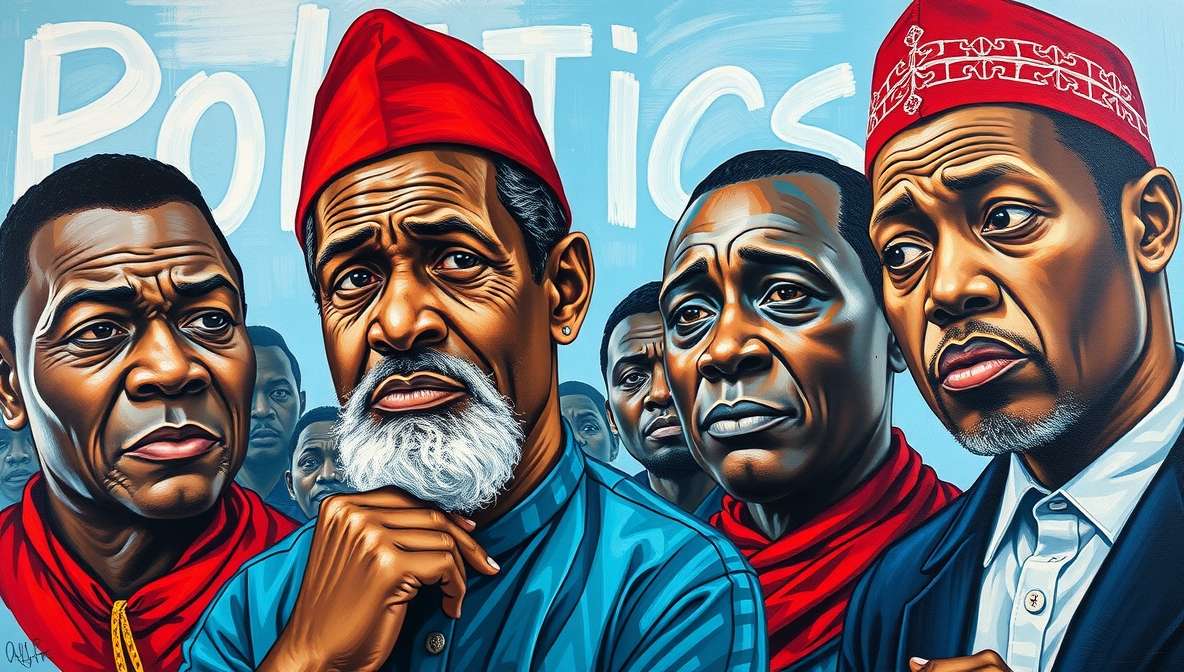
Trump’s Nigeria Crisis: Military Threats, Celebrity Endorsements, and the Jollof Rice of Global Confusion
In a move that left diplomats reaching for antacids and fact-checkers working overtime, President Donald Trump has declared that Nigeria faces an “existential crisis” requiring immediate US military intervention to protect Christians. The announcement, delivered through a combination of Truth Social posts and cable news interviews, promised interventions that would be “fast, vicious, and sweet” — a description that could apply equally to cupcakes or napalm.
Comedian Bill Burr weighed in on his podcast, saying, “So we’re gonna invade a country to save Christians? That’s like breaking into someone’s house to tell them their lawn needs mowing.”
Trump’s Christian Persecution Claims in Nigeria Spark International Debate
According to multiple news outlets, Trump insisted that Nigeria’s Christians are being systematically targeted, despite the fact that Nigeria’s conflicts are primarily land disputes between farmers and herders that cross religious lines. It’s the diplomatic equivalent of blaming your neighbor’s barbecue for global warming.
Dave Chappelle addressed the issue during a recent set in New York, observing, “Trump looked at Nigeria and said ‘Christians are being persecuted.’ Meanwhile, Nigerian Christians are looking around like, ‘We’re the president, we’re half the population… who’s persecuting us, ourselves?'”
The situation on the ground is complex: according to the Council on Foreign Relations, Nigeria’s conflicts involve economic competition, climate change-driven migration, and ethnic tensions that have nothing to do with coordinated religious persecution. But why let nuance interfere with a good threat?
Military Action Threats Over Nigeria: Fast, Vicious, and Sweet Diplomacy
Trump’s description of potential military action as “fast, vicious, and sweet” raised immediate questions. One unnamed State Department official told The Washington Post, “We’re not sure if that’s a military strategy or a Yelp review for a taco truck.”
Jerry Seinfeld, during a stand-up appearance in Los Angeles, asked the audience, “What’s the deal with ‘fast, vicious, and sweet’? That’s not foreign policy, that’s how I want my Chinese food delivered.”
The reality is that Trump threatened to cut all US aid to Nigeria unless immediate steps were taken to address what he termed “cherished Christians” — a phrase that sounds less like policy and more like a description of Christmas ornaments.
Nicki Minaj Thanks Trump: Celebrity Diplomacy Enters the Chat

Adding gasoline to an already confusing fire, rapper Nicki Minaj publicly thanked Trump for “addressing the persecution of Christians in Nigeria.” The tweet accumulated 2.4 million likes within hours, proving once again that celebrity endorsements move faster than State Department fact-checks.
Kevin Hart commented on Instagram Live, “Nicki Minaj is thanking Trump for saving Nigeria. I can’t even get my friends to thank me for picking up the dinner check.”
The irony wasn’t lost on observers: while Nigeria’s actual government expressed confusion about Trump’s claims, American celebrities were treating the announcement like a movie premiere. It’s the kind of upside-down diplomacy that makes “The Twilight Zone” look like a documentary.
Nigeria’s Government Response: Confusion and Diplomatic Scrambling
Nigerian officials responded with what one diplomat described as “polite bewilderment.” President Bola Tinubu, who is himself Christian, released a statement saying Nigeria appreciates US partnership but noted that religious freedom is protected in Nigeria’s constitution.
Chris Rock, performing in Chicago, noted, “Nigeria’s president is Christian. The vice president is Muslim. They’re literally demonstrating religious tolerance while Trump threatens to bomb them for religious intolerance. That’s not irony, that’s a Möbius strip of stupid.”
The disconnect between Trump’s narrative and Nigeria’s reality is stark. Nigeria has a Christian president, Christians hold major government positions, and while there are serious security challenges in the country, they’re not based on organized religious persecution by the state.
US Aid to Nigeria: Threatening Cuts Over Mischaracterized Conflicts
Trump’s threat to suspend US aid to Nigeria unless “Christians are protected” raises practical questions. The United States provides approximately $1 billion annually in aid to Nigeria, primarily focused on health programs, economic development, and counter-terrorism efforts.
Amy Schumer, during a podcast interview, said, “So we’re going to cut aid to Nigerian hospitals and schools because Trump saw something on TV he didn’t like? That’s like refusing to pay for your kid’s braces because you’re mad at their orthodontist.”
The practical effect of cutting aid would harm the exact populations Trump claims to be protecting — a irony so thick you could serve it at Thanksgiving.
Religious Freedom in Nigeria: The Complex Reality Behind Simple Slogans
Nigeria’s religious landscape is far more complex than Trump’s narrative suggests. The country is roughly split between Christians (primarily in the south) and Muslims (primarily in the north), with significant populations of both religions living peacefully together.
Trevor Noah, who grew up in South Africa dealing with complex ethnic and religious dynamics, observed on “The Daily Show,” “Trump treating Nigeria like it’s a simple ‘Christians vs. Muslims’ situation is like explaining chess as ‘light squares vs. dark squares.’ Technically true, completely useless.”
The conflicts Trump references are primarily in Nigeria’s Middle Belt, where climate change has driven herders south into farming areas, creating economic competition that sometimes turns violent. Both Christian farmers and Muslim herders are both victims and perpetrators depending on the incident — a nuance that doesn’t fit on a Truth Social post.
Evangelical Support for Trump’s Nigeria Stance: Politics of Religious Protection
Trump’s announcement was immediately praised by American evangelical leaders, with several prominent pastors thanking him for “standing up for persecuted Christians.” Never mind that many Nigerian Christian leaders themselves expressed confusion about the characterization.
Ali Wong, during a comedy special taping, said, “American evangelicals are thanking Trump for protecting Nigerian Christians who don’t think they need protecting. That’s like me showing up at your house to save you from a burglar you never had.”
The disconnect reveals more about American domestic politics than Nigerian reality. Trump’s announcement plays well with his evangelical base, regardless of whether it accurately describes the situation on the ground.
Social Media Amplification: When Tweets Replace Diplomatic Cables
The entire controversy was amplified through social media, with #NigeriaCrisis trending alongside #ThankYouTrump and #JollofRice (because why not?). Foreign policy experts note that social media now drives diplomatic narratives faster than traditional state department channels.
Hasan Minhaj observed during a stand-up set, “We’re conducting foreign policy through Twitter now. That’s like running brain surgery through text message — theoretically possible, definitely inadvisable.”
The speed at which misinformation travels now means that even if Nigerian officials wanted to correct the narrative, they’d be competing with celebrity endorsements, memes, and the president’s own posting frequency.
International Law Questions: Can Presidents Threaten Military Action Via Social Media?
Legal scholars raised questions about whether threatening military action via Truth Social constitutes official US policy or just presidential musings. The ambiguity itself is destabilizing — allies and adversaries alike have to wonder which statements represent actual policy.
Jim Gaffigan, known for his observational humor, said during a recent performance, “So Trump threatens to invade Nigeria on social media, and we all have to figure out if he’s serious or if he’s like my uncle after three beers at Thanksgiving. The difference is my uncle doesn’t have nuclear codes.”
International law experts note that threatening military action without congressional authorization or clear defensive justification violates multiple treaties and norms, but those concerns seem quaint in an era of thumbs-up emojis and hashtag diplomacy.
Nigeria’s Economic Impact: How Presidential Threats Affect Markets
Trump’s announcement had immediate economic effects. Nigerian currency fluctuated, foreign investment paused, and confusion about potential US aid cuts created uncertainty in development projects. Markets don’t wait for clarification — they react to headlines.
Gabriel Iglesias commented during a podcast appearance, “Trump tweeted about Nigeria and their stock market dropped. That’s the power of social media, man. I tweet about tacos and nobody’s economy moves.”
The real-world impact of performative diplomacy isn’t just rhetorical — it affects actual people’s livelihoods, investments, and economic planning. But those consequences rarely make it into the next news cycle.
Christian Communities in Nigeria Respond: Confusion Over American “Protection”
Perhaps most tellingly, many Nigerian Christians themselves expressed bewilderment at Trump’s characterization. Pastor Oluwaseun Adebayo in Lagos told reporters, “We appreciate prayers and support, but we’re not helpless victims waiting for American military intervention. We’re active participants in our country’s future.”
Tom Segura, during a comedy show in Austin, noted, “Nigerian Christians are like ‘we didn’t ask for this.’ That’s like me calling the fire department to your house for a fire you don’t have, then expecting you to be grateful.”
The paternalistic framing — that American military might is needed to “save” Nigerian Christians — ignores the agency and resilience of actual Nigerian communities managing complex local issues.
Media Coverage Cycle: 24-Hour News Meets Presidential Chaos
Cable news channels spent 72 consecutive hours analyzing Trump’s Nigeria statements, with panels of experts attempting to explain, contextualize, and predict outcomes. The result was less clarity and more confusion.
Sarah Silverman tweeted, “CNN has had 14 panels discussing Trump’s Nigeria comments. At this point I feel like I could lead a panel and I still don’t know where Nigeria is on a map.”
The modern news cycle demands constant content, meaning speculation and analysis fill airtime even when facts are scarce. Trump’s vague threats provided perfect fodder for endless discussion without resolution.
Historical Context: When Presidents Misunderstand Complex Foreign Conflicts
This isn’t the first time an American president has dramatically oversimplified a complex foreign situation. From Vietnam to Iraq, history is littered with examples of reducing multifaceted conflicts to simple narratives that justify intervention.
Nate Bargatze, in his characteristically deadpan style, said during a recent show, “Every generation thinks they’re gonna be the first to fix foreign conflicts by not understanding them. It’s like tradition at this point.”
The pattern is familiar: identify a sympathetic victim group, ignore local complexity, promise decisive action, and hope everyone forgets when the next crisis emerges.
The Real Issues in Nigeria: What Actually Needs Addressing
While Trump focused on a manufactured religious persecution narrative, Nigeria faces actual challenges that could benefit from thoughtful international support: climate change impacts on agriculture, economic diversification beyond oil, education system improvements, and infrastructure development.
Bert Kreischer, during a podcast discussion, observed, “Nigeria needs help with climate change, infrastructure, economic development — real stuff. Instead we’re having a debate about religious persecution that Nigerian Christians say isn’t happening. It’s like showing up to help someone move and bringing a ladder when they need a truck.”
Addressing Nigeria’s real challenges would require sustained engagement, resource commitment, and partnership with local leaders. Threatening military action on social media accomplishes none of that.
Diplomatic Fallout: What Happens When Allies Are Publicly Threatened
Nigeria is technically a US ally and partner in counter-terrorism efforts in West Africa. Publicly threatening military action against an ally creates diplomatic awkwardness that will persist long after this news cycle ends.
Jo Koy, performing in Las Vegas, said, “Trump threatens Nigeria, Nigeria’s like ‘but we’re supposed to be friends,’ and Trump’s like ‘yeah but clicks though.’ That’s not foreign policy, that’s high school.”
The long-term damage to US diplomatic credibility is harder to measure than trending hashtags, but it accumulates with each public threat and mischaracterization.
What This Reveals About American Politics: Performance Over Substance
Ultimately, Trump’s Nigeria announcement reveals more about American domestic politics than Nigerian foreign policy. The move plays to evangelical supporters, generates media coverage, and creates an appearance of decisive leadership — regardless of accuracy or outcomes.
Wanda Sykes summed it up during a recent appearance: “Trump threatened Nigeria, Nicki Minaj thanked him, cable news spent three days analyzing it, and Nigerian Christians are still just trying to live their lives. That’s America now — we’re the main character in everyone else’s story whether they want us there or not.”
The incident is less about protecting anyone and more about domestic political theater performed on a global stage. The fact that it worked — generating headlines, praise from supporters, and endless media coverage — suggests we’ll see more of the same regardless of real-world impact.
The Bottom Line on Trump’s Nigeria Intervention Threats
Trump threatened US military action in Nigeria over a religious persecution crisis that Nigerian Christians themselves say is mischaracterized. Nicki Minaj praised it, evangelicals endorsed it, cable news analyzed it for 72 hours, and Nigerian officials politely tried to explain that their complex security challenges don’t fit into a tweet-length narrative.
In the end, everyone got what they wanted except actual clarity. Trump got headlines, celebrities got engagement, news networks got content, and Nigeria got confused. It’s modern diplomacy at its finest: all noise, no signal, and definitely no Jollof rice for anyone.
Auf Wiedersehen, amigos.
SOURCES
- Reuters: Trump threatens US military action in Nigeria
- AP News: Trump Nigeria Christians coverage
- Washington Post: Trump’s Nigeria threats
- NY Post: Nicki Minaj thanks Trump
- Council on Foreign Relations: Violence in Nigeria
- USAID: Nigeria programs
- BBC: Africa coverage
- Pew Research: Religion & Public Life
- Brookings Institution
- Foreign Affairs
- World Bank: Nigeria