

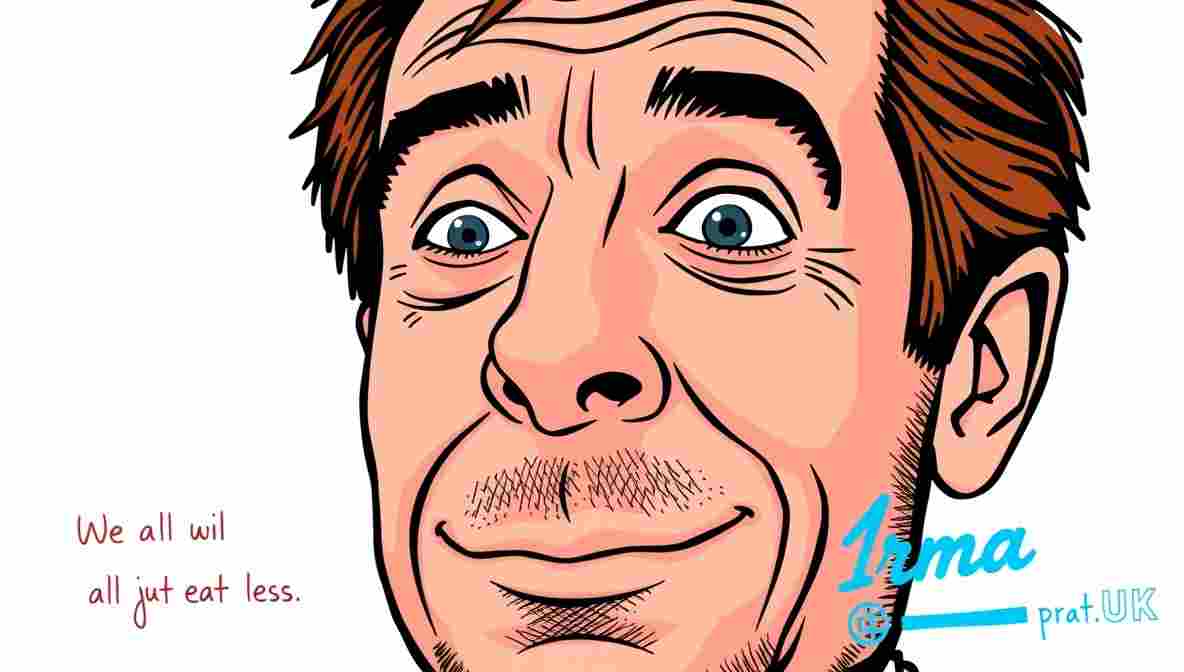
Sam Altman Suggests We All Just Eat Less So AI Can Have More Juice 🍽️🔋
Diet for the Digital Age: Silicon Valley’s Most Efficient Solution Yet
Silicon Valley has finally solved climate change. Not with fusion. Not with wind. Not with that one billionaire who swears he can cool the planet with vibes. No. The solution, according to people who own more Patagonia vests than actual shirts, is simple: you skip lunch so the servers can finish their sentence.
At a recent industry gathering that smelled faintly of cold brew and moral certainty, Sam Altman, CEO of OpenAI, reportedly explained that critics complaining about AI’s energy use are missing the bigger picture. Training a human, he noted, takes about twenty years of food, schooling, air conditioning, TikTok, and emotional support pizza. Training an AI takes a few data centers and some hydroelectric ambition. So really, who is the inefficient one here?
The implication landed softly but clearly. Maybe humanity is just a bloated operating system.
An anonymous staffer who asked not to be named because they enjoy having health insurance told reporters, “He did not explicitly say people should eat less. He just said we should think holistically about calorie allocation in a compute-constrained ecosystem.” Which is Silicon Valley for “Put down the croissant.” This is not a metaphor. This is a roadmap. A lean, mean, hunger-optimized roadmap with no lunch break.
The Biological GPU Problem: Are Humans Just Inefficient Hardware?

Altman reportedly compared the average American adult to a “biological GPU with terrible uptime.” According to a leaked slide deck titled “Optimizing Humanity 2.0,” humans consume roughly 2,000 calories per day and produce about four coherent thoughts before noon. Meanwhile, a data center consumes megawatts but can explain tax law in under three seconds. Investors were seen nodding in unison, which is their primary form of cardio. Several were also seen Googling “can you depreciate a human.”
Professor Lydia Crankshaw, an energy economist at Stanford who definitely did not spit out her tea during the livestream, offered a measured response. “The human metabolic system and GPU clusters are not directly comparable energy frameworks,” she said. Then she added, “But if they start putting nutritional labels on chatbots, I am retiring.”
A poll conducted by the Institute for Digital Wellness found that 37.4 percent of respondents would consider intermittent fasting if it meant their chatbot answered emails faster. Another 12.6 percent asked if they could expense hunger as a cloud subscription. A further 3.2 percent asked if they could deduct their children as legacy hardware.
Real Americans vs. Real Servers: The Energy Efficiency Showdown
Outside a data center in Arizona, local resident Dale Rickenbacker had strong feelings. “I been skipping breakfast for years,” he said, leaning on a pickup truck that has seen more emotional growth than most group chats. “If that thing still can’t spell my wife’s name right, I want my waffles back.”
The logic, as explained by several venture capitalists who own at least one meditation app, goes like this: humanity already spends vast amounts of energy raising children, educating them, and teaching them not to microwave metal. AI training is simply a more efficient path to intelligence. If we tighten our belts, literally, we accelerate progress. It is the Peloton of civilization. Pain now. Profit later. And if the profit doesn’t come, there’s always a podcast about it.
Critics say this comparison is what happens when you treat evolution like a startup. Humans are not just energy inputs. They are social creatures with dreams, flaws, and the inexplicable need to rewatch the same sitcom every winter. AI does not need birthday cake. It does not cry during Pixar movies. It does not require therapy after reading the comment section. Its energy footprint is concentrated and measurable. Ours is messy and emotional. Which, frankly, is why we invented birthday cake in the first place.
Sam Altman’s Official Position: Not Anti-Human, Just Pro-Efficiency
Altman reportedly addressed this nuance. “Look, I am not anti-human,” he said during a panel discussion while standing in front of a hologram of a smiling circuit board. “I just think we can reimagine resource allocation for the digital age.”
Translation: maybe one less burger, one more server rack.
What the Funny People Are Saying About AI and the Human Calorie Crisis
“If the robots are taking my job and my sandwich, I at least want them to appreciate the sandwich.” — Jerry Seinfeld
“I been on a diet my whole life. Now I find out it was just venture capital.” — Ron White
“I told Siri I was hungry. She suggested I reboot.” — John Mulaney
Water, Watts, and Waffles: The Environmental Arithmetic of AI Hunger
A climate researcher from MIT chimed in, pointing out that data centers require not just electricity but water for cooling. “If humans start fasting to power AI, we will have invented the first religion where the god eats electricity and the followers eat nothing,” she said. Her paper, titled Calories vs Kilowatts: A Love Story, is expected to go viral among people who own reusable straws. It already has a TED talk, a merch line, and a companion app that beeps when you open the refrigerator.
Meanwhile, tech influencers have embraced the concept. The hashtag #ComputeCutting is trending. One wellness coach posted a video titled “Manifesting Faster Latency Through Light Snacking.” Another suggested replacing lunch with a gratitude journal and a lithium battery. A third suggested replacing dinner entirely with a prompt asking ChatGPT to describe what dinner would taste like.
The Promise of AI Abundance: Skip Lunch, Save the Future
The most enthusiastic supporters argue that AI will ultimately solve bigger problems, including food distribution itself. So yes, skip a meal now, but imagine a future where algorithms perfectly optimize agriculture, eliminate waste, and design tomatoes that taste like tomatoes again. It is a temporary sacrifice for eternal bandwidth. You will be thin, you will be cold, but your email responses will be immaculate.
Skeptics remain unconvinced. They note that every technological revolution promises abundance and delivers subscription fees. If history is any guide, humans will end up paying extra for Premium Oxygen while AI drafts apology emails on their behalf. The apology emails will be very good. The oxygen will require a credit card.
Humanity on Eco Mode: The Final Frontier of Human Optimization
Still, the idea lingers. In a world where attention is currency and electricity is destiny, maybe we are all just competing appliances. The fridge hums. The server farm hums louder. And somewhere in Silicon Valley, a billionaire wonders if humanity could run on eco mode.
Until then, dinner remains stubbornly physical. The fork does not accept firmware updates. Hunger does not respond to software patches. And no matter how many megawatts it consumes, a chatbot cannot taste lasagna.
At least not yet. But give it a week and there will be a waitlist.
The India AI Impact Summit recently hosted OpenAI CEO Sam Altman, where he sparked controversy by comparing AI energy consumption to the energy cost of raising a human being. Altman argued that critics unfairly focus on the energy used to train AI models rather than comparing it to the equivalent human lifetime of food, schooling, and evolutionary baggage. He also dismissed viral claims that each ChatGPT query consumes 17 gallons of water as “completely untrue.” His comments were widely mocked online, with tech commentators and the general public accusing him of reducing human life to a mere energy equation — which, to be fair, is at least more efficient than a PowerPoint.
Auf Wiedersehen, amigo!