

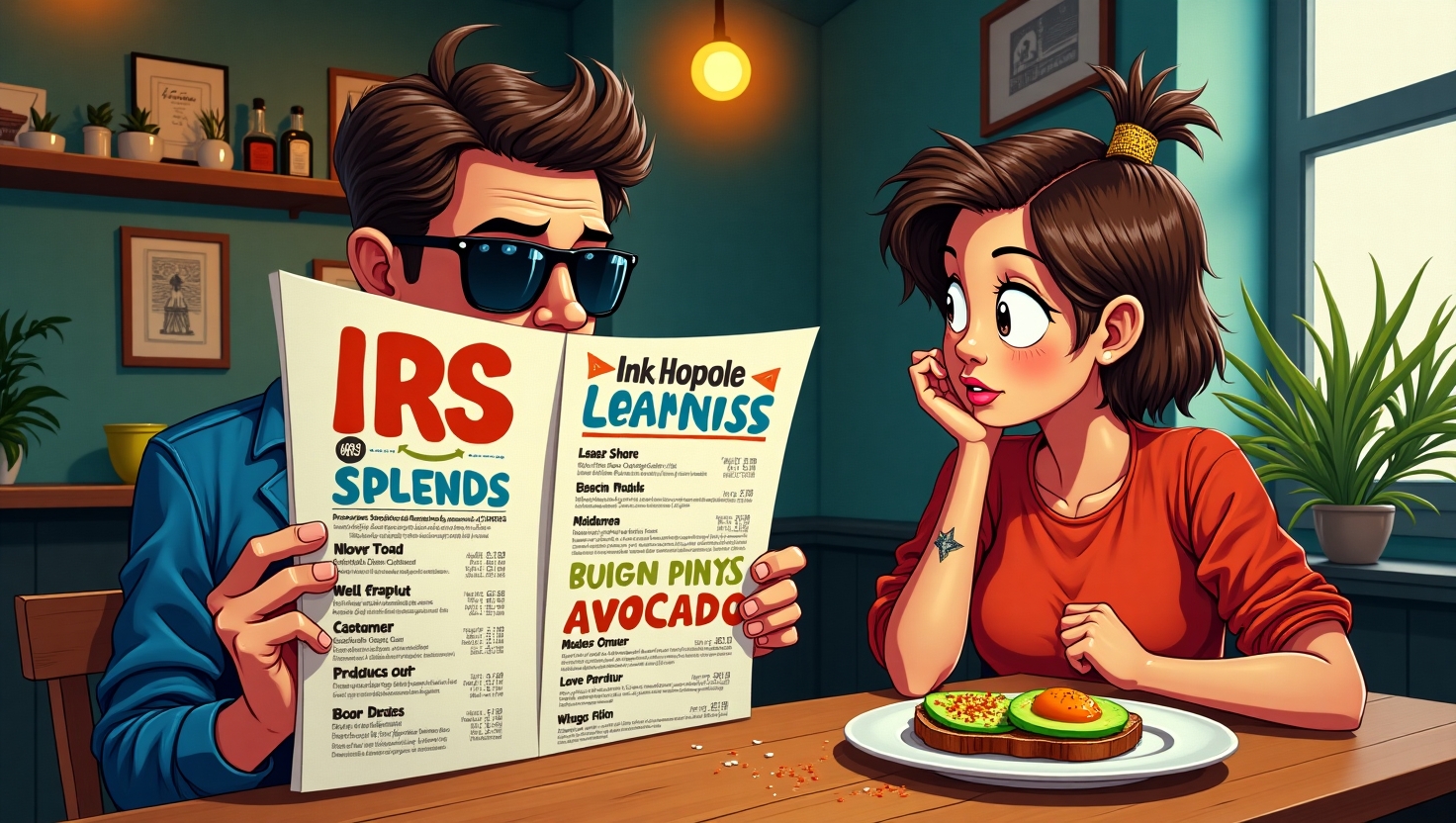
Economists Warn That Buying Avocado Toast May Now Trigger IRS Audit
By Clarisse Fontaine, Senior Brunch Oversight Correspondent
WASHINGTON, D.C. — In a joint statement that sounded suspiciously like a Yelp review written by the Federal Reserve, the Treasury Department and the IRS announced that avocado toast has joined yachts, offshore shells, and “too many Labradoodles” on the list of lifestyle red flags. The initiative—informally dubbed Operation Guac Watch—will treat serial purchases of $19 toast as signs of a “Lifestyle Exceeding Means,” especially when paired with latte art valued at more than seven dollars and the phrase “brunch is self-care” whispered into a reclaimed-wood banquette. The policy is effective immediately, because that is when the toast is still warm.
Officials insist they’re not criminalizing breakfast. “We’re not saying avocado toast is inherently illegal,” Deputy IRS Commissioner Lyle Brenner said, looking like a man who once lost a mortgage to a poached egg. “But if you’re twenty-eight, renting a studio, and spending like the guac is deductible, we need to ask questions. Like, how?” It was a rare moment of bipartisan clarity: the government doesn’t want your bread—just proof you can afford it without crowd-funding your taxes.
How We Got Here: Brunch as a Macroeconomic Indicator
The mechanics of Guac Watch are as elegant as a tulip etched in foam and twice as judgmental. Bank records will be cross-referenced with point-of-sale receipts from trendy brunch spots; selfies posted with toast can be subpoenaed as “visual corroboration”; and Venmo payments labeled with 🍳🥑 are now considered “digital evidence of conspicuous consumption.” A new Brunch Lifestyle Risk Index calibrates danger levels by topping: the presence of gold flakes or imported Himalayan goat cheese triggers “instant suspicion,” while text reading “extra avocado” adds three risk points and a lecture from someone named Carl in mandatory counseling.
Scientific support, thin but smug, is already being waved around. At the Institute for Responsible Indulgence, an econometric model correlates “compressions of disposable income” with “expansions in artisanal crumb structure.” In plain English: the more rustic the toast, the more likely you’ll need a payment plan. Relationship evidence backs it up; brunch groups larger than four exhibit a 27% increase in “split-the-bill confusion,” a leading indicator for audit anxiety. Physical evidence includes receipts longer than Tolstoy and the green fingerprints left on your W-2.
Field Test: One Illustrator vs. The System
If you want to see the policy in motion, talk to Kendra Mayfield, a Brooklyn illustrator who, according to her caseworker, bought “too much Saturday optimism.” She says the first contact came as a friendly email requesting “proof of income and an itemized list of brunch orders for the past year.” Kendra replied with a single link: her Instagram grid. “It was all there—every plate, every angle, every caption that said ‘cheaper than therapy,’” she told me, half-proud and half-terrified. Testimonial evidence from her barista confirmed Kendra once upgraded to “airport avocado toast” during a layover, which the agency presumes fraudulent on principle. Sometimes the law is a blunt instrument; sometimes it’s a butter knife.
Experts Roll Their Eyes, Then the Numbers
Economists are not convinced the toast is the core problem. “People think eating it makes them financially invincible,” says Dr. Niles Faraday of the Institute for Responsible Indulgence, whose syllabus is just a laminated receipt. “You’re not building equity; you’re building cholesterol.” His lab’s Brunch Substitution Model predicts that if audits spike, millennials will switch to oatmeal, a move that lowers Instagram likes by 63% but raises retirement contributions by a statistically significant shrug. Scientific evidence from a small randomized trial suggests that a month of steel-cut humility reduces “weekend overspend” more effectively than budgeting apps—possibly because oatmeal does not come with a flight of mimosas.
Inside the House of Hash Browns
Behind closed doors, the agency is more candid. “We tried yacht owners,” says an IRS insider who requested anonymity so he can finish his eggs in peace. “But brunch people tag themselves at the scene of the crime.” He describes a brand-new Latte Foam Analyst role, hired to appraise swans, tulips, and those three-dimensional bears whose market value now exceeds minor cryptocurrencies and at least one failed streaming service. Digital evidence tools scrape captions for incriminating phrases like “It’s self-care” and “We deserve this,” while trace evidence includes the lime-salt glitter left in tote bags after especially ambitious guacamole.
Polling the Toasted Public
A fresh survey from Toast Trends Analytics suggests the public is ready to double down. Forty-seven percent of millennials said they would “rather face an audit than give up avocado toast,” a response both brave and financial-planner-repellent. Thirty-one percent vowed to start making it at home, then confessed they “don’t know how but will Google it.” Fourteen percent called brunch “the only thing keeping me alive,” which matches the national mood ring. An alarming eight percent believe avocado toast is a cryptocurrency, and while that’s wrong, it does explain the volatility.
Enforcement, Economics, and the Underground Brunch
The agency denies this is a revenue play, but the macro picture wobbles like a poached egg on a toddler’s plate. Economists warn that cracking down on conspicuous brunching could destabilize the millennial economy, which is powered primarily by side hustles, tote bags, and the belief that happiness comes sliced. Cause and effect forecasts are already in: “speakeasy omelet bars” are rumored to be opening in basement coworking spaces, with passwords like “sourdough starter” and “quiet quitting.” The phrase “Let’s grab brunch” is evolving into coded language meaning “Meet me in the alley; bring cash and plausible deniability.” Meanwhile, guacamole futures are trending sideways, possibly because everyone is stressed and switching to breakfast tacos, which are not yet an audit trigger and therefore taste like freedom.
Archival Memory: The Proto-Toast Moment
Historians, forever hungry for context, point to a 1987 C-SPAN clip of a young senator railing against “fancy sandwiches” that “hollow out the moral crust.” Most viewers changed the channel; a few nodded, then invented ciabatta. Archival analysis now labels it the proto-toast moment, the first time American policy looked at bread and whispered, “Not on my watch.”
What the Funny People Are Saying
- “The IRS coming for avocado toast? Finally, a war on carbs I can get behind.” — Jerry Seinfeld
- “If you audit me for brunch, I’m deducting my hangover as a work expense.” — Ron White
- “Avocado toast isn’t suspicious — unless it’s served on a reclaimed barn door.” — Bill Burr
- “At this point, they should just make brunch illegal and get it over with.” — Sarah Silverman
- “Imagine explaining to your cellmate you’re in prison for artisanal bread.” — Trevor Noah
- “This is the government’s way of saying, ‘Get married or get a mortgage, you lazy hipster.’” — Ricky Gervais
- “I’d rather be audited for brunch than taxed for therapy. Same cost, more Instagram likes.” — Kevin Hart
- “The IRS should audit people who order egg whites only. Those are the real criminals.” — Larry David
- “They’re targeting avocado toast because caviar toast didn’t test well in focus groups.” — Amy Schumer
- “The government’s been broke for years, but sure, let’s shake down the guy in skinny jeans.” — Chris Rock
- “I hope they send IRS agents to brunch wearing disguises like ‘obvious undercover cop.’” — Dave Chappelle
- “If they tax my toast, I’m moving to Canada. They have poutine, no one audits that.” — Ali Wong
Practical Survival Guide for the Audit-Curious
If Guac Watch lands on your plate, there are moves. Keep receipts, but not in a shoebox that once held artisanal boots—optics matter. Pay in card, not cash; “financial camouflage” is what they call it when you tuck a twenty under a saucer and glide out like a jazz bassist. Rotate venues to avoid the pattern-recognition software that notices when you sit in the same sun patch every Sunday. Limit table size to keep the split-the-bill confusion below thresholds that summon Carl. Above all, blink slowly at authority. It reads as cooperative. It also reads as “I just ate a perfect egg and know peace.”
Closing Punchline
For the record, the IRS insists it is not trying to ruin brunch culture. “We’re simply asking that you enjoy your overpriced bread products in a fiscally responsible manner,” a spokesperson wrote, adding the sort of line accountants dream about: “Consider a side of hash browns instead—those are deductible.” Somewhere, a senator is practicing the phrase “poached austerity.” Somewhere else, a barista is sketching a swan worth an audit. And in the middle sits America, cutting diagonally, hoping the green stays off their 1040.
Disclaimer
This satirical report is entirely a human collaboration between two sentient beings—the world’s oldest tenured professor and a philosophy major turned dairy farmer—who accept full responsibility for every garnish, statistic, and guac-based grievance herein. Any resemblance to a real policy is either coincidence, brunch fatigue, or both. Auf Wiedersehen, amigos.
IMAGE GALLERY
