

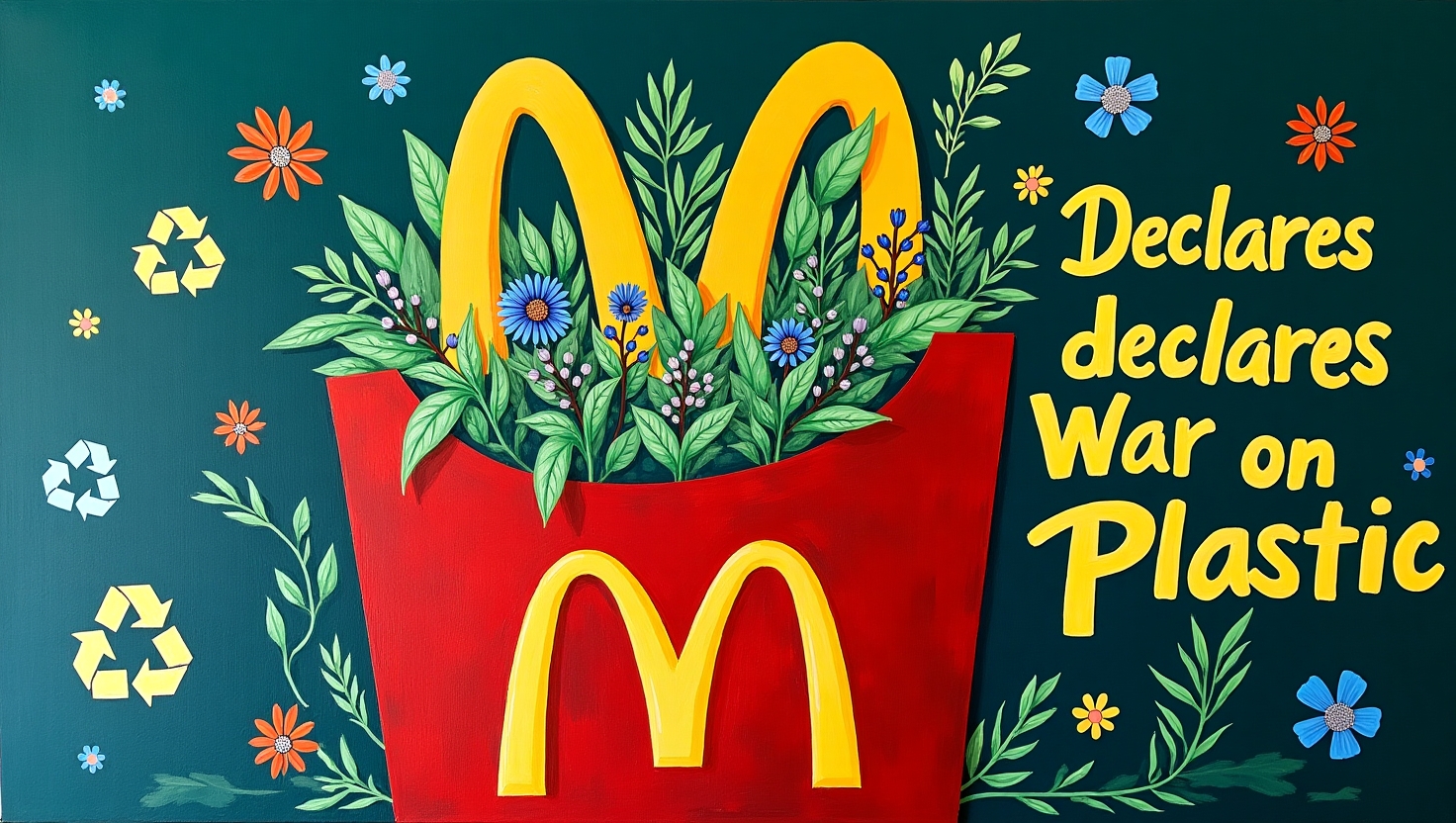
McDonald’s Declares War on Plastic: A Happy Meal for Mother Earth
In a world where politicians can’t agree on potholes and billionaires are flying into space to avoid paying taxes, McDonald’s has emerged as the unlikely savior of our planet. Yes, the same place that once sold Shamrock Shakes in Styrofoam cups now wants credit for saving 10,000 trees a year. And not just any trees—these are the metaphorical kind that make consumers feel like they’ve been knighted by Greta Thunberg every time they order a Big Mac.
According to the company’s triumphant announcement, the new packaging initiative will also keep 190,000 pounds of plastic out of landfills. For context, that’s about the weight of every Kardashian makeup line display stand combined. To celebrate, McDonald’s executives high-fived each other with their reusable silicone gloves and promised that the Quarter Pounder will now come wrapped in “eco-love.”
Three Years of Research: Paper vs. Plastic
Here’s where it gets hilarious. It took McDonald’s three years of research and development to reach the conclusion your grandmother knew in 1952: paper works better than plastic. Three years of scientists in lab coats standing over French fries, solemnly declaring, “The wrapper integrity has been compromised under heat lamp conditions.”
An anonymous staffer leaked part of a test report:
“Conclusion: paper = good, plastic = bad. Secondary conclusion: fries left on counter for three hours will not become biodegradable, but they will glow faintly in the dark.”
Let’s put this in perspective: the Wright brothers built and flew the first airplane in less time. Edison invented the lightbulb in less time. And yet, the world’s largest fast-food chain needed 36 months to rediscover the virtues of tree pulp.
Taiwan: Where the Future of Wrappers Begins
The company chose Taiwan as its first testing ground for this eco-salvation. Customers there were introduced to burgers wrapped in paper instead of boxes. Early reports describe it as both “slightly messier” and “a spiritual awakening.” One eyewitness told Eco-Times:
“I bit into my McChicken, and the wrapper tore. The sauce ran down my arm. Suddenly, I wasn’t just eating—I was communing with nature.”
A leaked memo claimed executives considered test-running the program in France, but the French refused unless the wrappers came in Camembert-scented compostable fabric.
The Rise of the Reusable Cup Revolution
McDonald’s has also declared that dine-in customers will now be given reusable cups. Sociologists are already predicting chaos. America barely manages to return shopping carts—now it’s expected to babysit McDonald’s coffee mugs?
Dr. Barry Crinkle, a sociologist at the University of Michigan, explained:
“Reusable cups require discipline. Most customers will either abandon them on the table, fill them with ketchup, or steal them. Within a week, eBay will be flooded with ‘rare McCups’ listed for $39.95.”
An eyewitness in Des Moines described the future scene:
“I saw a guy leave the restaurant carrying six reusable McDonald’s cups stacked like Russian dolls. He said, ‘Christmas shopping—done!'”
What the Comedy Icons Are Saying About McDonald’s Green Initiative
“McDonald’s is saving 10,000 trees a year. Which is great, but I think most of those trees died of shame anyway when they saw what was inside the McRib,” Ron White said during his recent tour stop in Austin.
“Three years of research to figure out paper works? That’s not research—that’s a long lunch,” Jerry Seinfeld said at a comedy fundraiser last week.
“Reusable cups at McDonald’s? Perfect. Nothing screams ‘romance’ like sipping from a mug still sticky with someone else’s Sprite,” Sarah Silverman said on her podcast.
“If McDonald’s really wanted to save the planet, they’d start with the bathrooms,” Larry David said during a recent interview.
Poll Results: Are We Loving It?
According to a poll conducted by the newly formed “Institute for Fast-Food Morality”:
- 42% of respondents said McDonald’s eco-move makes them “proud to be human again.”
- 37% said they’d still prefer Styrofoam because it “makes the Coke taste colder.”
- 21% admitted they would use the new wrappers as emergency Kleenex and “feel twice as virtuous.”
In a shocking twist, 8% claimed they’d compost their wrappers at home, though witnesses later clarified “compost” meant “toss it behind the garage.”
McDonald’s as Environmental Messiah
This is the role reversal no one saw coming: the Golden Arches, once demonized for supersizing America, are now trying to compost their sins. Environmental activist Leona “Leafy” Sprout offered cautious optimism:
“If McDonald’s can do this, anyone can. Except Arby’s. Arby’s is too far gone.”
Meanwhile, a leaked Vatican memo allegedly described Ronald McDonald as “the St. Francis of Fryers.”
Archival Footage and Grainy Cellphone Video
In grainy cellphone footage leaked from a corporate retreat, McDonald’s executives can be seen toasting biodegradable straws while chanting, “McGreen, McGreat, McFuture!” A second clip shows the Hamburglar attempting to steal the prototype wrappers, only to discover they dissolve in water. Experts hailed this as a metaphor for capitalism itself.
The Cultural Impact of Sustainable Fast Food
Sociologists believe this move may redefine eco-consciousness for a generation. For decades, children associated McDonald’s with Happy Meal toys made from petroleum. Now, they’ll grow up knowing their toys come wrapped in paper that can be recycled, composted, or used as notebook paper for detention.
As comedian Tig Notaro said:
“My nephew asked if he could use his Happy Meal box as origami. I said, ‘No, honey, that’s not a box anymore. That’s a better world.'”
The Slippery Slope to Total Eco-Domination
Critics worry this could lead to extreme outcomes. Today it’s wrappers. Tomorrow, McDonald’s might announce all burgers will be made from lentils. A leaked draft of “Vision 2030” suggests the company is considering:
- Solar-powered McFlurry machines
- Burgers wrapped in edible lettuce pouches
- Ronald McDonald recast as a climate activist named “Eco-Ron”
One anonymous staffer warned:
“It starts with paper. It ends with Ronald testifying at the U.N. in a hemp suit.”
The Real Question: Will Other Fast Food Chains Follow?
If Burger King joins the eco-crusade, experts estimate an additional 15,000 trees could be saved. Taco Bell, meanwhile, has pledged to consider wrappers that double as tortilla chips. KFC insists it will only switch to paper once scientists invent a bucket strong enough to hold 12 pounds of grease.
Conclusion: The Green Arches Have Arrived
So here we are. The Golden Arches, once a symbol of disposable culture, now leading the charge in sustainability. Sure, your nuggets may slip out of their new eco-wrapper and onto your jeans, but remember: that’s not grease, that’s progress.
One customer summed it up best while wiping sauce off his lap with a compostable napkin:
“I came for fries, but I left with hope. And also ketchup stains.”
In the end, McDonald’s doesn’t just want you to be lovin’ it—they want Mother Earth to lovin’ it too. And for the first time in history, Ronald McDonald might just be the clown who saved the world.
Image Gallery: McDonald’s War on Plastic

Disclaimer
This article is the result of a collaboration between two entirely human beings: the world’s oldest tenured professor and a philosophy major turned dairy farmer. Neither has ever thrown away a reusable cup, though one of them did once compost a cheeseburger by accident. Any resemblance to real press releases is strictly coincidental. Auf Wiedersehen, amigos.