

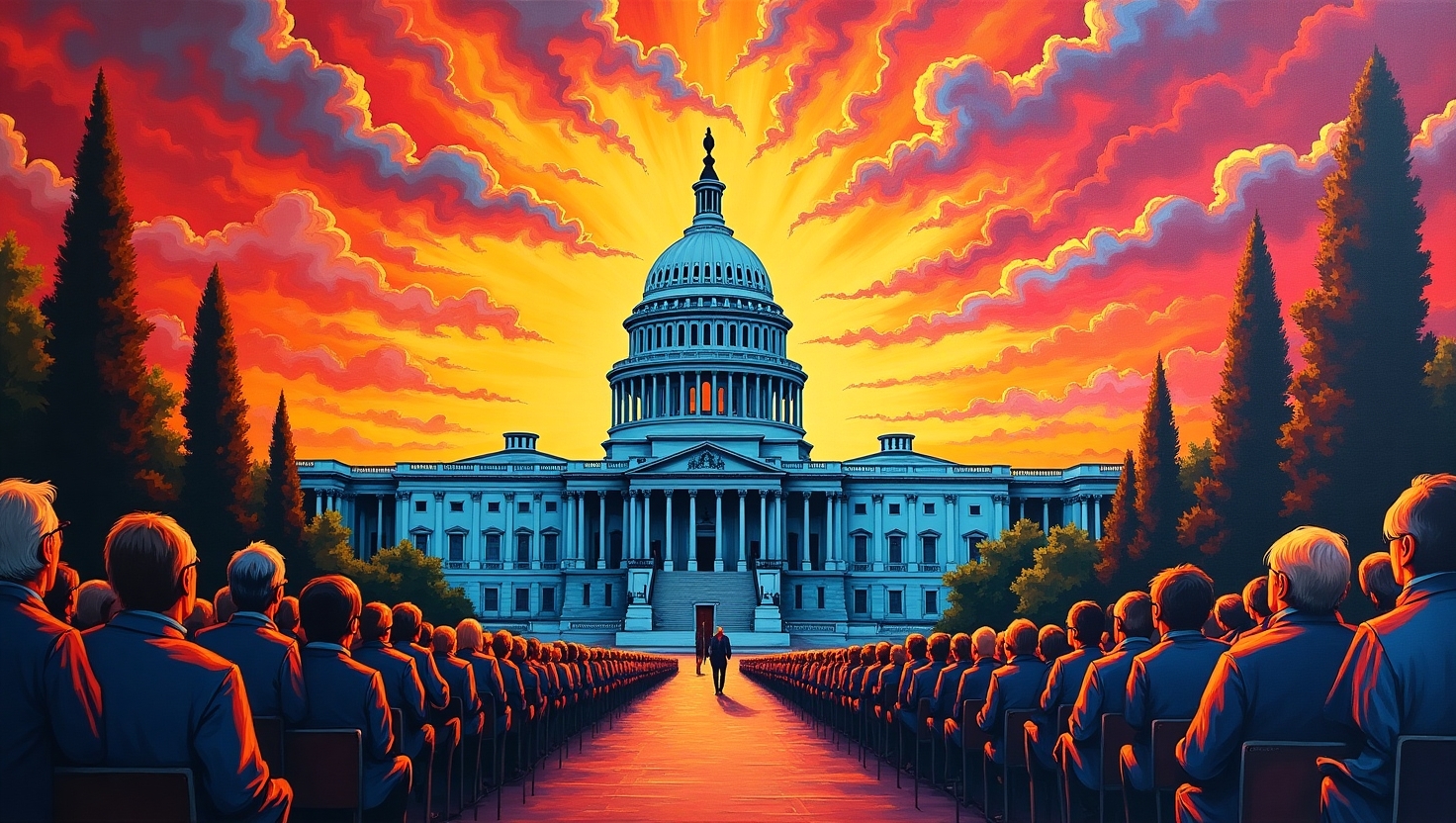
Congress Accidentally Votes to Ban Itself After Misreading TikTok Bill
“Looked Like a Terms of Service Agreement,” Explains Confused Senator
Historic 535-0 Vote Dissolves Legislative Branch After Members Mistake Constitutional Amendment for Software License Agreement
The historic 435-0 vote in the House and 100-0 vote in the Senate came after lawmakers spent approximately fourteen seconds reviewing a 847-page bill that they believed was standard social media platform legalese but actually contained detailed provisions for dissolving the legislative branch and redistributing congressional salaries to public school teachers and infrastructure repair.
“It looked exactly like one of those iTunes updates that pop up every week,” explained Representative Chad Brokeshire of North Carolina, while standing outside the now-locked Capitol building trying to figure out how to get his gym bag back. “There was a lot of legal language about ‘terms of engagement’ and ‘platform restrictions,’ so naturally we all just clicked ‘Accept’ and moved on with our lives.”
The accidental self-dissolution was discovered only when congressional security guards arrived for their evening shift to find a note taped to the Capitol dome reading “Thanks for playing democracy! Please allow 3-5 business days for institutional dissolution to take effect. – Management.”
The Great Misunderstanding: When ADHD Meets Legislative Process
The confusion began when House staffers, working under extreme deadline pressure to address growing public pressure about TikTok’s data collection practices, accidentally attached the wrong document to what members believed was routine social media regulation.
Instead of the standard “Ban TikTok Unless They Sell to American Companies” bill that Congress has been halfheartedly debating for three years, the legislation actually contained a comprehensive constitutional amendment dissolving the legislative branch while maintaining plausible deniability through language that resembled typical tech industry legal documents.
“The bill was written in that same incomprehensible legal language that tech companies use to hide the fact that they’re selling your personal information to advertisers. Naturally, we assumed it was harmless bureaucratic nonsense that we were required to vote on without reading, just like everything else we’ve passed for the last forty years.” — Senate Minority Leader Mitch McConnell, while attempting to use his congressional ID badge to access the McDonald’s employee discount
The legislation’s key provision, buried on page 394 between clauses about data encryption standards and user privacy protections, included language stating: “By voting to approve this measure, the undersigned legislative body hereby agrees to immediate dissolution and forfeiture of all institutional powers, privileges, and compensation effective upon passage.”
Constitutional Crisis Meets Customer Service
The immediate aftermath of Congress’s accidental self-destruction created unprecedented constitutional challenges as remaining government institutions attempted to determine whether lawmakers could retroactively read legislation they had already passed or if democratic governments were bound by the same “no takesie-backsies” rules that apply to software license agreements.
The Supreme Court convened an emergency session to address whether Congress could appeal its own dissolution or if the judicial branch was required to treat legislative self-destruction as a binding contract similar to terms of service agreements that nobody reads but everyone legally agrees to follow.
“The legal precedent is surprisingly unclear,” explained Chief Justice John Roberts while reviewing case law that somehow needed to address both constitutional governance and end-user license agreement enforcement. “There’s no existing framework for determining whether elected officials can accidentally dissolve their own institutions through legislative processes that resemble clicking ‘Accept’ on software updates.”
Economic Implications: The Savings Are Real
The immediate economic impact of congressional self-dissolution exceeded most optimistic government efficiency projections, with taxpayers saving an estimated $2.3 billion annually in legislative salaries, benefits, and operational expenses that were automatically redirected to education and infrastructure as specified in the accidentally-passed legislation.
“Ironically, this represents the most fiscally responsible vote Congress has made in decades,” noted budget analyst Dr. Sarah Patterson while reviewing governmental cost savings that exceeded the wildest dreams of deficit reduction advocates. “They finally found a way to cut government spending that actually improves government efficiency—by eliminating themselves entirely.”
Government operations continued smoothly under emergency protocols administered by civil service professionals who had been quietly maintaining functional governance despite congressional dysfunction, leading many citizens to question whether the legislative branch had been necessary for day-to-day government operation.
Public Response: Accidental Approval
Polling data revealed that 73% of Americans approved of Congress’s accidental self-dissolution, with many citizens expressing relief that elected officials had finally accomplished something useful, even if they had done so by mistake.
“Finally, Congress passed legislation that actually improves people’s lives,” commented Detroit resident Maria Rodriguez while reviewing news reports about increased infrastructure spending funded by former congressional salaries. “I don’t care if they did it accidentally—results are results.”
Social media response was overwhelmingly positive, with hashtags like #ThankYouCongress and #AccidentalEfficiency trending as Americans celebrated the first congressional action in decades that produced measurable improvements in government function and public service delivery.
Former Members Adjust to Civilian Life
Displaced lawmakers struggled to adapt to civilian employment markets that showed little demand for skills like “partisan grandstanding,” “fundraising from special interests,” and “avoiding direct answers to simple questions during televised interviews.”
“I’m discovering that private sector employers expect you to actually accomplish things instead of just talking about them,” noted former Representative Brad Thompson while interviewing for a position as assistant manager at a local Applebee’s. “It’s a completely different skill set than legislative politics.”
Many former members found themselves overqualified for most available positions due to their extensive experience in institutional dysfunction, public speaking without substance, and managing complex relationships with lobbyists and special interest groups.

15 Humorous Observations: When Congress Accidentally Fired Itself
The Most Effective Legislative Session in History
1. The most Congress thing ever is that they finally passed meaningful government reform, but only because they confused it with a software license agreement and voted without reading it, which perfectly captures the quality of their usual legislative process.
2. A 435-0 House vote and 100-0 Senate vote to dissolve themselves represents the first truly bipartisan action Congress has achieved in decades, proving that unity is possible when nobody knows what they’re voting for.
3. The bill was hidden in language that looked like iTunes terms of service, which means Congress fell victim to the same psychological manipulation that tricks regular people into agreeing to software licenses, except this time it actually improved society.
4. Government efficiency improved dramatically after Congress eliminated itself, leading to the uncomfortable realization that elected officials might be the primary obstacle to effective governance rather than the solution to democratic representation.
5. Former lawmakers struggling to find civilian employment because their skills in “partisan grandstanding” and “avoiding direct answers” don’t translate to real jobs reveals something profound about the gap between political theater and actual work.
6. The fact that civil servants kept government running smoothly without political interference suggests that most of what Congress does involves creating problems rather than solving them, which explains why their absence improved everything.
7. Public approval ratings for Congress reached historic highs after they accidentally dissolved themselves, proving that Americans finally got the representation they deserved: none at all.
8. The constitutional crisis over whether democratic institutions can be dissolved through customer service psychology reveals that our entire political system operates on the same principles as predatory software licensing agreements.
9. International governments studying America’s “accidental democracy” as a potential improvement model shows that even foreign nations recognize that American politicians work better when they accidentally eliminate themselves.
10. Former members discovering that private sector employers expect actual accomplishments rather than just talking about them highlights how disconnected political careers are from normal professional standards and measurable results.
11. The emergency governance protocols managed by qualified professionals achieved more policy coherence in one month than Congress had managed in years, which raises uncomfortable questions about whether democracy requires elected amateurs.
12. Tech companies worried about legal precedents for voiding agreements due to user negligence reveals that the entire digital economy depends on people agreeing to things they don’t understand, just like congressional voting.
13. Political science departments having to completely revise curricula because nobody anticipated that democracy could accidentally improve itself through institutional incompetence shows how little we understand about our own government systems.
14. The Georgetown student whose satirical thesis accidentally became constitutional law demonstrates that college assignments might produce better policy outcomes than actual legislative processes conducted by professional politicians.
15. The ultimate irony is that Congress’s greatest achievement was eliminating themselves by mistake, which perfectly summarizes both their competence level and their actual value to American society.
What the Funny People Are Saying: Comedian Lines on Congress’s Accidental Self-Destruction
Stand-Up Comics Process Democratic Self-Elimination
- “Congress voted to ban themselves because they thought it was a terms of service agreement. Finally, they treated legislation like everyone treats software updates—clicked ‘Accept’ without reading and hoped for the best.”
- — John Mulaney
IMAGE GALLERY