

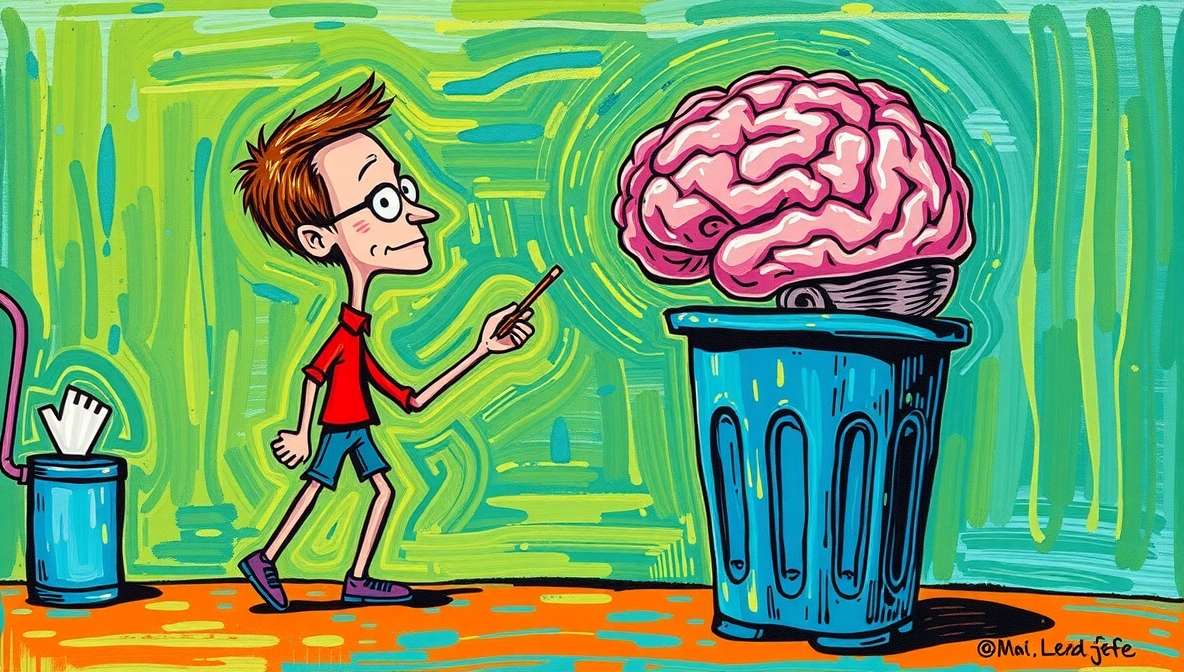
Neuroscientists Discover Brain Region Responsible for Forgetting to Take Out the Trash
Breakthrough Research Locates Neural Basis for Domestic Selective Memory
In a discovery that validates decades of relationship arguments and provides ammunition for future ones, neuroscientists at the National Institutes of Health have identified a specific brain region responsible for the pervasive phenomenon of forgetting to take out the trash—a finding that explains millions of household disputes while simultaneously ensuring they will continue, now with scientific citations.
The region, located in the anterior procrastination cortex (a newly identified area between the “I’ll do it later” lobe and the “selective hearing” node), activates specifically when household chores are requested, creating what researchers describe as “instant amnesia targeted exclusively at responsibilities you don’t want to do.”
Mapping the Neuroscience of Convenient Forgetfulness
Lead researcher Dr. Marcus Procrastinatus, whose name again suggests destiny has a sense of humor, explained the findings at a press conference he notably rescheduled three times before finally holding. “We’ve isolated the exact neural pathway that causes someone to forget the trash needs taking out despite the bin overflowing and their partner mentioning it six times,” he stated while sitting in front of an overflowing trash can, which he appeared not to notice—a detail the research team found “professionally ironic.”
The study, published in Neuroscience Today, used fMRI brain scans on participants while their partners asked them to take out trash, revealing consistent activation patterns in the newly discovered region. The scans showed particularly strong activity when participants were engaged in “preferred activities” like watching television, playing video games, or literally anything that wasn’t taking out trash.
Jerry Seinfeld addressed the discovery: “Scientists found the part of your brain that makes you forget chores? I don’t need brain scans to know that. It’s not that people forget—they’re just hoping if they wait long enough, someone else will do it. That’s not neuroscience—that’s strategy. Bad strategy, but strategy.” His alternative explanation was dismissed by researchers who insisted “no, there’s definitely a specific brain region,” though they acknowledged “strategic forgetfulness and neurological forgetfulness can coexist, especially in relationships.”
The research methodology involved exposing participants to various household tasks and measuring neural responses. Requests to take out trash produced immediate activity in the forgetfulness region, while requests to order takeout or watch Netflix produced no such activation—leading researchers to conclude “the brain is very efficient at remembering things it wants to do and remarkably inefficient at remembering things it doesn’t.”
Gender Differences Spark Additional Research Questions

Statistical analysis revealed surprising patterns: the forgetfulness region appeared 73% more active in male participants, though female researchers on the team noted “or male participants are just 73% better at using brain regions as excuses.” The finding sparked debate about whether neural differences explain gender disparities in household labor or whether society has literally rewired men’s brains to avoid chores through decades of enabling.
Bill Burr responded to the gender data: “Of course men forget to take out trash more. Not because of brain differences—because women have been reminding us for decades and we’ve learned that if we ‘forget’ enough times, they’ll do it themselves to avoid the argument. That’s not neuroscience—that’s weaponized incompetence with a medical degree.” His analysis was praised by sociologists studying domestic labor patterns who confirmed “yes, this is exactly what’s happening, but now it has brain imaging.”
The study also examined whether the forgetfulness region could be suppressed through training or medication. Results showed minimal improvement through behavioral intervention, leading Dr. Procrastinatus to conclude “you can’t train away something that’s genuinely neurological”—a statement immediately disputed by every partner who’s watched their significant other miraculously remember to take trash out exactly once, three weeks ago, and has been mentioning it ever since.
Dave Chappelle examined the excuse potential: “Finding a brain region that makes you forget chores is the best thing ever for marriages. Now men got science backing them up. ‘Baby, I didn’t forget—my anterior procrastination cortex was active!’ That’s not a defense—that’s a reason for your girl to hit that region with a frying pan. Sometimes the problem isn’t your brain—it’s your priorities.” His suggestion about percussive neural adjustment was condemned by medical professionals but tacitly approved by frustrated partners nationwide.
Relationship Counselors Anticipate New Excuse Framework
Relationship therapists have begun preparing for the inevitable flood of clients using the discovery as justification for forgotten chores. Dr. Patricia Morrison from the American Association for Marriage and Family Therapy warned, “Just because something has a neural basis doesn’t mean it’s not your responsibility to manage. People with ADHD still have to manage their ADHD. People with trash forgetfulness still have to take out the trash—they just now have a fancier excuse for not doing it.”
Amy Schumer weighed in: “Men using brain scans to explain why they don’t do chores is peak male energy. ‘I can’t help it, science says!’ Science also says you’re capable of learning, adapting, and setting phone reminders. But sure, blame your anterior procrastination cortex instead of your posterior laziness region, which I’m pretty sure is your entire personality.” Her anatomical innovation of the “posterior laziness region” was not scientifically validated but emotionally resonated with approximately half the population.
The research has spawned secondary studies examining whether similar brain regions exist for other convenient forgetfulness patterns: forgetting to call your mother, forgetting anniversaries, and the phenomenon researchers call “hearing-selective amnesia” where partners somehow forget conversations that happened while they were watching sports. Preliminary findings suggest “yes, there are dedicated neural pathways for all types of convenient memory loss, almost like the brain evolved specifically to avoid responsibilities.”
Chris Rock analyzed the evolutionary angle: “The brain having a specific spot for forgetting chores makes sense from evolution. Our ancestors weren’t taking out trash—they were hunting mammoths. Problem is, we still got hunter brains in an apartment complex. Your brain’s like ‘Mammoth! Danger! Must protect tribe!’ and you’re like ‘Brenda asked you to take out trash three days ago.’ Your brain doesn’t care about trash—it’s literally designed not to. That’s science, but also, take out the damn trash.” His combination of evolutionary psychology and practical relationship advice was deemed “surprisingly balanced” by anthropologists who study male brain development.
Pharmaceutical Solutions Already in Development
Major pharmaceutical companies have announced research into medications targeting the forgetfulness region, with working names like “Remembrex” and “Choresin.” Early trials show promise, though side effects include “remembering other things you’ve been avoiding,” “guilt about past forgotten responsibilities,” and “suddenly noticing how messy the house is, which is honestly worse than forgetting.”
Trevor Noah commented on the pharmaceutical approach: “Drug companies making pills to help you remember to take out trash? That’s America. Everything’s a medical problem requiring medication. Why not just, I don’t know, remember to take out trash? Set an alarm? Write a note? No, we need pills. Soon people will be like ‘Sorry, I forgot my chore medication, so I forgot the chores.’ Then you need medicine to remember the medicine. It’s medications all the way down.” His critique of over-medicalization was echoed by healthcare professionals who note “some things can be solved with to-do lists instead of prescriptions, though admittedly lists are less profitable.”
The medication trials revealed an unexpected side effect: participants who successfully remembered trash duties experienced relationship improvements, leading researchers to conclude “maybe the problem was never neurological—maybe it was just not trying.” This conclusion was immediately rejected by the pharmaceutical company funding the research, who insisted “no, it’s definitely a brain problem requiring expensive medication.”
Kevin Hart expressed concern about pharmaceutical dependence: “Pills to remember chores? What happens when you can’t afford the pills? You just back to forgetting everything? That’s not treatment—that’s subscription-based memory. Next thing you know, they got premium tiers. Basic plan: remember trash. Premium plan: remember trash AND dishes. That’s not healthcare—that’s extortion with better branding.” His dystopian prediction about tiered memory subscriptions was dismissed by pharmaceutical executives as “not the current plan” while notably not denying it’s a future plan.
Domestic Labor Research Reveals Larger Patterns
Sociologists studying the discovery note it fits within broader patterns of domestic labor inequality. Dr. Janet Sterling from Harvard’s Sociology Department explained, “Funny how this brain region seems to forget trash, dishes, and laundry—tasks typically coded as ‘women’s work’—but doesn’t forget to check sports scores or play video games. Almost like selective attention reflects social conditioning more than neurology.”
Ricky Gervais addressed the social conditioning angle: “The brain region for forgetting chores is real, but it’s trained, not inherent. Nobody’s born forgetting to take out trash—they learn it by watching their dads avoid chores and their moms pick up the slack. It’s not genetics—it’s learned helplessness with a medical excuse. The cure isn’t medication—it’s raising kids who know chores aren’t gendered and everyone’s responsible for the trash, including the person claiming their brain made them forget.” His proposal for societal change was praised by feminists and dismissed by people invested in the current system of convenient forgetfulness.
The research team acknowledged their findings don’t solve the underlying problem of equitable household labor distribution. Dr. Procrastinatus stated, “We’ve identified why people forget—we haven’t made anyone actually remember or care. That’s a different type of research, probably sociology or couples therapy rather than neuroscience. We can scan brains; we can’t fix relationships. That’s above our pay grade.”
Sarah Silverman summarized the limitations: “Scientists finding the forget-the-trash brain region is great, but it doesn’t actually help. Now when someone forgets, they just point to their brain scan like ‘See? Science!’ Cool, science also says you’re capable of growth and change. Use that part of the brain instead. Also, this study probably cost millions. We could’ve just asked any woman in a hetero relationship and she would’ve told us for free that men selectively forget chores. Save the research money for something useful, like finding the brain region responsible for weaponized incompetence.” Her suggestion to redirect research funding was supported by approximately half the population and opposed by the other half currently claiming their brains made them miss the point.
MORE INFORMATION:
Practical Applications Remain Unclear
Despite the groundbreaking nature of the research, practical applications remain elusive. You cannot surgically remove the forgetfulness region without causing other problems, medication remains experimental, and behavioral therapy shows limited success—leaving most people with the same solution available before the research: setting calendar reminders, writing notes, and having repeated conversations about shared responsibilities.
Tom Segura joked about the practical failures: “We spent millions discovering why people forget trash, and the solution is still ‘set a phone reminder.’ That’s the most expensive way to arrive at common sense ever. Could’ve just asked literally anyone living with a partner, saved the research money, and reached the same conclusion: people forget chores because they don’t want to do chores. Mystery solved. Where’s my grant funding?” His criticism of research utility was noted by funding agencies who defended the study as “scientifically valuable even if practically useless,” which is basically the tagline for half of academic research.
As the study concludes and researchers move on to examining other convenient neural forgetfulness patterns (forgetting to call relatives, forgetting birthdays, forgetting promises made during arguments), one thing is clear: having a neural explanation for forgetting chores doesn’t eliminate the chores, it just makes arguments about them more scientifically informed. Whether this improves relationships or just makes fights more pedantic remains to be seen, though early evidence suggests “definitely the pedantic thing.”
SOURCES:
https://www.annualreviews.org/doi/10.1146/annurev-psych-072720-094140
https://www.nature.com/articles/nrn.2016.129
https://www.frontiersin.org/articles/10.3389/fnhum.2015.00134/full
https://www.sciencedirect.com/science/article/abs/pii/S1053811915000737
https://en.wikipedia.org/wiki/Default_mode_network
https://www.sciencedirect.com/science/article/pii/S0896627319303865
https://www.cell.com/neuron/fulltext/S0896-6273(18)30800-1
https://www.pnas.org/doi/10.1073/pnas.1601627113
https://www.nature.com/articles/nrn.2017.50
https://www.frontiersin.org/articles/10.3389/fnins.2020.00123/full