

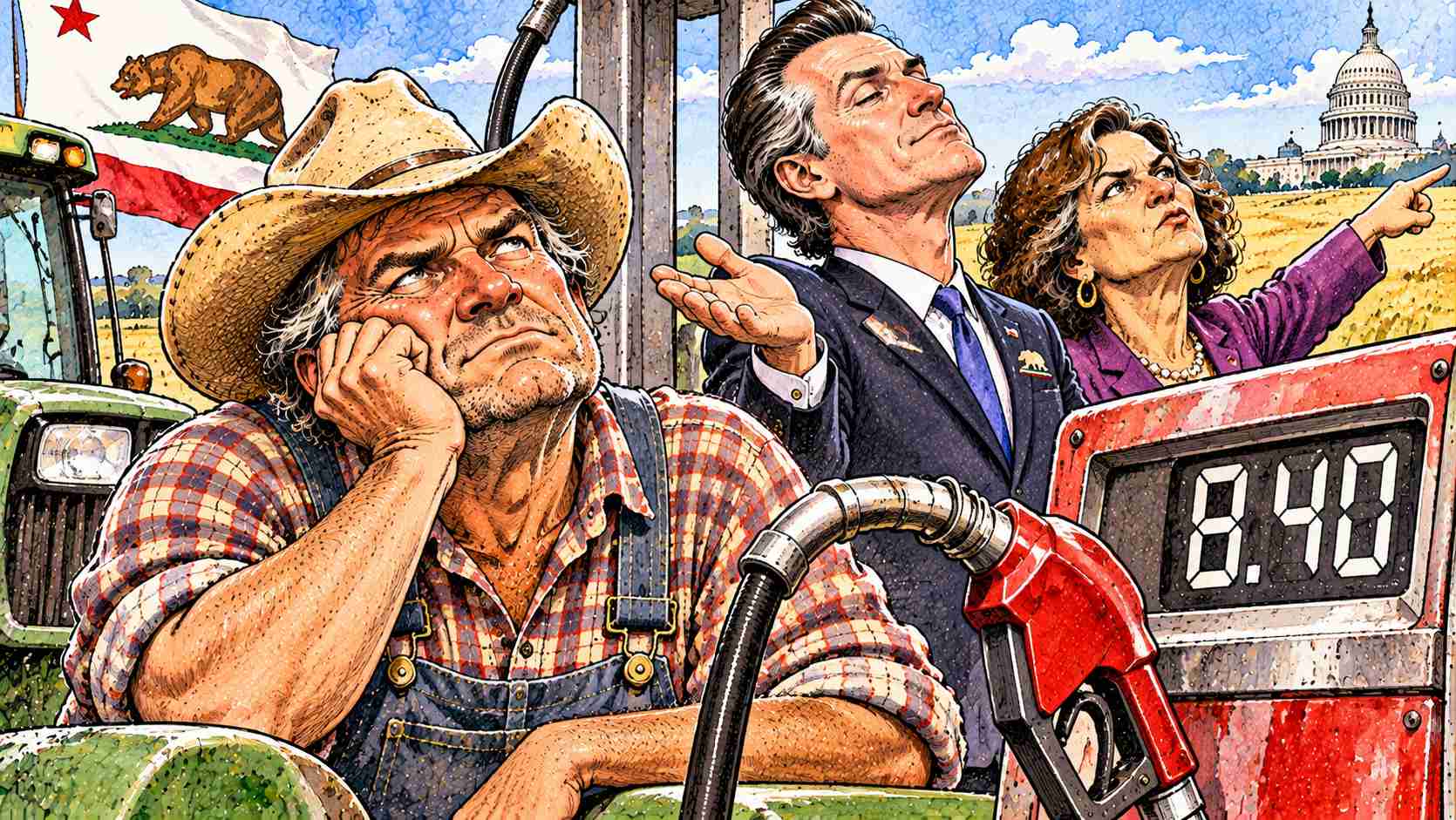
Blame Is the Only Fuel Politicians Make for Free
SACRAMENTO, California (Bohiney.com) — At $8.40 a gallon, the immediate economic calculation is considerably simpler than the politics.
Farmers need diesel. Trucks need diesel. Grocery stores need deliveries. Politicians need somebody to blame.
Of these four economic necessities, only the politicians have found a renewable energy source.
Blame.
California has developed what economists are calling an extraordinary new fuel substitute: politicians can talk for hours without using a single gallon of petroleum. Unfortunately, nobody has discovered how to connect Governor Gavin Newsom’s press conferences to a combine harvester.
The technology would revolutionize agriculture. One Sacramento speech could power the entire Central Valley through Christmas.
California Diesel Price Hits $8.40 a Gallon as Agriculture Requires Actual Fuel
California farmers are facing diesel prices around $8.40 a gallon, according to the U.S. Energy Information Administration’s diesel price data. That’s an amount traditionally associated with a respectable bottle of wine rather than a liquid used to move cow manure.
At these prices, filling a farm truck has become a financial decision requiring approval from a spouse, a banker and possibly the Federal Reserve.
A Thousand Gallons of Diesel Now Costs $8,400
That’s not a fuel bill. That’s a community college education with exhaust fumes.
And the farmer still has to buy fertilizer, seed, insurance, equipment parts and enough coffee to stay conscious through harvest.
“Used to be I’d fill my tractor and complain about the price,” explained one Central Valley grower. “Now I ask the pump whether it accepts inherited property.”
The pump does not. It does, however, accept credit cards, provided the farmer hasn’t already maxed them out buying replacement tractor tires.
A receipt from a Merced County fuel distributor, reviewed by Bohiney.com, itemizes a recent delivery to a family farm. Diesel, 1,000 gallons: $8,400.00. Delivery: $0.00. Fuel surcharge: $0.00. Regret surcharge: $41.20. A line at the bottom reads, “Thank you for your business. We understand.”
California Farm Bureau Survey: Diesel Costs Cut Farm Profits and Field Work
California has perfected a fascinating economic theory: food must remain affordable, agricultural workers must be well paid, environmental standards must be maintained and government revenue must stay secure. Somebody simply forgot to include the farmer’s ability to pay for all this.
The California Farm Bureau’s survey of more than 1,000 agricultural producers found that 81.3 percent said high diesel costs had reduced their profit margins, while more than 40 percent reported reducing field work.
These are not encouraging numbers. When farmers reduce field work, they don’t just eliminate unnecessary meetings and shorten their lunch breaks. They stop doing things that produce food.
Sacramento might eventually discover that agricultural productivity declines when the people operating the tractors can no longer afford to start them.
A government agricultural efficiency consultant would probably recommend reducing tractor idling. The farmer would explain that the tractor hasn’t been started since Tuesday.
“Excellent,” the consultant would reply. “You’ve exceeded your emissions target.”
Farm-to-Fork Transportation Costs: Why California Produce Keeps Getting Pricier
California loves the phrase farm-to-fork. It sounds wholesome, environmentally conscious and expensive enough to appear on the menu of a restaurant charging $36 for three carrots.
But between the farm and the fork is an inconvenient piece of machinery called a truck. The truck requires diesel. The diesel requires money. And the money, according to farmers, is becoming harder to find than a Sacramento official who understands a profit-and-loss statement.
Consider the humble California tomato. A farmer grows it, harvests it and ships it. A distributor handles it. A supermarket displays it. A customer purchases it. Every step involves transportation, refrigeration, labor or equipment.
At $8.40 a gallon, that tomato is beginning to acquire the transportation expenses of a visiting European diplomat. By the time it reaches San Francisco, it may need its own financial adviser.
One supermarket shopper, examining a $7 basket of vegetables, wondered whether the produce had traveled first class. The store manager explained that the lettuce had flown economy, but the diesel had demanded a luxury upgrade.
Trump’s Red Diesel Executive Order: Washington Offers Relief, California Requests Clarification
Earlier this fall, President Donald Trump signed Executive Order 14435, temporarily relaxing federal penalties and tax enforcement involving red-dyed diesel used on public highways. The federal diesel excise tax is 24.4 cents per gallon, and the IRS relief it prompted applies to federal tax only.
California maintains separate restrictions on highway use of dyed diesel, and agricultural organizations have asked Newsom to provide corresponding state relief, as the Sacramento Bee reported. The governor’s response remains unresolved.
This creates an uncomfortable political situation. The White House has proposed a fuel-cost measure. California farmers are requesting help. But the proposal originated with Trump, which in Sacramento apparently requires an additional review of the color red.
Red diesel is perfectly acceptable for a tractor working in a field. Put that fuel into a highway truck, however, and California law becomes considerably more interested.
The truck hasn’t changed. The diesel hasn’t changed. The farmer hasn’t changed. Only the government’s opportunity to collect highway fuel taxes has changed.
California’s state diesel excise tax is 48.2 cents a gallon, and the California Department of Tax and Fee Administration explains exactly how it’s collected. It’s remarkable how quickly a substance can become a government concern when it contains 48.2 cents that Sacramento expected to receive.
The transcript of a recent legislative budget hearing on agricultural fuel costs, obtained by Bohiney.com, runs four minutes.
CHAIR: Can you tell the committee what a gallon of diesel costs?
WITNESS: Eight-forty.
CHAIR: And is that a lot?
WITNESS: It’s a lot.
CHAIR: The committee will note that for the record and schedule a follow-up hearing.
California Politics and Farm Diesel Costs: Arguments Get Better Mileage Than Trucks
A California diesel truck may get six miles per gallon. A California politician can get six months out of one argument.
Newsom can criticize Trump. Trump can criticize Newsom. Sacramento can criticize Washington. Washington can criticize Sacramento. And the farmer can criticize everybody while watching the fuel gauge approach empty.
This is the only transportation system in California operating at full capacity.
A Fresno farmer recently developed his own political energy equation. One gallon of diesel equals approximately eight dollars and forty cents. One political argument equals four press conferences, seventeen social media posts and a television interview.
The first produces food. The second produces another argument. Neither party has yet demonstrated how to make the second one operate a grain truck.
California Dairy Farmers and Diesel Costs: Cows Refuse to Join the Debate
California’s dairy industry offers a particularly useful illustration. Cows must be milked regularly. Milk must be refrigerated. Tankers must transport it to processors. Processors must ship products to grocery stores.
And nowhere in this process does a cow ask whether the governor is a Democrat or the president is a Republican.
The cow has a much simpler economic model. Feed goes in. Milk comes out. The farmer pays for everything.
At current fuel prices, a dairy operator may eventually have to explain that milk transportation is suspended until California and Washington reach an agreement. The cows will keep producing milk anyway. They have no respect for Sacramento’s legislative calendar.
A Holstein asked to comment on the political dispute responded by chewing. Agricultural economists consider this a considerably more productive response than most committee hearings.
Imperial Valley Beekeeper’s Diesel Bill Hits $30,000 a Month
The Sacramento Bee reported that Imperial Valley beekeeper Bryan Ashurst saw his monthly diesel expenses climb from $16,500 last year to $30,000 this year.
Thirty thousand dollars. For transporting bees.
Bees are among nature’s most efficient workers. They fly thousands of miles collectively, pollinate crops, produce honey and operate without pensions. Unfortunately, moving millions of them between California farms requires trucks.
At $30,000 a month, a beekeeper begins wondering whether the bees could simply organize carpools. Perhaps the queen could lead a convoy. Perhaps worker bees could contribute toward gasoline. Perhaps Sacramento could approve a special pollinator transportation corridor where trucks are legally classified as extremely large insects.
Of course, that would probably require another permit. And an environmental impact study examining whether bees experience emotional distress while traveling through Fresno.
California Grocery Prices and Diesel: The Shopper Gets the Final Invoice
The political argument eventually arrives at the supermarket. It doesn’t arrive wearing a suit. It arrives inside the price of bread, milk, vegetables, beef and fruit.
The farmer pays more to produce the crop. The trucker pays more to transport it. The distributor pays more to deliver it. The supermarket faces higher operating costs. Then a customer in Los Angeles discovers that buying groceries requires the financial resources once associated with remodeling a bathroom.
Politicians respond by demanding to know why groceries are so expensive. This is rather like setting fire to a restaurant and complaining that the dinner service is unusually warm.
High fuel costs don’t account for every increase in food prices, and businesses can’t always pass them directly to consumers. But diesel is a real production and transportation expense. Those costs have to be absorbed somewhere. Farmers absorb some. Truckers absorb some. Consumers absorb some.
The political press conference, remarkably, absorbs none.
A study of 600 California farm operations by the San Joaquin Agricultural Policy Center found that farmers who check the pump price before filling a tank spend an average of 4.5 minutes staring at the display. Researchers noted this is roughly the length of the average opening statement at a Sacramento press conference, and that only one of the two produces a reading.
Diesel Relief for California Farmers: A Proposal Involving Arithmetic
Farmers are accustomed to complicated problems. They manage weather, pests, labor, irrigation, equipment, interest rates and commodity prices. They routinely perform calculations that would send a political communications director looking for a calculator and emotional support.
Their approach to the diesel crisis is considerably less complicated than Sacramento’s. If fuel costs rise, farming costs rise. If farming costs rise faster than crop revenue, profits decline. If profits decline long enough, farms close. If farms close, they stop producing food.
This sequence is known as cause and effect. In Sacramento, it may soon require its own Department of Agricultural Consequences, staffed by 200 analysts who have never repaired a hydraulic line.
There are real limits to temporary red-diesel relief. Federal tax payments may be deferred rather than permanently eliminated, and the policy doesn’t create additional diesel supplies or solve international energy disruptions, as the Associated Press reported. The USDA’s emergency diesel announcement puts the number of states taking complementary action at 31.
But those complications deserve practical solutions, not endless partisan theater. Farmers need predictable rules and costs they can survive.
California Farm Policy: Sacramento Will Never Run Out of Excuses
At $8.40 a gallon, California has reached a remarkable economic crossroads. Farmers can’t afford diesel. Truckers can’t afford diesel. Consumers can’t afford groceries. And Sacramento can’t afford to miss an opportunity to argue with Washington.
The state’s agricultural producers aren’t demanding luxury. They aren’t requesting gold-plated combines, government-funded vacation homes or personal chauffeurs for their livestock. They want to grow food, transport it and earn enough money to do it again next year.
There is nothing especially partisan about that. A Republican tomato and a Democratic tomato require exactly the same fuel to reach the supermarket. Neither has ever contributed to a campaign. Neither knows who Gavin Newsom is. And both will rot in the field if nobody can afford to harvest them.
California politicians have spent years explaining that government can solve society’s most complicated problems. Farmers are presenting them with a relatively straightforward one.
Farmers need diesel. Truckers need diesel. Grocery stores need deliveries. Politicians need somebody to blame.
Three of these groups are trying to keep California fed. The fourth is trying to keep the argument going.
The difference is that farmers can run out of diesel. Sacramento will never run out of excuses.
And at $8.40 a gallon, excuses remain the only thing in California available in unlimited quantities at absolutely no charge.
Five Humorous Observations on California’s $8.40 Diesel
- Eight-forty a gallon. That’s not fuel anymore, that’s a luxury liquid with a financing department. I walked up to a pump and a guy asked if I wanted to see the lease terms.
- Farmers need diesel. Truckers need diesel. Politicians need somebody to blame. Only one of those groups can run all day without fuel, and it’s the group that talks.
- A truck gets about six miles a gallon. A politician gets six months out of one argument. Now tell me which one’s the gas guzzler. At least the truck gets you to Fresno.
- Red diesel is fine on the farm and illegal on the highway. So the dangerous ingredient is asphalt. Asphalt! It’s the one thing in California everybody’s already driving on.
- The government spends ten thousand dollars on a meeting about saving a farmer ten dollars. And somebody catered it. The sandwich platter cost more than the ten dollars.
Editorial disclaimer: Entirely a human collaboration between two sentient beings, the world’s oldest tenured professor and a philosophy major turned dairy farmer. Both agree that tractors require fuel, cows require feed and Sacramento requires considerably more explanation than either.