

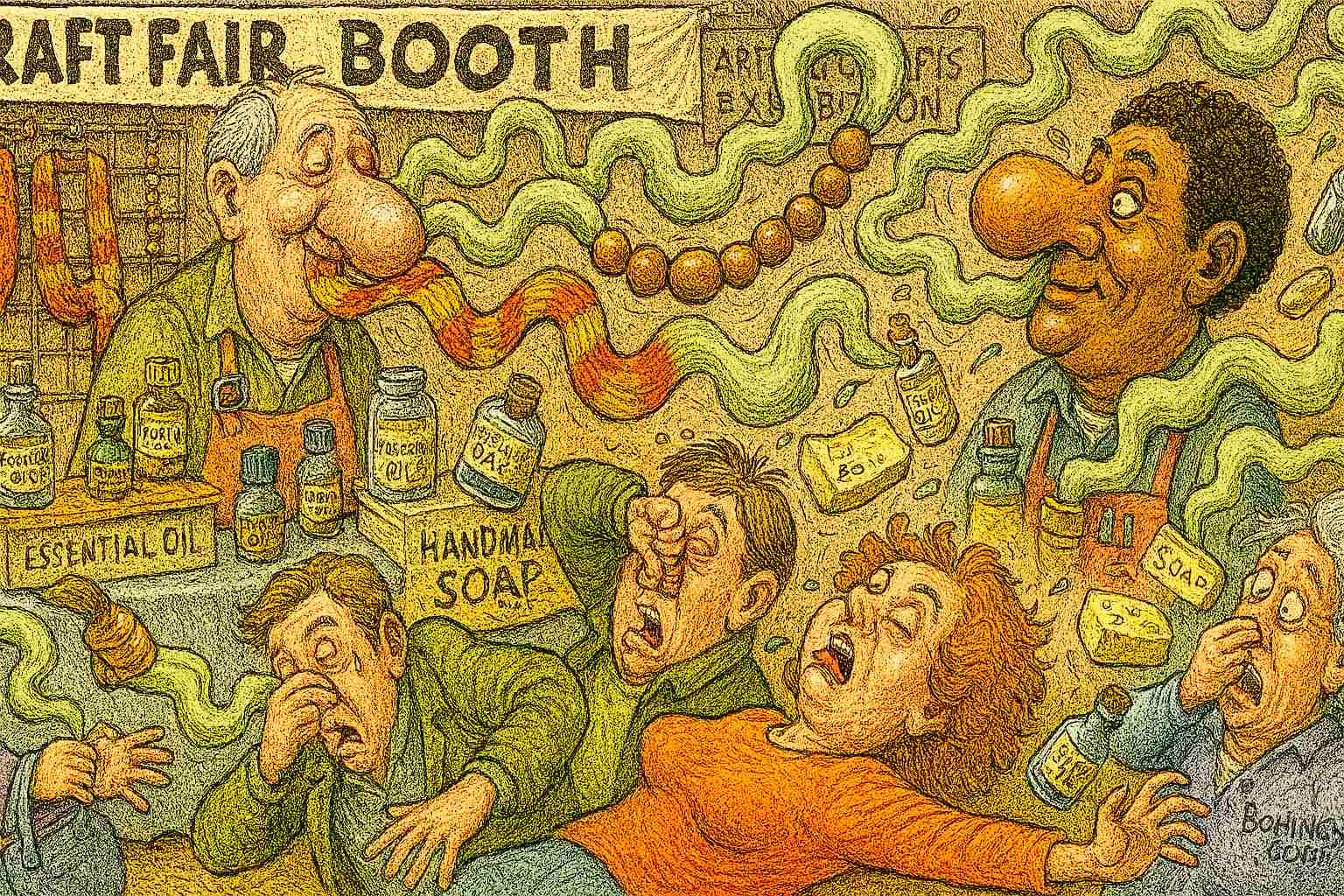
People Who Smell Like Etsy: The Olfactory Assault of Handcrafted Aesthetics
When Your Personal Fragrance is Patchouli, Privilege, and Poor Life Choices
The Aromatic Signature of Handcrafted Delusion
There exists a distinct category of humans whose scent profile can only be described as “smells like Etsy.” It’s a specific combination of patchouli, expensive essential oils that don’t work, homemade deodorant that really doesn’t work, and the faint undertone of believing crystals can cure diseases. This isn’t just poor hygiene–it’s a lifestyle choice that assaults everyone’s sinuses within a ten-foot radius.
These individuals have rejected mainstream personal care products in favor of “all-natural” alternatives that are neither all natural nor viable alternatives. They’ve traded effectiveness for aesthetics, competence for craft, and the basic social contract of not smelling terrible for the deeply held belief that aluminum in deodorant is a government conspiracy.
The Patchouli Problem Nobody Will Address
“I got in an elevator with someone who smelled like Etsy,” said Dave Chappelle. “It wasn’t one smell–it was LAYERS. Patchouli, sage, something that might’ve been homemade soap or might’ve been actual earth. I got out two floors early. My floor hadn’t arrived yet. I just left.”
Patchouli has become the calling card of people who think they’re spiritually evolved but are mostly just unemployed. It’s a scent that announces “I’ve made peace with not being employable in traditional settings.” Nobody in corporate America smells like patchouli unless they’re being ironically nostalgic for the sixties they weren’t alive for.
The smell persists because people who smell like Etsy have constructed elaborate ideologies about why commercial deodorant is toxic while their homemade coconut oil mixture that attracts flies is somehow better. They’ve confused “natural” with “good,” forgetting that cyanide and arsenic are also natural.
The Essential Oil Industrial Complex

Jerry Seinfeld said, “These people rub themselves with essential oils like they’re preparing for a ancient Egyptian burial. Lavender, tea tree, whatever oil is trending on the holistic message boards. They smell like a Bath & Body Works exploded in a farmer’s market.”
The essential oil movement has convinced people that smelling like concentrated plant matter is preferable to smelling like nothing. They’ve been sold on the idea that natural fragrance equals health, ignoring that natural fragrance still equals fragrance, which equals olfactory assault on everyone forced to share air with them.
The irony is that many commercial perfumes contain synthetic versions of the same compounds found in essential oils, but formulated by actual chemists who understand concentration levels. The Etsy smell crowd has rejected this expertise in favor of dousing themselves with undiluted oils that would make a skunk reconsider its defense mechanisms.
The Handmade Soap That Doesn’t Clean
Amy Schumer said, “My friend gave me handmade soap from Etsy as a gift. It smelled like a forest floor and accomplished nothing. I used it once and felt dirtier. Pretty sure it was just scented lard. I threw it away and she asked if I finished it. I lied.”
The handmade soap phenomenon operates on the assumption that industrial soap production is somehow inferior to someone melting stuff in their kitchen sink. These artisan soaps cost $15 per bar, last three days, and clean approximately nothing while leaving you smelling like a Renaissance faire porta-potty.
The marketing emphasizes the handcrafted process as if that’s a benefit rather than a liability. Mass-produced soap undergoes quality testing and consistent formulation. Handmade soap is whatever Karen felt like putting in the batch that day, which apparently includes herbs, flowers, and her unresolved trauma about the pharmaceutical industry.
The Natural Deodorant Lie
Chris Rock said, “Natural deodorant doesn’t work. I know this. You know this. The person using it definitely knows this. But they keep using it because admitting it doesn’t work means admitting they’ve been smelling terrible for ideology. That’s a hard L to take.”
The natural deodorant market has convinced people that aluminum-based antiperspirants cause cancer despite no scientific evidence supporting this claim. Meanwhile, the natural alternatives made from baking soda and coconut oil provide approximately four minutes of protection before bacterial colonies begin their hostile takeover.
People who use natural deodorant fall into two categories: those who admit it doesn’t work and are trying different brands weekly, and those who’ve gone nose-blind to their own stench and genuinely believe the ozone layer they’re destroying with their body odor is just “natural musk.”
The Sage Cleansing Nobody Consented To
Bill Burr said, “They burn sage to ‘cleanse the energy.’ The only thing that needs cleansing is them, with regular soap, under running water. The sage isn’t fixing anything except making everyone else’s eyes water.”
The sage burning ritual has become so common among the Etsy smell demographic that they often carry the lingering scent of burnt herbs everywhere they go. They’ve confused spiritual practice with acceptable public fragrance, not realizing that smelling like you just escaped a forest fire isn’t the vibe they think it is.
The sage cleansing ceremony is supposed to remove negative energy, but it’s creating plenty by forcing everyone in the vicinity to inhale smoke and reconsider their life choices. If your spiritual practice requires others to suffer your smell, maybe it’s not that spiritual.
The Fashion That Amplifies the Smell
Kevin Hart said, “The Etsy smell comes with a uniform: burlap-adjacent fabrics, multiple scarves in summer, pants that look like they’re from a different century. The clothes trap the smell. It marinates. By 3 PM they’re biohazards.”
The aesthetic that accompanies the Etsy smell includes natural fiber clothing that doesn’t breathe well, multiple layers that prevent air circulation, and fabrics that absorb and retain every scent they encounter. These people look like they fell through time from 1972 and smell like they brought the decade with them.
The clothing is often “upcycled” or “vintage,” which are polite terms for “smells like someone else’s sweat plus yours” and “was already fragrant when purchased.” Combined with natural deodorant failure and essential oil enthusiasm, the result is a mobile smell profile that announces their presence before they enter a room.
The Farmers Market Ground Zero
Ricky Gervais said, “Farmers markets smell like Etsy smell concentrate. Everyone there is competing to smell the most ‘authentic.’ It’s like a fragrance arms race but nobody’s winning. Everyone’s losing, especially the vegetables.”
The epicenter of Etsy smell culture is the farmers market, where handmade soap vendors, essential oil salespeople, and natural fiber clothing sellers congregate. The combined olfactory assault is enough to make fresh produce smell bad by association. These markets smell like hippie and regret in equal measure.
Visitors to farmers markets often make the mistake of stopping at soap booths, where vendors encourage them to smell every variety while explaining their chakra-balancing properties. Nobody’s chakras are balanced–they’re just confused about why they now smell like patchouli and broke because they spent $45 on three bars of soap.
The Office Environmental Hazard
Ali Wong said, “Someone at work smells like Etsy and HR can’t figure out how to address it. You can’t say ‘you smell bad’ but you also can’t say ‘your commitment to alternative hygiene is creating a hostile work environment.’ There’s no manual for this.”
The workplace collision between Etsy smell individuals and office environments creates HR nightmares. Standard dress codes don’t address “smells like attended Burning Man in 2003 and never recovered.” Companies struggle to enforce fragrance-free policies when the fragrance isn’t commercial–it’s someone’s deeply held lifestyle choice that happens to smell terrible.
Coworkers suffer in silence or passive-aggressively send department-wide emails about fragrance sensitivity, hoping the message lands without direct confrontation. It rarely works. People who smell like Etsy are immune to social cues because they’ve constructed entire identities around rejecting mainstream norms, including the norm of not smelling aggressively natural.
The Dating Profile Red Flag
Sarah Silverman said, “If someone’s dating profile mentions crystals, essential oils, or ‘natural living,’ I know they smell like Etsy. That’s not judgmental–it’s pattern recognition. I’ve been burned before. Literally, by sage.”
Dating someone who smells like Etsy means accepting that your home will eventually smell like Etsy. The essential oil diffusers will multiply, the handmade soap will colonize your bathroom, and you’ll slowly lose your sense of smell as defense mechanism against the constant aromatic assault.
The relationship warning signs include: refusing to buy commercial deodorant, owning more than five scarves, mentioning mercury retrograde unironically, and having strong opinions about aluminum. These indicators predict not just Etsy smell but an entire lifestyle that treats modern chemistry like witchcraft and witchcraft like modern chemistry.
The Children Raised in the Smell
Trevor Noah said, “Kids growing up in households that smell like Etsy don’t know they smell like Etsy until other kids tell them. That’s a rough day at school. ‘Your mom makes her own deodorant?’ Brutal.”
Children of Etsy smell parents often face social consequences they didn’t choose. They’re sent to school smelling like patchouli and privilege, carrying lunches in reusable containers that retain every smell from the previous six months, wearing clothing that’s “natural fiber” but smells like a thrift store basement.
These kids eventually rebel by embracing mainstream hygiene products with the enthusiasm of prisoners finding freedom. They discover Secret deodorant and Dove soap like previous generations discovered rock and roll–as beautiful rebellion against their parents’ choices.
The Explanation That Never Satisfies
Tom Segura said, “They always have explanations ready. ‘My body chemistry reacts differently to natural products.’ No, your body chemistry reacts normally–it sweats and produces odor. The natural products just don’t work. That’s not chemistry–that’s capitalism.”
The elaborate justifications for smelling like Etsy always involve conspiracy theories about Big Deodorant, concerns about chemicals despite everything being chemicals including them, and vague references to “doing their research” which means reading mommy blogs written by people also smell like Etsy.
The research never includes actual scientific studies, just anecdotal evidence from people whose normal smell baseline is “craft fair.” They’ve created echo chambers where everyone agrees that smelling like lavender, body odor, and poor decisions is actually enlightened while everyone using commercial products is poisoning themselves.
The Inevitable Conclusion
The Etsy smell phenomenon represents the intersection of consumer choice, pseudoscience, and the fundamental human need to believe we’re better than others because of our purchasing decisions. People don’t smell like Etsy because they lack access to functioning hygiene products–they smell like Etsy because they’ve chosen ideology over efficacy.
The tragedy isn’t the smell itself–it’s the defensive certainty with which they maintain it. They’re convinced that rejecting mainstream products makes them authentic, natural, enlightened. In reality, it mostly makes them smell bad and insufferable about why they smell bad, which is somehow worse than just smelling bad.
But hey, at least their chakras are aligned while they clear rooms with their presence. And really, isn’t spiritual wellness worth everyone else’s olfactory suffering? The answer is no, but nobody who smells like Etsy has accepted that yet. They’re too busy rubbing themselves with tea tree oil and wondering why nobody wants to carpool anymore.