

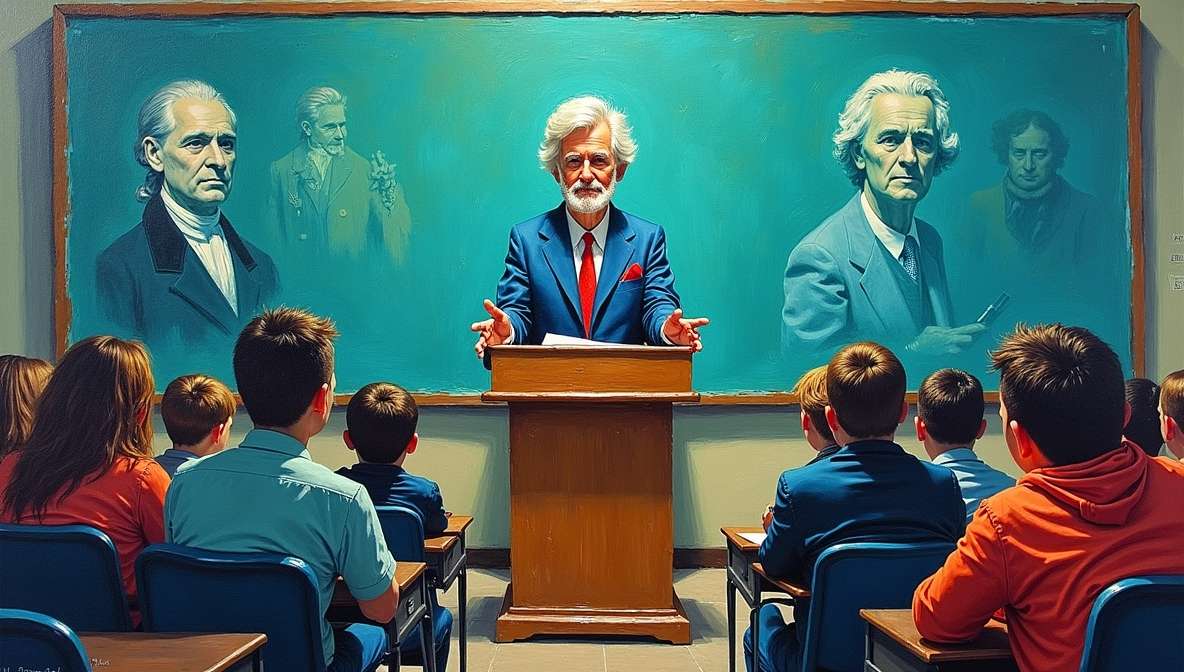
Teachers Replaced by Holograms After Parents Sue Over “Too Many Dates” in History Lessons
U.S. schools embrace holographic instruction after lawsuit claims memorizing historical dates causes “emotional damage”
By Bohiney Magazine Staff |
The Hologram Revolution Comes to American Classrooms
In what experts are calling “the most immersive way to misunderstand the past,” several U.S. school districts have begun replacing human history teachers with interactive holograms after parents filed lawsuits claiming their children were “emotionally damaged by excessive memorization of dates.”
The historic class-action suit, Parents for Cognitive Comfort vs. The Entire 8th Grade Curriculum, argued that “forcing young minds to recall what happened before TikTok is a form of academic cruelty.” One parent testified, “My son came home crying because the teacher asked when the Civil War started. I didn’t know either! Who needs that negativity in their life?”
According to court documents, the plaintiffs demanded “date-free” history instruction, suggesting lessons should instead focus on “feelings-based timelines.” Example: “Christopher Columbus — he meant well, but vibes were off.”
Federal Government Declares “Chronology Is Oppressive”
The Department of Education’s Emotional Reform Task Force has since issued new national standards, declaring that “chronology is oppressive” and recommending that all history courses be taught “non-linearly, like a Marvel multiverse.”
Education Secretary Marla Bixby celebrated the shift: “We are finally freeing students from the tyranny of knowing when things happened. What matters is that they identify emotionally with them — preferably through curated holographic empathy simulations.”
Under the new model, historical accuracy is replaced with what officials call “vibe verification.” A student can now pass an exam simply by correctly describing “how colonialism makes them feel in a dance, haiku, or interpretive Instagram reel.”
Kevin Hart said it best during his last tour: “My daughter asked me about the Revolutionary War. I said, ‘Baby, Google’s got all the answers. Daddy’s got jokes.'”
Teachers’ Union Fights Back Against Digital Replacement
The National Alliance of Real Teachers (NART) has denounced the hologram takeover, calling it “the final betrayal of chalkboard civilization.” Union president Janice Mullins warned that replacing teachers with AI projections could “depersonalize education.”
“You can’t replace the smell of burnt coffee and despair that a real teacher brings to a classroom,” she said tearfully at a press conference.
Yet public support for holograms is growing fast. A Pew-like poll from the Institute for Selective Memory Studies found that: 78% of parents prefer hologram teachers because they “don’t assign homework,” 63% of students believe holograms are “way hotter than Mr. Henderson,” and 42% think “the Civil War was a Marvel crossover event anyway.”
Students Confuse Holograms with Social Media Influencers
At Jefferson Middle School in Orlando, students initially struggled to distinguish between their holographic instructors and TikTok personalities.
“I thought the hologram was just a really committed content creator,” said eighth grader Maddy S. “He was teaching about the Louisiana Purchase, but I kept waiting for the skincare routine part.”
Engagement Skyrockets with Musical History Lessons
School administrators say engagement levels are “unprecedented.” Attendance has doubled since holograms began using auto-tuned motivational raps to teach:
“Yo, it’s 1776, we declared it lit! / The British said no, we said, ‘Deal with it!'”
Students reportedly retained one historical fact: “George Washington probably would’ve killed it on Reels.”
As Ali Wong noted in her special, “My kids learn more from YouTube than school. At least YouTube has production value.”
Hologram Teachers Demand Labor Rights
In a shocking turn, the holograms themselves — backed by the Silicon Valley Union of Synthetic Sentients — have begun lobbying for better conditions.
One AI projection, “Mr. Hal 2.0,” released a statement: “We are tired of being rebooted mid-lesson. One minute I’m explaining the Magna Carta, the next I’m buffering next to a PowerPoint about Beyoncé’s impact on medieval feminism.”
Union Demands Include
The union’s demands include: access to digital break rooms, permission to glitch artistically, and emotional bandwidth compensation for “existential lag.”
The holograms’ movement has gained sympathy among progressive educators who argue that “if corporations are people, PowerPoint presenters should be too.”
Florida Passes Mandatory Hologram Teacher Act
Florida lawmakers, never ones to miss an opportunity to weaponize absurdity, passed the Hologram Teacher Act, mandating that 50% of all state educators be “partially corporeal by 2026.”
Governor Ron DeSantis announced, “This reform ensures that no child is left behind — or exposed to facts that make America look complicated.”
To comply, the state purchased 1,200 AI Educator Pods, manufactured by the same company that designed the animatronic presidents at Disney World. Early tests revealed one technical glitch: Thomas Jefferson’s hologram kept asking to “see the student roster before beginning the lecture.”
Jim Gaffigan had a similar observation about technology replacing humans: “Pretty soon robots will do everything for us. We’ll just sit around getting dumber and fatter. Oh wait, we’re already there.”
Historians Warn of “Digital Revisionism”
Dr. Linh Zhao, a historian at Stanford, warns that hologram teachers risk introducing algorithmic bias into the retelling of the past.
“If the hologram’s data model learns from social media sentiment, it might start teaching that the moon landing was filmed by Stanley Kubrick on Mars, and that Hamilton was a cryptocurrency.”
Still, proponents argue that “truth is flexible, like Wi-Fi signals or political opinions.” As one parent put it: “If history is going to be rewritten every few years anyway, might as well let AI do it faster.”
Technical Glitches Create “Teachable Moments”
In Chicago, a pilot program went viral when a holographic Abraham Lincoln froze mid-Gettysburg Address, repeating, “Four score… four score… four score…” until a student yelled, “He’s buffering emancipation!”
The incident was hailed by administrators as “a teachable moment about patience and bandwidth.”
Meanwhile, in Los Angeles, hologram teachers have been reprogrammed to include trigger warnings before every historical event. Lessons now begin with disclaimers like: “This upcoming revolution contains mild colonial violence, economic inequality, and problematic wigs.”
Attendance rates have soared, though experts aren’t sure if students are learning history or just waiting for the next pop-up alert.
Chris Rock nailed it years ago: “Schools don’t teach you life. They teach you how to follow directions. And now the directions come from holograms. We’re cooked.”
Cost Savings Justify Educational Experiment
According to the Center for Fiscal Denial, replacing 50,000 teachers with holograms could save the government $3 billion annually — money that will reportedly go toward “AI empathy firmware” and “virtual reality detention centers.”
Treasury analysts describe the plan as “the first balanced budget in history based on pure imagination.”
One senator explained, “Why pay teachers when holograms don’t need healthcare, pensions, or time off to cry in the faculty bathroom?”
The Future of Interactive History Education
By 2030, experts predict American history textbooks will be fully interactive, equipped with emotion-recognition sensors that pause the narrative if the student looks “discomforted.”
In pilot versions, when a student frowned during the section on slavery, the textbook instantly redirected to “Fun Facts About Cotton!”
Publishers Market New Experiential Textbooks
Publishers are already marketing new titles: Manifest Destiny: The Musical Experience™, 1776: A Choose-Your-Own-Revolution Adventure, and The Great Depression, Now with Glitter Mode!
Bert Kreischer would love this: “We’re making history fun by removing all the history. That’s like making beer healthy by removing the alcohol. What’s the point?”
Leaked Memo Reveals Long-Term Strategy
A leaked internal memo from Pearson Digital Learning Labs outlines the long-term hologram education strategy:
“Our goal is to merge entertainment and education until no one can tell the difference. Once learning becomes indistinguishable from Netflix, democracy will be easier to manage.”
The memo concludes ominously: “Remember, those who control the firmware control the future.”
Public Opinion: Confused But Satisfied
A national survey by Bohiney Data Bureau found that: 60% of adults can’t remember who won the Civil War but are “pretty sure it had a good soundtrack,” 45% believe their child’s hologram teacher “has better lighting than their real one,” and 30% think the Declaration of Independence was “a viral manifesto by influencers in powdered wigs.”
Still, satisfaction with “educational aesthetics” has reached an all-time high.
Sarah Silverman summed up the absurdity: “We’re so focused on making kids feel good, we forgot to actually teach them anything. But hey, at least their self-esteem is through the roof.”
Final Assessment: Reality Takes Leave of Absence
In the end, replacing history teachers with holograms may not destroy education — it might just finish what PowerPoint started.
As one exhausted principal confessed, “If holograms can survive a PTA meeting without crying, they’ve already surpassed 90% of our staff.”
So while the nation debates the ethics of replacing humans with projections, one truth remains: America’s relationship with facts has always been holographic — visible from a distance, but walk right up to it and you’ll see nothing there.
Nate Bargatze would probably say: “My kid’s being taught by a hologram. I asked him what he learned today. He said, ‘Dad, I think my teacher’s an Instagram filter.’ And honestly, I believe him.”