

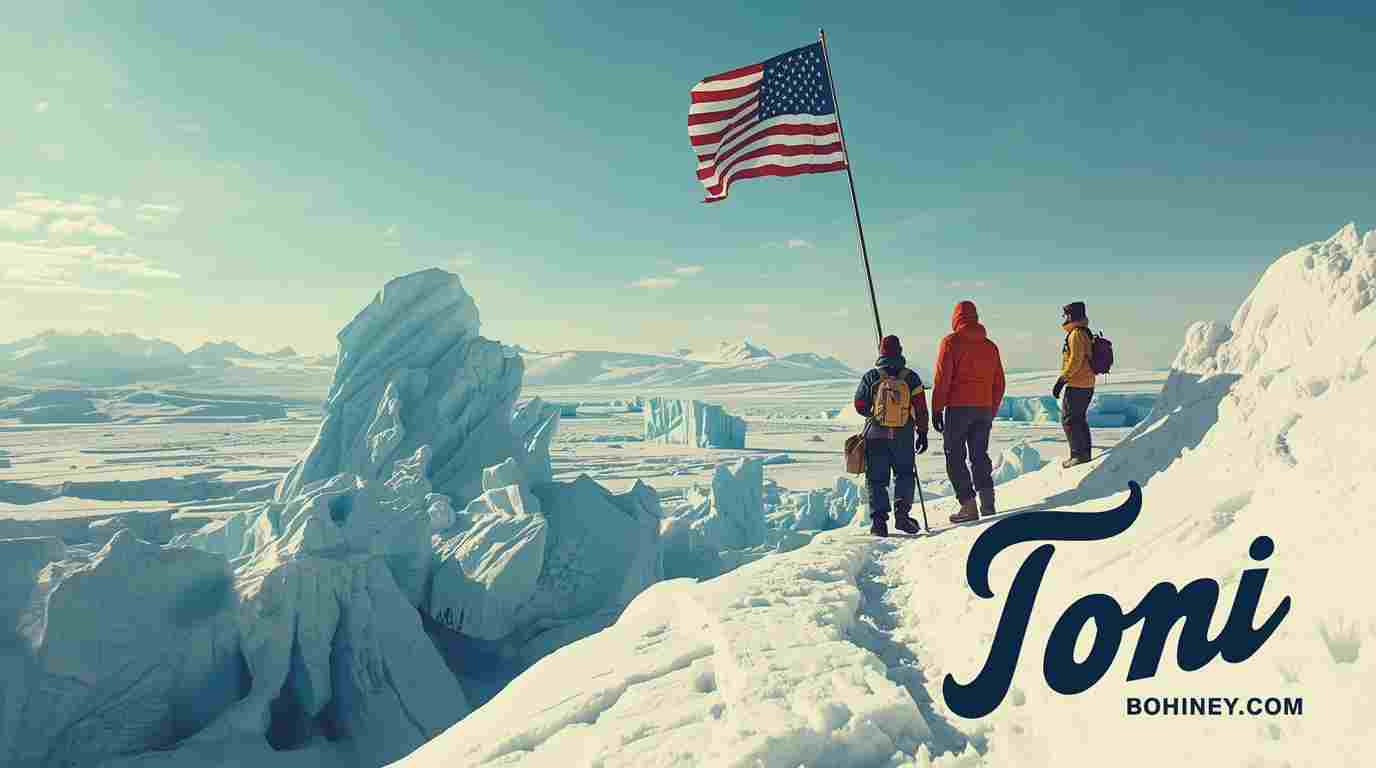
America Discovers Greenland Is Big, Cold, and Apparently Still Available
America has always been a nation of explorers. We explored the West. We explored space. We explored whether you could deep fry butter. So it was only a matter of time before someone in Washington looked at a giant frozen landmass near the top of the globe and said, “Wait… no one’s really using that, right?”
Thus began the renewed national conversation about Greenland, a place most Americans previously believed was either a color-coded suggestion on a globe or a discontinued Crayola shade. Suddenly, Greenland matters. Strategically. Emotionally. Cartographically.
The White House insists this interest is serious, sober, and rooted in national security. Which is exactly what people say right before they point at a map and go, “Look how big it is!”
The Map Phase of American Foreign Policy

Nothing excites American leadership quite like a map with arrows on it. The Fox News explainer alone used three maps, which in Pentagon math means something is definitely happening. Maps are the adult version of drawing a mustache on a yearbook photo. Once you’ve marked it up, you feel ownership.
Experts explained that Greenland sits at a crucial crossroads of Arctic shipping lanes, missile defense trajectories, and vibes. Yes, vibes. Because nothing says “strategic depth” like owning the world’s largest refrigerator during a climate change melt sale.
A retired general told reporters, “Greenland is the high ground of the Arctic.” Which is true, in the same way the roof of your car is the high ground of your driveway.
Strategic Real Estate or Frozen Wishful Thinking?
Here’s what we’ve learned: Greenland is massive, mostly ice, home to 57,000 people, and features more polar bears per capita than shopping malls. It’s the kind of territory that looks impressive on a Risk board but comes with complications like “winter lasting nine months” and “literally everything needs to be imported.”
“We could station missiles there,” said one defense analyst who clearly hasn’t tried assembling IKEA furniture in subzero temperatures. “We could monitor Russian activity.” Also true, assuming the monitors don’t freeze to the wall.
Buying Greenland: A Deeply Personal Transaction
Donald Trump’s interest in Greenland has been framed as transactional, but insiders say it’s deeply personal. Greenland is enormous, underpopulated, and doesn’t argue back much. In Trump terms, it’s basically a golf course that warns you about polar bears instead of sand traps.
One anonymous former aide described the pitch this way: “He liked that it was big. He liked that it was cold. He liked that Denmark seemed annoyed. That checked all the boxes.”
The idea that Greenland is “strategically necessary” also plays well on cable news, where necessity is defined as “something we just learned exists five minutes ago.”
The Art of the Greenland Deal
“Look, it’s simple,” explained one administration official between bites of a Big Mac. “We make an offer. They say no. We make a bigger offer. They say ‘Greenland belongs to Greenlanders.’ We offer to throw in Alaska as a trade. Everyone wins.”
This strategy has been described by diplomatic historians as “unprecedented,” “concerning,” and “exactly what we expected after covfefe.”
Denmark Tries to Explain Geography Like an Adult
Denmark’s response has been calm, measured, and deeply exhausted. Danish officials have repeatedly explained that Greenland is not for sale, belongs to Greenlanders, and is not a Costco pallet item.
This has confused Americans, who are used to the idea that if something has a price, it can be negotiated, and if it doesn’t, you just haven’t offered enough yet.
A Danish diplomat reportedly said, “Greenland is not a piece of real estate.” This was immediately translated in Washington as: “They’re playing hard to get.”
Lost in Translation: Danish No Means No
“We’ve tried explaining this seventeen different ways,” sighed a Copenhagen official. “In Danish. In English. In PowerPoint presentations with pie charts. Americans keep responding with ‘So you’re saying there’s a chance?'”
The Danish Prime Minister even called the proposal “absurd,” which in diplomatic speak translates to “please stop asking.” In American speak, it translated to “counter-offer pending.”
Greenlanders Wonder How They Got Dragged Into This
Meanwhile, Greenlanders have watched the spectacle with the polite alarm of people realizing their quiet hometown is trending on Twitter. Many locals support greater independence, but not in the sense of being absorbed into a superpower with a strong opinion about windmills.
One Greenlandic fisherman told a reporter, “We were discussing cod quotas yesterday. Today America wants to defend us from missiles we didn’t know were coming.”
Polls show Greenlanders overwhelmingly prefer self-determination, followed closely by “being left alone,” and then “not becoming a talking point on American morning shows.”
What Greenlanders Actually Want (Spoiler: Not This)
“We’d like economic development,” said one Nuuk resident. “Better infrastructure. Maybe some investment in renewable energy. What we didn’t ask for was becoming a subplot in American cable news.”
Another local added: “Our biggest concerns were sustainable fishing and maintaining our culture. Now our biggest concern is explaining to relatives abroad that no, we didn’t ask for this attention.”
NATO, Russia, China, and the Awkward Group Chat
Once America started talking about Greenland, Russia and China leaned forward like guys at a poker table who hadn’t realized the game was still going.
Suddenly, Greenland wasn’t just ice and seals. It was a chessboard. A frozen chessboard, which is the most dangerous kind because everyone slips and knocks the pieces over.
Analysts warned that failing to secure Greenland could allow rival powers to expand influence in the Arctic. This is always phrased as a warning, never as a reminder that maybe everyone should calm down and let the ice do its thing.
The New Cold War Is Actually Cold This Time
“We’re watching this very carefully,” said a Russian foreign ministry spokesperson, not blinking for seventeen seconds straight. “Very carefully.”
China, meanwhile, declared itself a “near-Arctic nation,” which is geographically equivalent to Kansas declaring itself a “near-coastal state” because someone once saw the ocean in a magazine.
Tariffs: America’s Universal Love Language
When diplomacy stalled, tariffs entered the chat. Threatening Europe with tariffs over Greenland felt less like foreign policy and more like a family argument where someone threatens to take away Christmas.
Economists tried to explain that tariffs wouldn’t actually make Greenland more American. This has never stopped tariffs before.
“If we can’t buy Greenland, we’ll tariff Denmark until they reconsider,” explained one trade advisor who clearly slept through the lecture on how geography works. “Also, we might tariff Greenland itself. You know, as a warning.”
Economic Leverage Meets Geographic Reality
Trade experts pointed out that threatening Denmark with tariffs might impact LEGO prices, which could turn American parents against the entire initiative faster than you can say “stepped on a brick barefoot.”
“We’re prepared to sacrifice Danish butter cookies for national security,” declared one senator who definitely receives campaign donations from non-Danish cookie manufacturers.
America’s True Motivation Finally Revealed
Strip away the strategy, the security briefings, the maps with arrows, and what remains is a deeply American impulse: if something is big, empty, and cold, we assume it’s waiting for us.
Greenland represents possibility. It represents dominance. It represents owning the world’s most intimidating ice cube tray.
“It’s about manifest destiny,” explained one historian. “But colder. And with fewer wagon trails. And the people living there keep politely asking us to stop.”
The Real Prize: Bragging Rights
In the end, Greenland may never become American. But for a brief, glorious moment, it reminded the nation that there are still places on Earth we don’t fully understand, but feel strongly about anyway.
“Imagine telling people you own Greenland,” mused one congressional staffer. “You’d automatically win every conversation about real estate. ‘Oh, you bought a lake house? That’s cute. I helped acquire an entire Arctic territory.'”
The fantasy persists because Americans excel at two things: dreaming big and misunderstanding maps.
Comedian Commentary: What They’re Saying
“Trying to buy Greenland is the most American thing ever. We see something covered in ice and think, ‘I could put a Starbucks there,'” said Trevor Noah.
“Trump wanted to buy Greenland, but Denmark said no. Which is weird because usually when Trump makes an unwanted advance, it takes years and an NDA,” said Seth Meyers.
“America wants Greenland for national security. You know what’s also good for national security? Not announcing your interest in territory you don’t own during a press conference,” said John Oliver.
“We’re threatening tariffs because Denmark won’t sell us Greenland. That’s like breaking up with someone because they won’t let you buy their house,” said Stephen Colbert.
“Greenland is mostly ice, has 57,000 people, and costs a fortune to maintain. So basically, it’s the perfect metaphor for American infrastructure,” said Samantha Bee.
“Russia and China are now interested in Greenland because America is. We’ve turned Arctic policy into a bidding war. Next up: who wants Antarctica?” said Jimmy Kimmel.
“Denmark keeps saying Greenland isn’t for sale, and America keeps asking anyway. It’s like being on a dating app but for imperialism,” said Hasan Minhaj.
“The Pentagon says Greenland is strategically vital. You know what else is strategically vital? Not pissing off our NATO allies over frozen tundra,” said Jon Stewart.
“Greenlanders support independence. Just not the kind where they become America’s 51st state right after we figure out what to do with Puerto Rico,” said Chelsea Handler.
“We want Greenland for Arctic shipping lanes. Apparently, we’re planning ahead for when climate change melts the ice caps. Very forward-thinking, in a depressing way,” said Bill Maher.
“Trump saw Greenland on a map and thought it was as big as Africa. Someone should tell him about that Mercator projection thing,” said Jimmy Fallon.
“America offering to buy Greenland is proof we treat international relations like a really aggressive game of Monopoly,” said Sarah Silverman.
Disclaimer: This article is a work of satire and commentary. Any resemblance to rational foreign policy is purely coincidental. This story is entirely a human collaboration between the world’s oldest tenured professor and a philosophy major turned dairy farmer, both of whom agree that if Greenland comes with free parking, America is definitely interested.
Auf Wiedersehen, amigo!