

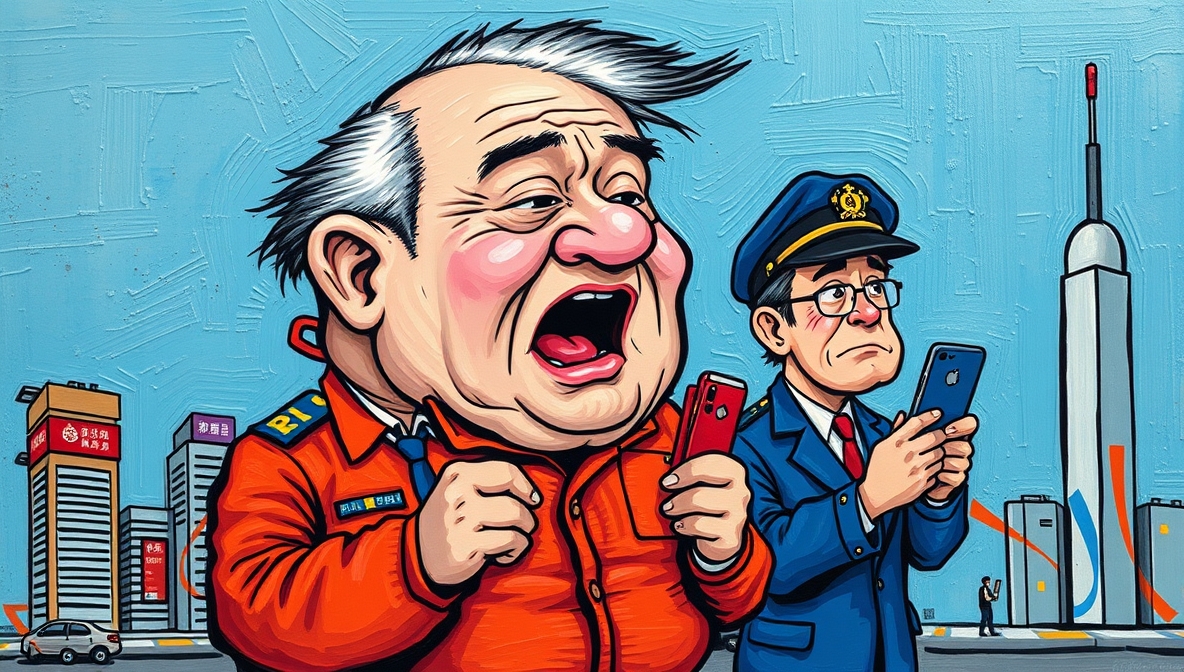
China Protests U.S. Warning, Says “Please Stop Warning People About Things We Just Announced”
Somewhere between diplomacy and a group chat argument where nobody admits they started it, tensions flared this week after China protested a U.S. advisory about Hong Kong’s shiny new “please hand over your passwords or else” policy.
According to the U.S. Consulate General in Hong Kong, Chinese officials expressed “strong dissatisfaction” after Washington warned its citizens that Hong Kong authorities can now require access to phones and computers in national security cases — effective March 23, 2026.

Which, in fairness, is like someone yelling, “Stop telling people about the surprise inspection we just gazetted, laminated, and posted on the door.”
Passwords, Please — And While You’re At It, Your Entire Digital Soul
Under the updated rules, refusing to provide passwords or assist with decryption can now land you in legal trouble. That’s not a typo. Not just your phone. Not just your laptop. Your complete digital existence, from your banking app to the embarrassing playlist you named “Do Not Open.”
Gadget Review reports that refusal carries a fine of HK$100,000 (roughly $12,700 USD) and up to a year in prison. Provide fake credentials? Three years. Which means your password strength is now directly proportional to your sentence length.
Experts say this marks a bold new frontier in law enforcement known as “Ctrl+Alt+Detain.”
A senior policy analyst, Dr. Leonard Grimsby of the Institute for Very Obvious Consequences, explained:
“Historically, governments needed warrants. Now they just need your Wi-Fi password and a decent charging cable.”
Meanwhile, a local eyewitness in Hong Kong, who asked to remain anonymous but insisted on being described as “extremely online,” offered this:
“I used to worry about forgetting my password. Now I worry about remembering it too well.”
U.S. Issues Travel Alert, Accidentally Invents Common Sense
The U.S. Consulate General issued a warning advising citizens to contact officials if detained under the new rules — advice technically known as “saying the quiet part at a normal volume.”
China, however, interpreted this as interference. Because nothing says “internal matter” quite like international tourists being told, “Hey, maybe don’t haul your entire digital life into a legal gray zone shaped like an airport.”
An anonymous State Department staffer, speaking from behind a stack of unread briefing documents, reportedly said:
“We didn’t even editorialize. We described the situation. Apparently that’s now considered commentary.”
Al Jazeera notes the new provisions also allow police to seize items with “seditious intention” — bypassing judicial authorisations entirely. In other words, the warrant went the way of the fax machine: technically still legal, just nobody’s using one.
Diplomatic Translation Guide (Now Updated for 2026)
Let’s decode the official statements using the ancient art of geopolitical translation:
- “Strong dissatisfaction” = Someone is definitely yelling in a conference room, probably at a speakerphone.
- “Firm opposition” = We would like you to stop doing the thing we cannot stop you from doing.
- “Internal affairs” = Everything. Including your phone. Especially your phone.
A leaked memo from a mid-level bureaucrat allegedly clarified: “If people know the rules, they might behave differently. And that creates… variables.”
Nothing creates variables like a population that reads the fine print.
What the Funny People Are Saying About Hong Kong’s Password Law
“I love that the policy is basically: ‘We respect your privacy. Please unlock it.'” — Jerry Seinfeld
“You ever notice how governments say ‘for your security’ like it’s a spa treatment? Sir, this is a cavity search for your iCloud.” — Ron White
“Nothing says romance like a country asking for your password before your date even asks your last name.” — Amy Schumer
Academic Community Finally Weighs In — Wi-Fi Is at Stake
A recent poll conducted by the Global Institute of People Who Just Heard About This found:
- 82% of respondents said, “Wait, they can WHAT?”
- 64% began deleting old messages immediately
- 12% tried to remember if they ever googled anything weird in 2012
- 100% suddenly became experts in international law
Professor Elaine Wickersham, a specialist in Digital Anxiety Studies, offered this sobering insight:
“This policy has achieved something remarkable. It has unified people across political lines in a shared panic about their search history.”
The Password Economy: VPNs, Encryption, and Emotionally Supportive Apps
Markets responded with the subtlety of a fire drill:
- VPN sales surged — Newsweek reports travelers are reassessing their entire digital hygiene regimen
- Password managers gained existential significance
- One startup began offering “emotionally supportive encryption”
Meanwhile, tech influencers began posting tutorials titled: “How to Forget Your Password Before the Government Asks For It.”
A Silicon Valley entrepreneur announced a new app called “Amnesia™,” which automatically scrambles your memory when approached by authority figures. Early reviews describe it as “legally questionable but spiritually comforting.” The app store rating: four stars, one review from a Hong Kong transit lounge.
Strider Intel — which tracks CCP convergence with Hong Kong’s legal environment — notes the change extends beyond device owners to anyone who knows access details: your spouse, your business partner, your IT administrator, and apparently your golden retriever if he ever watches you type.
Cause and Effect, Explained Slowly for Everyone
Let’s walk through the logic, step by loving step:
- Government introduces rule requiring password access
- Other government warns its citizens
- First government protests the warning
- Everyone pretends this is surprising
It’s like announcing a rainstorm, then getting upset when someone brings an umbrella. And then confiscating the umbrella as a national security risk.
The Philosophy of “Don’t Tell People What We Told People”
At its core, this situation raises a profound philosophical question:
If a rule is publicly announced, but another country mentions it… is it still internal?
A dairy farmer-turned-philosopher in Nebraska weighed in:
“If you put a sign on the barn that says ‘Watch out for the bull,’ you can’t get mad at your neighbor for reading it out loud.”
He also noted that the bull didn’t consent to the sign either, but that’s a different legal matter.
Real-World Impact: Packing Lists in the Age of Digital Surveillance
Critics argue the rules could fundamentally erode privacy and due process. JURIST notes the amendments represent one of the most aggressive expansions of digital surveillance power in any jurisdiction still claiming common law traditions. Supporters argue they’re necessary for stability — which is what someone always says right before stability becomes the only thing left.
Everyone else is quietly updating their passwords to something like: “NotTodayOfficer123!”
Meanwhile, travelers are reportedly adopting new packing lists:
Passport ✔️
Charger ✔️
Completely clean digital conscience ❓
Burner phone purchased in a different timezone ✔️
Closing Thoughts: Diplomacy in the Age of Screenshots
This entire episode feels less like international relations and more like two people arguing over who screenshot the conversation first.
One side says, “Don’t interfere.”
The other says, “We’re just telling people what you said.”
And somewhere in the middle, a tourist is nervously deleting memes from 2017.
Because in 2026, the most dangerous thing you can carry across borders isn’t contraband.
It’s your group chat.
This satirical article is a collaborative effort between two highly sentient beings: the world’s oldest tenured professor and a philosophy major turned dairy farmer. Any resemblance to real diplomatic confusion, password anxiety, or geopolitical group chats is entirely intentional. Reader discretion advised, especially if your password is still “password.” Auf Wiedersehen, amigo!
On March 23, 2026, Hong Kong’s government amended the implementing rules of its National Security Law, making it a criminal offense to refuse police access to personal electronic devices, including passwords and decryption assistance. The rules apply to everyone — residents, tourists, and travelers transiting Hong Kong International Airport, including U.S. citizens. The U.S. Consulate General in Hong Kong issued a security alert on March 26, prompting China to lodge a formal diplomatic protest accusing Washington of interference in internal affairs. The changes are part of a broader pattern of legal convergence between Hong Kong and mainland China following the passage of the Safeguarding National Security Ordinance in 2024, which itself followed the original National Security Law imposed by Beijing in 2020 after large-scale pro-democracy protests shook the city.