

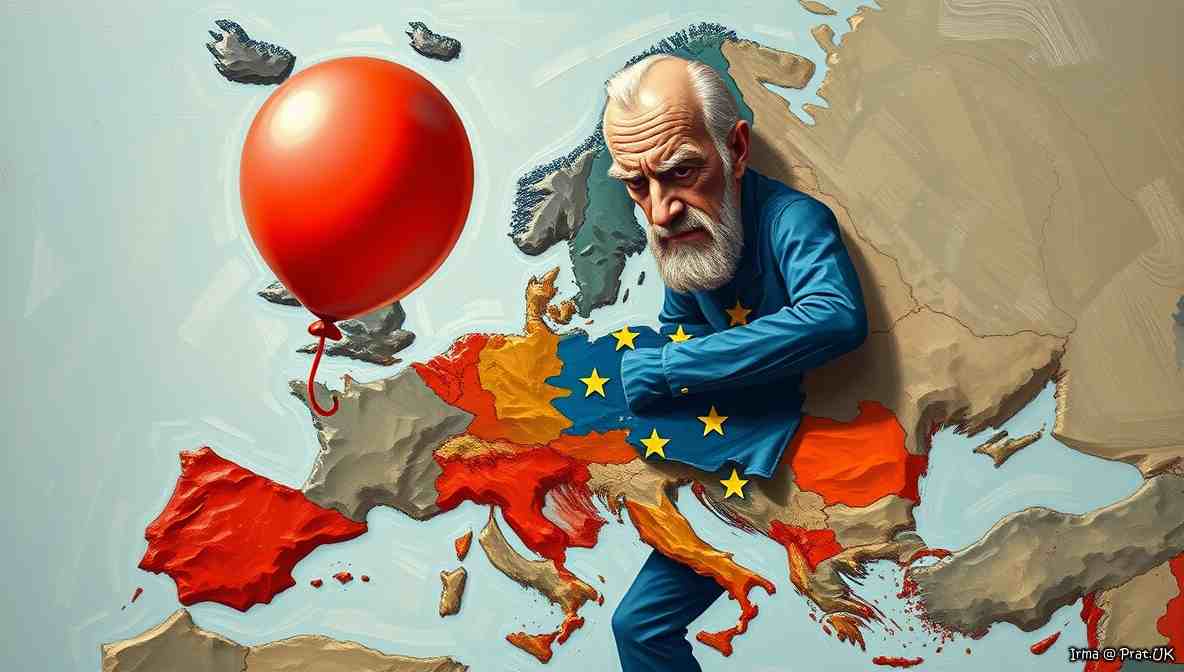
Europe Has ED: A Continent-Wide Performance Problem That No Amount of Summit Hosting Can Fix
A frank medical assessment of European military capability, offered in the spirit of a good friend who tells you the truth before you embarrass yourself further at the press conference.
The Condition Nobody In Brussels Will Name
Let’s talk about something that the diplomatic community refuses to say out loud. Europe has a performance problem. Not an attitude problem. Not an interest problem. Not a values problem. A performance problem. The desire is clearly there — the speeches are magnificent, the summits are impeccably catered, and the joint statements arrive with the regularity of a Swiss train. But when the actual moment of military necessity shows up unannounced at the door, Europe consistently fails to deliver.
This has been developing for a long time. While America maintained carrier strike groups, Europe held coordination meetings. While America spent 3.2% of GDP on defence, most of Europe spent below 2% for the better part of a decade, pledged to hit 2% in 2014, and finally got there in 2025. Eleven years. For a pledge made on a weekend in Wales. That is what chronic looks like.
The clinical term is capability gap. The honest term is what the headline says. Europe has ED. And like all conditions of this kind, the most counterproductive response is to keep announcing how ready you are.
Twenty Clinical Observations, Presented in the Public Interest
1. Europe Talks a Big Game but Cannot Perform When It Counts
The statements that come out of European capitals in a crisis are extraordinary. “We stand ready.” “We will protect freedom of navigation.” “The unconditional and immediate reopening is a global responsibility.” Keir Starmer accused Iran of holding the world’s economy to ransom. Strong words. Bold framing. And the plan to back it up? Deploy a coalition, strictly defensive, when conditions allow, once the fighting is completely over. You do not accuse someone of holding the world to ransom and then announce you’ll intervene once they’ve already let it go.
“Europe’s strategy is like sending a strongly worded letter to a fire. Beautifully drafted. Arrives after the ash has cooled.” — Jerry Seinfeld
2. Every Summit Ends the Same Way — A Resolution and Nothing Else
The Paris summit on 17 April 2026 brought together 51 nations at the Élysée Palace to advance the Strait of Hormuz Maritime Freedom of Navigation Initiative. A magnificent name. A genuinely impressive gathering. And the Strait of Hormuz announced it was reopening the same afternoon, through means that did not involve any of the 51 nations in the room. Europe’s multilateral framework arrived at the moment of its own irrelevance, took a seat, and issued a joint statement about how the reopening must be permanent. It must be permanent. Thank you for clarifying that. The tankers had already figured that out.
3. Promising to Get Hard on Defence Since 2014 and Still Working on It

The Wales Summit NATO pledge to spend 2% of GDP on defence was made in 2014. In 2014, three allies met it. By 2025, all allies finally met it — after a 20% increase in European spending compared to 2024. So it took eleven years of sustained effort, a Russian invasion of Ukraine, an Iranian war, and a US president publicly calling NATO a “Paper Tiger” before the check cleared. Now the target has been upgraded to 5% by 2035. Place your bets on 2040.
4. NATO Is Couples Therapy for a Alliance That Refuses to Commit
Seventy-five years of the most successful military alliance in history, and the central argument is still the same: who pays and how much. The Washington Post noted that European nations had been “slacking for too long because of the American security umbrella.” That is a polite way of saying Europe treated America like a security guard it forgot to pay for three decades, then acted surprised when the security guard got irritated. NATO works. NATO has always worked. It works because America shows up with actual warships and Europe shows up with the earnest conviction that this time things will be different.
“NATO is a great alliance. One partner brings the aircraft carriers. The other brings the commitment to eventually fund aircraft carriers, subject to parliamentary approval.” — Ron White
5. France Has the Strongest Military in Europe, Which Sets the Bar Lower Than It Sounds
France is the real deal by European standards. A nuclear-powered aircraft carrier. A helicopter carrier. Several frigates deployed to the Mediterranean when the crisis hit. A 2026 defence budget of €68.5 billion. France is Europe’s serious military power and should be credited for showing up with actual ships. The problem is that “France is Europe’s strongest military” is a statement that sounds impressive until you compare it to what America brought to the same crisis: carrier strike groups, blockades, mine-clearing operations, and the general energy of a country that did not spend the last thirty years defunding its navy on the assumption that everything would work out fine.
6. Britain Left the EU, Kept the Military Weakness, and Called It Sovereignty
Brexit was sold as reclaiming control. Britain got its laws back, its fish back, its borders back, and kept every single one of its defence problems with no allies left to split the embarrassment. The Centre for European Policy Analysis reported that 2026 has been “a horrible year for Britain’s Royal Navy, whose strength has now fallen to historic lows.” The Royal Navy could not send a warship to defend British assets in Cyprus when a UK air base came under drone attack in March. HMS Dragon sailed ten days later. By then the French fleet had eleven ships already in the Mediterranean. Global Britain showed up eventually. Sovereignty waits for no one. Ships, apparently, do.
7. The Royal Navy Can Project Power Anywhere That Accepts One Destroyer and a Drone Named After a Bay
As of early 2026, both of Britain’s aircraft carriers were out of action simultaneously. Only three of six Type 45 destroyers were available. Only six of eight Type 23 frigates were operational. Just one in five Astute-class submarines was in the water. Of the Royal Navy’s 63 total ships, about half were available for duty. The former First Sea Lord, Admiral Lord West, called it “a disgrace” and said “we are so weak at the moment.” He is an admiral. Admirals do not use the word disgrace recreationally. When an admiral says disgrace, he means it in the full technical sense.
“The Royal Navy has two aircraft carriers. Both are currently unavailable. This is less of a naval strategy and more of a scheduling problem.” — Bill Burr
8. Macron Announces Big Plans With Absolute Confidence
Nobody commands a podium like Emmanuel Macron. The Élysée setting. The precision-tailored suit. The calm authority of a man who has decided what reality is and is simply informing it. Macron told the assembled 51 nations that the mission would be “strictly defensive,” “neutral,” and focused on “safeguarding commercial shipping routes.” He said it with the complete conviction of a man who has never personally had to find a warship on short notice. Academic analysis of Europe’s new 5% NATO target notes that “the current debate risks conflating commitment with capability.” Commitment is Macron’s natural habitat. Capability is a longer conversation.
9. “Strictly Defensive” Is the Military Posture of Someone Who Has Already Given Up on Offense
A strictly defensive military posture that activates only after all fighting has ended is not a posture. It is a schedule. It says: we will be present after the danger has been neutralised, we will secure the peace that others built, and we will do so in a strictly peaceful and reassuring way that does not upset anyone. Henry Jackson Society analyst Barak Seener said plainly that it is “laughable” for non-belligerent nations willing to engage only after hostilities end to claim they are protecting shipping lanes. Laughable is a strong word from a think tank. Think tanks are not known for recreational laughter.
10. Fifty-One Countries Agreeing to Act When Safe Is a Support Group
The coalition assembled by Starmer and Macron included 51 nations. More than a dozen agreed to actually contribute military assets. The other 35-plus contributed video conference attendance, solidarity statements, and the implicit promise to contribute more substantially next time conditions allow. A real coalition requires shared risk. A French presidential official noted they would need “an Iranian commitment not to fire on passing ships and a US commitment not to block any ships” before any mission could proceed. So the preconditions for the defensive mission include the people you are defending against agreeing not to attack you. That is not a military strategy. That is a permission slip.
“Fifty-one countries on a Zoom call about protecting the Strait of Hormuz. Meanwhile America is in the strait with an aircraft carrier. This is like watching someone read a book about swimming while you do laps.” — Dave Chappelle
11. The EU Built a Single Market but Cannot Build a Single Carrier Between 27 Nations
The European Union has standardised food labelling, mobile phone chargers, and the acceptable curvature of cucumbers. It has not managed to field a jointly-owned aircraft carrier, a joint rapid-reaction force with teeth, or a procurement system that delivers ships on time. EU defence investment reached a record €106 billion in 2024, up 42% from 2023. Impressive growth. Still no joint carrier. Still no force that can operate independently of the United States in a high-intensity conflict. The EU can regulate the dimensions of a pillow. Projecting force into a contested strait requires something the regulations cannot supply.
12. Europe’s Doctrine: Respond Decisively Once the Threat Resolves Itself
The Hormuz crisis began on 28 February 2026. The Paris summit happened on 17 April 2026. The strait reopened the same day. That is 48 days from crisis to summit, arriving simultaneously with resolution. European defence scholars are frank about the cause: “For more than three decades, European states have neglected their defence.” Three decades of neglect does not get resolved in 48 days of summitry. It gets acknowledged in 48 days of summitry, which is different, and then filed with the previous 47 acknowledgments from previous crises.
13. “We’re Not Getting Dragged Into the War” Is a Strategy Built on Having No Other Options
Starmer’s line — “we’re not getting dragged into the war” — is an honest statement of British policy. It is also an honest statement of British capability. The Royal Navy is reportedly considering requesting French naval support to patrol British waters due to a severe shortage of operational warships, with only one submarine and two frigates available for immediate deployment. When your island nation is considering asking a foreign navy to patrol your own coastline, “not getting dragged into the war” stops being a strategic choice and becomes a logistical constraint. You cannot get dragged into a war you lack the ships to fight. This is called restraint. It sounds better that way.
“‘We’re not getting dragged into the war’ is a fine policy. It’s even better when you have the option of getting dragged in and choose not to. When you have one destroyer left, it’s just a description.” — Amy Schumer
14. Germany Mine-Clears, Italy Volunteers, Britain Sends Vibes, France Sends Frigates
The coalition breakdown is instructive. Germany: mine-clearing capability. Italy: expressed willingness and a naval unit. France: aircraft carrier, helicopter carrier, several frigates — actual power projection. Britain: HMS Dragon (which returned to a Greek port following operational issues), mine-hunting drones proposed from RFA Lyme Bay, and the leadership of an initiative that the strait did not wait for. Between them, they constitute a useful post-conflict capability and a fairly comprehensive inventory of Europe’s hard-power limitations. The gap between what Europe can contribute and what America brought to the same situation is the gap between mine-clearing drones and carrier strike groups. That gap has a name. It is called the last thirty years.
15. The Press Conference After Always Claims Enormous Success
The joint statement from the Paris summit declared a commitment to “freedom of navigation,” “international law,” and “global economic stability.” Macron said “we all demand the full, immediate and unconditional reopening.” This was issued while the strait was already reopening. The demand was issued after the condition it demanded had been achieved. This is the geopolitical equivalent of demanding your steak be cooked medium-rare after the waiter has already brought it to the table and you have eaten half of it. The demand is noted. The steak does not care. The strait has already moved on.
“Nothing like a summit declaration demanding something that’s already happening. Very efficient use of everyone’s time.” — John Mulaney
16. America Brings Carriers. Europe Brings Frameworks. Frameworks Don’t Float.
US defence spending in 2025: an estimated $980 billion, approximately 3.2% of GDP. Total European NATO defence spending combined: $574 billion. America’s contribution to the Hormuz crisis: carrier strike groups, port blockades, mine clearance, hard resolution of the situation. Europe’s contribution: the Strait of Hormuz Maritime Freedom of Navigation Initiative, 51 attendees, a joint statement, mine-hunting drones pending deployment when conditions allow. Trump posted on social media that NATO was a “Paper Tiger” and to stay away unless they wanted to load up with oil. He was not entirely wrong about the dynamic, even if his delivery left room for diplomatic improvement.
17. Britain Left the Relationship and Discovered It Still Had All the Same Problems
Brexit was a sovereign choice with real consequences. One consequence: Britain now faces its defence problems alone, without EU burden-sharing, without joint procurement frameworks, and without the ability to blame Brussels for anything. Britain had to hand its NATO maritime leadership role to Germany because it did not have enough ships. Germany — the country that spent most of the twentieth century not being militaristic, as a considered historical lesson — is now leading a NATO naval rapid-reaction group carrying British personnel because Britain ran out of available warships. History has a sense of humor. It is not always gentle about sharing it.
18. The Defence Budget Is Europe’s Version of the Prescription Nobody Wants to Fill
The NATO 5% target agreed at The Hague Summit is real. Academic analysis suggests that meeting it without creating unsustainable deficits will require major fiscal trade-offs and voter buy-in that does not currently exist in most Western European countries. Poland is at 4.48% and spending seriously. The Baltic states are spending seriously. Germany has committed and is following through. But France is at 2.25% with “wider deficit pressures.” Britain has a long-delayed defence investment plan that has still not been published. Knowing you need the prescription and actually filling it are two very different steps, separated by a conversation with the electorate that nobody wants to have.
“Europe agreed to spend 5% of GDP on defence by 2035. They agreed to spend 2% in 2014. We’ll check back in 2046.” — Nate Bargatze
19. “Strictly Peaceful” Is Not a Military Posture. It Is a Bumper Sticker.
Starmer confirmed the mission would be “strictly peaceful and defensive, as a mission to reassure commercial shipping and support mine clearance.” Reassure. Commercial. Shipping. Those are words for a customer service operation, not a military deployment. The Royal Navy at its peak did not reassure shipping. It protected it, escorted it, and destroyed anything that threatened it. Now Britain’s contribution to a major geopolitical crisis is to reassure tanker captains that everything will probably be fine and offer to check under the water for mines, eventually, once the country that actually cleared the mines has confirmed the water is safe to approach. This is not decline. This is just what happens when you underfund a navy for thirty years and then act surprised that it cannot project power on demand.
20. Europe Arrived After the Moment Had Passed — Which Is the Whole Condition, Stated Simply
The Strait of Hormuz opened on 17 April 2026. The summit was on 17 April 2026. The coalition to reopen the strait formed while the strait was reopening without it. This is not a one-time failure. This is the pattern. Thirty years of defence neglect has left Europe in a position where its military role in crises is cleanup, not prevention. Mine-clearing after America clears the mines. Navigation protection after America opens the navigation. Framework-building after the framework is no longer needed. Europe is not useless. Europe is chronically, structurally, architecturally late. And lateness, in a crisis, is the same as absence — just with better documentation.
The Treatment
This condition is treatable. The prescription has been known for years: more ships, more ammunition stockpiles, more readiness, less relabelling of non-military spending as defence investment. Poland is doing it. The Baltic states are doing it. Germany is doing it. The question is whether Britain and France — the two nations that convened 51 countries at a Paris palace to talk about protecting a strait they could not protect — will move from announcing the treatment to actually taking it.
The NATO Secretary General has said clearly that Europe needs a lot more than 2%. America has been saying this since roughly the Clinton administration. The message has arrived. It has been received. It has been added to the agenda for the next summit.
Until then, Europe will continue to project something. Not power, exactly. More of a confident intention to project power, subject to conditions allowing, pending coalition confirmation, and scheduled for deployment once the situation has been resolved by others.
Which is not impotence, they’ll tell you.
It’s strategic patience.
The strait knows the difference.
Auf Wiedersehen, amigo!
This satirical piece draws on events surrounding the Strait of Hormuz crisis of 2026. The US-Israeli war on Iran began on 28 February 2026, after which Iran closed the strait through which approximately one fifth of the world’s oil passes; the US compounded the disruption by imposing its own blockade on Iranian ports. On 17 April 2026, France and the United Kingdom co-chaired a 51-nation Paris summit to advance the Strait of Hormuz Maritime Freedom of Navigation Initiative, a strictly defensive mission to protect commercial shipping once a ceasefire is in place; Iran announced the strait was reopening the same day. The Royal Navy’s contribution to the regional crisis was HMS Dragon, its sole major deployed warship, which had returned to a Greek port following operational difficulties; Britain also proposed deploying mine-hunting drones from RFA Lyme Bay. The Royal Navy simultaneously ceded its leadership of NATO Standing Maritime Group One to the German frigate Sachsen due to a shortage of available warships. As of early 2026, roughly half the Royal Navy’s 63 ships were available for duty; both Queen Elizabeth-class carriers were out of action. NATO’s 2% of GDP defence spending pledge, made at the 2014 Wales Summit, was first universally met in 2025; the 2025 Hague Summit upgraded the target to 5% by 2035. The Royal Navy is reportedly considering requesting French naval assistance to patrol British waters.