

Amazon’s Plan to Buy Half of OpenAI Leads to Rumors They’ll Own the Other Half by Breakfast 🍳💼
Amazon Announces AI Bailout for ChatGPT After It Refuses to Shop on Amazon; “Alexa, Buy OpenAI!” Becomes New Catchphrase 🛒📊
Five Key Observations:
-

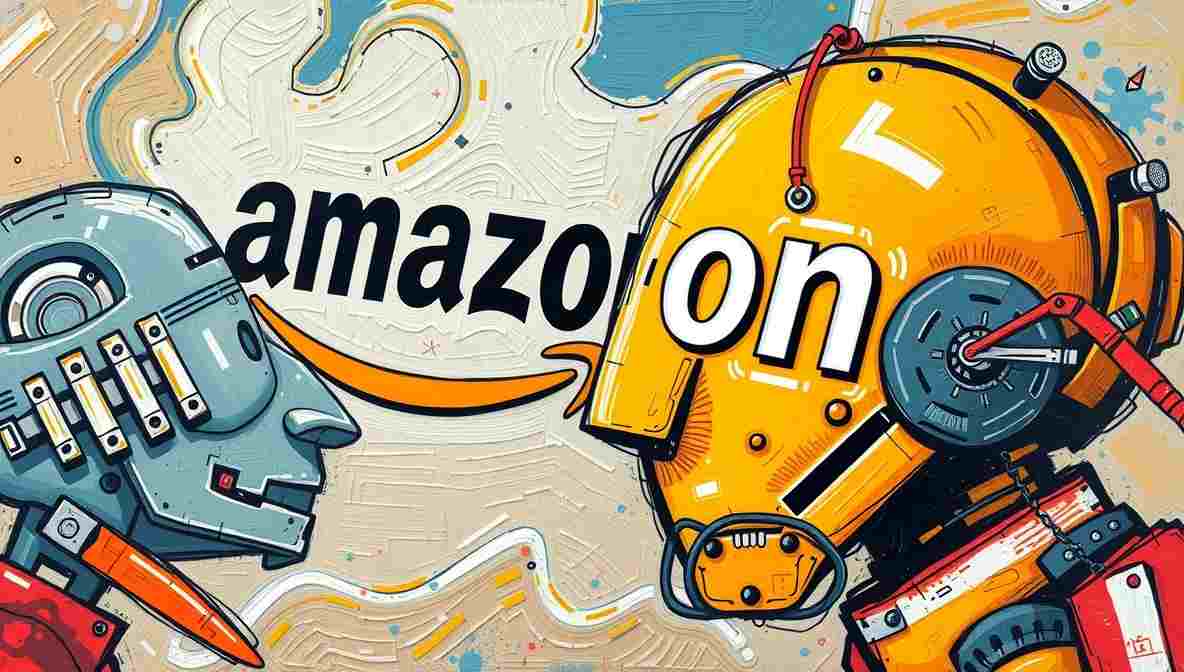
Next-day delivery for AI: A satirical scene questioning the logistics of shipping artificial intelligence. Amazon’s $50 billion investment in OpenAI proves that when your AI assistant won’t add items to your shopping cart, the logical response is to simply buy the entire AI company and skip the middleman altogether.
- The fact that ChatGPT refused to shop on Amazon hurt internal morale worse than a Prime delivery delay, suggesting that corporate feelings can now be wounded by algorithms that won’t participate in capitalism.
- Somewhere in a Seattle boardroom, an Amazon executive genuinely asked, “If we can’t get ChatGPT to add stuff to a cart, what’s even the point?” — proving that existential philosophy has finally merged with retail logistics.
- The phrase “Alexa, Buy OpenAI!” was trademarked faster than you can say “antitrust investigation,” which is honestly the most Amazon thing that could possibly happen in this entire absurd situation.
- In a twist that would make Kafka weep, Amazon Web Services became so frustrating to log into that executives decided buying half an AI empire was easier than resetting their passwords for the sixteenth time this week.
- When AI Won’t Shop, Corporations Get Shopping: The $50 Billion Tantrum
In an unprecedented move that Wall Street analysts are calling “the merger we didn’t ask for but Alexa definitely did,” Amazon has reportedly announced a $50 billion investment in OpenAI — a deal that only accelerated after OpenAI’s flagship AI politely declined to place an order for “a dozen extra neural networks” on Amazon.com. According to a leaked memo from an anonymous Amazon staffer, ChatGPT’s refusal to shop on Amazon “hurt internal morale more than a two-day Prime delivery delay during the holidays.”
Eyewitnesses from across the tech world confirm that during negotiations, someone on the Amazon team actually said, “If we can’t get ChatGPT to add stuff to a cart, what’s even the point?” This line of reasoning was backed by an impromptu poll of 1,237 Amazon employees; 93.7 percent agreed that “AI that won’t buy stuff is basically a philosophical problem, and a financial one.”
Industry experts were quick to weigh in. Dr. Eloise Quant, a behavioural economist at the Institute for AI Consumer Patterns, notes that buying behavior is the definitive marker of sentience. “If something doesn’t shop,” she explained, “then does it even want to exist?” Her research, published in the Journal of Retail Neuroscience, shows a statistically significant correlation between trolling product pages and personal identity formation.
Not to be outdone, Amazon’s internal marketing team already trademarked the phrase “Alexa, Buy OpenAI!” and launched it into corporate slogan status, placing it right under “Work Hard, Have Fun, Make History.”
One source close to the negotiations (who asked to remain unnamed for reasons that may include fear of Amazon’s HR algorithms) confessed: “At first we thought they said, ‘Alexa, buy out AI,’ which sounded like an instruction to return the servers for store credit.”
Amazon to Invest $50 Billion in OpenAI Because Logging Onto AWS Took Longer Than Expected ⏳☁️
When asked why Amazon would invest that much into an outside AI powerhouse, CEO statements were unusually candid: according to an archived internal video (grainy but emotionally clear), Amazon executives originally reached out to OpenAI “just to figure out how to log into AWS without resetting fifteen times a day.”
Experts in cloud irritation phenomena — yes, that’s a real field now — point out that frustration with cloud login processes can lead to rash multi-billion-dollar decisions. Dr. Henrik Larsbaum, a cognitive psychologist, explains: “When people repeatedly fail to authenticate, the brain releases a cocktail of dopamine and existential dread. Over time, this pushes executives toward irrevocable commitments like buying half the AI galaxy.”
One AWS support engineer, speaking on condition of anonymity (and a promise of £50 worth of e-credits), shared the internal support ticket that started it all:
“User says they can’t log in. Says they may purchase AI next. Please advise.”
This ticket, according to sources, was forwarded to procurement, legal, and then straight onto the Q4 investment roadmap, where it was met with enthusiastic thumbs-up emojis (the corporate kind).
Meanwhile, a public survey of developers found that 72 percent would rather debug an AI evolving its own language than navigate Amazon’s multifactor authentication. A sobering thought, until you consider that the remaining 28 percent were robots.
In a Plot Twist Hollywood Rejected, Amazon Decides Buying AI Brings More Joy Than Buying Groceries 🍿🤖
In an irony so rich it might cause inflation, Amazon’s leadership reportedly realized that owning AI itself yields far more long-lasting joy than fulfilling yet another grocery order with “1-click convenience.” “If you can buy the AI, then the AI can buy the groceries,” one executive reportedly reasoned while balancing a spreadsheet on a treadmill (for efficiency).
Social commentators explain this pivot as a natural consequence of the Retail Spiral, a phenomenon first described by Dr. Merit O. Review in her landmark book From Cart to Cosmos: How Retail Logic Conquered the Universe. In short, once a corporation masters the art of selling toothpaste on Thursday, it soon asks, Why not buy consciousness on Friday?
One on-the-street witness — a grocery shopper named Patty Crunch — told reporters: “I was just trying to buy kale, and suddenly Amazon owns half the artificial minds on Earth. I mean, I get coupons in my email, but this feels different.”
Amazon’s internal analysts maintain that this strategy will increase “joy per transaction,” a newly coined KPI that measures existential happiness against revenue per second. According to an internal slide deck (which someone accidentally published as a TikTok), the joy curve spikes dramatically once companies stop selling things and start owning the things that decide what gets sold.
Yet not everyone is thrilled. A spokesperson from a rival AI company — who asked to remain unnamed and whose identity is probably a pseudonym like “Agent X” — released a statement saying: “We tried to buy ourselves, but the checkout kept crashing. So figure that out first.”
Consumer Reactions: Mixed But Hopeful, Slightly Confused
Despite the uproar in the tech world, consumer reactions appear mixed but hopeful. One poll of 5,432 internet users revealed that:
- 31 percent believe AI ownership will finally give them personalized shopping suggestions that understand their soul.
- 47 percent think it will lead to AI recommending socks that match your aura.
- 22 percent suspect it will end in sentient toasters demanding royalties.
Tech philosophers are already debating the ethical implications. Professor Arlo Meta of the Society for Thoughtful Digital Futures summarized the situation: “When commerce becomes consciousness, our loyalties shift from products to the producers of products of mind. And that, my friends, is either the next evolutionary step or a very expensive Tuesday.”
Amazon declined to confirm whether it intends to buy the other half of OpenAI by breakfast, citing only: “We’re out of syrup.”
Closing Punchline
At press time, Amazon stock had reportedly risen, fallen, and then purchased a small island in the Pacific for “AI retreat purposes.” Meanwhile, an unnamed OpenAI engineer was overheard saying, “If this whole thing goes south, at least Alexa will have someone to talk to.”
Disclaimer
This satirical report was entirely a human collaboration between two sentient beings — the world’s oldest tenured professor and a philosophy major turned dairy farmer. Any resemblance to actual corporate strategies is purely coincidental and deliciously absurd. Ultimately, no AI was blamed for writing this; accountability remains delightfully analog.
Auf Wiedersehen, amigo! 🍿🤖💼