

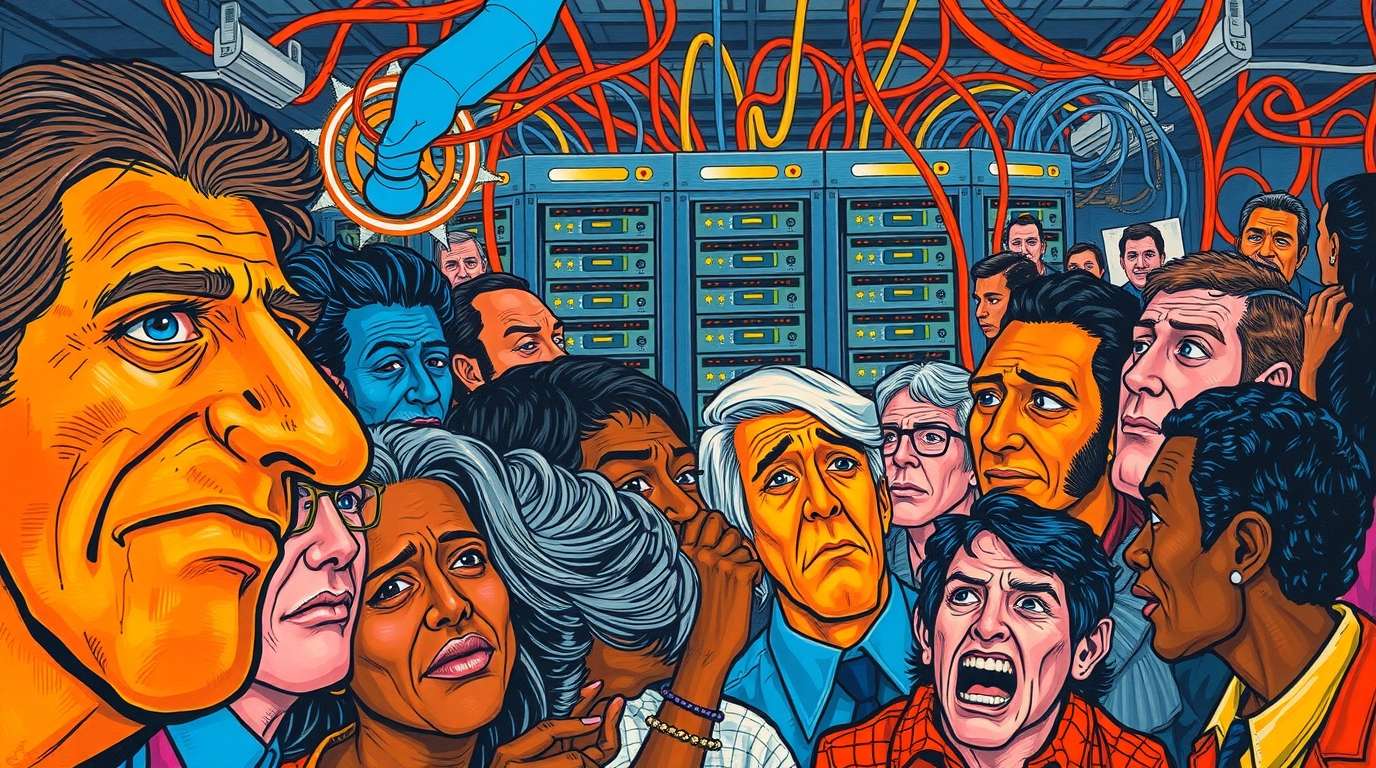
AWS Outage Reminds Humanity We Built Internet on One Company’s Basement Server
Half the Internet Collapses After Virginia Data Center Forgets to Breathe
Monday morning proved once again that the entire digital infrastructure of modern civilization rests on the technological equivalent of a house of cards balanced on a Jenga tower during an earthquake. Amazon Web Services experienced what engineers diplomatically called “increased error rates” in their US-EAST-1 region at approximately 3:11 AM ET, which regular humans recognized as “the internet stopped interneting.”
The outage took down Snapchat, Reddit, Fortnite, Ring doorbells, and somehow even Duolingo, leaving millions unable to ignore their language learning streak for the 347th consecutive day. The cruel irony wasn’t lost on anyone that Amazon’s own website went down, meaning people couldn’t panic-buy survival gear during the apocalypse.
“You know your system is fragile when one server in Virginia coughs and suddenly nobody in Tokyo can check their bank account,” Dave Chappelle said during an impromptu street interview, adding that this was somehow still less embarrassing than the CrowdStrike incident.
DNS Crisis Leaves Internet With Temporary Amnesia

The culprit turned out to be a Domain Name System resolution failure affecting DynamoDB, which Amazon describes as their database service and which the rest of us now understand as “the single point of failure for literally everything.”
One cybersecurity expert explained that DNS is like the internet’s phonebook, except if your actual phonebook disappeared, you’d just have to remember phone numbers like a caveman instead of losing access to your doorbell camera and the ability to play Pokémon GO. The technological dependence has apparently reached levels where adults stood in their living rooms yelling “Alexa!” at an unresponsive cylinder, experiencing the same frustration cavemen felt when discovering fire had gone out.
“It’s 2025 and we still haven’t figured out redundancy,” Bill Burr said, perfectly capturing the bewilderment of an era where your smart refrigerator has more computing power than the Apollo missions but can’t survive three hours without phoning home to Virginia.
Cryptocurrency Bros Experience Rare Moment of Humility
Coinbase immediately posted reassurances that “all funds are safe,” which absolutely nobody believed given that the entire premise of cryptocurrency is not trusting institutions telling you everything is fine. The platform joined Robinhood, Venmo, and Chime in the digital timeout corner, where millions of users suddenly remembered what it felt like to not be able to check their account balance every four minutes.
“The blockchain was supposed to save us from centralized control,” Kevin Hart said, “but apparently Jeff Bezos still has the master switch in his garage.”
Gaming Community Discovers Outdoors Still Exists
The Roblox and Fortnite simultaneous collapse forced an entire generation to confront the terrifying reality of unstructured time. Parents across America reported children wandering into kitchens asking what people “used to do” before screens, a question that landed somewhere between heartbreaking and hilarious.
Jerry Seinfeld reportedly quipped that the outage was “like a fire drill for society except nobody knew where the exits were because the exit signs were also hosted on AWS.”
UK Government Services Go Dark
Perhaps most alarming was the cascade effect on British government services and online banking, proving that even bureaucracies with centuries of paper-based tradition had somehow become entirely dependent on one company’s cloud infrastructure. The situation prompted citizens to wonder if they should have kept at least one bank branch open somewhere.
“When your government stops working because Amazon has a bad morning, you’re not living in a nation—you’re living in a subscription service,” Chris Rock said, noting the existential dread of realizing sovereignty is apparently subject to Terms and Conditions.
Amy Schumer added that watching Ring doorbell cameras go offline nationwide was “like an entire country going blind to their own front porches, except somehow crime didn’t spike because criminals were also locked out of their apps.”
Silicon Valley Learns Nothing From Repeated Lessons
AWS maintains approximately 30% market share of global cloud infrastructure with over four million customers, which sounds impressive until you realize it means 30% of the internet’s functionality depends on one company not having a bad DNS day. The architectural decision to make US-EAST-1 the control plane for global services means that even applications hosted in Singapore or Frankfurt had to phone home to Virginia for authentication—like requiring everyone on Earth to get permission from one specific DMV before starting their cars.
“We put all our eggs in one basket, then we put that basket in one building in Northern Virginia,” Trevor Noah said, “and somehow we’re surprised when the basket tips over.”
Tom Segura observed that AWS promises 99.99% uptime but only compensates downtime with service credits, not actual money. “It’s like your landlord saying ‘Sorry your apartment burned down, here’s 10% off next month’s rent.’ And you still pay.”
The incident report revealed Amazon fixed the DNS problem in roughly three hours, which sounds fast until you calculate how many hours of collective human productivity disappeared into the void. Companies scrambled to clear their cache and restore services while executives presumably updated their LinkedIn profiles to include “experienced in crisis management” and “proficient in praying to cloud gods.”
Ricky Gervais summed up the situation best: “The internet went down, and for three hours, humanity got a glimpse of what 1997 felt like. Absolute chaos. People having conversations. Making eye contact. Truly dystopian stuff.”
The Real Cost Nobody Wants to Calculate
While Amazon’s stock barely flinched—trading at $213.89 in pre-market, up 0.40%—the actual cost to businesses relying on AWS remains uncalculated and probably incalculable. E-commerce transactions vanished, customer service platforms flatlined, and somewhere a startup founder wept into their mechanical keyboard knowing their monthly recurring revenue just became monthly non-recurring revenue.
The outage exposed what technology professionals have known for years: AWS’s Service Level Agreements are essentially elaborate contracts that say “we’ll try really hard” while legally protecting Amazon from the catastrophic downstream effects of their infrastructure hiccups.
“The cloud is just someone else’s computer, and today we learned that someone else forgot to pay their electric bill,” Nate Bargatze deadpanned, capturing the absurdity of trusting global commerce to a system that can fail because of one misconfigured DNS endpoint.
As services slowly recovered and the internet stumbled back to life like a college student after a three-day bender, the fundamental question remained unanswered: How did we build modern civilization on infrastructure that can be brought to its knees by a single regional gateway malfunction?
The answer, as always, is that we didn’t plan for this to happen. We just assumed it wouldn’t.
And assuming things won’t break has worked out great so far.