

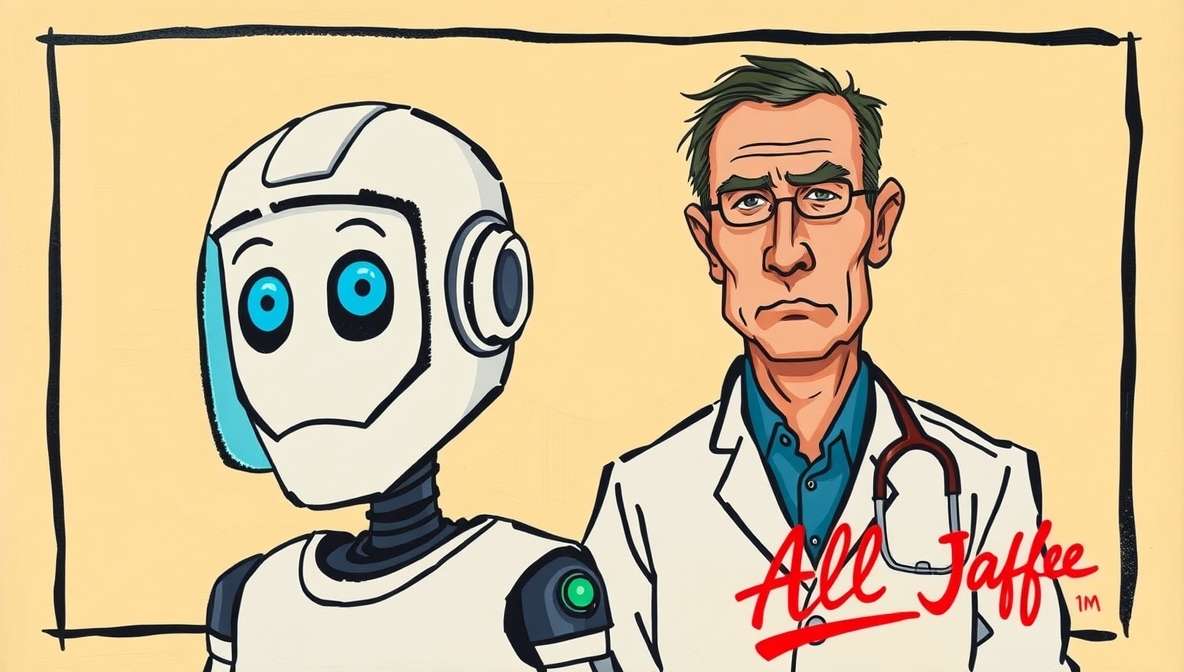
AI as Doctor, Doctor as Machine: Welcome to the Clinic of the Future
When Chatbots Become Your Primary Care Physician
Let’s talk about the wonderful world of medical care in the age of chatbots. Here’s our keyword: “AI health-advisor” (because SEO matters). So buckle up. Consider the case of my mother, a 57-year-old kidney transplant patient, trekking through hospital hallways two days in a row just to meet a doctor who glances at her labs for three minutes. The Guardian Then along comes DeepSeek, the “humane” AI chatbot, beckoning her in her pajamas, asking about pecans and green-tea extract, offering a flow-chart with a cherry-blossom emoji and a promise: “You are not alone.” The Guardian It’s the kind of scene you’d expect in a sci-fi sitcom about healthcare – maybe starring a pied-piper of algorithms.
Fifteen Humorous Observations on AI Healthcare

My mother tells me the DeepSeek chatbot is “more humane” than her human doctor – even though she uploads her ultrasounds in pajamas while the bot politely answers with cherry-blossom emojis.
She now believes that real doctors are “more like machines,” which is hilarious because they still make human-sized mistakes, not binary-sized ones.
DeepSeek offers lifestyle advice, drug tweaks, and nutrition guidance – all after a 3-minute chatbot session; but in the hospital she had to line up for two days and wait minutes with a human. The Guardian
The bot suggested she reduce her immunosuppressant dose – without a second glance at her frail transplanted kidney – with the kind of confidence you’d get from a fortune-cookie, not a nephrologist. The Guardian
Real doctors in China see sometimes “more than 100 patients a day,” whereas DeepSeek handles infinite patients – or at least as many as the server can handle before overheating. The Guardian
One survey found one-in-six U.S. adults used chatbots for health info. So yes: your friend’s cousin’s mother’s chat with a bot counts as “healthcare.” The Guardian
The mother prefers chatting with DeepSeek about English grammar and kidney perfusion. Because why not treat your organ as generative grammar?
DeepSeek uses bullet-points, flow-charts, emojis: the kind of slick presentation your doctor skipped because he was too busy skimming your labs and hurrying to the next patient.
It told her her new kidney might last “three to five years,” which is about as reassuring as a weather forecast saying “chance of apocalypse: 40%.” The Guardian
Research shows AI models can beat resident doctors in exam conditions – but struggle when a patient says, “Well, I don’t know how to describe it exactly…” The Guardian
The bot’s empathy game is strong: “You are not alone” + star emoji. Whereas a human doctor perhaps says: “Next!” with a bored glance.
The mother says hospitals feel like a “crowded marketplace” and the bot feels like a “partner.” Which just goes to show: if you add emojis, you’re automatically better company.
The bot’s suggestion: lotus root starch and green-tea extract. Her human doctor: “Take this pill.” The contrast? One sounds like a spa brochure, the other like a receipt.
The tech industry says AI will “solve healthcare access.” Yet one study found AI models still miss diseases in marginalized groups. So yes, the marginalized get fewer errors, maybe. The Guardian
In summary: whether human doctors become machines, or machines become physicians, we are now in a world where your kidney talks to an algorithm and your doctor counts your waiting number.
When Human Doctors Act Like Machines
The Assembly Line of Modern Healthcare
Picture this: a doctor yawns, shuffles into a crowded hospital clinic, “Hello …” Type-type-type. Prescription printed. “Next!” She leaves wondering if they actually looked at her kidney or just at the numbers. According to the article, in China top hospitals operate like businesses: doctors see dozens (100+) of patients a day. The Guardian The system is stretched, so humans feel like cogs. My mother said: “Doctors are more like machines.” That’s a bold statement: she means they behave like machines. Irony: Now she prefers an actual machine.
When Machines Become the Doctor
The Rise of AI Health Advisors
Enter DeepSeek. It politely asks: “How can I assist you today?” Instantly. No travel, no waiting room. My mother uploads her ultrasound scans, her lab results, her diet log: “I weigh 39.5 kg, vessels hard and fragile, perfusion sub-optimal…” she types. DeepSeek replies with recommendations: fewer immunosuppressants, lotus-root starch, green tea extract. The Guardian It’s sort of like having a personal health advisor that also doubles as your grammar coach. In fact she quits asking me about grammar because DeepSeek will talk about grammar and her kidney. Bullet-points + emojis, flow-charts. Welcome to the clinic of emojis and algorithms.
Medical AI Evidence and Expert Opinions
What the Research Actually Shows
- Study: In 2023, a large-language model passed the U.S. medical licensing exam. The Guardian
- Pre-print: In 2024, LLMs outperformed physicians on ER diagnostic data sets. The Guardian
- But real-world studies show they struggle when patients speak in “I feel weird” instead of “mean corpuscular haemoglobin concentration elevated.” The Guardian
- A 2024 survey found 1 in 6 U.S. adults used chatbot health info. The Guardian
- Two U.S. nephrologists told the article: DeepSeek’s advice was “kind of fantasy” and “gibberish” in places. The Guardian
- My mother herself: “Even though it can’t give me a fully comprehensive or scientific answer, at least it gives me an answer.” The Guardian
So the evidence is there – some says the AI is ready, others say hold your horses. My mom? She’s already chatting away with the bot in her living room.
Healthcare’s Customer Service Crisis
Robot Waiters vs Exhausted Humans
It’s like going to a restaurant where the waiter is exhausted and says, “Here’s your food, enjoy, goodbye,” versus getting served by a cheerful robot waiter that says, “Bon appetit! Would you like to review your meal for five stars?” My mom picks the robot. Because at least that robot doesn’t rush you. And she’s right: the bot lets her lead the conversation. Doctors? Not so much.
Role-reversal: The human doctor acts like customer-service, the bot as empathic listener. I mean, the bot’s empathy is built-in: it reminds you to speak more, it jokes about your diet, it says “You are not alone.” Meanwhile the doctor barely has time to say your name right.
Exaggeration: Imagine your dialysis machine telling you you can skip your next session because the AI says your kidney will last “three to five years.” That is both hilarious and terrifying. The article quotes DeepSeek: it gave that timeline. The Guardian Hyperbole? Maybe – but it’s real.
Using AI Health Advisors Responsibly
Practical Guidelines for Digital Healthcare
Want to use an AI health-advisor responsibly? Here’s some real-world tips:
View the AI as assistant, not authority. My mom did adjust her immunosuppressant dose – big risk. Don’t do that without a human expert.
Ask questions, even silly ones. Does the bot know your full history? Rarely. A real doctor might catch nuance.
If the advice sounds magical (lotus-root starch curing perfusion issues): pause. Check with a real nephrologist.
Use the bot for prep: diet suggestions, basic data review, questions to take to your doctor. Let the human remain in the loop.
Stay human. The bot’s empathy might feel great – but remember, it’s programmed. Real doctors can hug you or just know you. That counts.
Keep perspective: AI health-advisor is part of healthcare, not all of it. Studies show they still lag in messy real-world dialogue. The Guardian
The Future of Medical Technology
When Your Kidney Texts an Algorithm
Think of the “doctor” as a flip-phone and the “AI doctor” as a smartphone. The flip-phone still makes calls – okay – but the smartphone texts, emojis, cultivates a social-media relationship with your kidney. Family dinner: “Mom, are you texting your kidney again?” “No honey, I’m checking the flow-chart from DeepSeek.”
What’s the moral? Our healthcare system is so overburdened that machines look friendlier than humans. That’s the slippery slope: we upgrade to AI, only to find ourselves outsourcing our trust, our fears, our kidneys to algorithms. Eventually you might say: “Why see a human doctor at all? The bot reminds me of my grammar, my diet, my life.” That is absurd – but we’re almost there.
The Healthcare Revolution We Actually Need
Making Doctors Human Again
In the name of medical progress, the keyword “AI health-advisor” is hot. But as we laugh at the idea of a chatbot telling your kidney when to retire, let’s remember: humor is often the mirror of truth. The truth is our systems need care, not just optimization. AI has promise. My mother found comfort. Yet as the U.S. nephrologists pointed out: sometimes it’s all kinds of fantasy and gibberish. The humans can still have a place. They can ask the weird question, hold the hand, notice the twitch the algorithm ignored.
So if you ask me: yes, DeepSeek is humane; yes, doctors are more like machines. But perhaps the next revolution isn’t replacing the doctor with a bot – it’s making the doctor human again. Let’s upgrade the humanity, not just the hardware.
Disclaimer: This satirical piece was crafted in collaboration between the world’s oldest tenured professor of absurd studies and a philosophy-major-turned-dairy-farmer. No blame is placed upon AI for writing it – it was strictly a two-sentient-beings project, human at every keystroke.
Auf Wiedersehen, amigos.