

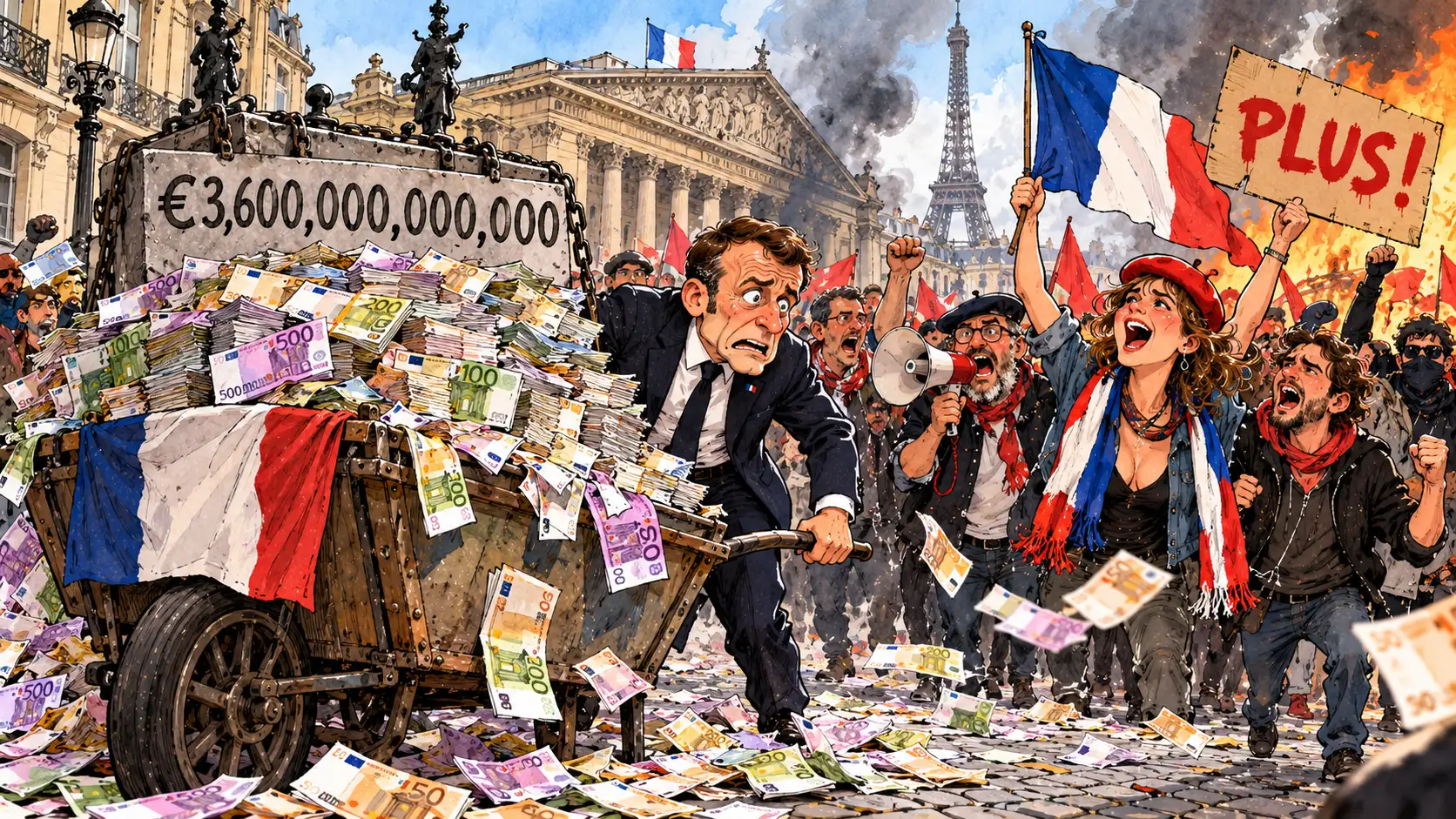
Debt Hits €3.6 Trillion, Demands Keep Coming
PARIS, FRANCE – France has perfected the art of protesting against an empty treasury, with demonstrators demanding additional government spending from a nation already carrying approximately €3.6 trillion in public debt.
According to France’s national statistics agency, INSEE, public debt reached €3.5955 trillion in the second quarter of 2026, equivalent to 119% of the country’s annual economic output.
In ordinary households, this would trigger a family meeting, the cancellation of several subscriptions and a stern conversation about why somebody keeps ordering champagne.
In France, it triggers another demonstration demanding free champagne.
The French have developed a remarkable economic philosophy: money may not grow on trees, but surely it can be harvested from the government if enough people gather beneath a tree holding placards.
Eurostat’s latest comparison ranks France third in the European Union for debt as a share of GDP, at 117.6% in the first quarter, behind only Greece and Italy. Third place, in Paris, is treated as a podium finish.
French Public Debt Runs on Bottomless Wine Glass Economics
France’s public finances now operate according to the principles of an exceptionally generous Parisian restaurant.
Everyone orders the finest wine, the most expensive cheese and three desserts.
Nobody wants to see the bill.
When the waiter finally arrives with the total, half the customers demand that the government pay, while the other half begin a demonstration against the outrageous price of eating.
Unfortunately, the government owns the restaurant, the waiter is a public employee, and the vineyard has already been mortgaged to Germany.
The French concept of a bottomless glass of wine has one obvious flaw: even a bottomless glass requires somebody to purchase the bottle.
French political activists have apparently solved this problem by demanding that the bottle itself become a constitutional right.
A second bottle, naturally, would require a separate government ministry. And the treasury’s deposits are mostly withdrawals.
France’s €3.6 Trillion Public Debt Is Only a Down Payment on Socialism
The most impressive feature of France’s economic difficulties is not the size of the debt.
It is the extraordinary confidence with which political campaigners continue demanding additional spending.
Consider €3.6 trillion.
That is not a budgetary inconvenience. That is a number so large that an ordinary calculator starts looking for work in Switzerland.
It would take a person earning €100,000 annually 36 million years to accumulate that amount, assuming they paid no taxes, purchased no groceries and somehow survived exclusively on the satisfaction of being financially responsible.
Yet French political debate routinely treats another billion euros as something that might be discovered in the pocket of an old ministerial jacket.
The country’s creditors are understandably interested in repayment.
Some spending campaigners appear more interested in discovering whether creditors can be classified as enemies of social progress. Several are flaunting the rules of arithmetic with a confidence usually reserved for lottery winners.
French Government Debt Now Pays for Previous Debt
France’s debt increased by approximately €59.6 billion during the second quarter of 2026 alone.
That represents a substantial expansion of obligations for a country already struggling to reconcile public demands with economic reality.
In June, France’s public audit court, the Cour des comptes, told lawmakers that every signal on the country’s finances was red. Red is also the color of the banner most of the protesters were already carrying.
Borrowing can finance useful investments and help governments through emergencies. The difficulty begins when each new promise arrives without a convincing explanation of how it will be financed.
French political economics has consequently become a sophisticated exercise in postponement.
Today’s benefits are financed with tomorrow’s taxes.
Tomorrow’s taxes are opposed by tomorrow’s protesters.
The resulting shortfall is financed with the following year’s borrowing.
Eventually, France will require a Ministry of Finding the Next Tomorrow.
It will employ 12,000 civil servants, occupy a magnificent building overlooking the Seine and announce that tomorrow has unfortunately been delayed by industrial action.
French Debt Protesters Demand Higher Benefits and Lower Taxes
The public would understandably prefer excellent hospitals, outstanding schools, generous pensions, affordable housing and minimal taxation.
Who wouldn’t?
Most people would also prefer to eat unlimited pastries without gaining weight.
The universe, however, remains stubbornly opposed to both arrangements.
Taxes finance public services. Borrowing shifts some of the burden into the future. Economic growth can make those obligations easier to support.
None of these mechanisms becomes more generous because somebody waves a revolutionary flag.
France’s economic challenge is therefore not a shortage of worthwhile public ambitions.
It is the increasingly uncomfortable relationship between those ambitions and the productive economy expected to finance them.
You cannot indefinitely expand the menu while telling the chef, the farmer, the delivery driver and the restaurant owner that somebody else will cover the ingredients.
Who Pays France’s Public Debt? The Taxpayer Who Skipped the Champagne
At the heart of the national debate lies a devastatingly simple question.
Who pays?
Political movements have spent generations perfecting increasingly elaborate methods of avoiding that question.
Tax the wealthy. Tax corporations. Borrow more. Create another subsidy. Establish a commission. Commission a report explaining why the previous commission was underfunded.
When those measures prove insufficient, organize another protest.
The French taxpayer now occupies the least desirable position at the national dinner table.
He did not order the champagne.
He did not approve the menu.
He was not consulted about dessert.
Nevertheless, when the waiter arrives, every other diner suddenly remembers that the taxpayer has a wallet.
The country’s fiscal future might improve if political leaders devoted as much energy to expanding prosperity as they do to dividing up the proceeds.
Until then, France will continue its celebrated national tradition.
The politicians will promise.
The activists will demand.
The treasury will borrow.
And somewhere in Paris, a waiter will approach a table carrying the final bottle of champagne.
“Who is paying for this?”
The entire restaurant will rise to its feet.
“UNACCEPTABLE! WE DEMAND ANOTHER BOTTLE!”
And that, ladies and gentlemen, is how a €3.6 trillion bar tab becomes a campaign for a longer happy hour.
Five Observations on the French Debt Bar Tab
- Protesting an empty treasury is like picketing an empty refrigerator. The refrigerator heard you. The refrigerator has nothing. It’s standing there with the light on, just like the finance ministry.
- A hundred and nineteen percent of GDP. You can’t owe a hundred and nineteen percent of anything. In school that’s extra credit. In finance it’s a hostage situation, and the hostage is the guy who was never invited to dinner.
- A bottomless glass of wine sounds generous until you notice somebody in the back keeps buying the bottles. There’s always a guy in the back. In France he’s called the taxpayer. In my house he’s called me, and it’s a taxing position.
- Thirty-six million years to earn that kind of money. I can’t keep a houseplant alive for thirty-six weeks, and I’m supposed to understand a number that outlasts the Alps?
- They’ll build a Ministry of Finding the Next Tomorrow with twelve thousand employees. Honestly, it’s the first government department with a job description you can say out loud without laughing. They’ll just never find it. It’s always in the other jacket.
The numbers underneath the jokes are real. INSEE, France’s national statistics agency, reported on September 29 that general government debt stood at 3,595.5 billion at the end of the second quarter of 2026, up 59.6 billion on the quarter and equal to 119.0% of GDP; Fabrice Lenglart is the director of publication for that release. The Cour des comptes, the country’s public audit court, had already warned in its June report that every signal on public finances was red, and Eurostat’s most recent comparison puts France behind only Greece and Italy among EU members for debt as a share of output. The protests over spending go on regardless.
Sources
- INSEE: At the end of Q2 2026, the Maastricht debt accounted for 119.0% of GDP
- Eurostat: Government debt at 88.9% of GDP in euro area
- Banque des Territoires: “Tous les signaux sont au rouge” en 2026, alerte la Cour des comptes
This article is American satire. It belongs to the tradition of American satirical journalism, and the public debt figures come from France’s official statistical agency. The restaurant scenarios, ministry descriptions and dialogue are comic exaggeration, the kind of American satirical news that treats a balance sheet as a punchline, and not reports of actual government programs. Peaceful political protest remains a legitimate democratic right, even when its demands inspire vigorous economic ridicule.
For the British take on the same fiscal hangover, visit The London Prat.
Auf Wiedersehen, amigo!