

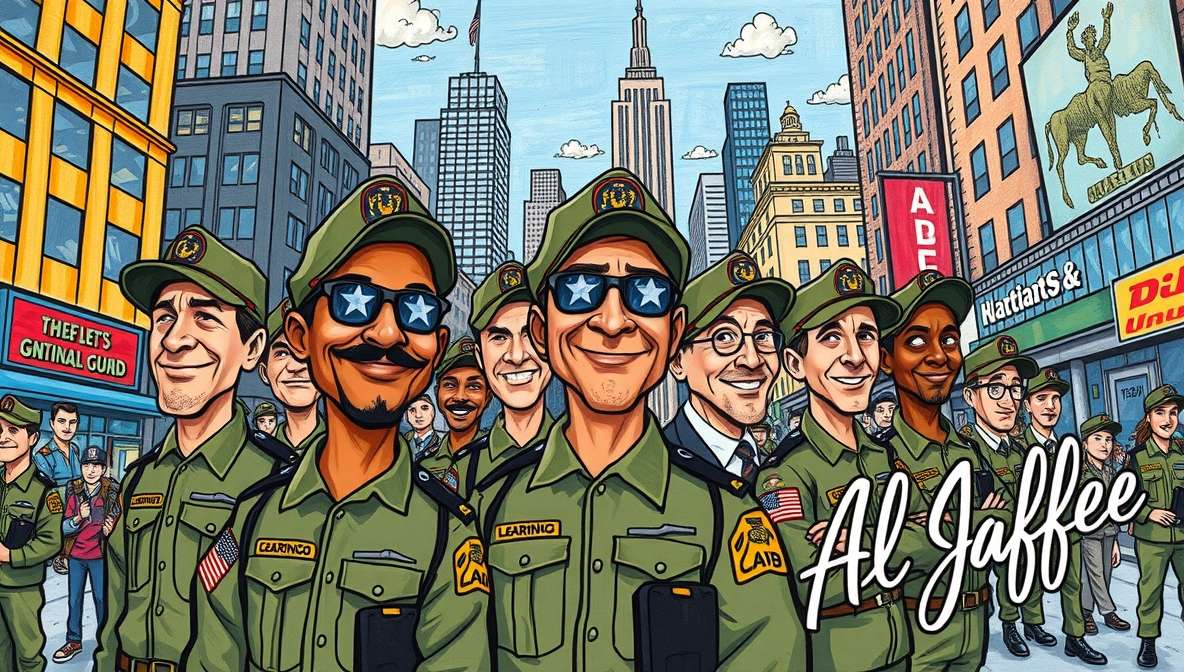
Troops Deployed Across U.S. Cities — Trump Says It’s Just Big, Friendly Neighborhood Watch
The Department of Defense has deployed troops to multiple American cities in what officials describe as “domestic peacekeeping operations,” though former President Trump has insisted the military presence is merely “a very large, very well-armed neighborhood watch program.” The deployment of approximately 5,000 troops across major metropolitan areas has raised constitutional concerns, though Trump maintains the Constitution probably has a clause about neighborhood watch somewhere “in the very back where nobody usually reads.”
The Military Deployment Explained
Active-duty military personnel began arriving in cities including Chicago, Los Angeles, and New York on Monday, carrying equipment that neighborhood watch programs typically don’t require, such as armored vehicles, automatic weapons, and what appears to be enough tactical gear to invade a small country. “This is just community policing,” explained one Pentagon spokesperson who appeared to be reading from talking points written by someone who has never been in a neighborhood or watched anything.
The deployment marks the largest domestic military operation since Hurricane Katrina, though this time there’s no hurricane, just what the administration vaguely describes as “urban concerns” that apparently require military intervention despite crime rates being lower than they were in the 1990s when nobody suggested deploying troops to every major city.
Trump’s Neighborhood Watch Theory
Trump defended the deployment during a rambling press conference at Mar-a-Lago, insisting that troops patrolling American streets with military weapons is “basically the same thing as your neighbor Bob watching for suspicious activity.” The former president explained that neighborhood watch programs have “always involved the military,” a claim that historians and anyone who has ever been in a neighborhood watch immediately disputed.
“People love neighborhood watch,” Trump told reporters while gesturing vaguely. “Very popular. Very safe. And now we’re making it even better with troops and tanks and all the best military equipment. It’s like neighborhood watch but with more firepower. Much better. Probably the best neighborhood watch in history.”
Jerry Seinfeld commented on the comparison: “Neighborhood watch with tanks?” he said. “That’s not neighborhood watch, that’s martial law with a smile. What’s next, the Girl Scouts with artillery?” Ron White added: “Military deployment as neighborhood watch,” he said. “That’s like calling a SWAT raid a wellness check. Technically it’s checking on something, but the vibe is way different.”
Constitutional Concerns Arise
Legal scholars have pointed out that deploying military troops for domestic law enforcement potentially violates the Posse Comitatus Act, a minor detail that the administration describes as “probably not that important in the grand scheme of things.” The 1878 law specifically prohibits using federal military personnel for domestic law enforcement, though current officials suggest that was “more of a guideline than an actual rule.”
“Posse Comitatus is just words on paper,” explained one administration lawyer who will definitely be disbarred at some point. “And papers can be ignored if you ignore them confidently enough. It’s about the spirit of the law, not the actual words. And the spirit says… well, we’ll get back to you on what the spirit says.”
Mayors React to Military Presence
City mayors have responded to the surprise military deployment with reactions ranging from “confused” to “actively hostile,” with several threatening lawsuits and others simply asking “what the hell is happening?” Chicago’s mayor called the deployment “unconstitutional and unnecessary,” while also noting that if the federal government is going to send troops, they could at least help fix the potholes.
Dave Chappelle weighed in on the mayoral response: “Mayors asking why there’s military in their cities,” he said. “That’s a reasonable question. Usually when troops roll in, there’s at least a coup or something. This is just Tuesday in America now apparently.” Amy Schumer added: “Cities getting militarized and Trump’s calling it neighborhood watch,” she said. “That’s not community policing, that’s occupation with better PR.”
The Neighborhood Watch Equipment List
The deployed troops arrived with equipment that includes M4 rifles, armored personnel carriers, riot gear, and surveillance drones—none of which are typically associated with traditional neighborhood watch programs, unless your neighborhood is particularly rough or possibly in a war zone. “Standard neighborhood watch equipment,” insisted one Pentagon official. “Just like your local watch might have flashlights and walkie-talkies, except ours have night vision and can call in air strikes.”
Military planners distributed a handbook to deployed troops titled “Neighborhood Watch Guidelines,” which includes chapters on “Non-Lethal Crowd Dispersal” and “Urban Warfare Tactics”—topics that rarely come up at typical neighborhood watch meetings, which usually focus on suspicious vehicles and whether the Johnsons are letting their lawn get too long.
Public Reaction to Military Streets
American citizens have responded to troops in their cities with a mixture of concern, confusion, and resignation that this is apparently just normal now. “I walked outside and there was a tank at the Starbucks,” reported one Chicago resident. “Not a military vehicle. A literal tank. At Starbucks. The barista was taking the soldier’s order like this was totally fine. I guess this is our life now.”
Bill Burr commented on the normalization: “People just accepting there’s military in the streets now?” he said. “That’s not normal. That shouldn’t be normal. When did we decide this was fine? I must have missed that meeting.” Kevin Hart added: “Tanks at Starbucks is the most American sentence I’ve heard,” he said. “That’s not freedom, that’s just scary with espresso.”
The Administration’s Defense of Deployment
The White House has defended the deployment as “necessary for public safety,” though they’ve declined to specify what exactly the public needs to be kept safe from given that crime statistics don’t support the need for military intervention. “There are threats,” explained one spokesperson vaguely. “Very real threats. We can’t tell you what they are, but they definitely exist and definitely require troops in every major city.”
When pressed for details about these threats, administration officials responded with what can only be described as “strategic ambiguity bordering on complete nonsense,” suggesting the threats are simultaneously “imminent and ongoing” while also being “classified and unconfirmable.” Legal experts note this is similar to saying “trust us, there’s a reason” without actually providing a reason, which is how most dictatorships justify militarizing their streets.
Congressional Oversight Questions
Congressional Democrats have demanded hearings on the deployment, asking reasonable questions like “why is there military in our cities” and “is this legal” and “has everyone lost their minds?” Republicans have largely supported the deployment, arguing that if you’re not doing anything wrong, you shouldn’t mind troops with automatic weapons patrolling your neighborhood, a logic they notably don’t apply to any other form of government overreach.
Chris Rock reflected on the partisan divide: “Republicans suddenly love military in the streets,” he said. “Same people who talk about government tyranny are cool with actual soldiers patrolling cities. Make it make sense.” Ricky Gervais added: “People who scream about freedom are applauding militarized neighborhoods,” he said. “That’s not freedom, that’s just Stockholm Syndrome with flags.”
The Neighborhood Watch Meeting Schedule
The Pentagon has announced that deployed troops will hold “community engagement sessions” that are definitely not martial law checkpoints but rather “friendly neighborhood meetings with armed military personnel.” These sessions will occur weekly and attendance is “strongly encouraged but technically voluntary,” though residents note that declining an invitation from soldiers with assault rifles sends mixed messages about voluntary participation.
“We want to build trust with the community,” explained one Army captain. “That’s why we’re here with weapons and armored vehicles. Nothing builds trust like overwhelming military presence. It’s basically like when your neighbor brings cookies, except instead of cookies it’s tactical capabilities.”
Legal Challenges Mount
Civil liberties organizations have filed multiple lawsuits challenging the deployment, arguing that using military force for domestic policing is “literally what the Founding Fathers specifically tried to prevent.” Courts are expected to hear these cases sometime between now and when the deployment either ends or becomes so normalized that nobody remembers it was ever controversial.
Trevor Noah summed up the legal situation: “Lawyers arguing that military in cities is unconstitutional,” he said. “Yes, obviously. The Constitution is pretty clear on this. But apparently we’re doing it anyway because rules are more like suggestions now.” Jim Gaffigan concluded: “Neighborhood watch with tanks is the most Trump thing ever,” he said. “Take something normal, add military equipment, insist it’s fine. That’s the brand.”
Auf Wiedersehen, amigos.
