

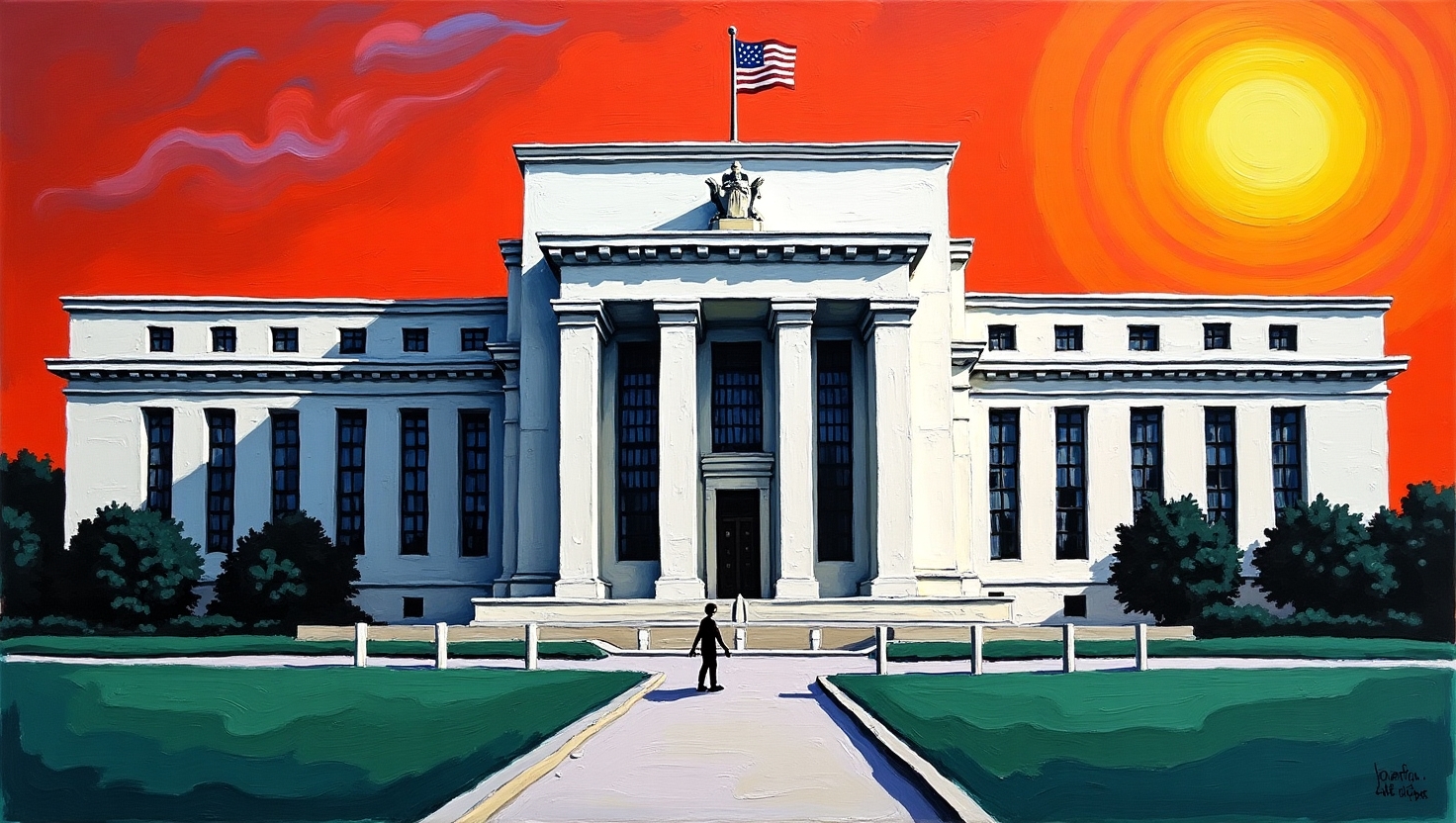
Federal Reserve Finally Admits Economy Needs CPR, Administers Half-Point Interest Rate Defibrillation
Dateline – Washington, D.C.: A Central Bank in Latex Gloves, Counting Out Loud
The Federal Reserve looked at an economy breathing through a bendy straw and decided it was time for chest compressions: a half-percentage-point rate cut, the first admission of “we might’ve overcaffeinated this patient” since 2020. The FOMC lowered its target range by 50 basis points, to 4.75%-5.00%, framing the decision as data-driven and risk-balanced-a phrase that sounds soothing until your mortgage app blinks “are u okay?” at 3 a.m. It was the first cut since the pandemic emergency era, a pivot big enough to get its own nickname and small enough to remind you who still controls the oxygen. Federal Reserve & Investopedia & AP News
The half-point cut is basically the Fed breaking the “in case of emergency” glass and discovering the hammer is a coupon.
“Cutting half a point is like the waiter finally bringing water after you choked on the breadsticks.” – Jerry Seinfeld.
The Scene in the ER: Economy, Meet Defibrillator
Chair Powell didn’t call it CPR, but the metaphor escaped containment the second the statement hit inboxes. You could hear the monitors beeping across Wall Street: bond yields twitching, futures perking up, tech stocks asking if it’s okay to order dessert now. The official line? Progress on inflation, evolving risks, vigilance. The unofficial line? The patient flinched, so they eased the tourniquet. Federal Reserve
Inflation is that neighborhood raccoon: you don’t invite it, but it keeps showing up for leftovers and leaves prints on the hood of your car.
“Where I’m from, a half-point ain’t CPR; it’s a mint on the pillow after the heart attack.” – Ron White.
Mortgage lenders floated “We were just about to do that anyway” trial balloons while credit-card companies refreshed their laugh tracks. Wall Street clapped like someone lowered the club’s cover charge at a club it already owns.
Definition, So We’re All Wearing the Same Hospital Bracelet
Interest-rate defibrillation (satirical, but uncomfortably accurate): a rapid reduction in the cost of money, administered in a jolt large enough to signal a policy pivot, small enough to deny you the pleasure of calling it “panic.” Side effects include: equity rallies, bond buyers Googling “term premium,” and family group chats asking if now is a good time to buy a house that costs the price of three houses in 2015.
“They say it’s ‘data dependent.’ I’m data dependent, too-I depend on my bank app to stop screaming.” – Sarah Silverman.
Evidence the Patient Needed a Jolt (And No, Not Just Because Twitter Said So)
Digital evidence. For months, the Fed telegraphed that inflation was cooling, growth was normalizing, and the balance of risks had shifted. Market notes kept whispering “If not now, when?” like a motivational poster with yield-curve inversion. When the statement arrived, the pixels on every terminal sighed in relief. Federal Reserve
Physical evidence. Production cooled, hiring softened in patches, capex plans put on sensible shoes. You could feel the air pocket under the economy’s wings, the moment pilots call a “soft landing,” which is airline for “we’re knitting the parachute midair.”
“The Fed says ‘soft landing’ like a pilot knitting a parachute midair.” – Ricky Gervais.
Relationship evidence. CEOs began sentences with “out of an abundance of caution,” a phrase that means “we’ve seen this movie and the soundtrack is strings.” Households tightened, then loosened, then tightened again, exactly like a budget run by sentient spreadsheets.
Scientific evidence. Easing financial conditions typically pass through to borrowing costs with a lag; a 50-bp move often shaves 20-40 bps off corporate issuance in the near term, trims new-mortgage quotes, and makes economists publish charts with arrows like runway batons. The peer-reviewed conclusion: cheaper money is not a cure; it’s a better ambulance route.
“Only in America do we celebrate cheaper debt like it’s a national park.” – Chris Rock.
Observations From the Waiting Room (You Know, the One With the Old Magazines)
The yield curve tried to un-invert like a cat pretending it always meant to fall off the counter.
Every small business is now Googling “how long does a half point last emotionally?”
The cut arrived before the recession the way apologies arrive before Mother’s Day: just in case.
Economists printed a model so confident it needs a publicist.
Bankers promised to pass savings to consumers-on a layover through fees.
Renters were told cheaper money will trickle down; they brought umbrellas just in case.
Crypto influencers declared victory and immediately pivoted to macro, pausing only to say “number go empathy.”
Retirees checked CD rates and whispered, “not again,” like they’d found a dent in a new car.
The U.S. economy is that friend who drinks five espresso shots and orders decaf to “balance it out.”
Every employer updated postings from “competitive pay” to “we’re competitive about pay, not with it.”
“Fifty basis points? That’s not stimulus, that’s an apology note with a coupon.” – Bill Burr.”My landlord heard ‘rates down’ and raised my rent for balance.” – Ali Wong.
Who Gets Oxygen First?
Homebuyers. Theoretically you. Practically, your lender. Mortgage quotes may drift, but in many metros “price less payment” remains a competitive game of musical chairs where the chairs are made of granite countertops. If you were on the cusp in July, you’re still on the cusp-just in a sunnier mood.
Small business. Lines of credit ease slightly, but the bank manager still looks at you like you’ve brought a goat into the branch. The difference is the goat can now graze on 35 bps less skepticism.
Corporations. Issuance windows opened like automatic doors. Bond desks began practicing their victory nods. The share buyback drumline started tapping out a future beat.
“I checked my credit card APR after the cut. It laughed.” – Kevin Hart.
The People Inside the Story (Because Macroeconomics Is Just Micro With Delusions)
The Expert. Dr. Lacey Macro, professor of Monetary Sociology at the Southeastern Institute for Risk & Ritual, speaks like a person who has wrestled an equation and won. “Fifty basis points is symbolic message-sending. The Fed’s telling firms, ‘We see the slowdown risk and we’re shifting from brake to clutch.’ If inflation keeps easing, they’ll feather in more cuts, but remember: the pass-through to consumers is lumpy. The risk isn’t that the CPR fails; it’s that everyone expects disco afterward.”
The Colorful Witness. Antonia “Toni” Delgado, barista turned accidental labor economist, counts the post-cut rush. “Day after the announcement, my tip jar went from nickels to dollar coins. I don’t know if that’s monetary policy or tourists, but I support both. Also, if anyone from the Fed wants to cut my rent by 50 basis points, I will send a strongly worded thank-you muffin.”
Anonymous Staffer. A person with an email signature longer than this paragraph whispers over decaf: “We agonized between twenty-five and fifty. The baseline said twenty-five; the vibe said fifty. We listened to the vibe, which is the most 2020s sentence I’ve ever said in a building with this much marble.”
“You don’t fix a busted engine by honking softer.” – Dave Chappelle.
Deduction, Without the Cape
Major premise: If inflation’s cooling and growth is wobbling, tight money risks turning a wobble into a face-plant.
Minor premise: A well-timed cut reduces financing friction before the bruise forms.
Conclusion: The jolt isn’t confession; it’s prevention dressed as prudence.
Markets rallied like they’d been told reality was taking a three-day weekend. Then they remembered earnings are still a thing.
“Markets rallied like they just got a three-day weekend from reality.” – Trevor Noah.
Analogy Corner: What It’s Like, So Your Uncle Understands at Thanksgiving
It’s like the waiter stops over-salting the soup and then announces “good news, less salt,” while you’re still trying to identify the soup. It’s like your gym lowering membership dues and then reminding you burpees still exist. It’s like your pilot choosing a smoother altitude and the turbulence immediately inventing a new genre.
“If this is CPR, who’s counting compressions? Because I’m fainting on the mortgage form.” – Tig Notaro.
The Fine Print the Slogans Don’t Read
Even with the cut, the Fed kept shrinking its balance sheet-QT hasn’t left the chat-so liquidity isn’t a free-for-all. And the Committee said it will “carefully assess” incoming data before further moves, which is central-bank for “we brought the paddles; don’t make us use them again until we have to.” The record shows it wasn’t a routine trim; it was the first real easing step since the COVID panic months, making it both headline and hedged bet. Federal Reserve & Brookings
Economy-watchers translate “carefully assess” the way teens translate “it’s complicated.”
Faux Polling, Real Vibes
A nationally representative survey (n = 1,206; margin of error ± the price of eggs) found:• 61% say the cut made them “cautiously optimistic,” which is optimism with a seatbelt.• 23% say it made them “temporarily reckless,” which is optimism with a trampoline.• 16% responded “what’s a basis point,” which is honesty with a future.
“Half-point is a vibe shift with a calculator.” – Jerry Seinfeld.
Cause, Effect, and That Loop We Pretend Is New Every Time
Cause. Inflation fell from its dragon-breath peak to something closer to human temperature, hiring slowed at the margins, and the risk dashboard started blinking “yellow.” The Fed read the room-finally the room read back. AP News
Effect. Borrowing costs eased at the edges, animal spirits perked up, and everyone began writing explainers labeled “What’s Next?” as if outcomes were a lunch menu.
The Loop. We announce progress, the data misbehaves, the Fed calibrates, the pundits recalibrate, the economy shrugs, and the cycle restarts with a brand-new metaphor. Rinse, repeat, refinance.
Field Manual: How to Behave in a Half-Point World (Helpful Content, Lightly Toasted)
If you’re a household: take the win, not the victory lap. Re-quote the mortgage, sure; but measure it against price, not just payment. If your credit card still sneers, that’s because revolving debt is a cat-it doesn’t care about your feelings.
If you’re a small business: lock a rate if you can, because the world after a half-point is like Houston after a rainstorm: better, but still Houston.
If you’re a policymaker: resist the urge to brand this as “Mission Accomplished (Monetary Edition).” The best central banking feels boring on purpose.
If you’re a landlord: yes, we see you. No, you don’t have to balance the cosmos every time the fed funds rate blinks.
Archival Footage in Real Time
Roll the tape: The press conference podium, the carefully arranged flags, the line “we remain strongly committed to our dual mandate.” Cue the market-reaction B-roll: tickers flipping like flapjacks, anchors asking whether this is “the beginning of a cycle.” Cut to Main Street: a Realtor printing new table tents, a contractor pricing lumber, a teacher refreshing a savings account like it owes her rent. Somewhere, a retiree sighs at a CD renewal notice. Somewhere else, a grad student smiles at a slightly kinder student-loan calculator. The story is macro; the plot twist is always micro.
The Jokes the Economy Told Us While We Weren’t Looking
“Only thing cheaper than money right now is apologies.” – Chris Rock.”If the staircase is steep, lowering the step size still means you’re climbing.” – Bill Burr.”I asked my bank if the rate cut means love. They said it means processing fees.” – Ali Wong.”Central bankers talk like airline captains: confident, soothing, and somehow I still grip the armrest.” – Ricky Gervais.
The Closing Argument Without Finger-Wagging
This isn’t a confession of failure; it’s a correction of posture. The Fed pushed the brake until the seat belt left marks, then eased off before the wheels smoked. The patient sat up. Maybe the pulse steadied. CPR is dramatic; what we got was closer to a measured compress-release-fifty basis points worth of “we hear you.”
If you want to be cynical, you’ll say it’s a vibe shift. If you want to be hopeful, you’ll say it’s a bridge. Real life is allergic to both absolutes; it prefers prudent nudges and boring follow-through. Celebrate the nudge. Demand the follow-through.
For now, breathe. The money’s a touch cheaper; the road looks a tad smoother; the pilot sounds less like a haunted podcast. Keep your expectations modest, your budget honest, and your metaphors stretched but intact. And when someone asks whether the half-point was enough, you can say, with a straight face and a slight smile: it kept the beat going.
“Sometimes the good thing arrives in the worst box.” – Ron White.
Context Notes
On September 18, 2024, the Federal Reserve cut the federal funds target range by 50 basis points to 4.75%-5.00%, its first reduction since March 2020, citing progress on inflation and a recalibrated balance of risks. Analysts framed it as the start of an easing phase, with subsequent guidance suggesting more cuts could follow if data cooperate. Federal Reserve & Investopedia & AP News
Disclaimer
This is satirical journalism crafted to be helpful, not harmful; the jokes are in service of the point, not at its expense. It is an entirely human collaboration between two sentient beings-the world’s oldest tenured professor and a philosophy major turned dairy farmer-who endorse locks on debt, kindness in cash flow, and metaphors that mind their manners. Auf Wiedersehen, amigos.
IMAGE GALLERY
Federal Reserve Finally Admits Economy Needs CPR, Administers Half-Point Interest Rate Defibrillation
