

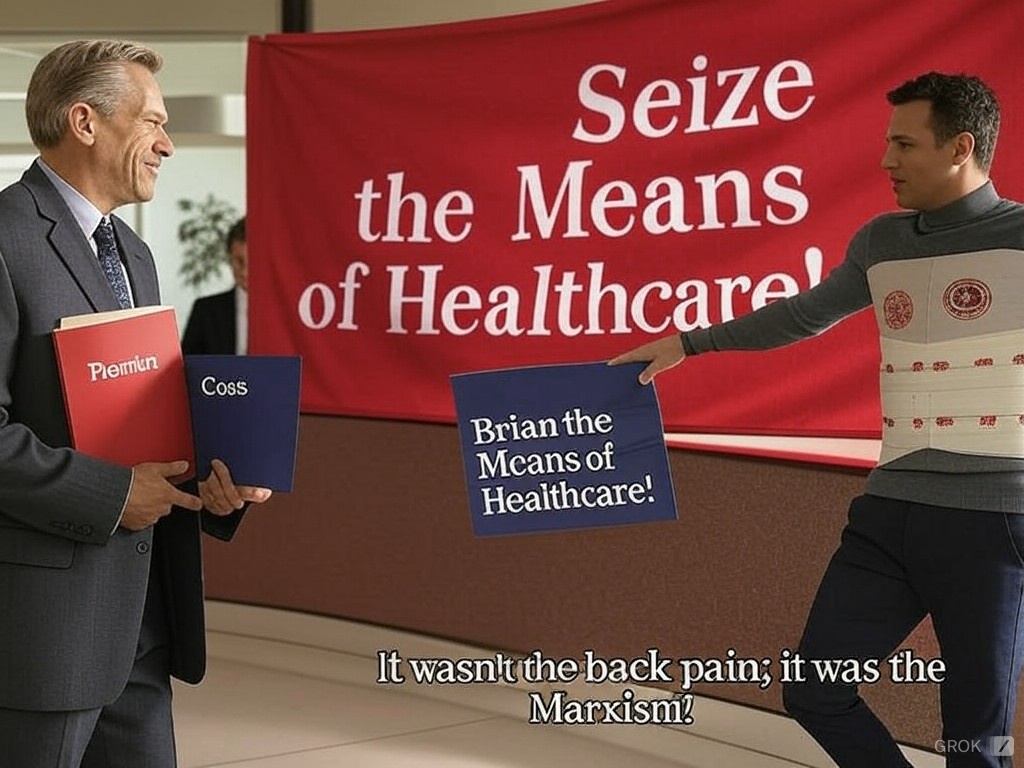
“It Wasn’t the Back Pain, It Was the Marxism that Made Me Do It!”
Patient Recovers from Surgery, Murders Health CEO in Ideological Frenzy
By J.P. “Pillow-Proletariat” McFlannigan, Staff Satirist
In a plot twist that has stunned both the medical and corporate worlds, former back-surgery patient Luigi Mangione was arrested today on charges of assassinating UnitedHealthcare CEO Brian Thompson. Though initial theories pointed to chronic pain, impatience, or maybe just a bad day at physical therapy, inside sources reveal the true culprit: radical Marxist ideology acquired during post-op recovery.
From MRI Scans to Marxist Tracts
Mangione’s journey started out with a herniated disc, a common enough malady. He entered the hospital expecting relief from spinal torment—not the seed of a revolution. According to hospital staff, all seemed normal until day two of recovery, when the patient rejected a Netflix queue and instead requested “The Communist Manifesto.”
“Typically, patients ask for Jell-O or an extra pillow,” said Nurse Jacqueline Fields, “but this guy asked for Marxist literature. I guess we should have seen it coming when he insisted that wealth redistribution would also apply to patient gowns and foam pillows.”
Orthopedic Gowns and Overthrowing the Bourgeoisie
Doctors often encourage positive mental stimulation as patients heal. But no one expected Mangione’s back-brace fittings to evolve into passionate lectures on class struggle. “We recommended relaxation techniques—imagining a calm lake or breathing steadily,” said Dr. Ima Knitwit (famous for her previous commentary on thick sweaters and sweat). “Instead, Luigi imagined storming the metaphorical Bastille of healthcare profiteering. He told me, ‘If I can’t have a functional spine, I’ll at least have equality!’ It was… unusual bedside manner.”
In hindsight, the warning signs were there. Hospital orderlies say Mangione practiced “downward dog” in physical therapy one morning and stood up chanting, “Workers of the world, unite… and also, is my insurance covering this session or what?” Observers report he fashioned his hospital blanket into a makeshift hammer-and-sickle flagpole. He even requested his lumbar support cushion be redistributed among the patients who had none, declaring, “No more pillow-inequality!”
Blame Shifts from Back Pain to Political Pain
Initially, friends thought the murder stemmed from frustration—chronic back pain can drive anyone to the brink. “We all assumed he just snapped,” said his cousin, who asked to remain anonymous. “But Luigi clarified: ‘It wasn’t the back pain; it was the Marxism!’ I mean, usually, you expect, ‘The pain was unbearable!’ not ‘The proletariat’s anguish under capitalist healthcare must end!’”
It’s a hasty generalization to assume all patients in recovery become revolutionaries. Yet Mangione’s case proves that endless hours in traction devices provide ample time to contemplate the cruel machinations of private insurance. One physical therapist reportedly tried to calm him down by suggesting yoga, but Luigi considered yoga a bourgeois distraction from class conflict. “He said, ‘I’d rather redistribute wealth than do warrior pose,’” the therapist recalled.
Lift With Your Knees, Not Into Class Warfare
Before long, Mangione abandoned the gentle counsel of his doctors. “It’s not just about a slipped disc, it’s about a slipped society!” he shouted at the ward’s orthopedic nurse. Proper lifting technique was replaced by rhetorical lifts of the worker’s plight. While other patients measured progress in reduced pain and improved mobility, Mangione measured his in the number of healthcare administrators he could metaphorically topple.
When asked why he chose Brian Thompson, the UnitedHealthcare CEO, Mangione reportedly explained: “Health insurance CEOs represent the pinnacle of exploitative capitalism, where the working man is forced into crippling premiums.” He continued, “This is the real backbreaker—capitalism is herniating the spine of our society!”
From Physical Therapy to Political Theory
In the rehabilitation room, other patients tried to share their own struggles. One man mentioned arthritis, another chronic migraines. Mangione cut them off, insisting all ailments were mere symptoms of class oppression. “Sure, back pain hurts,” he said, “but what hurts more is knowing some suit is profiting off my ailment!”
His healthcare providers noticed a bizarre synergy between stretching exercises and subversive lectures. Instead of counting reps—“one, two, three”—he’d chant: “Marx, Engels, Lenin!” Some say his spine rehab turned into a study circle. A TV blaring daytime soaps was replaced by Luigi’s impassioned readings of labor theory. Residents glancing into his room thought they’d wandered into a community college classroom teaching 19th-century political philosophy.
CEO at the Wrong Place, Wrong Time
The final straw came when Mangione was discharged with a hefty hospital bill. “A co-pay?” he bellowed, “This is what stifles the proletariat!” Hours later, Brian Thompson appeared at a local healthcare conference. Mangione confronted him, shouting, “It’s not my slipped disc or my impatience that brought me here—it’s your system of exploitation!”
In a tragic turn, Mangione allegedly unleashed his revolutionary fervor in the form of violence. The police found him later, ranting about dialectical materialism and insurance claim denials. While no official statement has been released by UnitedHealthcare, sources say the organization is “stunned that Marxism, not back pain, provoked the crime.”
A Doctor’s Perspective: Hallucinations of Utopia
Doctors weigh in: “Chronic pain can cause depression, anxiety, even personality shifts,” said Dr. Knitwit. “But a full-on proletarian uprising in the recovery ward? That’s next-level. Maybe he found solace in Marx’s promise of a just society. Or maybe the pain meds combined with hospital cafeteria food sparked radicalization. Who can say?”
Therapists claim the absence of proper mental health support can leave patients vulnerable. Instead of focusing on breathing exercises, Mangione focused on overthrowing the bourgeoisie. Instead of seeking peace, he sought revolution. “We suggested he channel frustration into journaling,” said a psychologist. “He channeled it into a political assassination. Major difference.”
The Moral of the Story
The health industry is no stranger to complaints, but rarely do patients respond with political violence. This case highlights the complexity of recovery. Sometimes, it’s not the physical agony, nor the slow progress, nor even the impatience with bodily healing. Sometimes, it’s that weighty ideology you pick up while lying flat on your back, staring at the ceiling, pondering who truly benefits from your pain.
We must acknowledge that Mangione’s approach is… extreme. Most people leave the hospital with a prescription, not a five-point plan for dismantling corporate healthcare. Still, his story is a cautionary tale: when patients are left too long with nothing but their discomfort, a few philosophy books, and glaring hospital bills, who knows what radical thoughts might emerge?
Sweaters, Saunas, and Surgeons of Social Reform
Remember the earlier quips about chunky sweaters and fashion revolutions? This story suggests a parallel: just as men are discarding heavy wool knits for breathable fabrics, Mangione discarded practical solutions for ideological fervor. One might say he tried to redistribute the means of medical treatment much like one tries to redistribute sweaters. Except this time, someone got hurt—really hurt.
We can’t blame the herniated disc entirely, nor can we say impatience alone triggered violence. Mangione himself said it best: “It wasn’t the back pain; it was the Marxism!” If nothing else, this confirms that while physical agony can break you, political theory can remake you—sometimes into something none of us expected.
The Aftermath and Public Opinion
Public opinion is divided. Some radical online forums hail Mangione as a misunderstood Robin Hood of healthcare. Most people, however, recoil at the thought of mixing surgery recovery with revolution. “Take your physical therapy and your political rebellion separately,” advised a local pharmacist. “Rebellion doesn’t reduce inflammation—and trust me, I’ve tried.”
Meanwhile, in the hospital’s orthopedic wing, patients now get a pamphlet warning them against mixing painkillers with political manifestos. Nurses consider adding a mental health screening to ensure no patient leaves as a would-be revolutionary. Because if this episode taught us anything, it’s that a broken back can heal, but ideological zeal might leave an even bigger scar.
Disclaimer (Purely Human Collaboration!)
In this entirely human collaboration between a 80-year-old muckety-muck with tenure and a 20-year-old philosophy-major-turned-dairy-farmer, we present a satirical news story that should not be taken seriously. No actual Marxist revolutionaries or CEOs were harmed in the making of these words. If you find yourself blaming back pain or impatient recovery for radical thoughts, maybe skip the revolutionary literature. Or at least wait until after your post-op follow-up.
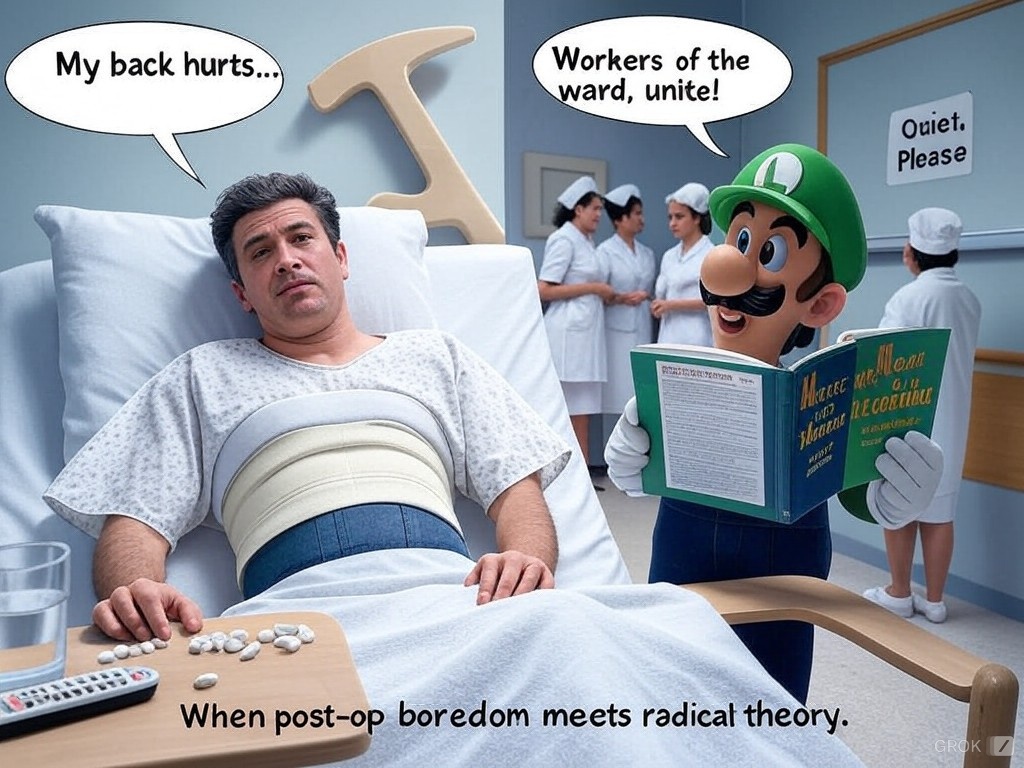
Top 10 Reasons We Know Luigi Mangione is a Communist
1. The Manifesto on the Nightstand
While most patients keep a phone charger and maybe some puzzle books handy, Luigi’s hospital bedside featured a dog-eared copy of “The Communist Manifesto,” wedged between his painkillers and an extra pillow.
2. Rehabilitation by the Red Book
Instead of following doctor’s orders to do gentle stretches, Luigi spent therapy sessions quoting Marx’s theory of surplus value, insisting that “spinal alignment should be free for the masses!”
3. Pillow Redistribution
When asked if he wanted an extra pillow for his sore back, Luigi said, “Only if everyone gets one.” He refused special treatment, demanding equal pillow distribution across the entire ward.
4. Hospital Billing Revolt
While most patients grumble about medical bills privately, Luigi staged a mini-uprising at the billing desk. He loudly proclaimed, “Hospital care should not be a commodity—it’s the people’s right!” and handed out socialist pamphlets in the waiting room.
5. Therapy Mat or Political Platform?
His yoga mat in physical therapy became a soapbox. Instead of deep breathing, Luigi orated on overthrowing corporate healthcare and abolishing insurance premiums, leaving other patients too stunned to stretch.
6. No One Escapes the Rhetoric
From nurses on their lunch breaks to janitors mopping hallways, everyone got a crash course in dialectical materialism. Luigi insisted that if his spine couldn’t stand tall, at least his ideology would.
7. The CEO Confrontation
He didn’t just complain about the healthcare system; he confronted the actual CEO, wielding worker-solidarity slogans like scalpel blades. His critique of profit-driven healthcare models left onlookers wondering if they’d signed up for a revolution instead of a routine checkup.
8. Free Healthcare for All—Literally
When offered an extra blanket during the chilly hospital night, Luigi responded, “Blankets for all, or blankets for none!” leading nurses to scramble to ensure no patient felt the cold of capitalist inequality.
9. Immune to Bribes
Gift shop coupons, free coffee vouchers—none of these “perks” could sway him. Luigi saw them as mere bourgeois distractions, insisting true healthcare progress couldn’t be bought for the price of a latte.
10. He Said It Himself!
Finally, the smoking gun: When caught up in the aftermath of his CEO confrontation, Luigi declared, “It wasn’t the back pain; it was the Marxism that made me do it!” If that’s not a confession of communist zeal, what is?