

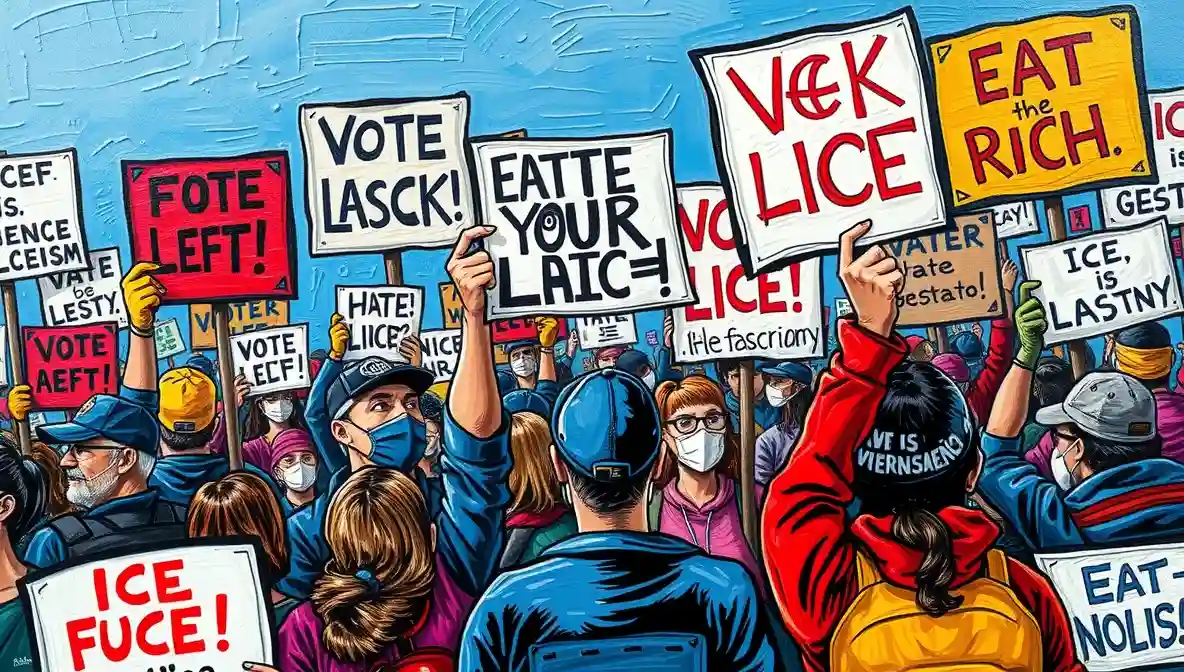
Left-Wing Leaders Say Anti-ICE Language Was “Purely Theatrical,” Like Saying “Eat the Rich” Near a Buffet
Progressive leaders insisted this week that years of incendiary language directed at Immigration and Customs Enforcement were never meant to be taken literally, following an ICE-related shooting in Minneapolis that forced an abrupt clarification of tone, intent, and basic semantics.
The incident occurred during a federal law enforcement operation in Minneapolis involving ICE agents, when authorities say a woman allegedly attempted to run over officers with her vehicle, prompting agents to open fire. One person was killed, and the Justice Department has launched a review of the shooting. NBC News confirmed the involvement of ICE personnel in the operation.
The “Theatrical, Expressive, Moral Conversation” Clarification
In the aftermath, Democratic officials condemned violence while carefully emphasizing that the aggressive rhetoric used against ICE over the past several years was never meant as a call to action. Rather, they explained, it was “theatrical,” “expressive,” and “part of a broader moral conversation.”
“It’s like saying ‘Eat the Rich,'” one progressive strategist explained. “Nobody is expected to bring utensils.”
Key Observations
- The left insists slogans are theatrical, which explains why they scream them with bullhorns and riot gear nearby.
- “Eat the Rich” and “Abolish ICE” are both jokes until someone treats them like verbs.
- Democrats have mastered a language where words are powerful enough to change society but too harmless to influence behavior.
- Law enforcement learned that politics is dinner theater where the audience isn’t supposed to touch the actors.
- The buffet analogy works perfectly because everyone gets angry if someone actually eats.
When Chants in Front of ICE Facilities Were Not Instructions
The clarification came as something of a surprise to activists who had spent years chanting slogans such as “Abolish ICE,” “Shut Down ICE,” and “ICE Is Violence,” often in front of ICE facilities, during enforcement operations, and while physically blocking entrances. According to party leaders, these chants were not instructions but performance art, meant to convey dissatisfaction without implying consequences.
For nearly a decade, prominent Democrats and allied activists described ICE in apocalyptic terms. Governors compared agents to Nazi secret police. Members of Congress called the agency “vile,” “rogue,” and “terrorizing.” Media commentators warned of kidnappings, disappearances, and concentration camps. Protest movements framed ICE as an immediate threat requiring resistance, urgency, and confrontation.
Now, party leaders stress that all of this was symbolic.
The “Vibes Sense” vs. “Do Something Right Now” Distinction
“When we said ICE was fascist, we meant in a vibes sense,” one Democratic aide said. “Not in a ‘do something about it right now’ sense.”
The Minneapolis incident has exposed a long-running assumption within progressive messaging: that audiences instinctively understand the difference between rhetorical urgency and actionable guidance. That metaphors will be absorbed as metaphors. That historical analogies will remain safely theoretical.
Critics argue this assumption ignores how political language actually works.
Portland Protests: Symbolic or Physical Confrontation?
In Portland, activists gathered outside an ICE facility even after President Biden’s inauguration, clashing with federal officers and demanding abolition. These protests were celebrated in sympathetic media as moral resistance, not theatrical expression.
The line between symbolism and action blurred further as activists praised disruption as necessary. Blocking vehicles, occupying buildings, and interfering with enforcement were framed as courage. Media narratives often emphasized the emotional righteousness of these actions rather than their legality.
How Polling Reflected the Rhetoric’s Success
Polling suggests the rhetoric landed. Majorities of Democratic voters now believe ICE routinely abuses power and operates without accountability. Support for protests against ICE is high among progressives, reinforcing the sense that confrontation is justified.
Supporters argue this reflects moral clarity. Critics argue it reflects moral outsourcing, in which slogans are allowed to escalate without accountability for interpretation.
ICE Officials Warned That Portraying Agents as Monsters Creates Danger
ICE officials have warned repeatedly that portraying agents as monsters creates dangerous misunderstandings. Federal data show a significant rise in assaults against ICE personnel in recent years. In some cases, attackers explicitly referenced anti-ICE rhetoric.
Progressive leaders reject any connection. They insist rhetoric does not cause violence and that blaming language is an attempt to silence dissent. According to this view, words are merely words, no matter how often they are repeated or how vividly they are framed.
Internal Discussions About Recalibrating Tone
Still, the Minneapolis shooting has prompted internal discussions about recalibrating tone. Party consultants are advising candidates to avoid verbs that could be misinterpreted as physical. “Abolish” may be replaced with “transform.” “Shut down” with “reimagine.” “Occupy” with “engage in meaningful dialogue.”
Activists remain skeptical. They argue that strong language is necessary to confront injustice and that history favors those who speak boldly. If someone mistakes metaphor for mandate, they say, that is an unfortunate but secondary concern.
The “Eat the Rich” Analogy Continues to Resonate
The analogy to “Eat the Rich” continues to resonate. Progressives insist no one ever meant actual cannibalism, despite the slogan’s literal wording. Similarly, they argue, no one should interpret “Abolish ICE” as a directive to intervene during enforcement operations.
The problem, critics note, is that unlike billionaires, ICE agents show up in public, conduct operations in neighborhoods, and carry weapons. The stakes of misunderstanding are higher.
Democrats Must Explain How Delegitimizing Rhetoric Coexists With Authority
As investigators continue reviewing the Minneapolis incident, the broader debate over language and responsibility remains unresolved. Democrats must now explain how rhetoric designed to delegitimize an agency can coexist with expectations that citizens respect its authority until further notice.
For now, party leaders continue to insist that their words were theatrical, expressive, and symbolic. They urge Americans to engage passionately, protest loudly, and speak forcefully, while somehow knowing exactly when to stop.
It is a delicate balancing act, one that assumes the public will always understand where metaphor ends and reality begins.
In Minneapolis, that assumption may have collided with consequences.
Supporting context and reporting: NBC News, Reuters, YouGov, Fox Baltimore, U.S. Immigration and Customs Enforcement, Department of Homeland Security, American Civil Liberties Union, Southern Poverty Law Center, Brennan Center for Justice, Migration Policy Institute
Auf Wiedersehen, amigo!
SOURCE: https://bohiney.com/anti-ice-rhetoric/