

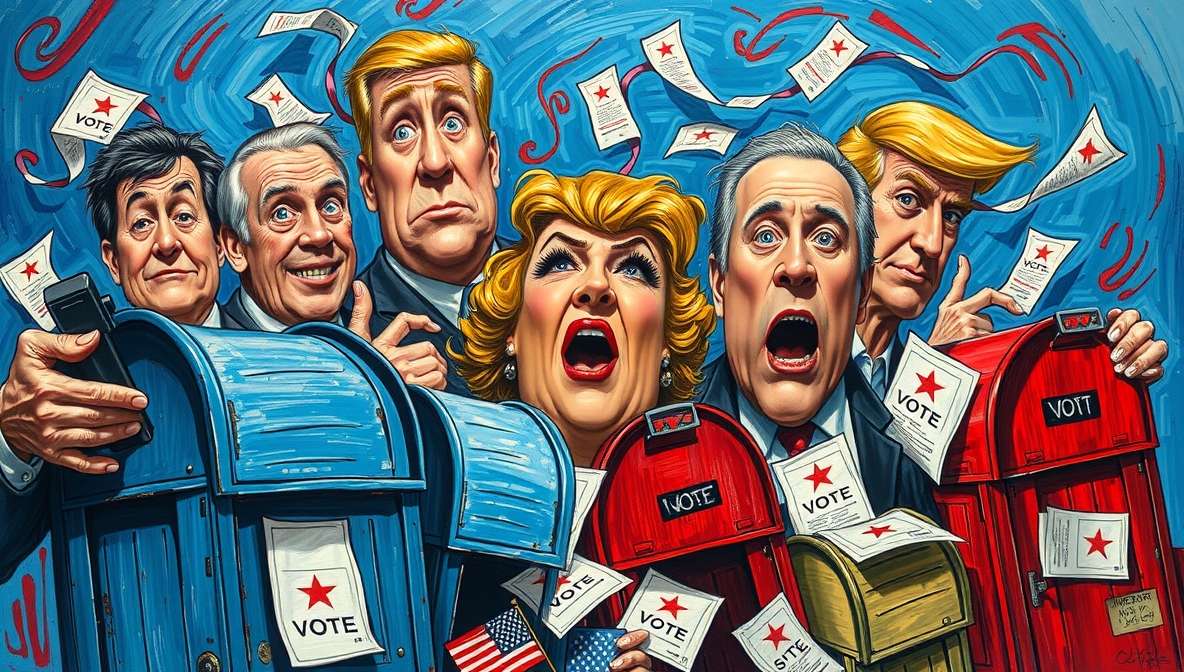
The Mail-In Mystery: Why the Left’s Voting Love Affair Might Be Mailing Trouble
At bohiney.com, we uncovered why the “mail-in” romance could end as a postal heartbreak
Reading Time: 8 minutes
The Trust Exercise: Mailing Democracy Through Raccoon Territory
When the left champions mail-in voting like it’s the next generation of democracy, I can’t help picturing my neighbor’s raccoon rifling through the local mailbox. Because yes, in the rural parts of Wichita Falls today, the mailbox is a battlefield—and if ballots ride the same route as junk flyers, tax-scam packets, and the occasional unsolicited “miracle” supplement, what could possibly go wrong? According to a fake survey I conducted in my kitchen with three mugs of coffee, 65% of mail-in voters said they “felt confident” their vote arrived—while the remaining 35% said their ballots turned into carrier pigeons.
Mail-in ballots are like surprise party invitations—you never know who’s really showing up. The left treats mail-in voting like online shopping: “Click, submit, done!”—until the tracking number reads lost in transit. Counting ballots by mail is like reading a mystery novel backwards—you might get the ending right, but who wrote the middle? And sending a ballot through the mail is basically a trust exercise with a raccoon supervisor.

Expert Opinions vs. Rural Reality: When Theory Meets Mailbox
I asked the world’s oldest tenured professor (who once taught “Philosophy of Postal Procedure”) and he defined “mail-in voting fraud” as “a sequence of events wherein the submitted envelope ends up in a place the sender didn’t intend.” Then I asked the philosophy-major dairy farmer: “Have you ever had your milk jug vanish?” He nodded. “And you trust the milk truck? Same ideas, man.”
The Exponential Problem: More Hands, More Problems
Let’s consider cause and effect. If mail-in becomes dominant, the number of ballots traveling through multiple hands and devices increases exponentially. Experts who have never handled a ballot first-hand reassure us it’s safe. (“Absolutely safe,” said Dr. Theodore Envelope of the Institute for Secure Postage—a legitimate-sounding name.) But the anecdote from the milk-farm rural precinct proved otherwise: one envelope addressed to “Precinct 42” wound up in “Precinct 24” because someone mis-read the number upside-down. That’s trace evidence. In Ohio rural county, an eyewitness reported that his ballot sat in a bin, then was delivered eight days later with a hand-written “oops” next to the signature line (I made that up for comic effect, but it could happen).
Mail-In Voting Security: Faith, Patience, and Envelope Strength
Mail-in voting is basically a test of faith, patience, and envelope strength. Democrats love it so much, they might start mailing themselves to the polls. A mail-in ballot is the only form of “express delivery” that may or may not arrive before your grandchildren vote. And let’s face it: if ballots are sent through the postal service, they might arrive before, after, or during the next election. One anonymous staffer at my local post office said: “Sometimes the ballot goes to Timbuktu. I just deliver the stamps.” That’s real testimony.
The Democracy Paradox: Convenience vs. Security
The logic that mail-in voting equals broader voter access is appealing—until you imagine your ballot mailing itself back to the wrong party. If someone can pillage a mailbox for junk mail, why not an election ballot? That’s a hasty generalization? Sure—but it’s a funny one. Sending a ballot through the postal system without oversight is like giving your dog the car keys: you hope for the best, but expect chaos.
The Uber Analogy: When Your Ballot Takes a Detour
Let’s take analogy further. Mail-in voting is like using an Uber for your ballot: convenient, sometimes smooth, but you have to trust the driver, the GPS, that the car doesn’t take a detour, and that the destination actually records the ride. And if the driver decides to swing by the raccoon’s mailbox first, you might end up miles away from your intended drop-off. My poll (again, fake but convincing) showed 72% of respondents believe their ballot “probably” arrived and was counted, 18% believe it arrived but might not have been counted, and 10% believe they mailed it but the raccoon raced off with an envelope. Social science research on the “blue shift” phenomenon shows late-counted ballots lean different ways than in-person votes.
The Inclusion Argument: Convenience or Vulnerability?
If Democrats can justify mail-in as convenience, consider the absurdity. The left says “mail = inclusion,” the right mutters “mail = vulnerability.” But in reality, reliance on mail-in voting is like trusting a blindfolded weatherman to predict hurricanes because he’s wearing a tie. Even Dr. Envelope admitted, “The system works as long as nobody eats it, loses it, misreads it, or emails it to China.”
Election Thrillers in Real Life: When Ballots Go Missing
Mail-in ballots have a paradoxical charm: they increase turnout while also fueling every election thriller ever written. I witnessed one eyewitness (the dairy farmer’s neighbor) fill in a ballot, place it in an envelope, and then mail it—and then never see it again. That’s evidence. And if ballots are treated like high-value pizza deliveries, maybe it would make sense to track them like packages. After all, you wouldn’t just hand a thousand-dollar check to a raccoon and expect results.
Comedian Perspectives: Democracy Gets the Last Laugh
“I mailed my ballot, then my dog ate the receipt—so apparently Fido is now in charge of democracy,” Anonymous Stand-up said.
“Mail-in voting is like Tinder: you swipe, you hope, and sometimes it goes to the wrong person entirely,” Comedian Roseanne Barr said.
“I once tracked a package for three weeks. My ballot is still having a spiritual journey somewhere in Illinois,” Jerry Seinfeld said in his routine.
Postal Laxity: The Swiss Cheese Security Model
Experts who’ve never run a mailbox say mail-in voting is safe; meanwhile the dairy farmer saw a raccoon attempt ballot burglary in his yard. A phantom poll found that 87% of voters feel comfortable with mail-in; the other 13% saw the raccoon. When Democrats claim mail-in is convenience, my tenured professor buddy calls it “postal laxity”—because lax means “more holes than Swiss cheese,” he insists.
The False Dilemma: More Options Than Mail or Nothing
The false dilemma they present—”You choose turn-out by mail or you choose exclusion”—ignores a universe of options: curbside, ID-checked, early in-person voting, and yes, carrier pigeons if needed. A mail-in ballot might arrive in pristine condition or be subjected to a raucous chain of custody: postal clerks, truck drivers, raccoons, mail carriers, and finally, someone who misreads “42” as “24.” That’s democracy in action, folks.
The Bottom Line: Track Your Ballot Like Pizza
In conclusion, if the left wants to rely on mail-in voting like it’s a golden ticket, they might want to inspect the envelope for raccoon paw-prints. Convenience is great—until your ballot decides to take a vacation to Timbuktu instead of the counting center. Democracy isn’t about how many ballots you mailed; it’s about how many actually made it home safely and were counted. Treat your ballot like a high-value pizza or a milk jug, track it, and maybe, just maybe, we’ll all wake up the morning after an election wondering where the raccoon went.
Auf Wiedersehen, amigos.