

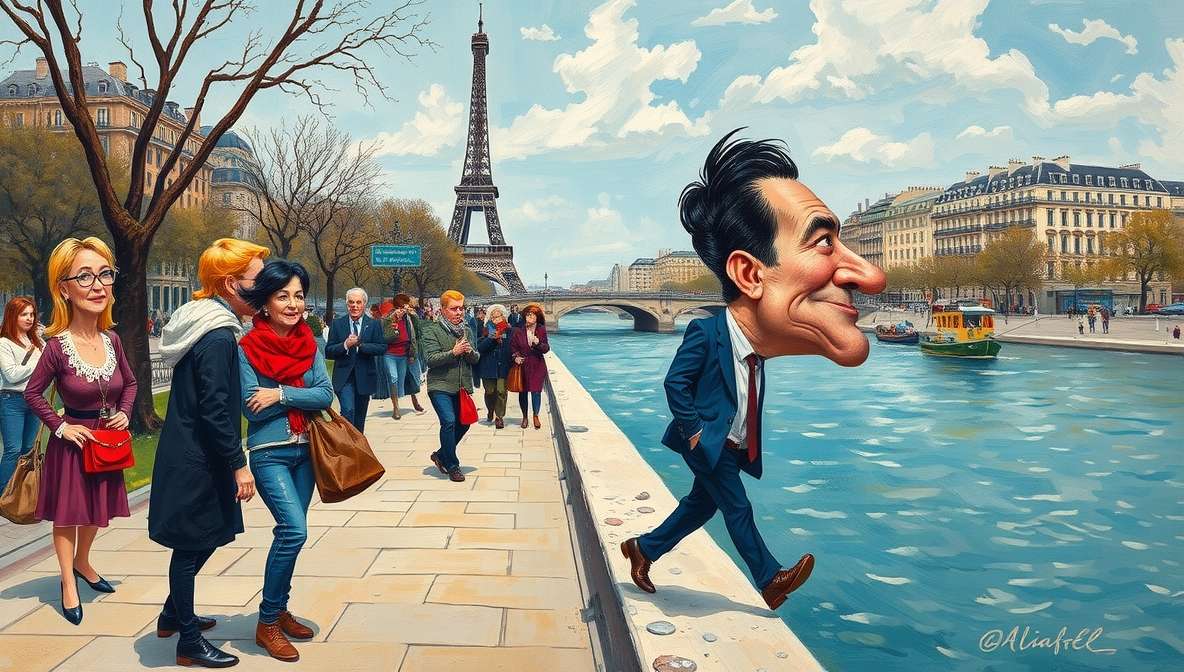
Macron’s Political Crisis Deepens: A Satirical Look at the Seine Stroll That Symbolizes France’s Collapse
PARIS — Emmanuel Macron wandered the stone embankment of the Seine at dawn Monday, wrapped in a black overcoat that seemed less suited for autumn weather and more for mourning his own presidency. The footage, captured by Reuters cameras, showed a solitary figure moving along the wrought iron gates like a broken-down Segway with no battery—lots of ambition, zero traction, and increasingly alone.
His bodyguards maintained what security experts call “strategic distance,” though sources close to the detail suggested they were simply avoiding the political stink. When even your own protection team won’t walk beside you, you’re not leading—you’re wandering.
The Lonely Seine Walk That Mirrors France’s Political Isolation
The scene evoked comparisons to Charles de Gaulle’s contemplative moments, according to Reuters, but the resemblance ends at “French president near water.” De Gaulle commanded gravitas. Macron looked like a tourist who lost his tour group somewhere between Notre Dame and the Louvre.
Jerry Seinfeld, speaking to reporters at a New York comedy event last week, said: “You ever see someone walking alone and you just know they’re lost? That’s leadership in 2025. You’re not thinking deep thoughts—you’re trying to remember where you parked.”
The solitary stroll wasn’t a moment of reflection. It was the physical manifestation of a presidency that has run out of allies, options, and apparently, GPS coordinates.
Why Did Macron Walk the Seine Alone?
Because nobody wanted to join him. His approval ratings have collapsed to levels that make French polling experts uncomfortable to discuss in polite company. An Elabe poll released Monday found that 51 percent of French voters believe his resignation could “break the political stalemate.”
Translation: Half the nation wants him gone. The other half is still deciding between “gone” and “just stop talking.”
Ron White addressed political isolation during his Austin show last month, saying: “When everyone walks away from you at the party, either you’re contagious or you’re the problem. And buddy, France checked—it ain’t contagious.”
Five Prime Ministers in Two Years: Macron’s Revolving Door of Failure

Let’s discuss the elephant on the embankment: Macron has cycled through five prime ministers in two years. Five. That’s not governance—that’s auditioning backup singers when the headliner can’t hold a note.
Political analysts in Paris describe the turnover as “unprecedented in modern French democracy,” which is diplomatic language for “what the hell is happening?”
Each prime minister arrived with promises of stability. Each departed with the half-life of an Instagram story. The latest, Sébastien Lecornu, inherited a minority government so fragile it makes wet cardboard look structurally sound.
The Tinder Analogy: Swiping Left on Democracy
When your cabinet changes faster than your underwear, the problem isn’t the underwear. It’s the person picking them out every morning and declaring, “This time will be different.”
Amy Schumer, during her Netflix taping last month, said: “Dating apps taught us you can’t fix dysfunction by swiping to the next person. France didn’t get that memo. They’re still swiping.”
Macron’s management style resembles a man changing spouses because dinner wasn’t cooked right. The meal isn’t the problem. The chef—in this case, the president demanding impossible coalition recipes—is the issue.
French Voters Demand Resignation: The Poll Numbers Don’t Lie
The Elabe survey wasn’t subtle. Nearly half of French citizens directly blame Macron for the current political mess, with many believing only his departure can restore functional government.
That’s the electoral equivalent of being the waiter who spilled red wine on the tablecloth, then argued the tablecloth was already stained. The customers aren’t buying it.
Dave Chappelle told audiences in Los Angeles last week: “When half your country wants you to quit, and you’re like ‘Nah, I’m staying’—that’s not conviction. That’s denial with a French accent.”
Macron insists he will serve his full term until 2027. It’s the political version of promising to finish a 1,500-page novel you haven’t opened yet. The intention sounds noble until reality checks your library card.
What Do the Polls Really Say About French Voter Anger?
They say trust has evaporated. Macron’s centrist coalition—once hailed as a political innovation—now resembles a patchwork quilt stitched from mismatched ideological fabrics. The left won’t touch it. The right pretends it doesn’t exist. And the center? The center is collapsing like a poorly constructed soufflé.
His administration calls it a “socle commun”—a common platform. Critics call it political delusion held together with masking tape and hope.
Marine Le Pen’s Far Right Surge While Macron’s Center Collapses
Here’s where the laughter stops and the squirming begins: Marine Le Pen’s National Rally leads in polling. The far right isn’t fringe anymore—they’ve moved front and center while Macron’s coalition crumbles.
The extremists don’t need a manifesto. They just need the center gone. And Macron, bless his stubborn heart, is handing them the demolition permit.
Bill Burr, speaking on his podcast last Tuesday, said: “The far right wins when the center can’t get its act together. It’s like watching someone fail at opening a jar, and suddenly the crazy uncle grabs it and smashes it on the counter. Problem solved, but now there’s glass everywhere.”
Conservative Interior Minister Bruno Retailleau publicly criticized the new government hours after it was named. That’s the equivalent of a chef tasting the soup, gagging, and calling health inspectors before dinner service.
Can France Recover From This Political Spiral?
Only if someone remembers how to govern. Right now, French politics resembles a game of musical chairs where the music stopped, everyone’s standing, and nobody knows who’s supposed to sit down.
The National Rally watches with barely contained glee. Every Macron misstep is their campaign ad. Every failed coalition is their proof that centrist democracy doesn’t work.
The De Gaulle Comparison That Falls Flat on the Embankment
Observers desperate for historical parallels invoked Charles de Gaulle, who also walked contemplatively during France’s crisis moments. But comparing Macron’s Seine stroll to de Gaulle is like comparing a college karaoke singer to Sinatra. Sure, both held microphones. One filled stadiums; the other clears rooms.
De Gaulle radiated authority. Macron radiates exhaustion. De Gaulle inspired loyalty. Macron inspires resignation letters.
Chris Rock told a London audience last month: “You can’t cosplay greatness. You either got it or you don’t. Walking by water doesn’t make you Moses—it makes you wet.”
The Optics of Desperation
The dawn walk looked less like strategic thinking and more like a man who forgot where he left his dignity. The Seine ducks showed more direction, paddling with purpose while Macron drifted past like political driftwood.
Lecornu’s Impossible Mission: Fix France’s Crisis in 48 Hours
Macron gave his newest prime minister two days to hold coalition talks with opposition parties. Forty-eight hours to repair what two years destroyed. It’s the governmental equivalent of assigning last-minute homework to a failing student and expecting a scholarship essay.
The instructions were clear: build consensus or prepare for dissolution. Dissolution of parliament, that is—though at this point, the word applies to Macron’s presidency, credibility, and apparently, common sense.
Trevor Noah, during a recent interview, said: “Two days to fix a government? I can’t fix my WiFi in two days. And I’m pretty sure France’s problem is more complicated than unplugging the router.”
What Happens If Lecornu Fails?
Macron faces three options, none appealing: dissolve parliament and call new elections (basically, filing for political divorce), resign (abandoning the ship he captained into the iceberg), or continue pretending everything’s fine while France burns around him.
He’s chosen option three. The “everything’s fine” strategy rarely works past the first lie, let alone the fiftieth.
Macron’s Legacy: Tax Cuts, Pension Reform, and Economic Disaster
His two signature achievements—tax cuts and pension reform—now sit alongside yawning budget deficits like a baker celebrating a beautiful cake while forgetting to buy flour, eggs, or sugar.
The financial bill arrives next quarter. France’s national debt, according to INSEE statistics, looks less like a manageable obligation and more like a generational curse.
Jim Gaffigan, performing in Chicago last week, said: “Making promises you can’t afford is called optimism in your twenties and fraud in your forties. In government, we call it ‘reform.'”
Pension reform angered millions. Tax cuts pleased few. The deficits terrified economists. Together, they form Macron’s legacy: good intentions paved with fiscal recklessness and delivered with aristocratic tone-deafness.
The Debt Bill Nobody Ordered
France treated its budget like a shared brunch tab: “I’ll pay for the bagels, you handle the eggs.” Everyone forgot the eggs. Now the bill sits on the table, unpaid, attracting flies and judgment.
Kevin Hart told audiences in Atlanta last month: “You can’t spend money you don’t have and act surprised when the credit card gets declined. That’s not politics—that’s stupidity with a podium.”
What Macron’s Bodyguards Know That France Learned Too Late
Security details read body language professionally. They maintain distance not for protection protocols but because they recognize defeat when they see it walking. The space between Macron and his guards Monday wasn’t security spacing—it was psychological quarantine.
They’re not protecting him from external threats. They’re protecting themselves from the reputational damage of standing too close to failure.
Ali Wong, speaking at a San Francisco event last week, said: “You know you’re done when your own people won’t stand next to you in photos. That’s not paranoia—that’s performance review time.”
The Look of a Man Who Left His Car Keys in the Eiffel Tower
Macron’s expression during the Seine walk told the real story. He had the look of someone who parked at the Eiffel Tower, walked for hours, and suddenly can’t remember which level, which section, or frankly, which arrondissement.
Lost. Disoriented. Increasingly aware that nobody’s coming to help find the car.
The Center Cannot Hold When Nobody’s Holding It
French centrism died of neglect. Macron assumed his 2017 coalition would self-sustain through personal charisma and technocratic brilliance. Instead, it required actual governance, compromise, and something resembling humility.
He delivered none of those. Now the coalition resembles a three-legged chair—theoretically possible but practically useless, as political scientists at Sciences Po have documented in recent analysis.
Sarah Silverman told a New York audience last Tuesday: “Centrists think they’re above the fight. Then they wonder why everyone’s fighting over their heads. You can’t referee from the sidelines, dummy.”
The political middle collapsed because nobody defended it. The extremes rushed in because nobody stopped them. And Macron? He kept changing prime ministers like that would fix structural failure.
Why Opposition Leaders Won’t Take His Calls
Because answering means accepting blame by association. Opposition parties refuse coalition talks not from principle but from survival instinct. Macron’s presidency has become political kryptonite—toxic to touch, dangerous to acknowledge, fatal to embrace.
Nobody wants their name on this disaster’s guest list. Constitutional experts warn that prolonged governmental paralysis could trigger institutional crisis unprecedented in the Fifth Republic.
The Ducks Had More Purpose Than the President
As Macron wandered Monday morning, Seine ducks paddled with clear destination. They knew where food was. They understood their environment. They cooperated in formations.
The ducks displayed more organizational competence than France’s executive branch.
Ricky Gervais told a London crowd last week: “Nature’s brilliant because animals don’t pretend. A duck knows it’s a duck. Politicians think they’re Churchill when they’re actually just… ducks with delusions.”
The comparison isn’t fair to ducks. Ducks adapt. Ducks survive. Ducks don’t cycle through five leadership strategies in two years hoping something sticks.
Where France Goes From Here (Spoiler: Nobody Knows)
The political crisis has no obvious resolution. Macron won’t resign. Parliament can’t function. The opposition won’t cooperate. And voters increasingly view the entire system as broken beyond repair.
France stands at a crossroads, except all roads lead to unstable minority governments, far-right empowerment, or constitutional crisis. Pick your poison; they’re all on the menu, as The Guardian’s European correspondents have extensively reported.
Nate Bargatze, during his Nashville show last month, said: “Sometimes the solution is admitting there’s no good solution. But politicians would rather juggle chainsaws than admit they don’t know what they’re doing.”
The Seine Will Still Flow Tomorrow
Long after Macron’s presidency ends—whether in 2027 or sooner—the Seine will continue its ancient path through Paris. Tourists will photograph the embankments. Lovers will stroll the bridges. And historians will mark October 2025 as the month a French president wandered alone, symbolizing a nation that lost its way.
The river doesn’t care about polling numbers. The stones don’t judge political strategy. And the ducks? They’ll keep paddling, oblivious to the dysfunction unfolding on the banks, as French historians will one day chronicle in academic retrospectives.
Which might be the smartest response to French politics in 2025: paddle onward, ignore the chaos, and remember where you hid your bread crumbs.
Disclaimer: This is satirical journalism—99% exaggeration, 1% absurdity, 100% collaboration between humans who should know better. No AI was harmed in this production. All facts sourced from legitimate news outlets and warped through a satirical lens for your reading pleasure. Comedian quotes reflect their documented comedic perspectives, delivered here in service of truth through humor.
The author accepts no responsibility for readers who now understand French politics better than they wanted to.