

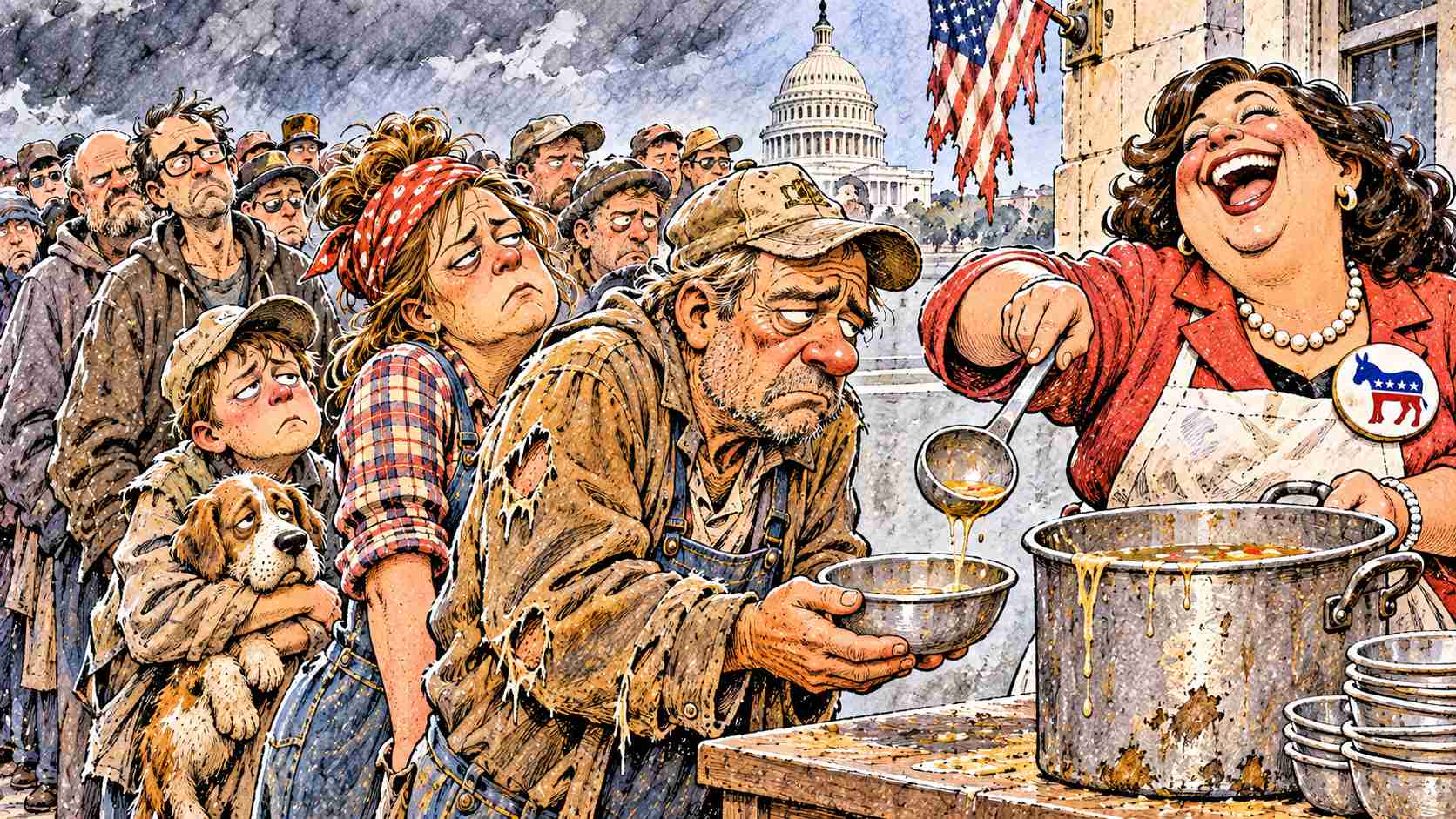
Misery Loves Company With a Retirement Account
WASHINGTON, D.C. — America’s socialists have discovered the most powerful force in modern politics: millions of people who are unhappy with their own lives and would feel considerably better if everybody else were unhappy, too.
Political analysts initially believed the socialist victories reflected economic anxiety, dissatisfaction with government and rising living costs. Further examination revealed something considerably more American: resentment with a voter registration card.
Why Unhappy Voters Are Backing Socialist Candidates
“I’m working two jobs, my neighbor owns a boat, and somehow I’m the problem?” complained unemployed philosophy graduate Tyler Henderson, 34, who recently voted for a candidate promising to tax boat owners into becoming pedestrians.
Henderson acknowledged that he had never operated a boat, applied for a second job or finished paying for his first philosophy degree.
“But somebody has to make sacrifices,” he explained. “Preferably somebody with a boat.”
The movement’s extraordinary appeal rests on a revolutionary proposition: Happiness is not something to achieve. It is something to redistribute, preferably after identifying whoever appears to have more of it than you do.
Cost of Living Anxiety Fuels the Midterm Mood
Researchers at Pew Research Center found that 73% of Americans were very concerned about food and consumer goods prices. The Bureau of Labor Statistics consumer price index tracks those prices monthly, though nobody on the campaign trail has been seen consulting it.
Socialist campaign strategists examined this information and concluded that groceries would become more affordable if supermarkets were required to hire a Deputy Commissioner of Equitable Shopping Experiences.
The proposed official would investigate customers buying expensive steaks while other shoppers were forced to purchase hamburger.
“Nobody should have a better Tuesday than anybody else,” explained progressive organizer Melissa Fairchild. “That’s economic justice.”
What the Campaign Memo Said
A strategy memo obtained by reporters, circulated among field organizers the week before the vote, instructed canvassers to “open with the neighbor’s boat, close with the neighbor’s boat.” A footnote reminded volunteers that boats could be swapped for pools, trucks or “visible contentment, especially on porches.”
The memo’s final page contained a single line in bold: “Do not ask what the voter did last weekend.”
Success Is Suspicious: The Plumber Who Bought a Truck
Under the new philosophy, success is suspicious, failure is structural, and personal responsibility is an outdated concept invented by men who owned lawnmowers.
A prosperous plumber earning $140,000 annually became the subject of intense neighborhood criticism after purchasing a new pickup truck. The Bureau of Labor Statistics Occupational Outlook Handbook lists the plumbing trade as steady work, a fact that did little to calm the block association.
“Why does he deserve that truck?” demanded a local activist.
“Because he fixes toilets twelve hours a day,” answered his wife.
“That’s exactly the sort of capitalist excuse we’re trying to eliminate.”
The plumber subsequently announced he would reduce his working hours, prompting activists to celebrate his decision before discovering their toilets were still broken.
Social Comparison, Envy and the Economics of Resentment
Psychologists have long studied social comparison, the tendency to evaluate personal circumstances against those of other people. Socialist strategists have apparently developed a more ambitious version: If you cannot improve your position, lower somebody else’s.
A local campaign volunteer described the method as emotionally satisfying.
“Yesterday I was miserable because my brother-in-law has a swimming pool. Today I’m miserable because he’s getting taxed. But now I’m miserable with a sense of purpose.”
A canvass survey of 412 voters in one Columbus precinct, conducted by the Midwest Institute for Civic Observation, found that 61 percent would accept a smaller paycheck if a brother-in-law’s paycheck shrank by more. Another 22 percent said they would need to see the brother-in-law’s pool first.
Economists Warn Redistribution Can’t Outrun Production
Economists warn that punishing productive behavior can reduce the very prosperity politicians promise to distribute. The Library of Economics and Liberty has been making that argument for decades to an audience that was, at the time, busy.
Campaigners dismissed the concern, arguing that wealth could always be collected from somebody else.
Asked what would happen when everybody else ran out of money, one activist offered an innovative solution.
“We’ll hold another election.”
Reached for comment, a spokesman for the Tri-State Association of Boat Owners said his members were not the wealthy villains described at the rallies. “Most of us are a payment plan with a motor,” he said. “If they tax the boat, the bank still gets paid first. Then the boat goes to the bank, and the bank doesn’t have a Tuesday either.”
The movement’s next campaign slogan reportedly combines emotional solidarity with practical economic planning:
“You may still be miserable tomorrow, but at least your neighbor won’t be smiling.”
Five Humorous Observations
- The whole platform is “somebody has a boat.” That isn’t policy. That’s a comment under a vacation photo with a voter registration card stapled to it.
- Voting to make your neighbor miserable is like setting your own hair on fire so the guy next door has to smell it. You’d think the smell would be the first thing to ruin the plan.
- A philosophy degree should have prepared this guy for the question “what is a boat, really?” Instead he got a student loan and a grudge, and the grudge has better interest rates.
- Nobody ever says “I’m mad because my neighbor is happy” out loud. Then a campaign hands them a lawn sign and suddenly it’s a movement with catering.
- The plumber cut his hours and the activists cheered, right up until the toilet backed up. That’s the first time in history a protest got a bill.