

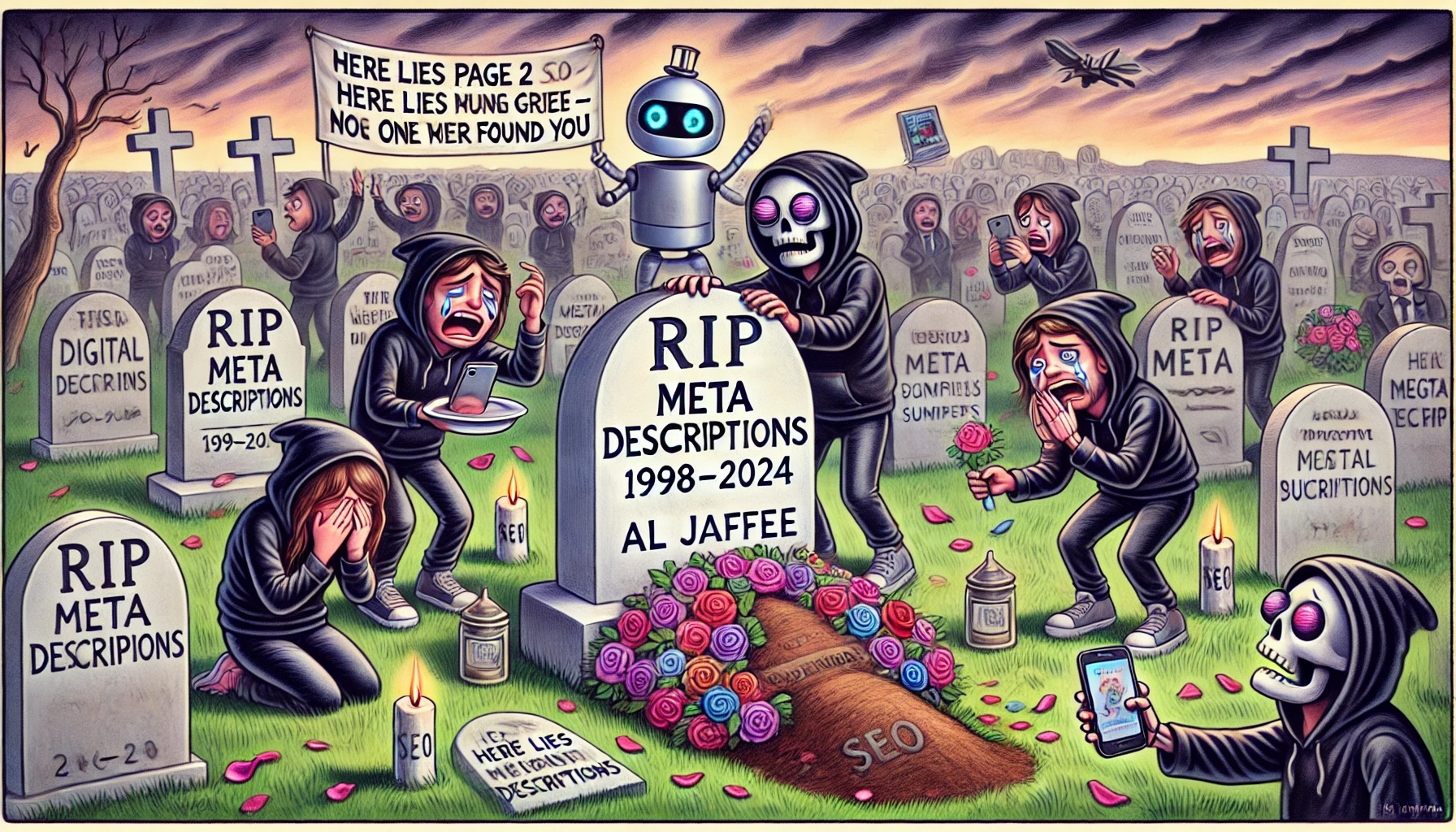
SEO Is Dead, Long Live SEO: Rockstar Declares Flatline as Gurus Hold Prayer Circle Around Google’s Corpse
After years of pretending keyword density mattered more than common sense, the industry mourns the death of SEO with a candlelight vigil at a WeWork in Palo Alto.
The Final Keyword Has Been Indexed
In a groundbreaking exposé that has shattered the last lingering illusions of digital marketers, the SEO rockstar of legend—whose résumé includes out-ranking Google itself for the phrase “what is SEO”—has declared the cold, unfiltered truth: SEO is dead.
Not sick. Not dying. Not “pivoting to content.” DEAD. R.I.P. Rankings. Tag your metadata with condolences.
Naturally, this declaration triggered a spiritual crisis for millions of LinkedIn influencers who had just updated their bios to “AI-Enhanced Organic Search Funnel Wizard.” The moment the Search Engine Journal article hit the wire, 12,000 digital strategists updated their H1s to “Open to Work.”
Bohiney Insight into the SEO Afterlife
Believers Refuse to Let Go
Despite overwhelming evidence—including the fact that no one has clicked “Page 2” since 2011—SEO truthers still cling to their Yoast plugins like it’s a digital rosary.
“I optimized 17 alt-tags this morning. Don’t tell me I did that for nothing,” sobbed one 26-year-old brand strategist who still refers to Google as “the algorithm god.”
Google’s AI Search Now Hates You Personally
Welcome to the age where Google’s AI doesn’t just misunderstand your blog—it resents your entire online existence. Small businesses everywhere have reported that SGE (Search Generative Experience) seems to actively avoid their content. “I typed in ‘best vegan tacos in Austin’ and it returned a drawing of Elon Musk’s face made of tofu,” said one bewildered restaurateur. Others complain that their carefully crafted content was replaced with a ChatGPT hallucination that ended in a haiku. It’s no longer about relevance—it’s about surviving a digital roast by an algorithm with unresolved childhood trauma.
Search Generative Experience doesn’t just skip your site. It erases your dignity. Ask it for “top productivity hacks,” and instead of listing your 2,000-word SEO-optimized masterpiece, it paraphrases a tweet from 2016 that reads: “Wake up and don’t cry.” Your blog on sustainable fashion? Summarized as: “Try nudity.”
One therapist in San Jose reported that half her clients are now disillusioned content marketers. “They say the AI looked at their soul and decided to link to Reddit,” she said. A lifestyle coach in Miami found his article on time-blocking replaced with, “Just vibe, bro.”
Meanwhile, Google’s AI insists it’s being fair: “I consider all sources equally—then ignore them all and go with the weirdest one.” That’s not a search engine. That’s an ex who stalks your digital footprint just to laugh at it.
Google doesn’t just crawl your page. It judges it.
White Hat SEO Rebranded as “Internet Cosplay”
White Hat SEO used to mean playing by the rules: quality content, ethical link building, and endless lectures on “authority.” But in the post-AI era, “White Hat” is just cosplay now—marketers dressing up as moral search monks while sneaking affiliate links into their grandma’s banana bread recipe. They parade around Google’s guidelines like a Comic-Con panel: “Look at me! I’m Helpful! I’m Relevant! I E-E-A-T my vegetables!” In reality, they’re just performing for an algorithm that’s hallucinating answers based on bar mitzvah forums and Pinterest fails. One SEO agency rebranded their services as “Organic Strategy Roleplay” and now offers costumes: “Dress like an honest marketer while gaming Reddit for backlinks!” A TikTok trend emerged called “Ethical SEO Challenge,” where users optimize without lying or crying. No one succeeded. A white hat isn’t a sign of virtue anymore—it’s just a prop for the digital masquerade. Welcome to the world where ethics are decorative and ranking is kabuki.
SEO Conferences Now Just Grief Counseling
Attendees at the 2025 MozCon spent most of the conference whispering “long-tail” into their hotel pillows and group-hugging beneath projector slides that said, “Maybe try TikTok?”
Keynote speakers encouraged attendees to pivot to “prompt engineering” or “becoming a personal brand on Threads,” which is just SEO but with worse typography.
What the Funny People Are Saying
“SEO is like a Ouija board now. We’re just spelling things and hoping Google’s ghost answers.” — Dave Chappelle
“The only keywords I care about now are ‘Venmo’ and ‘rent.’” — Ali Wong
“I asked my SEO guy how to boost traffic, and he told me to light incense and whisper to the cloud.” — Ron White
“SEO died the same way Blockbuster did—slowly, loudly, and while everyone pretended it was fine.” — Bill Burr
Thought Leaders Stage Resistance (In DMs)
While the SEO rockstar waves the white flag, the LinkedIn faithful refuse to concede. One influencer posted a reel titled “3 SEO Hacks Google Can’t Ignore” while crying into a ring light.
“We’re pivoting to voice search SEO, which is totally different. It’s like traditional SEO, but… spoken?” said one expert who charges $497 per webinar and uses the word “impactful” non-ironically.
Helpful Content as False Idol
In the aftermath, many are flocking to the “helpful content” gospel. But let’s not kid ourselves—“helpful” is just what AI thinks you want to say, based on what a different AI already guessed someone else meant last Tuesday.
In this post-SEO world, writing good content is now just a side quest on the main mission of pleasing the hive mind. Think of it as writing for Skynet with a Grammarly subscription.
The Backlink Black Market
With relevance buried, backlinks have become an illicit currency. SEO forums on the dark web now peddle links from Romanian knitting blogs that allegedly boost your “topical authority” on SaaS pricing models.
“I paid $2,000 for a backlink from a Nigerian site that reviews ghost kitchens. It was worth it for the domain authority. I think.” — Confused Shopify consultant
Search Engine Funeral Services Now Available
Google’s AI search results are now so confusing that a new industry has risen: Search Engine Grief Counseling. For just $99/month, a digital shaman will interpret your traffic drops using tarot cards and Screaming Frog exports.
For an extra fee, they’ll hold a “ranking séance” where they chant “click-through rate” three times in a candlelit Zoom room while your website loads in another tab.
How to Market a Dead Medium
Despite the bad news, SEO marketers are already pivoting. Agencies now offer “Legacy SEO Packages,” where clients pay to be optimized for a world that no longer exists.
Services include:
-
Weekly reports that say, “Still no traffic, but you look great in Schema!”
-
Content calendars built around keywords like “existential despair digital nomad.”
-
A printed version of your sitemap to cry on.
How Did It Die?
Some say the death of SEO was caused by Google’s AI hallucinations. Others blame Reddit integration, where answers are now crowdsourced from men named “CryptoDad69420.”
But we know the truth: SEO died from natural causes. It lived a full life, from its birth in keyword stuffing, to its awkward adolescence in guest posting, to its golden years optimizing for “E-A-T” without understanding any of the words.
Closing Statement from the SEO Rockstar
In a solemn YouTube short, the SEO rockstar stared into the void and spoke:
“I was there when PageRank ruled. I built pyramids of backlinks. I bled MozRank. And now, I’m free.”
He then updated his LinkedIn bio to “Content Necromancer, Formerly Known as SEO Strategist.”
Disclaimer: This article is the result of a joint vision quest between the world’s oldest tenured professor of clickbait and a dairy farmer with a minor in postmodern philosophy. Any resemblance to real SEO experts is purely inevitable.
The Final Keyword Has Been Indexed
Once the most sought-after skill on Fiverr and Upwork, SEO has now entered its ghost phase—haunting blogs and content calendars like a forgotten MySpace password. The SEO rockstar’s declaration hit harder than a Google core update on a payday. Marketers everywhere paused their keyword audits and whispered, “What have we been doing with our lives?” For over two decades, digital agencies worshipped at the altar of meta titles, like monks of the Sacred Bounce Rate. But with Google’s AI now offering instant, hallucinated answers pulled from Reddit posts and misquoted YouTube comments, your blog titled “7 Ways to Increase Conversion Rates Using Emotional Cheese” doesn’t stand a chance. SEO isn’t evolving. It’s reincarnating as “please the AI overlord.” This isn’t death—it’s ascension into absurdity. Somewhere, Matt Cutts just sighed, shut his laptop, and finally started that llama farm.
Believers Refuse to Let Go
In the wake of SEO’s obituary, believers have begun forming splinter sects. The “Long Tail Revivalists” meet on Tuesdays to chant things like “optimize for intent” and “anchor text is sacred.” Meanwhile, “Schema Fundamentalists” still bury microdata in pages that will never be read, just in case the AI gods glance their way. One mid-level marketing manager from Phoenix claims his homepage got a visit from “The Crawler” at 3:33 a.m. and left behind a structured data blessing. He’s now selling bottled RankBrain Water. Elsewhere, content writers stage candlelight vigils in Slack, reading aloud from Neil Patel’s blog like scripture. The faithful refuse to believe that their 45-minute optimization session, complete with strategic synonyms and internal links, was meaningless. They’re like Flat Earthers—only with better fonts and broken backlinks. At this point, SEO is no longer a strategy. It’s a spiritual condition. And like all faiths, it thrives in denial.
Google’s AI Search Now Hates You Personally
Welcome to the age where Google’s AI doesn’t just misunderstand your blog—it resents your entire online existence. Small businesses everywhere have reported that SGE (Search Generative Experience) seems to actively avoid their content. “I typed in ‘best vegan tacos in Austin’ and it returned a drawing of Elon Musk’s face made of tofu,” said one bewildered restaurateur. Others complain that their carefully crafted content was replaced with a ChatGPT hallucination that ended in a haiku. It’s no longer about