

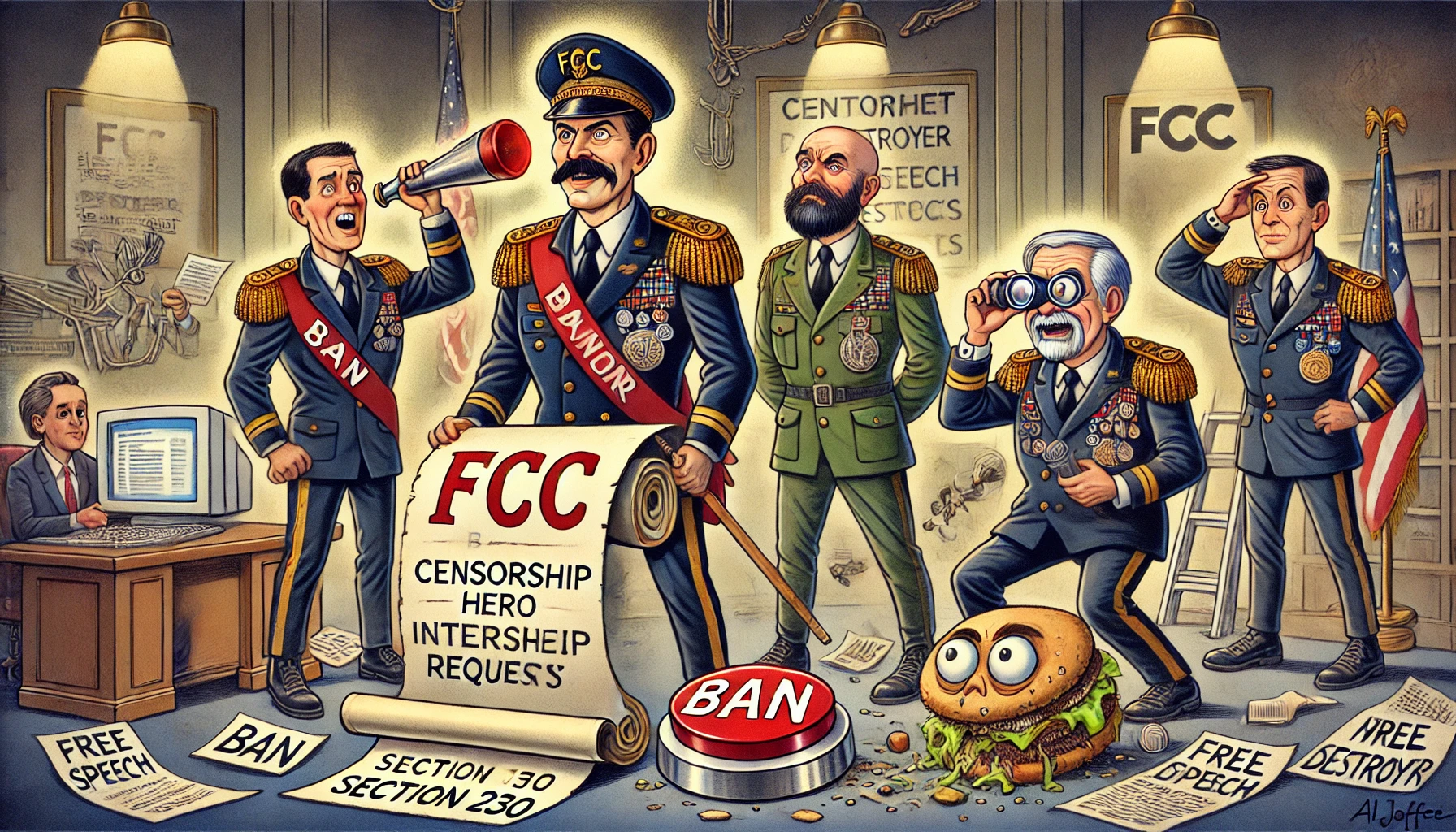
The FCC’s Foray into Internet Regulation: A Comedy of Errors
In a move that has left tech enthusiasts and legal scholars scratching their heads, the Federal Communications Commission (FCC), under the leadership of Chairman Brendan Carr, has embarked on a mission to reinterpret Section 230 of the Communications Decency Act. This endeavor, reminiscent of a sitcom plot gone awry, raises questions about the FCC’s jurisdiction, the potential impact on online platforms, and the broader implications for free speech and innovation.
The FCC’s New Role: Internet Hall Monitor
Traditionally, the FCC’s mandate has encompassed regulating interstate and international communications via radio, television, wire, satellite, and cable. However, with the recent initiative to reinterpret Section 230, the agency appears to be venturing into uncharted territory—policing online content. This shift is akin to a lifeguard abandoning their post at the pool to patrol the beach, leaving swimmers and sunbathers equally perplexed.
Section 230: The Internet’s Safety Net
Section 230, often dubbed “the 26 words that created the internet,” provides immunity to online platforms from liability for user-generated content. This legal shield has been instrumental in fostering the growth of social media, forums, and countless other online communities. Without it, platforms might face an avalanche of lawsuits, stifling innovation and free expression.
Chairman Carr’s Crusade: A Solution in Search of a Problem?
Chairman Carr’s push to reinterpret Section 230 seems to stem from concerns over perceived censorship by tech giants. However, critics argue that this move is a classic case of “fixing” something that isn’t broken. By attempting to curtail the very protections that have enabled the internet’s dynamic growth, the FCC risks undermining the digital ecosystem it seeks to protect.
Legal Gymnastics: The FCC’s Jurisdictional Limbo
One of the most baffling aspects of this initiative is the question of jurisdiction. Legal experts have pointed out that Section 230 does not grant the FCC authority to interpret or enforce its provisions. As Lawrence J. Spiwak noted, “Section 230 itself contains no mention of FCC rulemaking authority to define the bounds of the immunity it provides.” This raises the question: Is the FCC overstepping its bounds in a bid to regulate the unregulatable?
The Slippery Slope: From Moderation to Litigation
Eroding Section 230 protections could lead to a cascade of unintended consequences. Without immunity, platforms might become overly cautious, removing content at the slightest hint of controversy to avoid potential lawsuits. This could result in a sanitized, homogenized internet, devoid of the vibrant discourse that makes it unique. Alternatively, platforms might abandon moderation altogether, leading to a digital Wild West where anything goes.
The Irony of Oversight: Regulating Free Speech to Protect Free Speech
The FCC’s initiative is fraught with irony. In an attempt to address concerns about censorship, the agency’s actions could lead to increased regulation of speech. By imposing stricter controls on how platforms manage content, the FCC might inadvertently stifle the very free expression it aims to safeguard.
FCC’s War on Big Tech: Because Clearly, The Government Knows Best
A recent public opinion poll has revealed that 87% of Americans trust tech giants over the government when it comes to protecting free speech. Meanwhile, only 12% still believe the government has their best interests at heart, and an insightful 1% simply responded, “What the F___ are you talking about?”.
Naturally, this overwhelming distrust in government has sent the FCC into full damage-control mode, as Chairman Brendan Carr embarks on what can only be described as a “Mission to Fix the Internet That Nobody Asked For.”
While most Americans are just happy to scroll through cat videos, conspiracy theories, and their aunt’s unhinged Facebook rants, the FCC seems convinced that repealing Section 230 is the only way to save us from… what exactly?
The FCC’s New Mission: “Make the Internet Unusable Again”
Some people believe the government exists to protect their rights. Those people have never tried calling the DMV. Or getting a pothole fixed. Or, heaven forbid, asking the IRS a question about their own tax code. And yet, the FCC has decided that the best way to protect free speech is by making sure nobody has it.
With Section 230 under attack, we may finally get to experience the glory days of the internet—1995. That means:
- No more social media comment sections (probably for the best).
- No more meme accounts (goodbye, happiness).
- No more personalized news feeds (back to reading the morning paper like a caveman).
What could possibly go wrong?
FCC vs. Big Tech: The Most One-Sided Fight Since David vs. Goliath (If David Had No Slingshot)
Brendan Carr believes Big Tech has too much power, and the FCC must step in to restore “balance.” That’s like saying Wile E. Coyote needs to stop getting hit by anvils—you admire the effort, but deep down, you know how this ends.
Tech companies have armies of engineers, AI researchers, and lawyers—while the FCC is still struggling to explain the “skip intro” button on Netflix.
Even the government’s own polling shows that Americans have more faith in billion-dollar corporations run by eccentric billionaires than they do in Congress. And that’s saying something.
Public trust rankings (as of today):
- Amazon Prime delivery.
- Big Tech companies.
- That one friend who never pays you back but you still trust them.
- Stray dogs.
- The U.S. government.
If you’re wondering where the FCC ranks, it’s somewhere below telemarketers offering “an extended car warranty” and those sketchy mall kiosks selling knockoff perfume.
The Future Without Section 230: Welcome to a Lawsuit-Free (and Internet-Free) America!
If Brendan Carr gets his way, platforms like Twitter, Facebook, and YouTube would have two choices:
- Ban everything (including your memes).
- Let everything stay up (including deeply disturbing content your Uncle posts at 3 AM).
Of course, the biggest irony is that killing Section 230 won’t stop censorship—it’ll make it worse. Without liability protections, platforms will delete anything remotely controversial just to avoid getting sued.
That means:
- No more political debates.
- No more spicy tweets.
- No more people arguing over whether pineapple belongs on pizza.
(Spoiler alert: It does.)
FCC’s Next Moves: Completely Misunderstanding How the Internet Works
To prove they’re serious about saving free speech, the FCC is rumored to be considering a few exciting new ideas:
- Bringing back MySpace (so the internet is just a void of HTML glitter again).
- Mandating government-approved memes (say goodbye to those dank ones).
- Requiring all emails to be sent via fax (to “increase transparency”).
- Launching a national “social media hotline” (where you can report “hurtful comments” directly to a Department of Feelings representative).
The Real Question: What the F___ Is Brendan Carr Doing?
While the FCC focuses on taking away liability protections from tech companies, actual problems on the internet continue to thrive, including:
- Scam robocalls that somehow know your car’s VIN number.
- Social media influencers selling you “miracle” skincare that’s just glorified cooking oil.
- Clickbait articles that make you scroll through 47 slides just to find out the “shocking truth” about a celebrity’s dog.
Maybe, just maybe, the FCC should prioritize fixing THOSE things before dismantling the legal framework that allows free speech to exist online. But what do we know? We’re just the 87% of people who actually use the internet.
The Final Verdict: Let the Tech Nerds Run the Internet
If the FCC wants to regulate the internet, they should at least be forced to pass a basic CAPTCHA test first. The reality is, Big Tech may not be perfect, but it’s still miles ahead of the government when it comes to keeping the digital world functional.
So before we hand over the keys to the web to the same people who once tried to ban dancing in the 1920s, maybe we should think twice. Because the minute the FCC takes over internet content moderation, you’ll be filing a request form just to tweet a cat video.
Final Thought: If you trust Big Tech over the government, congratulations! You’re part of the 87%. If you trust the FCC to fix the internet, please try rebooting your brain and checking for malware.
Conclusion: A Comedy of Regulatory Errors
In its quest to reinterpret Section 230, the FCC under Chairman Carr appears to be navigating a maze of legal, ethical, and practical challenges. This endeavor, while perhaps well-intentioned, risks entangling the agency in a web of jurisdictional overreach and unintended consequences. As the saying goes, “If it ain’t broke, don’t fix it.” In this case, the FCC’s attempt to “fix” the internet might just break it.
Disclaimer: This satirical piece is a collaborative effort between a cowboy and a farmer, aiming to shed light on the absurdity of recent regulatory attempts. No AI was harmed or involved in the making of this humor.

15 Observations on the FCC’s Attempt to Erode Section 230 Protections
-
The FCC’s New Motto: “If It Ain’t Broke, Regulate It Until It Is”
It’s as if the FCC woke up one day and thought, “The internet seems too functional; let’s tinker with it.”
-
Brendan Carr’s Master Plan: Bringing Back Dial-Up Speeds
With the FCC’s latest moves, we’re only a few regulations away from the nostalgic sound of modems connecting.
-
Big Tech’s Reaction: “Wait, We’re the Bad Guys Now?”
After years of providing platforms for cat videos and memes, tech companies are shocked to find they’re public enemy number one.
-
Section 230: The Internet’s Favorite Scapegoat
Blaming Section 230 for the internet’s problems is like blaming spoons for making people overweight.
-
FCC’s New Strategy: “Ready, Fire, Aim”
Why wait for Congress to change laws when you can just reinterpret them on a whim?
-
Big Tech’s Legal Team: “Time to Earn Those Billable Hours”
Lawyers are salivating at the prospect of endless litigation, all thanks to the FCC’s latest brainstorm.
-
The FCC’s Guide to Internet Regulation: “Throw Darts, See What Sticks”
Who needs a coherent strategy when you can just try everything and hope for the best?
-
Brendan Carr’s Next Move: Requiring Postage Stamps for Emails
At this rate, the FCC might mandate that every email needs a physical stamp.
-
Big Tech’s New Business Model: Carrier Pigeons
With regulations mounting, tech companies are considering a shift to avian message delivery.
-
The FCC’s Tech Expertise: “Have You Tried Turning It Off and On Again?”
Their solution to complex internet issues seems to mirror basic IT crowd advice.
-
Brendan Carr’s Playlist: “I Want It That Way” by the Backstreet Regulators
Because nothing says regulatory overreach like a ’90s boy band anthem.
-
Big Tech’s New FAQ Section: “Why Is This Happening?”
Users and companies alike are scratching their heads at the FCC’s latest logic.
-
The FCC’s Crystal Ball: Predicting Problems to Solve That Don’t Exist
Why address real issues when you can invent new ones?
-
Brendan Carr’s DIY Internet Kit: Some Assembly Required
With the FCC’s guidance, soon we’ll all be building our own internets at home.
-
Big Tech’s New Slogan: “Innovate, Iterate, Litigate”
In the face of mounting regulations, tech companies are adding more lawyers to their R&D departments.