

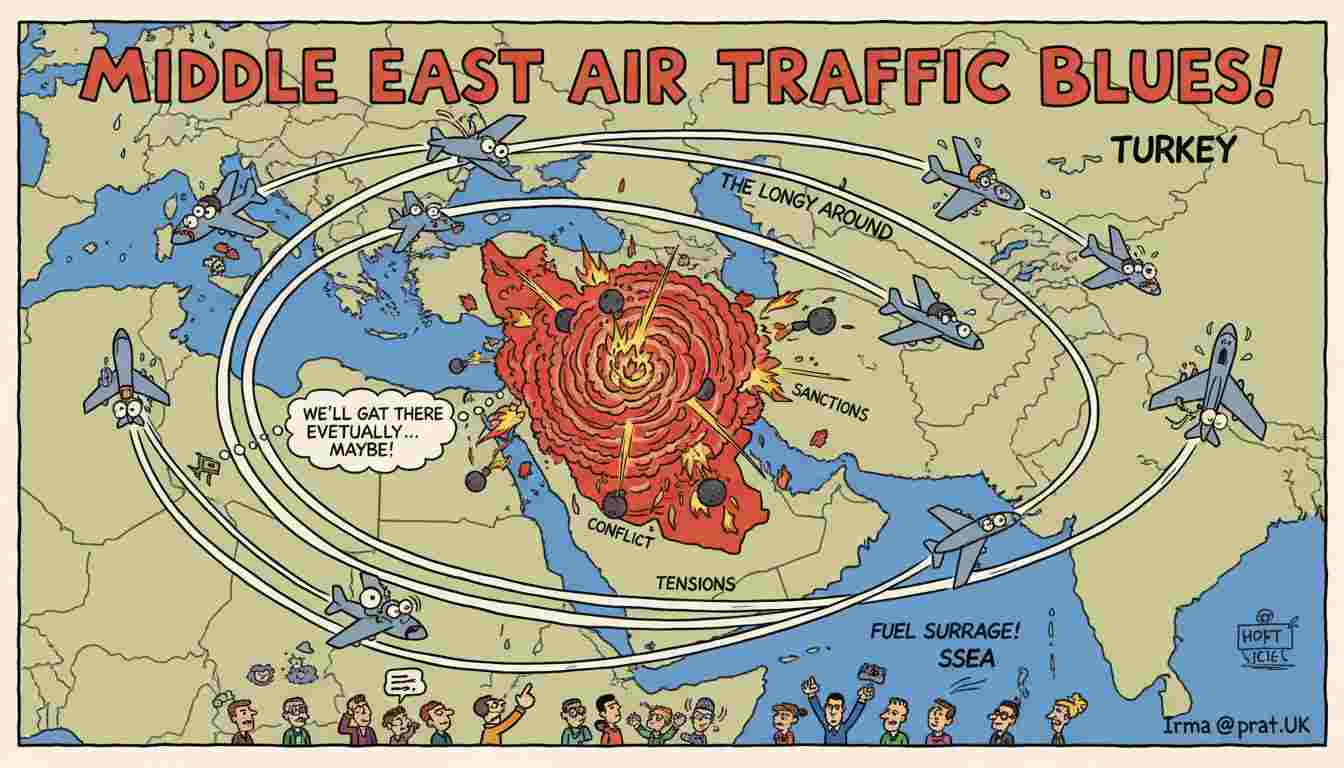
Planning a Vacation to the Middle East? Experts Recommend Travel Insurance and Light Body Armor
Before you pack sunscreen and sandals, aviation authorities would like to remind you that the sky is currently in beta testing. Several countries have temporarily closed airspace after what diplomats are calling missile-related enthusiasm. Airlines are adapting. Passengers are adapting. Geography is adapting.
Here are five quick observations for the weary traveler.
- The only thing more dynamic than airline pricing is regional stability.
- Nothing ruins a poolside margarita like a push notification reading Airspace Closed Until Further Notice.
- Google Maps now includes a feature called Avoid Ballistic Objects.
- Travel influencers have begun describing missile trails as aesthetic vapor accents.
- Every flight itinerary now includes the phrase subject to reality.
Now to the brochure.
Airlines Introduce New Fare Class: Basic Geopolitical Uncertainty

In response to the escalating situation, major carriers unveiled a new seating tier designed for modern times. Basic Geopolitical Uncertainty includes a middle seat, no carry-on, and the possibility that your plane might circle Cyprus until the sky feels better.
An anonymous airline executive explained the innovation. “We noticed customers were already experiencing uncertainty,” he said. “We simply monetized it. That is customer service.”
Under this fare, passengers receive complimentary alerts every nine minutes reading We are monitoring the situation. For an additional fee, travelers can upgrade to Premium Stability, which includes a text message from a pilot that says We are also monitoring the situation.
According to Dr. Leonard Bluth, a senior fellow at the Institute for Applied Panic Studies, this new pricing model reflects a broader truth. “Consumers crave transparency,” he said while pointing at a digital map filled with blinking red icons. “If the sky is unpredictable, the invoice should be too.”
A recent poll conducted by the Global Association of People Who Just Wanted a Beach Vacation found that 63.7 percent of travelers prefer knowing their trip might be rerouted through four continents, while 28.4 percent said they would consider staycationing in Ohio. (Ohio did not comment.)
Pilots Ask If They Can Just Go Around Iran Like It Is Construction on I-95
Commercial pilots, normally unflappable professionals who calmly announce we are experiencing minor turbulence during what feels like atmospheric boxing, have begun asking a simple question. Can we just go around?
Captain Ron Delaney, a 27-year veteran of transcontinental routes, described the scenario in relatable terms. “When I see a big red zone on the map, I treat it like highway construction near Newark. I look for the orange cones and I think, can we just swing wide and grab a coffee in Greenland.”
Air traffic control officials confirmed that rerouting is underway, though the phrase just go around involves thousands of additional nautical miles and fuel costs roughly equivalent to the GDP of a small principality.
One anonymous staffer at a major carrier said internal planning meetings now resemble fantasy football drafts. Someone suggests Iceland. Someone else suggests the North Pole. Then legal asks if Santa requires a visa.
Flight Tracker App Now Classified As Thriller Entertainment
Meanwhile, the most downloaded streaming service in America is not Netflix. It is your flight tracker.
Passengers who once used these apps to see if their plane was arriving on time now refresh the map like it is a live episode of Who Wants to Avoid a Missile. The little airplane icon inches across the globe while users whisper, do not turn left, do not turn left.
Behavioral psychologist Dr. Miriam Kline has a theory. “We are wired for suspense,” she explained. “In previous eras, humans gathered around fires to hear stories of dragons. Today we gather around smartphones to watch a 737 dodge geopolitics.”
An eyewitness at JFK airport described the atmosphere as cinematic. “Everybody is staring at their phones,” she said. “When the plane makes it past a flashing red zone, people actually clap.”
The Federal Aviation Administration denies that it has added a background soundtrack to the app, though one update did include dramatic zoom effects.
Missile Diplomacy Forces Delta To Reroute Through Somewhere Calm, Maybe Greenland?
As tensions rise, several airlines confirmed dramatic reroutes. One Delta flight reportedly took off from Atlanta en route to Dubai and arrived in what crew members described as a scenic fjord adjacent to calm.
Greenland tourism officials welcomed the accidental visitors. “We have glaciers and zero missiles,” said a spokesperson who seemed pleasantly surprised. Tourism brochures are being updated accordingly.
Logistics experts say this illustrates the new math of air travel. When the shortest distance between two points becomes diplomatically inconvenient, the longest distance becomes the safest.
Energy economist Farhad Mendez noted that every reroute adds hours and millions in fuel. “But on the bright side,” he added, “passengers receive breathtaking views of places they did not know they were visiting.”
Back in the cabin, one frequent flyer summarized the experience. “I booked a direct flight,” he said. “Now I have circumnavigated the Arctic. But at least my tray table still works.”
The Economics of Vacationing Under a Sky With Feelings
Travel insurance companies report record demand for policies that include Acts of Geopolitics. One brochure now lists coverage for missile-adjacent inconvenience, sudden airspace mood swings, and unexpected Arctic layovers.
Economists warn that prolonged closures could ripple through oil markets, supply chains, and the global economy. But at Gate 47, the conversation is simpler. Will we board, and will we land somewhere that serves coffee.
The Middle East has long been a crossroads of civilization. It is now also a crossroads of rerouted Boeing aircraft.
What the Funny People Are Saying
“I love that my boarding pass now says subject to foreign policy. That feels stable.” — Jerry Seinfeld
“You ever notice how the safety card does not cover missile diplomacy? That is a missed opportunity.” — Ron White
“I booked an aisle seat. I did not know it came with a front-row seat to geopolitics.” — Ali Wong
“When your vacation requires a briefing from NATO, maybe pack differently.” — Trevor Noah
Final Boarding Call
So should you cancel your trip? Travel experts say the region remains beautiful, historic, and full of culture. They also recommend flexible tickets and emotional resilience.
Airlines insist that safety is their top priority. Pilots continue to do what they have always done, navigate complexity with calm professionalism. And passengers will continue to chase sunsets, even if the path to paradise includes a scenic detour over ice.
In the end, planning a vacation to the Middle East in 2026 is like booking a window seat on history. It might get delayed. It might get rerouted. But it will definitely give you a story.
Disclaimer: This article is a work of satire and is entirely a human collaboration between the world’s oldest tenured professor and a philosophy major turned dairy farmer. Any resemblance to actual reroutes, fare classes, or emotionally unstable airspace is purely coincidental. Safe travels and Auf Wiedersehen, amigo!