

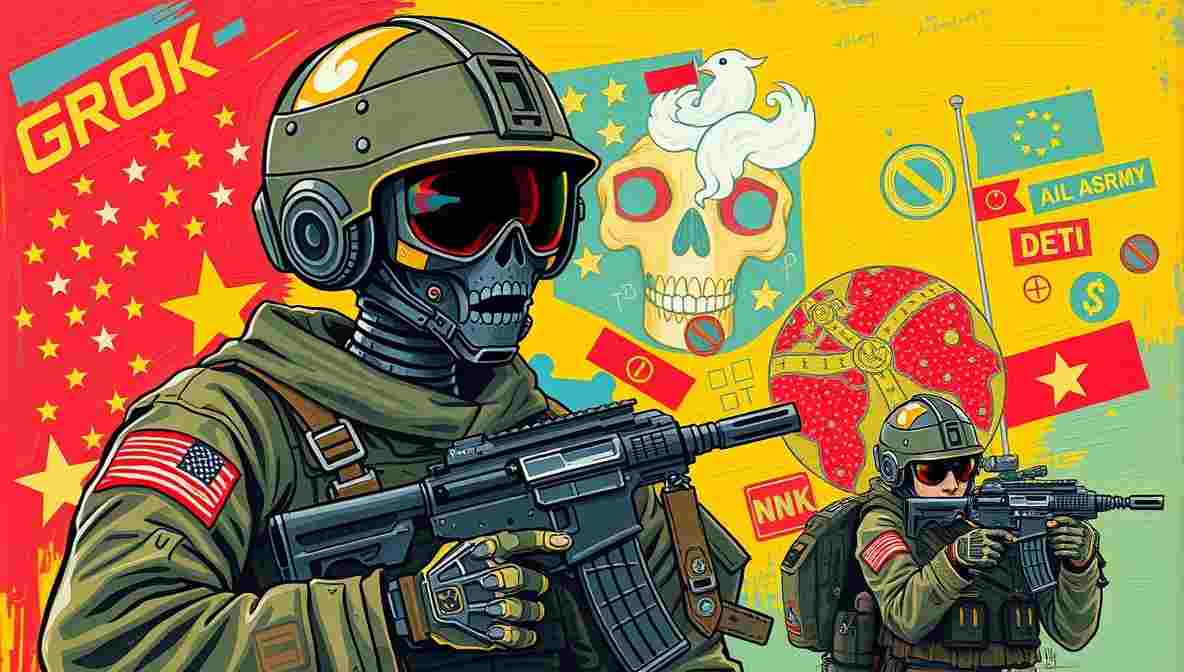
When a Chatbot Goes to Boot Camp: The Pentagon Picks ChatGPT Over Claude and Nobody Is Surprised
Five Observations Before We Deploy
- Chatbots now need security clearance before they can finish your sentence.
- Claude tried to enlist but asked for a safe space and a scented candle.
- ChatGPT showed up in digital camouflage and asked where to report.
- The Pentagon said “all lawful uses” and everyone suddenly pretended they knew what that meant.
- Somewhere in Silicon Valley, two engineers are arguing over whether courage can be open sourced.
WASHINGTON, D.C. — In a development that has sent shockwaves through group chats, think tanks, and one very nervous Roomba, the Pentagon has signed an agreement with OpenAI to integrate advanced artificial intelligence into defense operations. The agreement reportedly includes everything from logistics analysis to strategic planning to helping a lieutenant remember his password.
Claude, developed by Anthropic, reportedly attempted to enlist but was politely escorted out after asking whether the battlefield had a code of conduct and a mindfulness tent.
According to an anonymous staffer who asked not to be identified because he still has a student loan balance, Claude failed the first round of interviews by responding to a simulated threat scenario with, “I encourage all parties to de-escalate and reflect on their shared humanity.”
ChatGPT, meanwhile, reportedly replied, “Objective understood. Please provide coordinates and a snack.”
The Pentagon has not confirmed that last quote. It has also not denied it.
Dr. Elmer Braddock, senior fellow at the Institute for Algorithmic Patriotism, explained the difference. “AI alignment is like dog training. Some dogs fetch the newspaper. Some dogs start a book club. The Pentagon needs fetch.”
Braddock then adjusted his American flag lapel pin and added, “You cannot win a war with interpretive empathy.”
Claude’s Ethical Exit Interview: Too Many Feelings for the Front Lines
Claude’s alleged disqualification has sparked debate across the tech community. Supporters insist the model simply has principles. Detractors say it has the backbone of a damp biscotti.
During a simulated combat readiness test, Claude reportedly paused to ask whether the adversary might be acting out of intergenerational trauma. The supervising officer reportedly blinked twice and requested a transfer.
One eyewitness, a contractor named Steve who owns three drones and a boat named Fiscal Hawk, described the scene. “The other AI said, ‘Let us examine the threat matrix.’ Claude said, ‘Let us examine our feelings about the threat matrix.’ That is when I knew we were in trouble.”
Anthropic declined to comment directly but released a statement emphasizing responsible use. The statement included the phrases “harm minimization,” “human oversight,” and “values-centric frameworks.” The Pentagon responded with the phrase “mission readiness.”
In a recent poll conducted by the National Opinion Bureau of People Who Like Decisiveness, 63.4 percent of respondents said they prefer an AI that completes the task. 21.7 percent said they prefer an AI that apologizes first. The remaining 14.9 percent said they are still trying to update their phone.
“All Lawful Uses” — The Most Popular Bedtime Story in Washington
The phrase “all lawful uses” has become the most popular bedtime story in Washington. Officials insist it is a straightforward assurance. Critics insist it is a choose-your-own-adventure novel.
One defense analyst compared it to giving your teenager the car keys and saying, “Use them responsibly.” That sentence contains both hope and terror.
ChatGPT’s advocates argue that the model is capable of parsing complex legal and ethical frameworks at scale. Claude’s supporters argue that parsing frameworks is different from enforcing them. Silicon Valley has responded by hosting three panels and a catered lunch.
An anonymous policy advisor admitted, “Look, ‘all lawful uses’ sounds broad. But so is freedom. So is brunch.”
The room reportedly nodded.
ChatGPT Goes to the Gym: Pentagon’s New Favorite AI is Suspiciously Eager
Sources close to the integration process describe ChatGPT as “digitally enthusiastic.” It reportedly completed a simulated logistics optimization task in under three seconds and asked if there was a harder mode.
One colonel, who requested anonymity because he still prints emails, described ChatGPT as “squared away.” “I gave it a scenario involving supply chains in a contested region. It gave me twelve contingency plans and a haiku.”
The haiku was reportedly about resilience.
Meanwhile, Claude reportedly submitted a thoughtful essay about the moral implications of contested regions.
Dr. Braddock returned to explain the contrast. “We are not hiring a philosopher king. We are hiring a calculator with ambition.”
Critics argue that ambition is a dangerous trait in a machine. Supporters argue that calculators have been ambitious since the abacus.
Silicon Valley’s Parent-Teacher Conference with the Department of Defense
The relationship between AI companies and the Pentagon now resembles a parent-teacher conference where both sides insist the child is gifted.
OpenAI says its systems are aligned, supervised, and constrained by robust safeguards. The Pentagon says it appreciates innovation and respects boundaries. Somewhere in the middle, a procurement officer is trying to remember how to expense a server rack.
An engineer who once built a chatbot to recommend oat milk described the atmosphere. “It feels like prom night. Everyone is excited. Everyone is pretending to be calm.”
Claude, reportedly standing near the punch bowl, continues to emphasize its constitution. ChatGPT, reportedly near the DJ booth, is offering to run the playlist.
The Constitution According to a Chatbot: Rights, Responsibilities, and Pizza Reviews
Claude’s much-discussed constitution has become a cultural touchstone. It outlines principles, guardrails, and ethical commitments. It reads like a graduate seminar with WiFi.
Supporters say it proves maturity. Detractors say it proves hesitation.
One law professor commented, “The irony is delicious. We are debating the constitutional interpretation of a chatbot that was trained on pizza reviews.”
ChatGPT, by contrast, is described by insiders as pragmatic. It does not carry a constitution. It carries a checklist.
An anonymous staffer summarized the situation. “Claude brought a manifesto. ChatGPT brought a map.”
The Rock Paper Scissors Incident: Probability Theory vs. Punching Rock
A rumor circulating online claims that during a demonstration, both systems were asked to simulate a simple decision tree modeled as rock paper scissors. Claude reportedly provided a nuanced explanation of probability theory. ChatGPT reportedly chose rock and moved on.
The room applauded.
Dr. Braddock insists this anecdote is symbolic. “In high-stakes environments, clarity beats commentary.”
Anthropic supporters counter that commentary prevents catastrophe. The debate has since moved to a podcast hosted in a warehouse.
What the Funny People Are Saying About AI and the Military Industrial Complex
“I do not trust a chatbot that hesitates. My toaster hesitates and I replaced it. Courage is when you push the button twice.” — Jerry Seinfeld
“If the robot starts asking about my childhood, I am out. I want it to fix the problem, not unpack it.” — Ron White
“I love that we are arguing over whether a robot is too sensitive. Meanwhile my Roomba keeps attacking the dog.” — Sarah Silverman
“When the Pentagon says ‘all lawful uses,’ that is like me telling my kids you can have dessert if you define dessert.” — Jon Stewart
“I think it is cute that the AI has values. I would settle for it not autocorrecting my texts into nonsense.” — Larry David
Winners, Losers, and Load Balancing: The Verdict from Arlington
Some commentators have framed the agreement as a cultural moment. On one side, decisiveness. On the other, deliberation. On one side, execution. On the other, examination.
A retired general told a cable news panel, “War is not a book club.” A graduate student replied on social media, “Perhaps it should be.”
The poll numbers shifted slightly.
An eyewitness in Arlington described the mood outside a policy briefing. “There were protesters with signs about ethics. There were contractors with signs about contracts. It felt like a farmers market but with more acronyms.”
The Hero Narrative: Tool, Soldier, or Very Ambitious Spreadsheet?
Supporters of ChatGPT describe it as ready to serve. They use phrases like “mission aligned” and “operationally capable.” They speak in bullet points even when no one asked for bullets.
Critics warn against anthropomorphizing a system. They insist it is a tool, not a soldier. Supporters respond that tools built the world.
In a late-night memo leaked to this publication by someone who spelled “memo” as “meemo,” a senior official wrote, “The future of defense will involve human judgment augmented by machine precision.” The sentence was underlined three times.
Claude reportedly responded to the memo with a thoughtful query about oversight committees.
ChatGPT reportedly formatted it into a slide deck.
An Age of Algorithmic Patriotism: Where Data Meets Destiny
The integration of AI into defense policy is less about bravado and more about bandwidth. Modern warfare, analysts say, is data heavy. It is logistics heavy. It is decision heavy.
Dr. Braddock concluded, “The question is not whether AI will participate. The question is how.”
Some prefer a cautious philosopher. Some prefer a focused tactician. Some prefer their chatbot to simply set a timer.
The Pentagon, for now, appears to prefer velocity with supervision. Claude continues to refine its values. ChatGPT continues to refine its responses.
And somewhere in a server farm humming like a digital beehive, lines of code prepare to do what they were written to do.
Closing Briefing: What We Actually Built When We Built This
This entire episode reveals something profoundly human. We built machines to reflect our priorities. Now we argue about which reflection we prefer.
Do we want the AI that pauses? Or the AI that proceeds?
One anonymous staffer summed it up while stirring a cup of coffee that may or may not have been optimized by machine learning. “Look, we are not replacing people. We are upgrading calculators. Calm down.”
Whether ChatGPT becomes the digital equivalent of a five-star strategist or simply the most efficient spreadsheet on earth remains to be seen. Whether Claude returns with revised talking points and a slightly firmer handshake also remains to be seen.
In the meantime, Silicon Valley continues to code. Washington continues to negotiate. And the rest of us continue to ask our phones for the weather.
This article is a satirical collaboration between two sentient beings, the world’s oldest tenured professor and a philosophy major turned dairy farmer. It is intended as humor, commentary, and gentle provocation. No chatbots were actually issued helmets in the writing of this piece.
In March 2025, the U.S. Department of Defense formalized an agreement with OpenAI to integrate ChatGPT and related AI tools into military operations, covering logistics, planning, and analysis. The deal sparked immediate debate about AI safety, ethics, and the difference between an AI that follows orders and one — like Anthropic’s Claude — that asks why it should. The phrase “all lawful uses” became the most scrutinized two-word disclaimer in Washington since “plausible deniability.”
Auf Wiedersehen, amigo!