

Dow and Nasdaq futures fall as investors flee tech stocks
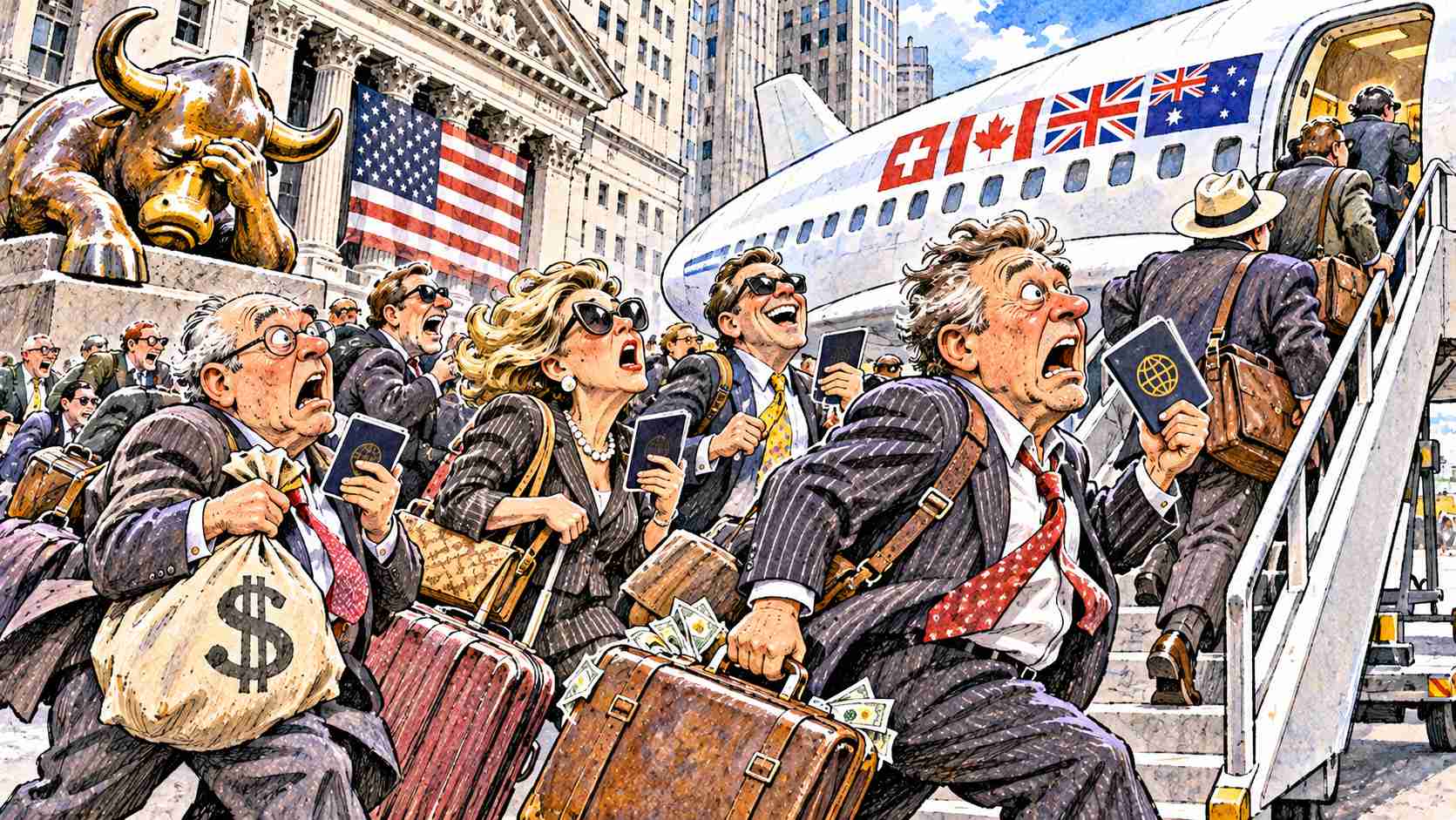
NEW YORK, N.Y. — Wall Street announced Tuesday night that it was considering relocating to another country after American voters demonstrated their continuing inability to understand that democracy is supposed to produce whatever election result makes investment bankers comfortable.
The announcement followed strong Democratic performances in congressional races that sent financial markets into a collective nervous breakdown.
Dow Futures Fall 0.8% and Nasdaq Futures Sink 2.1%
Dow Jones futures dropped approximately 0.8%, while Nasdaq-100 futures fell 2.1%. Investors began selling technology shares, reducing their exposure to political uncertainty, and searching Google for countries where elections are conducted exclusively among people who own brokerage accounts.
Switzerland emerged as an early favorite.
Unfortunately, Switzerland has regulations, taxes, and citizens who occasionally disagree with billionaires.
Singapore also attracted interest, although several traders expressed concern about its strict laws.
Hedge Fund Manager Proposes a Cayman Islands Republic
One hedge fund manager suggested establishing an independent republic in the Cayman Islands, populated entirely by investment bankers and administered by a government whose only responsibility would be ensuring that stock prices continued rising.
The proposed constitution contained three articles.
The first guaranteed freedom of speech, provided nobody mentioned capital gains taxes.
The second prohibited politicians from discussing wealth redistribution within 500 feet of a stock exchange.
The third declared that market corrections were unconstitutional.
The fine print, according to a draft circulated by email Tuesday night, includes a clause allowing the republic’s president to suspend any article “during periods of downward movement.” A footnote defines downward movement as “Tuesdays.”
According to Investor’s Business Daily’s election-night market analysis, technology shares faced pressure as investors considered the implications of Democratic gains for artificial intelligence, data centers, and corporate regulation.
Economists Explain Why Markets Look So Far Forward
Meanwhile, economists attempted to explain why investors were reacting so dramatically to election results before the winners had even entered office.
“Markets are forward-looking,” explained one financial expert.
Asked how far forward, he replied, “Apparently far enough to have a nervous breakdown over legislation nobody has written.”
The explanation satisfied everyone except ordinary Americans, who continued wondering why their retirement savings depended on whether a political candidate in Georgia had secured enough votes to upset a semiconductor company’s future profit projections.
A telephone poll of 1,000 adults, conducted by a Columbus market research firm after the polls closed, found that 63 percent believed their 401(k) was somehow involved in the election. Another 22 percent believed it had voted.
One Ohio factory worker offered a simple alternative.
“Maybe Wall Street should get a job.”
His proposal was immediately rejected because it threatened the foundations of modern finance.
Both Parties Claim the Market Drop as Proof
In Washington, Democratic strategists celebrated the stock market’s reaction as evidence that their political message was reaching wealthy Americans.
Republicans interpreted the same decline as proof that civilization was approaching its final chapter.
Independent voters wondered whether either party had considered lowering grocery prices.
Meanwhile, cryptocurrency investors attempted to escape the turbulence, only to discover that Bitcoin was also declining.
The development severely disappointed investors who had purchased cryptocurrency specifically because it was supposed to protect them from everything except the normal operation of financial markets.
Host Countries Tighten Immigration Rules for Bankers
By midnight, Wall Street’s proposed international relocation had encountered an unexpected obstacle.
Every prospective host country wanted to know whether the bankers intended to bring their financial problems with them.
When the bankers said yes, several countries immediately announced stricter immigration requirements.
Minutes from an emergency session of one trade association, released to members late Tuesday, record a motion to “pause democracy pending review.” The motion failed for lack of a second, after the only member who considered seconding it was asked whether he had voted in the last election himself.
Wall Street ultimately agreed to remain in America, provided voters promised to behave more responsibly.
The voters declined.
They had apparently confused democracy with the right to choose their own government.
Five Observations on Wall Street’s Election Night Meltdown
- Wall Street wants to leave the country because the voters didn’t pick the right guy. Folks, that’s not a relocation, that’s a breakup text sent to 330 million people.
- The Cayman constitution says market corrections are unconstitutional. I tried that with my doctor. He said “cholesterol isn’t a vote,” and he was very confident about it.
- Sixty-three percent of people think their 401(k) was in the election. Honestly, that’s fair. It’s the only thing in my life that has ever gotten that nervous about a Tuesday.
- Switzerland has taxes and citizens who disagree with billionaires. That’s every country, man. That’s just a country. You’re describing a country.
- The motion to pause democracy died because nobody would second it. That’s the one time in history a finance guy walked into a room and found out nobody wanted to go along.