

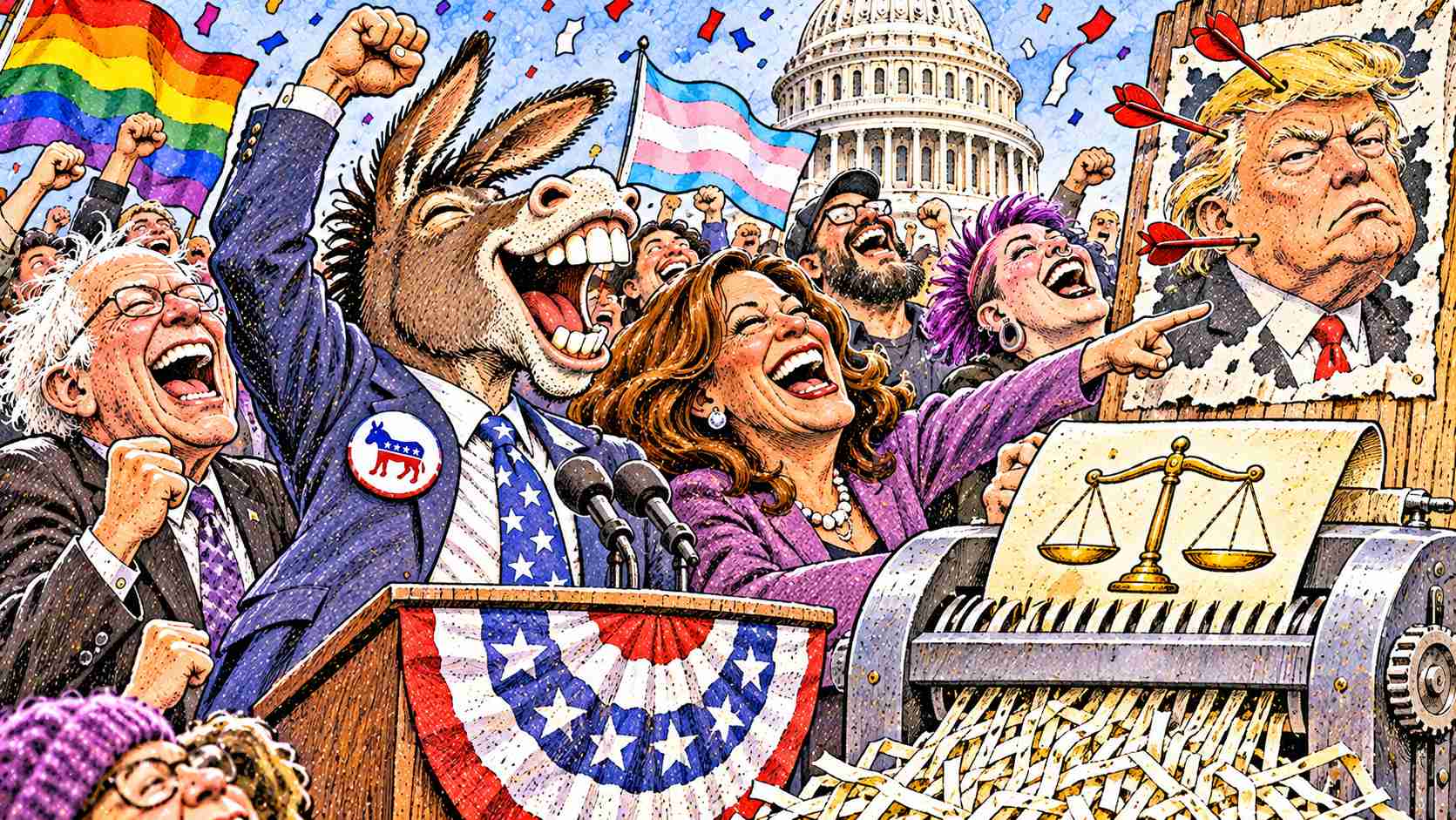
Anti-Trump Candidates Promise to Fight Fascism With Socialism
WASHINGTON, D.C. — American politics has entered a revolutionary new era in which hatred is no longer considered an unfortunate political emotion. It is now an economic development strategy, a campaign platform and possibly the next renewable energy source.
Democrats emerging victorious from the midterm elections have demonstrated that an angry voter can accomplish things an optimistic voter would never consider, including electing politicians whose spending plans make the national debt look like a modest bar tab.
Why Anger Beats Optimism in a Midterm Campaign
Hope requires patience. Hatred offers immediate gratification.
Hope asks what kind of country we want to build. Hatred asks whether Donald Trump will be upset when the election results arrive.
That second question apparently enjoyed considerable electoral success.
The modern campaign speech has consequently become a masterpiece of emotional efficiency.
First, announce that America faces an unprecedented crisis. Second, explain that billionaires are responsible. Third, promise that government will solve everything. Finally, remind the audience that Trump exists.
Standing ovation. Campaign contribution. Repeat.
The old-fashioned political candidate once presented economic policies, explained financing and attempted to persuade citizens that the numbers added up. Modern candidates can apparently skip the arithmetic provided their outrage is sufficiently photogenic.
The Political Fundraising Industry Behind Partisan Resentment
Of course, Republicans are hardly innocent participants in America’s political anger industry. Washington has spent years transforming partisan resentment into an extremely profitable subscription business.
Both sides have discovered that an angry voter is more likely to donate than a contented voter. Filings with the Federal Election Commission and tracking by OpenSecrets show where the money goes, and it does not go to the contented.
A happy American buys a fishing boat. An angry American sends twenty-five dollars to a political action committee that promises to save civilization before midnight.
Naturally, the fundraising deadline gets extended.
One email obtained from a donor’s inbox carried the subject line “FINAL NOTICE: Democracy Ends at Midnight.” A second email arrived at 12:14 a.m. under the subject line “We Got an Extension.” A third, at 6:02 a.m., read “Last Chance (Really).” Each requested twenty-five dollars. The donor, a retired insurance adjuster in Dayton, Ohio, said he had kept every one. “At this point I’m just collecting them,” he said. “I’ve got a folder.”
What makes the Democratic victories especially interesting is the apparent determination of some activists to interpret dissatisfaction with Trump as an enthusiastic endorsement of progressive economics.
These are not necessarily the same thing.
A voter who dislikes the president’s tariffs might still believe private businesses should remain private.
Someone worried about grocery prices might not consider higher corporate taxes a substitute for affordable eggs.
And a family struggling with rent may not regard another government committee as the architectural breakthrough America needs.
Nevertheless, the activist wing has a compelling response to such objections: you obviously need more government.
The Federal Budget and the Cost of Winning on Resentment
Consider the federal budget.
America already spends enormous sums of money while borrowing additional enormous sums to cover the difference, a gap the Congressional Budget Office publishes in tables most campaigns have declined to open. The proposed solution from the most enthusiastic spending advocates often resembles ordering another round because the restaurant bill has become too frightening to examine.
Eventually, someone must pay.
Politicians prefer calling that person a taxpayer because it sounds less alarming than victim.
“The arithmetic doesn’t care who won,” said Dr. Leonard Achterberg, a fiscal policy analyst who has reviewed federal budgets for three decades. “You can win a Senate seat on anger. You can’t pay interest on it.”
There is a cruel irony in winning political power through resentment. The moment a candidate becomes responsible for government, voters begin expecting results rather than explanations about the previous administration.
Affordable housing still requires construction. Economic growth still requires investment. And the Treasury Department still refuses to accept indignation as legal tender.
Democrats celebrated an impressive election.
Now comes the difficult part: proving that hatred can do something besides win one.
Five Observations on Winning With Hatred
- “Democracy ends at midnight.” Okay. It’s 12:14. Democracy’s still here. It’s in my inbox. It wants twenty-five dollars.
- A happy American buys a fishing boat. You ever see an angry man buy a boat? No. He buys a boat when he’s relaxed. Nobody has ever been furious and thought, I need a pontoon.
- The national debt looks like a modest bar tab. Sure. If the bar is the size of Delaware and the bartender is China.
- Hope takes patience. That’s the problem with hope. It’s slow. Hatred is fast. It’s the drive-thru of emotions. You pull up, you yell, you get a Senate seat.
- The Treasury Department won’t accept indignation as legal tender. I’ve tried. I went to the grocery store, I was very upset, I said, “I’m furious about this cheese.” They still wanted the nine dollars.