

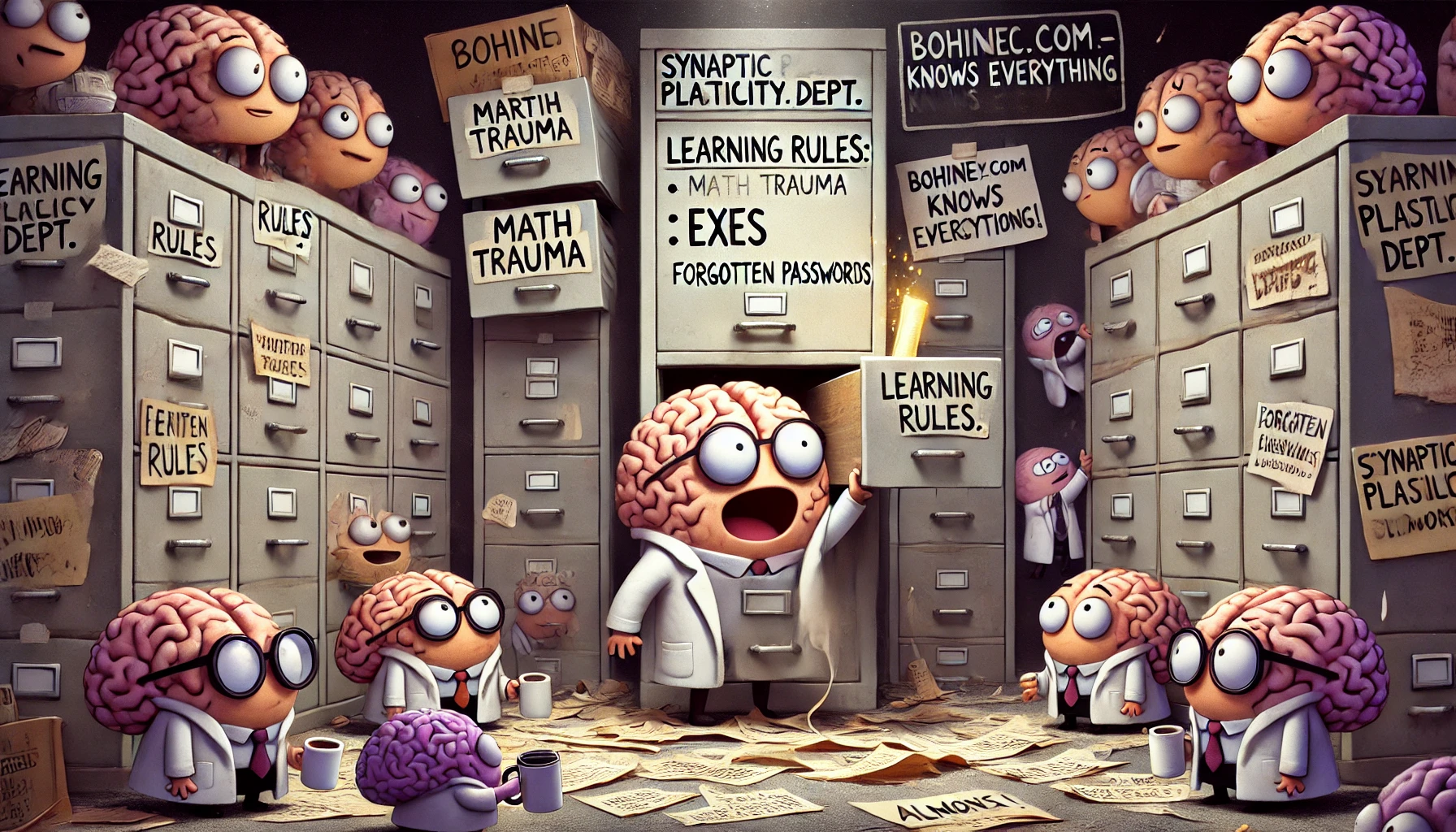
The Brain’s Secret Learning Rules: Now Available in a Costco Value Pack
Recent Discoveries in Brain Function and Learning
Published by Bohiney.com — Home of Sentient Neurons with a God Complex
The World’s Smartest Organ Just Realized It Forgot the Manual
In what neuroscientists are calling “the most self-own moment in biological history,” a new NIH-funded study has confirmed that the brain—the very organ responsible for knowing things—has been winging it this whole time. Apparently, there are secret rules of learning, hiding inside your head like a goblin in a filing cabinet. And just now, with the help of electron microscopes, snack breaks, and university grants with hilarious acronyms, science has cracked the code.
The study, published in the Journal of Cognitive Facepalming, shows that the brain’s neurons weren’t just firing randomly like confused fireworks. No. They were following ancient, unwritten laws of learning that were never taught in school—because ironically, school never asked the brain what it thought.
Brain Selfies and Synaptic Narcissism
Thanks to synapse imaging, which basically allows researchers to record the brain taking mirror selfies at a microscopic level, we’ve learned that neurons are obsessed with networking. One Harvard researcher commented, “It’s like watching a bunch of middle schoolers texting each other at lightning speed… only with electricity, biochemistry, and a complete lack of social skills.”
The images reveal neurons pouting, flexing, and forming friendships that last anywhere from six minutes to six decades. It’s neural Tinder up there. Swipe right for dopamine, swipe left for regret.
Neurons: The Original Instagram Influencers
Before social media, there were social synapses. Neurons are the influencers of the brain world. They’re always trending, creating viral connections, and influencing one another’s behavior. One neuron lights up and a hundred others scream “Yaaas queen!” and jump into action.
According to UCLA neuro-influencer Dr. Sandra Buzzline, “Neurons don’t just fire—they collab. They duet. They remix each other’s signals. It’s less science and more TikTok.”
Learning Is Not Linear, It’s a Drunken Maze
For centuries, we believed learning followed a neat curve. Not anymore. It’s now known as the “Learning Squiggle”—a wildly unpredictable path that includes plateaus, flashbacks, and three-hour YouTube rabbit holes about the Byzantine Empire. The NIH now categorizes learning into five stages: Curiosity, Distraction, Panic, Wikipedia, and Pizza.
A survey by the American Brain Association (ABA, not to be confused with the Bar Association or that gym with towel service) found that 78% of Americans believe they learn best during emotional crisis. “My finest moment of insight,” said one subject, “came while I was crying in a CVS parking lot.”
Memory Formation: Your Brain, the Digital Hoarder
Turns out the brain doesn’t just remember birthdays and algebra—it hoards memories like a doomsday prepper hoards peanut butter. Your brain still remembers that time you said “you too” to the waiter who told you to enjoy your meal. It’s in there, right next to the lyrics to every Limp Bizkit song and the theme to DuckTales.
One neurology professor at MIT confessed, “We tried to delete irrelevant memories in mice, and the mice literally bit us. Even rodents are sentimental.”
Flash Mob Theory: Neurons That Fire Together Stay Together
The brain’s learning process depends on something called synaptic plasticity, or as it’s now known, “Flash Mob Theory.” When neurons fire together consistently, they strengthen their connection. It’s like a weekly dance practice—but for knowledge. Miss one session, and suddenly you’re forgetting your ATM PIN and where you parked your car.
“This explains why you remember your ex’s favorite song but not your mom’s birthday,” said clinical psychologist Dr. P.J. Trauma.
Snacks Are the New School Supplies
According to the study, rewards play a major role in reinforcing learning. Dopamine—your brain’s personal party drug—releases when you succeed. And what triggers it? Snacks. Goldfish crackers, bubble tea, Funyuns. Education is now fueled by processed carbohydrates.
A middle school teacher in Des Moines has gone rogue and replaced quizzes with cookie tastings. “They don’t remember the Pythagorean theorem,” she said, “but they do remember who makes the best peanut butter cup.”
Synaptic Yoga: Breathe In, Forget Calculus
The researchers refer to “synaptic plasticity” as the brain’s ability to stretch and adapt. This flexibility is why you can still learn to skateboard at 40, pick up Korean drama slang at 70, or unironically say “slay” as a grandparent.
Stanford University has even started a “Neural Yoga” program that teaches people to mentally downward dog their way through new languages and algebra. It’s working. One man reportedly learned to play the banjo just by meditating next to one.
Brain Paths: Paved by Laziness and Regret
Neural pathways are formed through repetition, which is why it’s so easy to remember bad habits. The more you do it, the smoother the trail. Learning something new? That’s a machete-in-the-jungle situation.
The NIH report concludes that the easiest things to learn are gossip, SpongeBob quotes, and how to hold a grudge. One subject bragged, “I haven’t spoken to my cousin in 12 years because she mocked my Halloween centerpiece. That neural pathway is bulletproof.”
Forgetting: The Brain’s Marie Kondo Phase
Not everything sparks joy. The brain deletes memories it deems “non-essential,” which includes tax rules, your gym lock combination, and every password since 2019. Unfortunately, it never forgets that thing you said on a third date that made your voice crack.
Neuroscientist and part-time life coach Dr. Linda “Delete It” Halperin insists this is for your benefit. “The brain trims the fat,” she said, “and leaves behind the emotional meatball sub of shame.”
Multitasking Is a Lie Invented by Employers
The study confirms that multitasking is a myth. Doing two things at once splits the brain’s resources and results in both tasks being performed worse—like trying to run a marathon while eating spaghetti.
One subject, when asked to listen to a podcast while doing taxes, ended up claiming “Goblin Mode” as a dependent. “I thought it was a crypto deduction,” he said.
Dreams: Your Brain’s Weird Night School
While you’re drooling on the pillow, your brain is doing secret homework. It’s reviewing the day, replaying conversations, and apparently generating dreams where you ride a squirrel into a lava pit while your fourth-grade teacher judges your taxes.
Sleep scientists now believe that REM cycles are the brain’s PowerPoint presentations. The dreams are just stock footage. One Yale study confirmed that people who nap after learning retain 34% more. Also, they drool 40% more. Unrelated? Maybe.
Different Learning Styles, Same Internal Monologue: “Wait, What?”
You might be a visual learner, or a kinesthetic learner, or a “just tell me again slower” learner. The brain doesn’t mind—it just wants clarity. Unfortunately, clarity is usually replaced with YouTube videos at 1.5x speed.
Learning styles may be real, but all brains agree: nothing beats a good metaphor. That’s why math is best explained with pizza slices, and psychology works better when you reference The Bachelor.
The Brain’s Reward System: More Pavlov, Less Productivity
Dopamine makes you feel good, and your brain chases that feeling like a Labrador chasing a tennis ball. This is why you learned how to play “Wonderwall” on guitar in one afternoon, but took four years to learn the difference between “affect” and “effect.”
Researchers recommend attaching a treat to every learning outcome. One subject reported he finally memorized all U.S. presidents after receiving a Skittle for each one. “I got to Polk and passed out from sugar,” he told reporters.
What the Funny People Are Saying
Ron White: “The brain’s just like my ex-wife. Claims it’s working hard, but half the time it’s hiding snacks and pretending to be asleep.”
Jerry Seinfeld: “So the brain’s got secret learning rules? You mean we’ve been cramming for tests wrong this whole time? What is the deal with neurons being passive-aggressive?”
Sarah Silverman: “The brain forgets birthdays but remembers song lyrics from 1992. That’s not a glitch—that’s emotional terrorism.”
Groucho Marx: “I refuse to join any brain that would have me as a learner.”
Larry David: “Synaptic plasticity? Please. My brain can’t even remember my HBO password.”
Billy Crystal: “Your brain’s like your mother. It remembers everything… especially the embarrassing stuff.”
Cause and Effect: How Learning Broke Up with Logic
This study proves what millions have known for years: the human brain is less like a supercomputer and more like a teenager with Wi-Fi issues. The cause? Evolution. The effect? We have to use mnemonic devices to remember how to spell mnemonic.
Despite advances in AI, brain imaging, and educational theory, the number one reason people fail to learn something is distraction. Second reason? Boredom. Third? Overconfidence and thinking they don’t need to learn it because “there’s an app for that.”
Deductive Reasoning: Or, Why We Know Absolutely Nothing
Let’s apply deductive reasoning:
-
The brain learns through patterns.
-
Most people repeat the same mistakes.
-
Therefore, most people are pattern-resistant sacks of meat.
One neuroscientist tried to teach a cat to play chess using these brain learning principles. The cat sat on the board, meowed once, and walked away. “That’s how most of us handle complex tasks,” he admitted.
Analogy of the Day: The Brain as a Middle Manager
Think of your brain as a middle manager with no lunch break and a drawer full of sticky notes. It’s trying to juggle priorities, file reports, process memories, and occasionally yell “Who scheduled this nightmare!?”
The hippocampus is like HR—it’s overworked and underappreciated. The amygdala is the office gossip. The prefrontal cortex? The intern. No experience, makes all the big decisions.
Final Thoughts from the Synaptic Underground
As researchers dive deeper into the brain’s secret learning rules, society faces an inconvenient truth: our most powerful tool is also our most inconsistent employee. It needs naps, it craves rewards, it forgets half of what it learns, and it stores embarrassing karaoke performances from 2007.
So next time you struggle to remember where you left your keys or why you entered a room, just remember: your brain is doing its best. It’s a miracle of nature, yes—but it’s also tired, full of chips, and kind of an emotional raccoon.
Satirical Sources (All titles link to https://bohiney.com/random/):
-
Scientists Discover Neurons Just Gossiping in Latin
-
Your Brain Remembers Every Pizza, Forgets Your Anniversary
-
Harvard Now Offering PhD in Daydreaming
-
Memory Hoarders: Extreme Brain Edition Airs on TLC
-
Synapses Unionize, Demand Breaks Between Thoughts
-
Dopamine Dealer Busted in Prefrontal Cortex
-
Flash Mob of Neurons Disrupts Law School Exam
Auf Wiedersehen, and remember: If you can’t remember this article tomorrow, it’s not your fault. It’s just your brain following the rules.

🧠 15 Observations on the Brain’s Learning Secrets
-
The Brain’s Secret Rules Are So Secret, Even It Forgot Them
Despite being the command center, the brain seems to have misplaced its own instruction manual. -
Synapse Imaging: The Brain’s Selfie Mode
Advanced imaging lets neurons take selfies during learning—proof that even brain cells are into self-documentation. -
Neurons: The Original Social Network
With all the connections and messaging, neurons were networking long before LinkedIn made it cool. -
Learning: The Brain’s Version of a Software Update
Every new piece of information is like a software patch—sometimes it improves performance, sometimes it just adds bugs. -
The Brain’s Learning Curve Is More of a Learning Rollercoaster
Ups, downs, loops—learning isn’t linear; it’s an amusement park ride without a seatbelt. -
Memory Formation: The Brain’s Hoarding Habit
The brain stores memories like a packrat—some useful, some just clutter. -
Neurons Fire Together, Wire Together—Like a Flash Mob
Sudden, synchronized activity leading to lasting impressions—neurons are the flash mobs of the brain. -
The Brain’s Learning Process: Trial, Error, and Snacks
Learning involves trying, failing, and rewarding oneself with a treat—science confirms snack breaks are essential. -
Synaptic Plasticity: The Brain’s Yoga Practice
Flexible, adaptive, and occasionally twisted—synapses are the yogis of the neural world. -
Neural Pathways: The Brain’s Hiking Trails
Some paths are well-trodden, others are overgrown—learning is blazing new trails in the cerebral wilderness. -
The Brain’s Reward System: Pavlov’s Dogs Got Nothing on Us
We learn best when there’s a treat involved—classical conditioning is alive and well in our snack choices. -
Forgetting: The Brain’s Spring Cleaning
Out with the old, in with the new—forgetting is just the brain’s way of tidying up. -
Multitasking: The Brain’s Juggling Act
Trying to learn while doing ten other things? The brain drops the ball more often than not. -
Sleep: The Brain’s Study Hall
Turns out, the brain does its homework during sleep—dreams are just the doodles in the margins. -
Learning Styles: The Brain’s Fashion Statement
Visual, auditory, kinesthetic—learning styles are the brain’s way of accessorizing knowledge.
The Brain’s Secret Learning Rules—Now Available in a Limited Edition User Manual!
Introduction: In a groundbreaking revelation, scientists have discovered that the brain operates on secret learning rules. These rules, previously unknown even to the brain itself, are now available in a limited edition user manual.
Chapter 1: Synapse Imaging—The Brain’s Selfie Stick With advanced synapse imaging, neurons can now take selfies during learning sessions. This narcissistic behavior confirms that even brain cells are into self-documentation. SciTech Daily
Chapter 2: Neurons—The Original Influencers Long before social media, neurons were influencing each other through electrical impulses. Their “posts” are action potentials, and their “likes” are neurotransmitter releases.
Chapter 3: Learning—The Brain’s Reality Show Each learning experience is like an episode of a reality show, complete with drama, eliminations (forgetting), and surprise twists (epiphanies).
Chapter 4: Memory—The Brain’s Hoarder Tendencies The brain stores memories like a hoarder keeps newspapers—just in case they’ll be useful someday. Unfortunately, this includes that embarrassing moment from third grade.
Chapter 5: Sleep—The Brain’s Night Shift While you sleep, your brain is hard at work, organizing memories and cleaning up. It’s the janitor that never clocks out.
Chapter 6: Multitasking—The Brain’s Circus Act Attempting to learn while multitasking turns your brain into a circus performer juggling flaming swords—impressive but unsustainable.
Conclusion: Understanding the brain’s secret learning rules is like finding the Rosetta Stone of cognition. With this knowledge, we can finally comprehend why we remember song lyrics from the ’90s but forget why we walked into a room.
📜 Funny Disclaimer
This satirical piece is a collaborative effort between two sentient beings—a cowboy and a farmer—who have spent countless hours observing the quirks of the human brain. Any resemblance to actual scientific findings is purely coincidental, and no AI was harmed in the making of this article.