

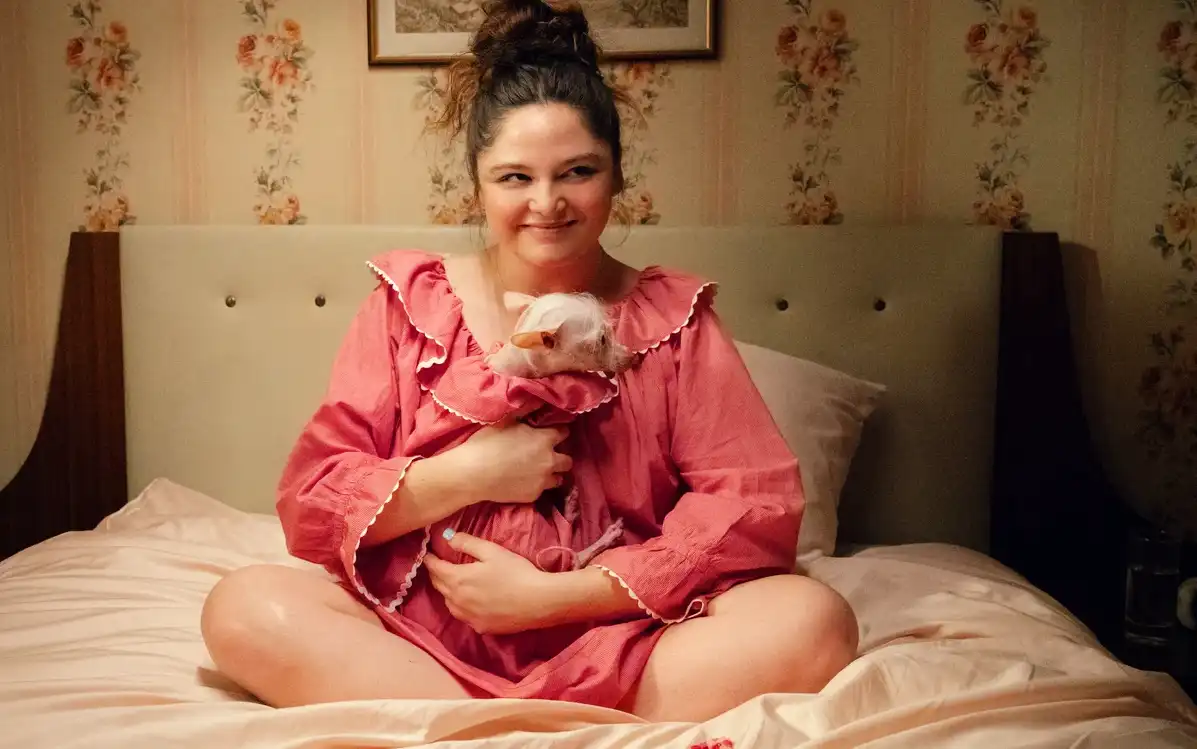
Lena Dunham’s Too Much: A Neurotic Symphony in Twelve Tones of Trauma
Lena Dunham’s Too Much has arrived on Netflix, and if you’re Jewish, over 30, and have ever cried into a cold bagel while yelling at your therapist on WhatsApp, congratulations: you are this show’s target demographic. And if you’re not? Don’t worry — this seven-part kvetch opera will make you feel like you are.
Like its protagonist, Too Much doesn’t walk into a room — it spirals in with lipstick on its teeth and a full list of emotional grievances going back to 1994.
It’s Lena Dunham’s Girls… if the girls were older, British, and actively being haunted by the ghost of their own Tinder profiles.
British Men, Jewish Women, and Emotional Sabotage
Set in London, because apparently neurosis demands classier accents, Too Much follows Jessica, a Manhattan woman who’s fled to England after a divorce, a breakdown, and possibly an unpaid therapy bill in three zip codes.
She meets Zev, a Nice Jewish Boy™ from Brooklyn who has that rare ability to talk about his mother for twenty uninterrupted minutes and still sound sexy. Their connection? Immediate. Their dysfunction? Ancient.
You can practically hear her therapist whispering, “Oh no… not this again.”
Their whirlwind romance is built on a strong foundation of:
-
unresolved childhood trauma
-
an erotic encounter with a mezuzah
-
and a mutual love of sobbing during intimacy
This isn’t just a love story. It’s a tale of self-sabotage, self-awareness, and self-immolation — quite literally, as Jessica sets herself on fire in the pilot episode.
“Jessica in the show lights herself on fire. Which is actually a pretty chill metaphor for trying to date in your 30s while maintaining a relationship with your mother.” — Tig Notaro
Grandmother Homer: A One-Woman Greek Chorus of Guilt
Enter Grandma Homer, Jessica’s grandmother and the emotional keystone of the series. She’s the kind of woman who tells you you’re too skinny, then calls you fat in the same breath — while handing you a brisket.
A woman whose love is conditional, her opinions are biblical, and her vocabulary is mostly passive-aggressive.
“This show isn’t called Too Much because of the drama — it’s called Too Much because that’s what every Jewish grandmother says when you serve her more than one matzo ball.” — Jerry Seinfeld
Grandma Homer doesn’t so much appear in scenes as she invades them — wielding her Jewishness like a flaming sword dipped in sarcasm. She informs Jessica’s romantic life by reminding her that every bad date is one step further from giving her a great-grandchild.
And every moment she’s not on screen, you can still hear her voice. That’s not dramatic exaggeration. That’s just Jewish biology.
Trauma: The Official Love Language
Jessica’s identity in Too Much is less a character arc and more a walking TED Talk on “How To Ruin A Relationship Before the App Loads.” Her romance with Zev is built entirely on shared trauma, uncomfortable therapy flashbacks, and the universal Jewish experience of being shouted at by someone holding Tupperware.
“Zev is one of those ‘Nice Jewish Boys’ who’s so nice, he ghosted me with a five-paragraph apology and a Venmo request for therapy he says I caused.” — Amy Schumer
Their sexual tension is palpable, though mostly in the form of guilt-induced panic attacks and discussions about which parent did more emotional damage.
They cry, they scream, they project their unresolved issues onto each other, and then they make love to the sound of distant clarinet music — which might be live klezmer, or just the show’s soundtrack whispering, “your ancestors are watching.”
When “Jewish” Is Just a Vibe™
Though the characters are explicitly Jewish — Jessica and Zev both reference it in dialogue, and Grandma Homer could guilt Moses into coming home early — the show mysteriously drops this identity after episode one.
It’s as if the show itself went to Birthright, got overwhelmed, and ghosted its own heritage.
“The series doesn’t explore Jewishness as much as it shows up, panics, and flees the party by episode two.” — Comedic Observation #13
This bait-and-switch approach has led critics to debate whether Dunham’s representation is “too much” or “not enough” — a debate that’s as Jewish as it gets.
By episode three, the only Jewish identity left is Jessica’s tendency to over-apologize and Zev’s dietary restriction subplot, which is never resolved but implies he’s spiritually allergic to closure.
“Watching this felt like going to a Seder where everyone’s ex is there, everyone’s drunk, and Elijah just straight-up refuses to show up.” — Larry David
Too Much or Just Right?
The title Too Much might suggest excess, but what the show actually delivers is a very specific, curated emotional chaos. It’s not universal — it’s Upper West Side–meets–Camden Market. This is not the Jewish experience. This is a Jewish experience — curated through an iPhone screen and smeared with artisanal hummus.
“British guys in Lena Dunham shows always talk like they’re apologizing for colonizing your heart and your uterus.” — Ricky Gervais
The show walks a strange line: intimate but performative, raw but curated, messy but symmetrical. It’s like a challah loaf braided by someone crying on mushrooms.
One moment you’re watching two broken people fall apart in a very poetic way. The next, you’re asking yourself: “Wait… did she just DM her ex’s wife from a dog’s Instagram account?”
Yes. Yes, she did.
What the Funny People Are Saying
“Zev’s version of flirting is describing his childhood trauma while adjusting his reusable tote bag. Sexy!” — Ali Wong
“I asked my girlfriend if she wanted to watch Too Much and she said, ‘Why? You already live it.’” — Ron White
“It’s called Too Much because Just Enough got canceled by HBO during Yom Kippur.” — Trevor Noah
Cultural Commentary: A Mirror With Lashon Hara
Too Much is a mirror held up to a very specific corner of modern Jewish life: the neurotic, educated, emotionally articulate urbanites who write apology letters to their inner child and ask, “But is it trauma or just gluten?”
In that sense, the show is both an emotional reckoning and a very elaborate in-joke. It’s not trying to tell a story about being Jewish — it’s using Jewishness as aesthetic shorthand for a kind of socially acceptable dysfunction.
And that’s the real tension: when cultural identity becomes set dressing for psychological drama, is it representation, or just spiritual name-dropping?
“This isn’t a love story. It’s a cautionary tale wrapped in a bar mitzvah speech, buried under a broken shofar.” — Jackie Mason
Final Scene: Jessica, Crying in London Rain, Holding a Candle for a Man Named Zev
In the final moments of the season, Jessica stands alone in the drizzle of London, holding a Shabbat candle like it’s a broken lightsaber, reflecting on lost love, family guilt, and whether her therapist was right about that time she tried to fix a man by quoting Brene Brown.
It’s quiet. It’s haunting. And somewhere, faintly, you can hear Grandma Homer screaming, “You should’ve married a podiatrist!”
BREAKING NEWS: Lena Dunham
Lena Dunham Explains Why Jewish Guilt Is Hot Now
In a TED Talk nobody requested but everyone secretly needed, Lena Dunham stepped onto a Jerusalem-themed carpet at Netflix HQ to declare, “Jewish guilt is officially hotter than any goy with a barbell and a podcast.” Her thesis? Guilt is emotionally ripped. It has depth. It texts back within two hours but with a typo that haunts it for days. “Look,” she said, clutching a crystal menorah, “Catholic guilt is sweaty. Jewish guilt is exfoliated.”
The new Netflix mini-doc Too Much, which chronicles Dunham’s romantic failings and ritualistic apologizing in a North London neighborhood where challah is sold on Etsy, has sparked a Jewish renaissance of feelings. Sephora is launching a new line of moisturizers called “Moisture But Make It Shame.” Therapy offices now offer dual sessions with your therapist and her therapist’s mother.
Sociologist Dr. Hadassah Feinstein wrote in the Journal of Generational Trauma & Style that “guilt is the new sexy” because it “implies accountability and extremely polite overthinking.” Lena confirms this: “Hot is the guy who takes responsibility for your disappointment AND makes you a grilled cheese with caramelized onions.”
When asked what comes next, Dunham whispered, “Talmudic thirst traps.”
Zev Cries at the Sight of Pickles: A Love Story
Zev Horowitz didn’t cry at his circumcision. He didn’t cry when his parents divorced over a brisket. But when Miriam handed him a handmade half-sour pickle on their third date, he burst into tears like someone had played the klezmer version of “Claire de Lune.”
The viral romance began when Zev, a 29-year-old part-time violin teacher and full-time worrier, matched with Miriam on a dating app for Jews with gastrointestinal boundaries. Miriam described herself as “emotionally available between the hours of 4 and 6 p.m.” Their first date was at a fermentation café in Austin where kombucha flows like ancestral regret.
When the pickles arrived, Zev’s lower lip quivered. “It just… reminded me of Grandma Ethel. And Yom Kippur. And that time I dropped a gherkin and was made to repent,” he sobbed into a napkin made of recycled Torah commentary.
The moment was immortalized on TikTok under #CryForTheBrine and picked up by Modern Love under the headline: “In a World Full of Dill, Be Zev.”
Miriam now makes artisanal pickles and emotional balm in matching jars. Zev, newly in touch with his tears, hosts “Kosher Cry Circles” every Wednesday. He still cries every time she says “Vlasic.”
Netflix Considers Spinoff ‘Nice Jewish Therapist Universe’
In an unholy merger of mental health and Marvel-style franchising, Netflix is rumored to be developing the Nice Jewish Therapist Universe (NJTU) — a spinoff inspired by Lena Dunham’s Too Much, in which one therapist’s quiet nod reverberated across six boroughs and at least one Shiva call.
The NJTU will feature interconnected series such as:
-
Coping with Clarissa, where a therapist battles burnout by crocheting yarmulkes for her clients.
-
Freud & Sons, a Brooklyn-based father-son therapy duo who refuse to treat anyone under a 7 on the neurosis scale.
-
SuperEgo Squad, a ragtag team of therapists who intervene mid-wedding speeches to prevent generational trauma.
Executive producer Naomi Goldstein-Mandelbaum explains, “We want each character to confront their own tzimtzum — contraction of the self — while cross-referencing Jungian dream journals and brisket recipes.”
The twist? The therapists all have therapists. One is a sentient bagel.
Critics say it’s just Avengers with more interruptions and less punching. “At the end of every episode, they just talk about boundaries,” one intern sighed. “And somehow I cry. Every time.”
The pilot ends with an emotional climax when six therapists say, in unison, “So what I’m hearing is…”
Grandma Homer Launches TikTok for Passive-Aggressive Recipes
Esther “Grandma” Homer, 84, of Boca Raton, has become an overnight TikTok sensation with her viral cooking channel: @EatThisOrStarveWithShame. Her specialty? Recipes infused with centuries of technique and a heaping spoonful of passive aggression.
In her first post, she expertly rolled matzo balls while saying, “I’m sure YOUR wife’s kugel is lovely. If you like things bland and full of disappointment.” That video now has 8 million views and a duet from a Polish grandmother who called it “a declaration of culinary war.”
Grandma Homer walks viewers through every dish with exacting instructions and veiled jabs:
-
“Use real schmaltz, unless you enjoy sadness.”
-
“Don’t overbake. This isn’t your cousin Marcy’s second marriage.”
-
“If you refrigerate my brisket, may your thermostat break during the Seder.”
Food critics call it “weaponized nourishment.” Family therapists call it “unsurprising.”
Her most popular recipe? Emotional Support Latkes — served cold, like old revenge.
She now sells an apron that says, “It’s Fine. I’ll Just Eat My Feelings.” Her merch line includes potholders embroidered with, “This Kitchen Runs on Spite and Love.”
Grandma Homer has no plans to stop. As she says in her latest video while chopping dill: “You call this viral? You should see what I caught from Larry in 1958.”
Jews in London Start Support Group: ‘Too Much But British’
Following the release of Lena Dunham’s Too Much, Jewish communities across London have launched a support group called “Too Much But British” — a space for neurotic over-sharers who say “sorry” before finishing a sentence but in a restrained, colonial way.
The group meets every Tuesday at a kosher tea room in Golders Green. Meetings open with a polite apology and a 7-minute silence so everyone can process being alive. One member, Rachel Fein-Hamilton, explains: “We’re too loud for England but too repressed for Tel Aviv. We’re emotional orphans with Earl Grey.”
Support topics include:
-
How to weep without disrupting scones
-
Dating tips when your sarcasm reads as terrorism
-
Complaining in a way that doubles as flattery
The group recently released a podcast titled “Oy But Quietly”, where hosts whisper about parental guilt, therapy inflation, and why Tesco’s bagels are crimes against flour.
A recent guest described themselves as “Golda Meir trapped in a Hugh Grant screenplay.”
Membership is growing. Even the rabbi joined after muttering, “I just want to cry without interrupting anyone.”
The goal? To create a space where one can be simultaneously too much and not enough, ideally while holding a lukewarm biscuit.
Emotional Support Dog Develops Complex Watching Dunham Show
Reports from Austin confirm that “Bagel,” a certified emotional support goldendoodle, has developed a neurological complex after watching all six episodes of Lena Dunham’s Too Much from under his owner’s anxiety blanket.
Witnesses say Bagel began growling at screens showing London buses and flinching at the word “neurodivergent.”
Veterinarian Dr. Shira Kaplan explains: “He was conditioned to associate violins and internal monologues with dread. By episode three, he began licking his own paws in what we call ‘vicarious therapeutic distress.’”
The final straw? The scene where Lena stares into a mirror whispering, “Do I deserve joy?” Bagel reportedly ran in circles and hid under the sofa, clutching his weighted toy menorah.
His owner, Ezra — a 31-year-old who identifies as “emotionally available with deadlines” — now plays Bluey to re-regulate Bagel’s cortisol. “He needs an Australian dog to unlearn codependency.”
Bagel is now enrolled in a six-week desensitization program involving hummus exposure therapy and daily reassurance from a Jewish therapist who moonlights as a dog whisperer.
Netflix has since issued a disclaimer: “Some scenes may be unsuitable for viewers prone to emotional mirroring, including golden retrievers, border collies, and most Pisces.”
Critics say Bagel’s journey is proof that even our pets are Too Much now.

Disclaimer
This article is a work of satirical journalism and should not be interpreted as an actual review or psychological diagnosis of Lena Dunham, her Netflix series Too Much, or the Jewish diaspora. All quotes and observations were generated in a collaboration between the world’s oldest tenured professor and a dairy-farming philosophy major, with no assistance from AI robots who have never cried into matzo ball soup.
Auf Wiedersehen, amigos.