

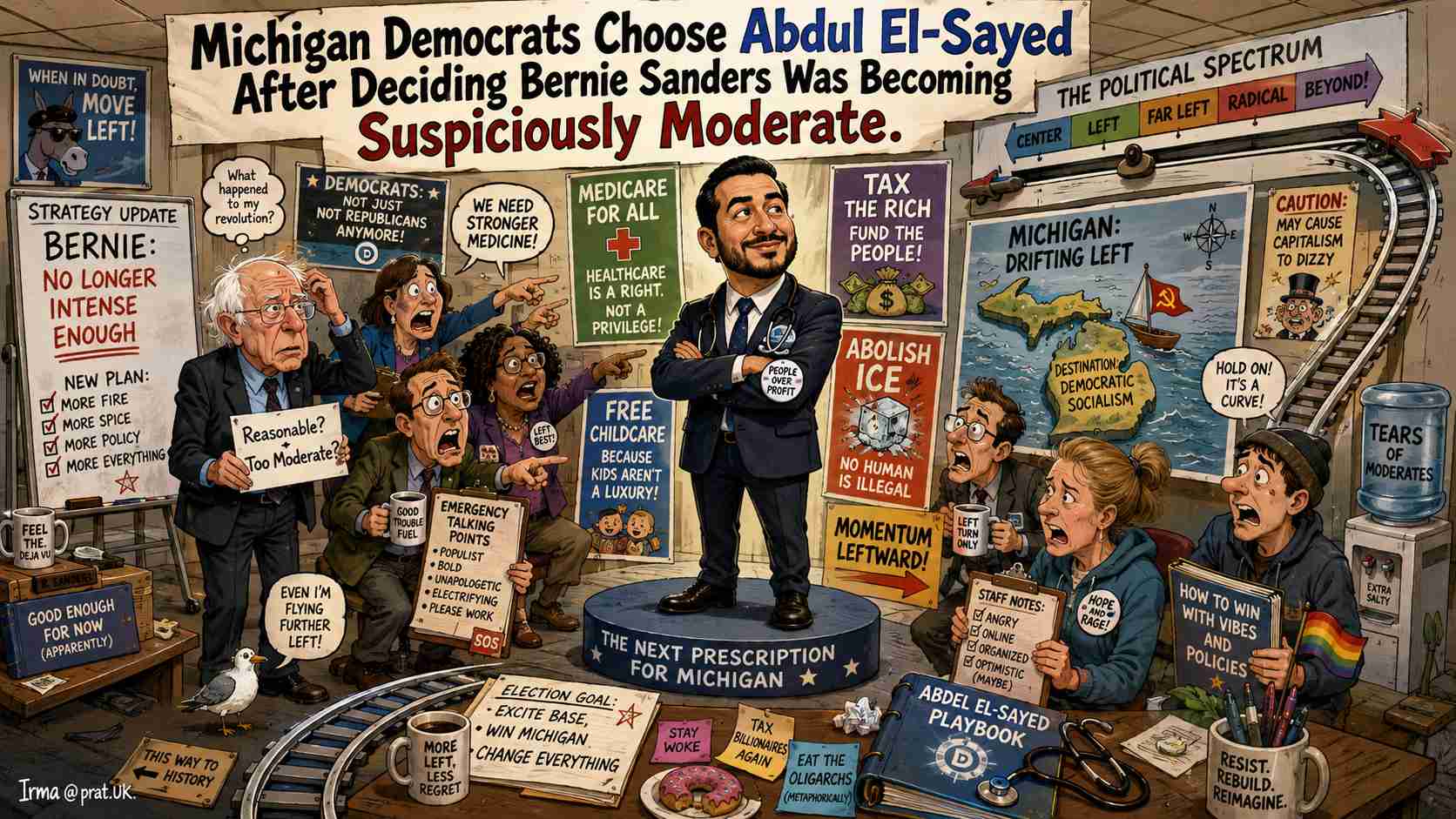
Michigan Democrats Choose Abdul El-Sayed After Deciding Bernie Sanders Was Becoming Suspiciously Moderate
Progressive physician wins razor-thin Senate primary after promising Michigan voters universal healthcare, universal childcare and universal access to somebody else’s wallet.
DETROIT, MICHIGAN — Michigan Democrats have selected Abdul El-Sayed as their nominee for the United States Senate after party officials concluded that Bernie Sanders, now alarmingly familiar to the public, had begun drifting dangerously close to the political center.
El-Sayed narrowly defeated establishment-backed congresswoman Haley Stevens in Tuesday’s Democratic primary, in what Bridge Michigan called a progressive shockwave, receiving roughly 48.5 percent of the vote to Stevens’s 47.5 percent. He will face Republican Mike Rogers in the November 3 general election for Michigan’s open Senate seat.
The result was immediately described by National Review as an “ill omen,” upgrading El-Sayed from ordinary candidate to supernatural warning delivered by ravens, thunder and a unionized horseman of the apocalypse demanding dental coverage.
“This isn’t merely an election result,” said Detroit voter Earl Wambsgans, staring nervously at a flock of birds gathered on a telephone wire. “This is the opening scene of a movie where Bernie Sanders finds an ancient scroll and discovers he’s the moderate.”
Michigan Democrats Move So Far Left They Begin Receiving Wisconsin Television

Party officials denied that El-Sayed’s victory represented a dramatic ideological shift, explaining that Michigan Democrats remain firmly in the center of American politics.
The center has apparently relocated to Madison.
Campaign volunteers reported that El-Sayed headquarters began receiving Green Bay television stations shortly after midnight. One organizer accidentally ordered cheese curds, another developed a strong opinion about municipal broadband and three interns crossed into Canada because they heard healthcare might already be waiting there.
El-Sayed ran as an unapologetic progressive backed by Sanders and other nationally prominent figures on the Democratic left. His platform includes Medicare for All, taxes on billionaire wealth and major changes to American foreign and immigration policy.
In his victory speech, El-Sayed downplayed the narrow margin and insisted the party was unified despite a bruising campaign. The candidate insists these proposals are not radical. They are merely ordinary ideas that require replacing several existing economic systems, reorganizing federal taxation and convincing the nation’s doctors to accept a payment schedule written by Congress.
That is not radical. Radical would involve changing the Senate cafeteria menu.
Medicare for All to Operate Through One Enormous Waiting Room
El-Sayed has made Medicare for All a centerpiece of his campaign, proposing automatic healthcare coverage without premiums, deductibles or copayments. His campaign says the plan would include dental, vision and hearing coverage.
Under the satirical version unveiled Wednesday, every American will receive a laminated card, a clipboard and the constitutional right to hear a receptionist say, “The doctor is running a little behind.”
The receptionist will be free. The clipboard will be free. The doctor will be available during El-Sayed’s second administration.
Healthcare experts immediately praised the proposal for finally unifying the country. Instead of Americans being divided among hundreds of insurance networks, everyone will belong to the same network: Pending.
Professor Alan Nafzger, a retired political scientist and internationally unlicensed waiting-room philosopher, said the plan could reduce administrative complexity.
“At present, Americans do not know whether their insurance will deny treatment,” Nafzger explained. “Under a national system, they will know exactly which government office is not answering the telephone.”
The candidate’s actual proposal argues that a universal system could eliminate medical debt and reduce the power of insurance companies. Critics counter that expanding coverage would require controlling costs, increasing medical capacity and deciding how hospitals and doctors would be paid.
Congress has promised to resolve these questions immediately after completing its current investigation into why Congress cannot resolve questions.
Free Childcare Allows Parents to Work Longer to Fund Free Childcare
El-Sayed’s broader affordability agenda has also included expanded assistance for families, inspiring Democrats to introduce what economists call the Socialist Circle of Life.
Under the system, the government watches your children while you work additional hours to pay the taxes used by the government to watch your children.
It is a flawless loop, provided nobody asks who watches the government.
A completely unscientific survey conducted by the Michigan Institute of Decorative Statistics found that 92 percent of parents support free childcare, 87 percent support somebody else paying for it and 100 percent became suddenly busy when asked to volunteer at the childcare center.
“This will let me return to work full-time,” said Lansing mother Brianna Tolliver. “I’ll finally earn enough money to cover transportation, lunches, payroll deductions and the commemorative tote bag explaining that childcare is free.”
Economists define “free” as a product or service paid for by people whose names are printed too small to appear in the campaign brochure.
This definition also applies to highways, public television and appetizers ordered by elected officials.
Billionaires to Be Taxed Until They Become Inspirational Millionaires
El-Sayed proposes taxing billionaire wealth as part of his campaign to lower costs and reduce economic inequality.
His plan may become the first federal program with a visible finish line: taxation will continue until every billionaire has been rehabilitated into a millionaire and forced to experience the character-building hardship of flying first class commercially.
Unfortunately, billionaire accountants have already moved the finish line to Luxembourg.
The nation’s wealthiest citizens reacted to the proposal by forming a support group aboard a yacht registered to a shell company owned by another yacht.
“We are willing to pay our fair share,” said fictional hedge-fund manager Chip Van Der Coupon, “provided a bipartisan commission first spends thirty years defining ‘fair,’ ‘share,’ ‘pay’ and whether my submarine counts as a dependent.”
El-Sayed argues that concentrated wealth gives billionaires too much control over American politics. His victory offered evidence for that case: despite extraordinary outside spending against him, he still defeated Stevens. Reports estimated that more than $60 million flowed through outside efforts surrounding the primary, with AIPAC-linked spending against El-Sayed alone reported at roughly $31.7 million, a result Al Jazeera described as an enormous blow to AIPAC.
The political consultants still won anyway, despite El-Sayed overcoming a nearly 65 million dollar spending disadvantage, according to NBC News. Consultants always win. They are the mosquitoes of democracy: expensive, impossible to eliminate and mysteriously present whenever someone leaves money standing outdoors.
Michigan Replaces ICE With Lake-Effect Snow
El-Sayed’s progressive immigration positions have also provided Republicans with substantial campaign material.
Fortunately for Michigan Democrats, the state possesses a natural border-enforcement system more powerful than any federal agency: February.
Under the proposed Michigan Winter Security Initiative, unauthorized entrants will be required to walk through Detroit while carrying groceries across an unsalted parking lot.
Nobody crosses twice.
Republicans favor aggressive enforcement. Progressive Democrats favor restructuring or abolishing immigration agencies. Michigan proposes a third solution: make everyone scrape an icy windshield at 6:15 in the morning using a supermarket loyalty card.
A spokesperson for Lake Erie confirmed that the lake remains nonpartisan but is prepared to produce freezing fog regardless of citizenship status.
“Michigan weather does not discriminate,” the spokesperson said. “It makes everybody regret coming here.”
Democratic Establishment Discovers Money Cannot Purchase Voters in Correct Size
The Democratic establishment and aligned outside organizations spent tens of millions attempting to stop El-Sayed, only to discover that political money works much like an expensive wedding: spending more does not guarantee that the central relationship survives.
Television viewers endured an avalanche of advertisements explaining that El-Sayed was too risky, too progressive, too inexperienced or possibly hiding underneath their beds with a single-payer reimbursement form.
Most voters responded by pressing mute.
El-Sayed instead built a campaign around hundreds of events, visits to more than 100 cities and a volunteer network reportedly numbering around 12,000 people.
Political scientists call this “organizing.” Consultants call it “unauthorized voter contact conducted without a media-buy commission.”
The primary therefore produced one of democracy’s most upsetting lessons: citizens occasionally make decisions even after experts have purchased several million dollars’ worth of instructions.
One-Point Victory Declared Sweeping National Revolution
El-Sayed’s victory margin was approximately one percentage point, which is not a mandate so much as two neighbors standing in a driveway arguing over ownership of a lawnmower.
Nevertheless, progressive leaders immediately declared the result a historic transformation of American politics. Moderate Democrats declared it an isolated anomaly. Cable television declared it seven panels and a touchscreen map.
A poll conducted among people already celebrating El-Sayed’s victory found that 104 percent believed the entire country had endorsed his platform. The extra four percent represented podcast hosts.
Every close primary is interpreted as an ideological revolution until the general election begins. Then it becomes a difficult local race requiring outreach, moderation and the sudden rediscovery of voters who do not use political vocabulary on social media.
Bernie Sanders Confirms El-Sayed Is Safely Left of Bernie Sanders
Sanders endorsed El-Sayed after examining his platform and determining that the younger progressive was ideologically qualified to inherit the senator’s mittens.
Elizabeth Warren also supported El-Sayed, giving the campaign both wings of the progressive eagle and seventeen separate plans for taxing its nest.
According to witnesses, Sanders reviewed El-Sayed’s proposals, nodded gravely and said, “At last, a young man reckless enough to explain Medicare reimbursement at a county fair.”
Sanders then returned to Vermont, where he reportedly keeps capitalism inside a small fenced enclosure so schoolchildren can observe it safely.
The endorsement demonstrates how far progressive politics has evolved. Sanders spent decades being described as the left edge of American public life. He is now the kindly older gentleman who introduces the next generation and asks whether they might consider leaving one private business open as a historical landmark.
Democrats Announce El-Sayed Represents the Future, Present Requests Refund
Democratic activists say El-Sayed represents the party’s future. This is encouraging because the present already costs too much.
The future apparently includes universal healthcare, expanded family benefits, higher taxes on vast fortunes and universal confidence that somebody else will receive the invoice.
Republicans say the arithmetic does not work. Democrats reply that arithmetic was invented by corporations to prevent good things from happening. Both parties then approve another trillion-dollar measure after renaming it fiscal restraint.
El-Sayed’s supporters argue that his victory shows working people are tired of incremental policies that fail to reduce healthcare, housing and childcare costs. His critics argue that swing-state voters may resist the scale of his agenda in November. The general election against Rogers will test whether a progressive platform that succeeded in a Democratic primary can command a broader Michigan electorate.
Republicans Discover Their Best Advertisement Is El-Sayed’s Website
Republicans have begun calling El-Sayed a radical, simplifying the opposition-research process considerably.
Mike Rogers may not need elaborate attack advertisements. He needs dramatic music, a printer and an intern capable of reading policy pages aloud.
“Medicare for All,” the narrator will whisper as a black-and-white photograph of a hospital appears. “Tax billionaire wealth,” he will continue as lightning strikes a yacht. “Reduce military aid to Israel,” he will add while a bald eagle drops a receipt.
El-Sayed’s positions on healthcare and Israel are openly stated and have already become central dividing lines in the race.
Democrats will respond by reading the Republican platform aloud, turning the election into the first statewide audiobook competition.
Michigan Chooses Between Socialism and Whatever Republicans Call Capitalism This Week
The November election will present Michigan voters with two competing philosophies.
El-Sayed will promise a larger public role in healthcare, childcare and economic policy. Rogers will promise smaller government while requesting a larger military, a larger border operation, larger subsidies for preferred industries and a campaign contribution large enough to explain the contradiction.
El-Sayed will argue that government must protect ordinary people from concentrated corporate power. Rogers will argue that government should stop interfering, except when government is needed to protect favored businesses from China, regulate social behavior or name an airport after somebody.
Michigan voters will carefully compare the two systems before performing their traditional civic duty: blaming the potholes either way.
The race will be watched nationally because Michigan is a competitive state and control of the Senate may depend on its result. El-Sayed must now unite Democrats after a bitter primary while persuading independents that his program is ambitious rather than alarming. Rogers must persuade voters that his previous statewide loss was valuable experience rather than a completed customer review.
National Review may be correct that El-Sayed’s victory is an ill omen. But in American politics, every omen is immediately hired by a super PAC, placed in a thirty-second advertisement and asked to frighten suburban voters before the evening news.
By November, Michigan will have seen enough ravens, flaming scrolls, billionaires, socialists, consultants and ominous voice-overs to make the Book of Revelation look like a municipal zoning meeting.
The only certainty is that somebody will win, somebody will demand a recount and every resident will still be waiting for the road department to fill the hole outside their house.
Key Humorous Observations
- National Review treated a one-point primary win as a supernatural omen complete with ravens and thunder.
- Free childcare is funded by parents working longer hours, creating a loop where nobody has time to ask who is actually watching anyone.
- Billionaire taxation has a proposed finish line: full rehabilitation into a character-building coach middle seat.
- Michigan’s real border enforcement turns out to be February and an unsalted parking lot.
- A poll of already-celebrating supporters found 104 percent approval, with the extra four percent attributed to podcast hosts.
- Bernie Sanders has gone from the left edge of American politics to the kindly elder statesman vouching for someone further left than himself.
- Republicans’ most effective attack ad may simply be reading El-Sayed’s own website aloud.
Disclaimer: This satirical story exaggerates political positions, campaign behavior, ideological arguments, healthcare bureaucracy, billionaire accounting and the supernatural powers of Michigan weather. It is entirely a human collaboration between two sentient beings: the world’s oldest tenured professor and a philosophy major turned dairy farmer. No ravens were registered to vote, although several consultants attempted to bill them.