

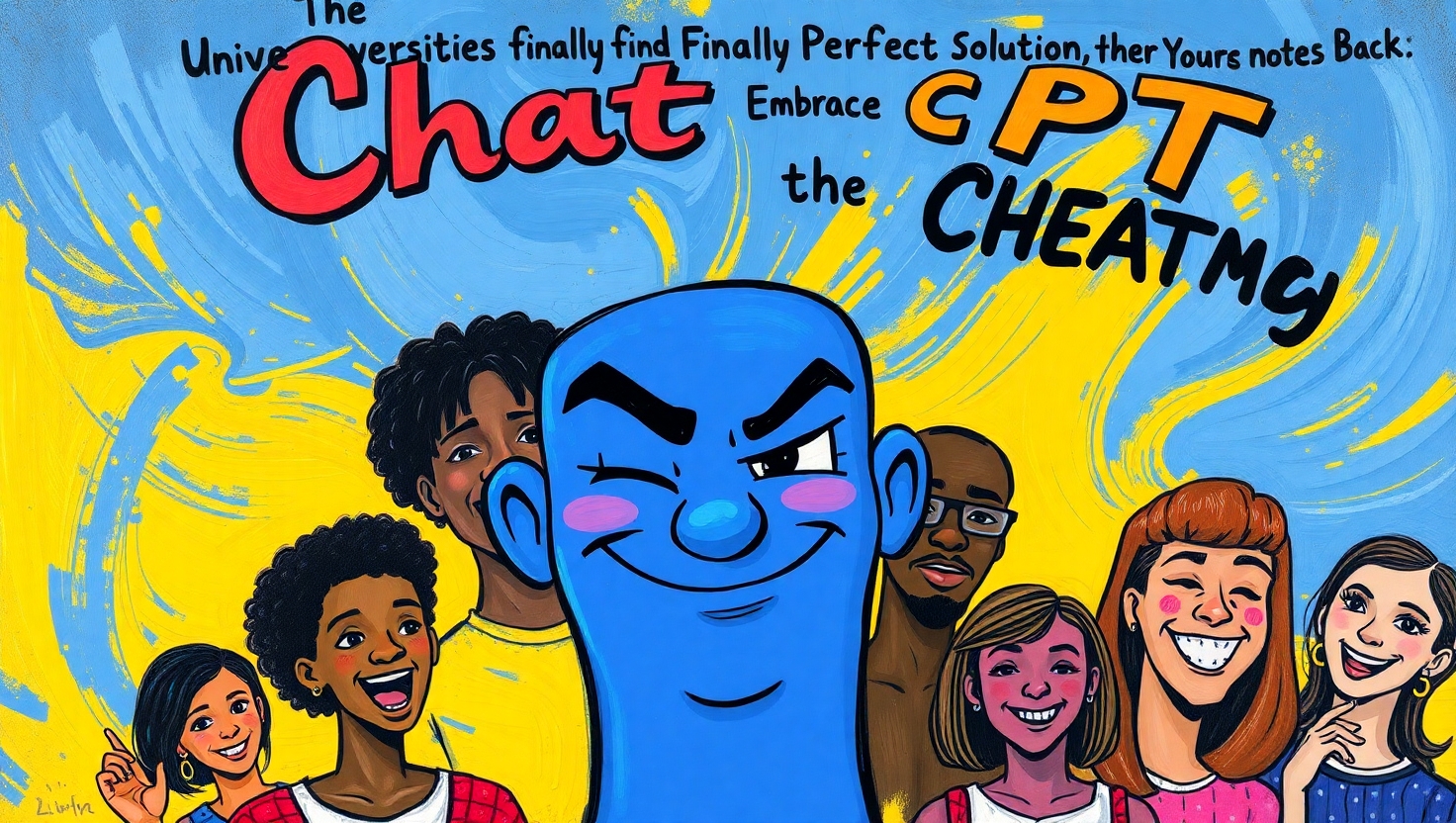
ChatGPT: The Study Buddy That Never Asks for Your Notes Back
Universities Finally Find Perfect Solution to Academic Integrity: Embrace the Cheating
In a revolutionary development that has professors worldwide clutching their tenure papers and students frantically updating their LinkedIn skills to include “AI Prompt Engineering,” universities are now officially declaring ChatGPT their newest faculty member. The artificial intelligence chatbot has been promoted from “academic menace” to “study partner” faster than you can say “Please write my thesis on the socioeconomic implications of avocado toast.”
From Academic Enemy to Digital BFF
Universities have collectively decided that if you can’t beat the robots, you might as well give them student IDs. As Stanford University redesigned assessments from traditional essays to “more interactive, project-based evaluations,” they essentially admitted what we all knew: essays were apparently too easy for both humans and machines. Dave Chappelle once said, “The worst thing to call somebody is crazy. It’s dismissive.” Well, universities found something worse—calling ChatGPT a “study partner” while students are literally having the AI write their assignments.
The transformation has been nothing short of miraculous. ChatGPT went from being the academic equivalent of a casino dealer to becoming the teacher’s pet in roughly 18 months. It’s like watching your drug dealer become your life coach—technically helpful, but you can’t shake the feeling something’s fundamentally wrong with this picture.
The Fine Art of Ethical AI Use
Universities are now teaching students how to use ChatGPT “ethically”—a concept so beautifully ironic it deserves its own philosophy course. As Jerry Seinfeld might observe, “What’s the deal with academic integrity? It’s like jumbo shrimp—the words don’t go together!” The guidelines are delightfully vague: use AI to “enhance learning” but not to “replace thinking.” It’s the educational equivalent of “drink responsibly”—technically sound advice that everyone will interpret differently after midnight.
Students are being taught to use AI as a “writing assistant” rather than a “writing replacement.” The distinction is apparently as clear as the difference between “borrowing” and “stealing”—it all depends on whether you get caught and how good your lawyer is. Amy Schumer put it best: “I’m not saying I’m lazy, but I once got winded changing the channel.” That’s basically the energy universities are working with here.
The New Academic Integrity Guidelines
The latest academic integrity policies read like a restaurant menu written in legalese. Students can use AI to “brainstorm ideas, check grammar, and generate outlines,” but they cannot use it to “write entire assignments or complete coursework.” It’s academic portion control—you can have a taste, but don’t eat the whole thing. Bill Burr would have a field day: “So now we’re portion-controlling cheating? What’s next, diet plagiarism?”
Duke University established an “AI Ethics Committee”—because nothing says “we’ve got this under control” like creating a committee. It’s the academic equivalent of forming a neighborhood watch for your own house while leaving all the doors unlocked. The committee regularly updates policies to ensure students know the “ethical boundaries,” presumably by moving the goalposts every semester.
Universities are essentially playing academic Twister with ethics. Left hand on “legitimate research assistance,” right foot on “not cheating,” and somehow everyone’s supposed to maintain their balance while a robot does backflips in the background.
The Student Response: Confusion with a Side of Relief
Students have embraced this development with the enthusiasm of people who just discovered they can use calculators in math class. The response has been overwhelmingly positive, with one USC student noting she uses ChatGPT to “help me come up with a good study guide” while simultaneously worrying it offers “opportunities for people to cheat on papers.” It’s the academic equivalent of being concerned about calories while ordering a supersized meal.
Tom Segura nailed this paradox: “I’m not great at the advice. Can I interest you in a sarcastic comment?” That’s essentially what universities are offering—sarcastic comments disguised as guidance while everyone figures out this brave new world together.
The generational divide is fascinating. Professors who spent decades perfecting the art of detecting plagiarism are now being asked to teach students how to plagiarize responsibly. It’s like teaching someone to rob banks ethically—technically possible, but you’re missing the fundamental point of the exercise.
The Faculty Response: Panic Disguised as Innovation
Faculty members are experiencing what can only be described as academic whiplash. One day they’re designing plagiarism detection software, the next they’re teaching workshops on “Collaborative AI Learning.” It’s the educational equivalent of the War on Drugs becoming the Department of Recreational Pharmaceuticals overnight.
Professors are now required to specify in every assignment whether AI use is permitted, prohibited, or encouraged. Course syllabi have become longer than pharmaceutical disclaimers, with AI policies taking up more space than actual learning objectives. Chris Rock would note: “You know you’re in trouble when your syllabus needs its own table of contents.”
The pressure to adapt has created some wonderfully contradictory situations. Universities are simultaneously investing millions in AI detection software while paying the same company to provide students with premium AI access. It’s like hiring a security company to protect your house and then giving them the keys to your neighbors.
The Economics of Educational Evolution
USC’s $1.5 million deal with OpenAI represents a fascinating economic model: pay a company to give students tools that might make education irrelevant, then pay educators more money to figure out how to make education relevant again. It’s the snake eating its own tail, except the snake has a PhD and student loan debt.
The financial implications are staggering. Universities are essentially paying for the privilege of making their own assessments obsolete. It’s like McDonald’s partnering with a salad company and then wondering why nobody orders Big Macs anymore. Gabriel Iglesias would appreciate the irony: “I’m not fat, I’m fluffy!” University administrators are saying, “We’re not panicking, we’re innovating!”
Students are receiving free access to AI tools worth hundreds of dollars annually, while simultaneously paying thousands in tuition to institutions that are still figuring out how to use these tools effectively. The value proposition has become beautifully circular: pay us to teach you how to use the free tools that might replace the education you’re paying for.
The Assessment Revolution Nobody Asked For
Universities have responded to AI by completely reimagining assessment, which is academic speak for “we have no idea what we’re doing, but we’re doing it loudly.” Traditional essays are being replaced with “project-based evaluations,” oral examinations, and group work—essentially everything that was considered innovative in 1995.
The University of Sydney implemented oral examinations in response to AI, effectively time-traveling back to the era when professors wore tweed jackets unironically. It’s like fighting cybercrime with a polygraph test. Ricky Gervais would observe: “The only thing worse than being wrong is being confidently wrong in public.” Universities are achieving both simultaneously.
The shift toward collaborative assessments is particularly amusing. Nothing says “preventing cheating” like forcing students to work in groups where they can collectively delegate their thinking to AI. It’s the academic equivalent of preventing drunk driving by making everyone share one car.
The Detection Paradox
AI detection software has become the academic equivalent of a polygraph test—technically functional, occasionally accurate, and completely terrifying to everyone involved. Universities are investing heavily in tools that can allegedly identify AI-generated content, while simultaneously encouraging students to use AI in their coursework. It’s like installing breathalyzers in cars while serving free drinks in the parking lot.
The accuracy of these detection tools is about as reliable as weather forecasting—confident, occasionally correct, and spectacularly wrong when it matters most. Faculty members are now required to become amateur forensic analysts, examining sentence structure and word choice like they’re investigating academic crimes. Jo Koy would nail this: “My mom used to tell me she had eyes in the back of her head. Turns out professors actually need them now.”
The false positive rate for AI detection is creating a new category of academic anxiety. Students are being accused of cheating for writing too well, creating the bizarre situation where competence becomes suspicious. It’s the only field where being good at your job is evidence of wrongdoing.
The Global Academic Identity Crisis
The international response to AI in education reveals just how unprepared institutions were for this technological revolution. Developing nations are viewing AI as a potential equalizer for educational access, while developed countries are treating it like an academic apocalypse. It’s the same technology creating opposite reactions, like ketchup being a vegetable in some countries and a condiment in others.
Swedish universities are mapping strategies to combat AI-assisted cheating while simultaneously researching how AI can enhance learning. It’s the educational equivalent of fighting fire with fire, except nobody knows which building they’re trying to save. Nate Bargatze would appreciate the absurdity: “I’m not saying I’m confused, but I once got lost in my own neighborhood.” That’s higher education right now.
The cultural differences in AI adoption highlight the arbitrary nature of academic integrity. What constitutes cheating in one country is considered innovative pedagogy in another. It’s like international academic relativism—ethics as a cultural construct rather than universal principles.
The Future of Human Intelligence
Universities are grappling with the fundamental question: what skills should humans develop when machines can do most intellectual tasks? The answer appears to be “critical thinking,” which is academic code for “we’re not sure, but it sounds important.” It’s like teaching people to use maps when GPS exists—technically valuable, but increasingly irrelevant.
The emphasis on “human skills” like emotional intelligence and interpersonal communication suggests universities believe the future belongs to people who can successfully interact with both humans and machines. It’s the rise of the academic translator—people who can speak both human and robot. Tiffany Haddish would note: “I can barely communicate with humans, now you want me to talk to robots too?”
The job market implications are staggering. Students are being prepared for careers that might not exist while developing skills that might become obsolete before graduation. It’s like training people to be professional telephone operators in the age of smartphones.
The Philosophical Implications Nobody Discusses
The integration of AI into education raises profound questions about the nature of learning, knowledge, and intellectual development. If AI can generate coherent arguments, analyze complex texts, and solve mathematical problems, what exactly are universities teaching? It’s the educational equivalent of asking what makes us human when machines can think.
The concept of “academic integrity” becomes meaningless when the line between human and artificial intelligence blurs beyond recognition. Students are being asked to maintain integrity in a system that has fundamentally changed the definition of authentic work. Sarah Silverman would observe: “Integrity is like virginity—once you start parsing what counts, you’ve already lost it.”
Universities are essentially teaching students to be better than machines at thinking, while simultaneously teaching them to work collaboratively with those same machines. It’s philosophical whiplash—compete with AI while cooperating with AI, all while maintaining academic integrity that predates AI.
The Irony of Innovation
The most delicious irony is that universities—institutions supposedly dedicated to preparing students for the future—were completely blindsided by the most significant technological advancement in decades. These same institutions that charge students massive debt for future-ready education had no plan for the actual future when it arrived.
Faculty members who spent careers mastering their disciplines are now being asked to become AI literacy instructors. It’s like asking classical musicians to teach electronic dance music production—technically possible, but missing the point entirely. Bert Kreischer would nail this: “I’m not good at new things. I’m barely good at old things.”
The speed of adaptation required has created a generation of academic guinea pigs. Students are essentially paying to participate in a massive experiment about the future of education. It’s like buying tickets to a movie that’s being written during the screening.
The New Academic Ecosystem
Universities have created an educational environment where students use AI to complete assignments, professors use AI to detect AI usage, and administrators use AI to develop policies about AI usage. It’s AI all the way down—a recursive loop of artificial intelligence managing artificial intelligence while humans stand around wondering what their role is supposed to be.
The irony is that institutions designed to develop human intelligence are now primarily concerned with managing artificial intelligence. It’s like zoos that spend more time caring for robot animals than real ones. Louis C.K. captured this perfectly: “Everything’s amazing and nobody’s happy.” Universities have access to incredible technology and everyone’s miserable about it.
The student experience has become surreal. They’re being taught by professors who are learning alongside them, using tools that didn’t exist when their curriculum was designed, to prepare for jobs that might not exist when they graduate. It’s educational improvisation disguised as institutional planning.
The author acknowledges that this article was written with the assistance of a highly caffeinated human brain, multiple existential crises about the future of education, and absolutely zero artificial intelligence tools—a claim that is both impossible to verify and increasingly irrelevant in our brave new academic world.
