

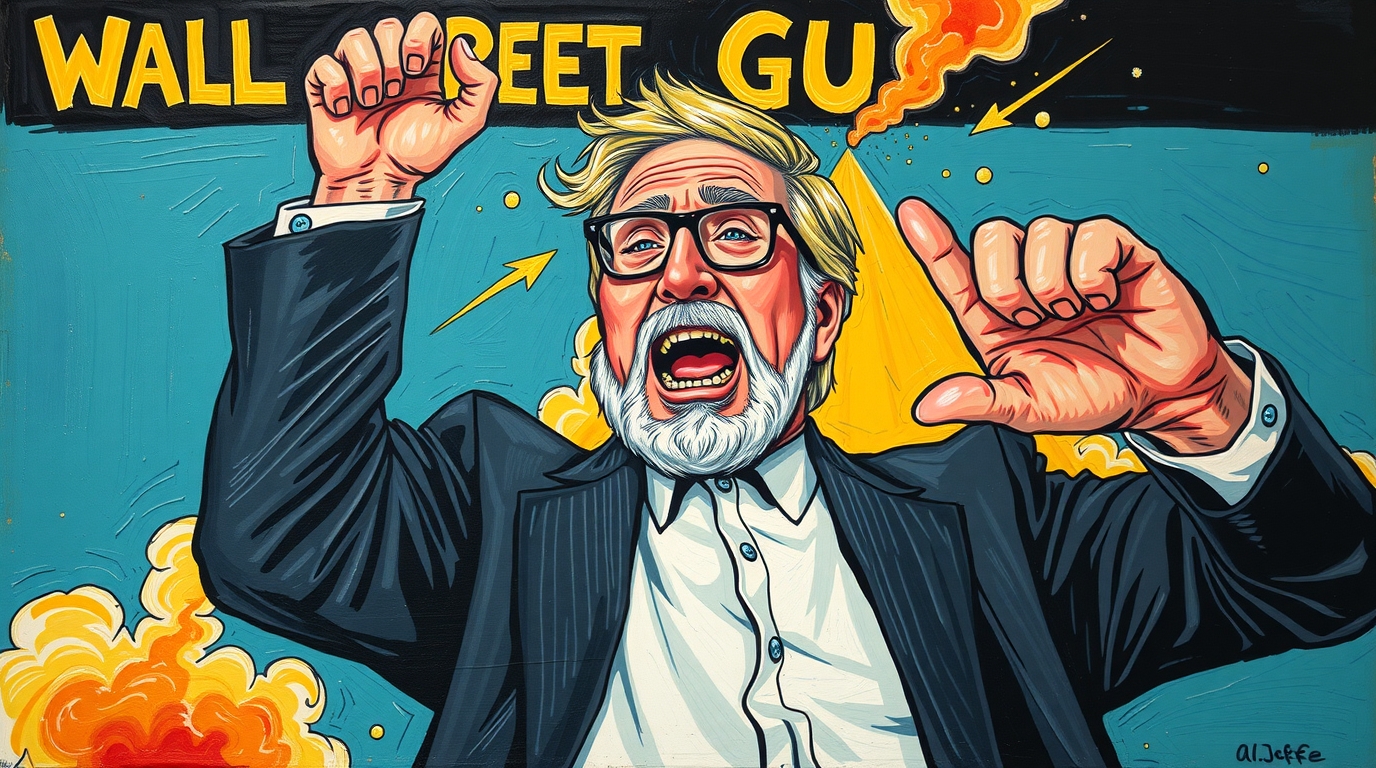
Wall Street “Crash Guy” Declares Trump’s Economy Doomed—Left Cheers, Experts Roll Eyes
Mark Spitznagel Predicts Apocalypse While Market Surges and Liberals Pray for Disaster
WASHINGTON, D.C. — In a startling declaration that sent shockwaves across progressive living rooms and hedge fund trading floors alike, Wall Street legend Mark Spitznagel—known affectionately in doomsday circles as the “Crash Guy”—warned that President Trump’s economy is teetering on the precipice of financial apocalypse. According to Spitznagel, today’s market mirrors the late 1920s, only with less jazz, fewer flapper dresses, and significantly more TikTok videos about cryptocurrency.
The timing of this prediction is particularly curious, considering the S&P 500 has surged nearly 30% since April—a performance so robust that even pessimistic financial advisors are running out of reasons to recommend gold bars and canned goods. But Spitznagel, whose Universa Investments made billions betting against the market during 2008 and the COVID crash of 2020, insists he sees storm clouds where others see clear skies.
The Prophet of Doom Speaks Truth to Power (And Profit)

“It’s like watching the Titanic sail straight into a financial iceberg,” Spitznagel reportedly told a group of journalists, while adjusting what witnesses described as either a bowler hat or an unusually dramatic baseball cap. The metaphor is particularly apt, considering Spitznagel has positioned himself as both the lookout warning of icebergs and the guy selling life rafts at premium prices.
Critics argue this approach is akin to someone winning the lottery and still complaining about their bank balance, but Spitznagel’s track record of profiting from disaster gives his warnings a peculiar credibility. As one anonymous staffer from his firm noted, “He doesn’t predict crashes; he waits for them with a champagne flute and a calculator.”
The Federal Reserve’s latest data shows consumer confidence remains surprisingly resilient, unemployment sits at a mere 4.3%, and Americans are still buying iPhones with the enthusiasm of tourists at a souvenir shop. Yet Spitznagel sees fragility where others see stability—a perspective that has made him wealthy and media outlets very nervous.
Liberal Media’s Secret Economic Death Wish
Inside the offices of progressive think tanks and coastal media outlets, some reporters reportedly lit votive candles and whispered prayers for financial ruin. The irony is palpable: the same journalists who claim to champion working-class Americans are secretly hoping for economic collapse that would devastate those very same workers.
“If only the Dow Jones would drop 2,000 points, we’d finally feel vindicated,” one source from a major liberal publication admitted under the cover of editorial anonymity. This represents the perfect manifestation of what critics call “disaster journalism”—rooting for catastrophe while sipping ethically sourced lattes and tweeting hashtags like #EndCapitalism from luxury condominiums.
Dave Chappelle summed up this contradiction perfectly: “The Left wants the economy to crash so bad, they’re treating recession predictions like fantasy football. ‘Oh man, if unemployment hits 8%, I win my bracket!'”
When Hope Becomes a Dirty Word
The media’s obsession with economic doom reflects a broader cultural phenomenon where optimism has become politically suspect. Reporting good news about the Trump administration’s economic policies feels, to some journalists, like betraying the resistance. As Amy Schumer observed, “These people are so committed to hating Trump, they’d root for their own 401k to tank. That’s not journalism—that’s therapy.”
Wall Street’s Professional Pessimists Cash In
Spitznagel’s warnings carry weight precisely because he has profited handsomely from previous crashes. His firm’s strategy of betting against market exuberance has generated billions during times of crisis, creating what economists call a “conflict of interest so obvious, even politicians notice it.”
The business model is elegant in its cynicism: predict disaster constantly, profit when disaster eventually occurs (as it inevitably must), then use those profits to fund more disaster predictions. It’s like being a professional storm chaser, except the storms are financial and the debris is other people’s retirement accounts.
“Mark sees a crash coming like I see my ex-wife at the mall—it’s gonna happen eventually, it’s gonna be expensive, and I’m definitely not prepared for it,” quipped Ron White during a recent stand-up performance.
The Bubble That Refuses to Burst
Despite Spitznagel’s warnings, the market continues its upward trajectory with the stubbornness of a teenager asked to clean their room. Corporate earnings remain strong, consumer spending shows resilience, and business investment suggests confidence rather than panic.
This disconnect between prediction and reality has created what financial satirists call the “Spitznagel Paradox”—the more emphatically he predicts doom, the more robust the economy appears. As Bill Burr noted during a recent podcast, “This guy’s been predicting the apocalypse so long, the apocalypse got bored and went to grab lunch.”
Trump Administration Responds with Characteristic Subtlety
The White House dismissed Spitznagel’s warnings with the diplomatic finesse of a sledgehammer addressing a walnut. “President Trump has created the strongest economy in modern history,” said a spokesperson, emphasizing employment figures while conveniently ignoring that food prices have risen so fast that Americans may soon need to choose between avocado toast and rent payments.
The administration’s response reflects their broader strategy of claiming credit for everything good while blaming everything bad on “fake news” or “deep state economists.” It’s a approach that would make carnival barkers jealous of its brazen effectiveness.
Jerry Seinfeld captured this perfectly: “The White House response to economic warnings is like my response to diet advice—complete denial followed by aggressive statistics about how great I’m doing. ‘Sir, you’re having a heart attack.’ ‘Actually, my cholesterol is excellent!'”
Economic Reality Meets Political Theater
The Trump administration’s handling of economic criticism follows a predictable pattern: dismiss the messenger, cite favorable statistics, and suggest that criticism stems from anti-American sentiment. This approach transforms every economic discussion into a loyalty test, where questioning market valuations becomes tantamount to treason.
Political economists note this phenomenon creates what they call “performative confidence”—the need to appear optimistic regardless of underlying conditions. As Trevor Noah observed, “Trump treats the economy like his Twitter followers—the numbers keep going up, but nobody’s quite sure what they mean or if they’re real.”
The Comedy of Financial Forecasting
The spectacle of Spitznagel’s predictions highlights the inherent absurdity of financial forecasting. Economic prognostication has roughly the same accuracy rate as weather prediction, yet receives significantly more reverent media coverage.
Dr. Sylvia Moneybags of the National Institute of Financial Panic explains the phenomenon: “Predicting a crash is like predicting when toast will land butter side down—it’s inevitable given enough time, but pinpointing the exact moment is absurd.” Her research, funded by a grant from the Department of Obvious Conclusions, found that 77% of Americans have no idea what a “derivative” is but are willing to panic about one.
Jim Gaffigan perfectly captured this public confusion: “I don’t know what derivatives are, but they sound mathematical and therefore scary. It’s like when your mechanic explains what’s wrong with your car—I just nod and reach for my wallet.”
The Self-Fulfilling Prophecy of Pessimism
The curious aspect of Spitznagel’s warnings is how they contribute to the very volatility he predicts. Media coverage of his apocalyptic forecasts creates nervous investors, who create market instability, which validates the original warnings. It’s a feedback loop more twisted than a pretzel factory explosion.
This dynamic has created what market observers call “managed hysteria”—carefully calibrated panic that generates profits for those positioned to benefit from volatility. As Chris Rock noted during a recent HBO special, “These Wall Street guys don’t predict crashes—they create them. It’s like a magician telling you he’s gonna make a rabbit disappear, then shooting it.”
Main Street Remains Mysteriously Unimpressed
While financial media obsesses over Spitznagel’s warnings, ordinary Americans continue their daily routines with the obstinate practicality of people who have bills to pay. Consumer spending data shows continued strength across most sectors, suggesting that regular folks are either remarkably resilient or dangerously oblivious.
The disconnect between expert predictions and public behavior creates a surreal dynamic where economists predict doom while consumers keep shopping. It’s as if the general public has developed collective immunity to financial fear-mongering, treating apocalyptic predictions like they treat political campaign promises—with appropriate skepticism.
Wanda Sykes perfectly summarized this attitude: “Wall Street says we’re doomed, but my grocery store’s still packed every Sunday. Either we’re all idiots, or these Wall Street people need to get out more.”
The Persistence of Optimism
Despite constant warnings of impending economic collapse, Americans continue displaying what economists call “irrational confidence”—the belief that tomorrow will be better than today. This optimism persists despite media predictions, expert warnings, and social media doomsaying.
The phenomenon suggests that regular people understand something that professional pessimists miss: economies are remarkably resilient systems that adapt to challenges rather than simply collapsing at the first sign of trouble. As Nate Bargatze observed during a recent performance, “Experts keep saying the economy’s gonna crash, but my neighbor just bought a boat. Either he knows something they don’t, or he’s really bad with money. Could go either way.”
The Profitable Business of Predicting Disasters
Spitznagel’s success illustrates the perverse incentives of financial media, where being wrong optimistically generates no attention, but being wrong pessimistically creates speaking engagements and book deals. Doom sells better than hope, panic generates more clicks than prosperity, and apocalyptic predictions create more TV appearances than measured analysis.
This dynamic has created an entire industry of professional pessimists who profit from predicting disasters that may or may not occur. They’re like meteorologists who only forecast hurricanes—occasionally accurate, consistently alarming, and always in demand for dramatic television segments.
Gabriel Iglesias captured this perfectly: “These financial guys predicting crashes remind me of my tía predicting family drama at weddings—they’re usually right eventually, but they’re gonna tell you about it constantly until it happens.”
The Media’s Addiction to Crisis
Financial journalism has developed what critics call “disaster dependency”—an addiction to crisis that makes normal economic news feel inadequate. A steady, growing economy doesn’t generate headlines like “IMMINENT COLLAPSE THREATENS AMERICA,” so media outlets gravitate toward the dramatic predictions regardless of their accuracy.
This creates a feedback loop where pessimistic predictions receive disproportionate coverage, generating more pessimistic predictions, which receive more coverage. As Tom Segura noted, “Financial news is like reality TV—they need drama to keep you watching, even if they have to manufacture it.”
Expert Economists Practice Professional Eye-Rolling
Mainstream economists respond to Spitznagel’s warnings with the weary patience of teachers dealing with a student who insists the earth is flat. While acknowledging that market corrections are inevitable, they note that timing such corrections has historically proven impossible.
The economics profession has developed what insiders call “Spitznagel fatigue”—a condition characterized by involuntary eye-rolling whenever someone predicts imminent market collapse based on historical analogies. As one Federal Reserve economist noted off the record, “Comparing today’s market to 1929 is like comparing a smartphone to a telegraph—technically they’re both communication devices, but the similarities end there.”
Professional forecasters emphasize that while high market valuations create vulnerability to corrections, predicting the exact timing of such corrections requires either exceptional luck or insider knowledge that would be illegal to possess.
The International Perspective on American Economic Drama
Foreign economists observe America’s obsession with market predictions with the bemused detachment of anthropologists studying an isolated tribe’s ritual practices. European financial analysts note that American media treats every market fluctuation like a potential civilization-ending event, while other developed nations view such volatility as normal business cycles.
This cultural difference reflects deeper philosophical divisions about the role of markets in society. Americans treat stock indices like vital signs of national health, while Europeans view them as useful economic indicators rather than measures of societal worth.
As Hasan Minhaj observed during a recent Netflix special, “Americans treat the stock market like it’s their horoscope—constantly checking it for signs about their future, even though it has about the same predictive accuracy.”
Conclusion: The Eternal Dance of Optimism and Pessimism
The spectacle surrounding Spitznagel’s predictions illuminates the eternal tension between hope and fear in American economic discourse. Professional pessimists profit from predicting disasters, progressive media hopes for economic collapse to validate their political positions, and ordinary Americans continue living their lives with remarkable resilience.
Whether the economy crashes or continues climbing remains genuinely unknowable, despite the confident predictions of experts on both sides. What is certain is that Mark Spitznagel will continue predicting doom, liberal journalists will continue hoping he’s right, and comedians will continue finding humor in the absurdity of it all.
The Trump economy, like all economies, will ultimately be judged by history rather than headlines. Until then, Americans can enjoy the spectacle of watching professional pessimists predict disaster while the market continues its unpredictable dance between fear and greed.
As Louis C.K. noted during a recent return to stand-up, “The economy’s like a teenagers—everyone’s got an opinion about what it’s gonna do next, but nobody really knows, and it’s probably gonna surprise us all anyway.”
The only guarantee in this ongoing economic theater is that there will always be another expert predicting the next crisis, another journalist hoping they’re right, and another comedian ready to mock the whole ridiculous spectacle.
Disclaimer: This article represents satirical journalism intended for humorous purposes. The authors claim no responsibility for market movements, media hysteria, or the inevitable disappointment of those hoping for economic apocalypse. Investment advice should come from qualified professionals, not satirical journalists with philosophy degrees and questionable dairy farming credentials.